Software
Houzz Logo Print
jyl_gw

Pantry . . . Cabinet?

last year
last modified: last year

Walk in pantries get discussed a lot. I thought, why not airtime for the alternative of pantry cabinets?

A pantry cabinet, to me, is i) a built-in cabinet ii) away from the kitchen core work triangle (ice-water-stone-fire), iii) designed to hold a large volume of things both large and small, that may be needed every day or every week but not every minute or every hour, with nothing hidden or lost.

It is an alternative to a walk in pantry and to a free-standing piece like a hutch.

The reason I natter on about pantry cabinets is that they are often more efficient and effective than the alternatives.

Unlike a walk-in pantry, the pantry cabinet does not need to hold a person or two people, and give them room to bend over, squat, turn around. The volume not used to hold a human body can be used to hold pasta and stockpots. This advantage fades if you do, indeed, want to hold bodies, so discerning serial killers endorse walk-in pantries and I certainly won’t argue with them.

Unlike a free-standing piece, the pantry cabinet can be sized exactly to the space available, is securely anchored to the wall without tipping issues, and can be customized for the user’s needs without hiring a custom furniture maker who are more expensive than custom cabinet makers. Lots. More. Expensive.

These virtues allow a pantry cabinet to be placed where there is not enough space for a walk-in pantry and not the right shape/size of space for grandma’s baking hutch. A nook, a corner, even a passageway, the empty space where a laundry chute or water heater used to be.

If you are going to build or have built a pantry cabinet, I recommend against the all-drawer stack that we use in base cabinets. Instead, use doors with rollout shelves. Yes, this requires three actions (open right door, open left door, pull out shelf) instead of one (pull out drawer), but we’ve stipulated the things there are needed daily or weekly, not every five minutes. Have the cabinet insides pre-drilled so that your slides can be easily re-positioned higher or lower. When you switch to a different brand of cooking sake that comes in a taller bottle, just re-position the shelf. Can’t do that with drawers.

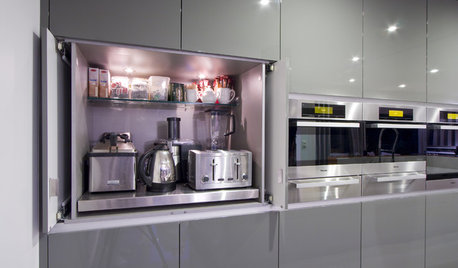
A pantry cabinet can be fitted with electrical outlets to become the much-maligned appliance garage, but one that isn’t taking up counter space. Heat and steam-producing appliances shouldn’t be operated in there, at least not with doors closed, but your blender and mixer are fine. Better yet if their shelf pulls out to use them in the open. Better again yet if your cabinet maker builds in pullout workboards to put things on as you use the mixer - or simply to set down grocery bags.

Have you built pantry cabinets into your kitchen? I would like to see people’s creative, useful, lovely, useful, cool, useful pantry cabinets. From Ikea to full-zoot custom, all are appreciated!

Comments (12)

  • last year
    last modified: last year

    We have a reach-in pantry at one end of our galley kitchen. Shelves are 12” deep, which is perfect. More efficient use of space, than needing to accommodate my body. Nothing gets lost, and the shelves hold a ton. The shelves hold small appliances, like a rice cooker, air fryer, popcorn maker.


  • last year

    My mother designed two reach-in pantries for her kitchen. One was just deep enough for 12” shelves and maybe 6’ or maybe it was 8’ wide. All shelves, held all the food for the family. (well, pb was next to the bread drawer and refrigerator, cereal was in the cabinet by the brakfast table, near the bowls and spoons, rice was near the stove.) The other held 4 or 5 24” deep shelves, was about 3’ wide. It held things like picnic and bbq gear, large rolls of foil, that kind of thing.

    I think it all depends on how you use a pantry. If you also keep the broom and swiffer in there for tending to the floor after meals, maybe you want a walk-in with a side wall for hanging it, or hang it on the back of the door. If you will keep napkins and placemats thre, maybe you want drawers. But yes, I would take pullouts over drawers for many lower storage situations involving cookware and bakeware, if those are going in the pantry.

    In any kitchen storage (well, ANY storage) planning, it is essential ESSENTIAL to make an inventory of what you have, how you use it, what will go where, measure the items and how much space they need, note if they have accessories that should be stored with them, if they will be used where they are stored, etc. THEN you can start planning the space and work it out.

  • last year
    last modified: last year

    I designed and built a cabinet with 12" shelves for storage. Cabs with pullout shelves are expensive starting at $1500 or more per 24" cab. Designers love to include them.

  • last year
    last modified: last year

    We used 2 15x15 tall ikea cabinets turned side ways as a fridge surround and built a small broom storage pull out on the other side to stow mop and cleaning stuff. This set up was the best option in my small five doored kitchen. It hold a bunch for only being 15 deep by 30wide.


  • last year
    last modified: last year

    My pantry cabinets, work-in-progress kitchen. They were custom made, as the space behind was odd and we had to allow for some ducting, move a bit of plumbing, remove some studs.

    The boxes are 3/4” maple ply. I specified unfinished paint grade maple for the face frames and doors, and did the install, door hanging, slide install, and finishing myself to save money.

    The original plan was to paint them white, scratch, dent, and distress them, then paint them again with brush marks and runs, so they’d look like the original built-ins in this 1911 house. But that was going to be a lot of work, so I’ve temporarily settled on a clear finish.


    The handles are TBD. I think I’ll go with long slim stainless vertical edge pulls, looking for a place to get those custom made - which sounds pricey, but it will actually cost less than buying stock edge pulls. The door catches are also TBD, I think I’ll use magnets.

    The shelves are a little over 2 feet deep, if I recall correctly. There was a lot of measuring to be sure the boxes, which I recall are 28” deep?, would fit in the available space.

    All the shelves pull out and we’ve organized stuff by category. One shelf for pasta/rice/legumes, another for nuts, another for Asian stuff, one for crackers, another for bread, wine and other tall bottles in one place, sauces/vinegars/dressing/oils in another, and so on. The cat gets her very own shelf stocked with Fancy Feast and whatnot. Yes, it took a meaningful while to figure out where everything goes and then to remember it.

    There Have Been Arguments. Does tomato sauce go with sauces or with canned goods? Do canned water chestnuts go in the Asian specialty shelf or with the canned tuna? Is cereal more like pasta or more like nuts? Does the champagne want to share space with the bulk cooking oil? Sometimes someone sneakily goes down at night and re-arranges things to be not As Negotiated.

    Oddly, the shelves are getting less full as we use them. With the old kitchen, we could never find anything so would buy another one, pretty soon you end up with 2, 3, 4 of everything. As we eat our way through all the surplus, our pantry gets roomier. Its kinda magic.

    The topmost spaces are used for stockpots, pressure cookers, popcorn makers, other bulky things. These spaces could be bigger. I should have made the effort to raise the header and allow taller cabinets.


    The left and center bays are set up as appliance garages with quad receptacles, but I only need one so far. I usually use the Vitamix and Robot Coupe in situ, the KitchenAid normally gets moved to the counter. Each bay has a pullout shelf as shown, which are seldom needed but very helpful when they are. There is also a switched outlet in case I want to add LED tape lighting.


  • last year

    I grew up in a house with one of those pantry cabinets with shelves on the door, back to back hinged shelves that swung out and adjustable shelves in the very back, total about 24" deep. Other than the fact that they started to make some cans larger so they hung over (albeit tipped back slightly because there was a raised edge on the shelves, it was very efficient, everything was one layer deep, things could not be hidden behind something else. It did not store everything but it stored all canned and bottled things, jars, some boxed goods and paper towels. There was another cabinet for cake mixes and sugar and flour and such, and a big deep drawer for cereal and crackers. It had a bread drawer with the metal lid but we actually kept our bread in the fridge and the metal drawer was for candy, chocolate chips and baking chocolate and the brown sugar and such.

    Most of my upper cabinets are none standard sizes, one bank because of a window is about 8.5"-9" inside and it is perfect for pantry type things that can be stored one or two layers deep and it also fits glassware. I have a deeper cabinet above the counter where the oven is that has mostly baking and big tubs of things. And I have a dish, glassware, untensil and pots/pans cupboard that is about 15" deep. It has a couple of alternating shelves in between that are about 6" deep that hold glasses or coffee cups.

    In the basement stairwell there is some additional pantry, utility storage for paper towels and cleaning products and bulk items which don't need to be accessed every day.

    I find most standard deep pantries with layers of things on deep shelves kind of inefficient and if I had a walk in pantry (I never will, because I don't plan on moving) One side would have shelving that was all about 6" deep max.

  • PRO
    last year

    We have a large pantry with a window and counters in this house ( my husbands main request). In our last house we had 24” wide 24” deep ikea pantries with pullouts flanking our fridge. One held all our food/ baking supplies, the other was pots and pans etc. They worked great.

  • last year

    I love reach in pantries that are shallow - 10 to 12" shelves are wonderful!! And cheap! We built one in our last kitchen reno and I will do it again when I can. Before that I'd had a 24" deep wall oven tower converted to pantry and it was detestable. Rummaging for far back layers of food and kitchen supplies is no fun.

    Here's my only photo I could find of that shallow pantry cabinet - I kept bulk overflow and paper towels and cat food on the bottom, and had adjustable shelves with lots of pantry food staples behind the top three doors (all open inside - not a divided space - we reused cabinet doors removed from elsewhere in the house to build this).

    The fridge was around the corner from the pantry, and the sink was opposite it, so it was a very very easy kitchen to prepare a meal in. I don't like people in my workspace when I cook, for those of you who object to 1-butt kitchens :)


  • last year

    My pantry is much as @palimpsest described. My cabinet maker and I designed it. I was accustomed to having a walk-in pantry, but this kitchen is too small for that. The one I designed works fairly well. The larger, seldom-used appliances like the rice cooker are stored in the banquette seen to the side of the pantry.


  • last year

    The pantry cabinet's negative, of course, is that it's exponentially more expensive than a simple closet with shelves.

  • last year

    Love my pantry cabinet. It has 3 drawers and when you open the doors, two pull out adjustable shelves and some shelving that is also adjustable. Works well for my small kitchen and much better than the pantry cabinet it replaced. Also wider 36” vs pantry closet because once we removed the closet and the framing we gained more usable space

  • last year

    Love my pantry cabinet. It has 3 drawers and when you open the doors, two pull out adjustable shelves and some shelving that is also adjustable. Works well for my small kitchen and much better than the pantry cabinet it replaced. Also wider 36” vs pantry closet because once we removed the closet and the framing we gained more usable space