

Over the range microwave vent
How many CFMs are needed for an exterior venting OTR microwave/vent above an induction range?
What are the best brand OTR microwaves with this many CFMs? Are they considerably more than other OTR M's with fewer CFMs?
Any other pros and cons to OTR microwave/vent?
I'm helpings friend brainstorm their small kitchen that has 3 doorways. Space is tight and budget is modest. It makes so much sense to put the microwave above their anticipated new induction range to save space. (No island, peninsula, or pantry location for microwave. Base drawers are needed for pots and pans.)
They have an exterior duct hole cut in their extremely thick stone wall and understandably will not cut another hole elsewhere to relocated the range. I'd advocate for another position that would require a 90-degree elbow and 5 ft run to the exterior duct. I don't think they will go for that for location for other reasons, but would that configuration make the draw way too diminished with an OTR hood anyway?
Comments (31)
 last year
I have the ge cafe OTR micro externally vented, it claims 400 CFM. I assume it is the same as other GE brands devices. We previously had no venting, so this is an improvement even though it's not perfect, a lot of effluent/steam from the front burners is not captured by the vents.
I don't think there is any OTR microwave that has higher CFM? so the longer pathway is probably out of consideration.
 last year
No OTR externally vented microwave will have as many CFMs as are needed to be effective. I don't think most people pay any attention to microwave CFMs because of this. I'd say just get one that can be externally vented that is the best choice based on other factors. I had one that was on an external wall so the run to the outside was very short and it was still barely better than nothing. At least it didn't blow out onto the cabinets above the range.
Related Professionals
Dallas General Contractors · Little Rock Home Remodeling · Madison Home Remodeling · Merced Home Remodeling · Reno Home Remodeling · DeRidder Bathroom Remodelers · Columbus Bathroom Remodelers · Anchorage Bathroom Remodelers · Southaven Bathroom Remodelers · Wichita Falls Kitchen Remodelers · Reno Kitchen Remodelers · Lancaster Kitchen Remodelers · Los Angeles Kitchen Remodelers · Everett Kitchen Remodelers · Bend Custom Countertops- last yearlast modified: last year
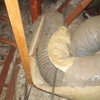
One factor to consider is the size of the existing "exterior duct hole cut in their extremely thick stone wall ." Posters in some past threads here have reported finding 4" ducting behind their OTRs. That's clothes-dryer size venting and a size that pretty much makes rated CFM capacity irrelevant.
Ran into that a few years ago when helping neighbors replace the OTR in a newly purchased house. Fortunately for my friends, we were working with a framed wall with siding rather than a stone or brick wall, so enlarging the hole was relatively easy. Hopefully, your friends' kitchen's duct hole is a standard size for either 6" diameter round ducting or 3¼"x10" rectangular ducting.
For those, more CFMs will be better.
It seems to be hard to find anything rated at over 400 cfm. My quick search just turned up none, but there may be some out there.
Something that might be worth considering is an OTRMW with an extendable vent tray. That is what my neighbors wound up with. A pop out tray extends out from the base of the OTR to put some intakes at least partially over over pots on their stove's front burners. It retracted when the fan was not in use. Seemed to work about as well as a range hood with a flat base (as opposed to a canopy shell which can help corral more of the effluent plume.) Not great but better than nothing as 3katz4me says.
Don't recall what brand or model number my neighbors bought, but a similar model is now sold under the GE Profile and LG brands for around $600. The two models seem very similar. Not surprising as both seem to be sourced/subcontracted from Midea which is one of the major sources of cheap microwaves in today's market. Long term durability and repairability are accordingly uncertain.
 last year
I bought a second home with an OTR microwave exhaust vent. The problem with these things as I've experienced is that the "hood" barely overhangs the back row of burners and doesn't extend over the front row at all. I doubt if any amount of CFM performance, short of one that would suck up a passing cat, could capture the steam of a rapidly boiling pot or a sizzling skillet on a front burner.
We tend to use the front burners almost exclusively because it's more convenient and easier for my short wife. The exhaust function at high speed seems to have a good draw, and we open a window so there is enough air flow, but it's mostly useless for front burner cooking. When we cook something at a higher heat that will produce more odor or vapor, we try to use a back burner. Oddly enough, our cooktop has burners of different sizes for different heat needs and the high capacity one is in front and the two at the back are one medium and one small for simmering.
See if there's a model that has a hood feature to attach that will reach out farther.
- last year
How important is the microwave to your friend? I got rid of mine entirely, and replace my OTR microwave with a range hood. Much better for the way I use my kitchen.
 last year
" What are the best brand OTR microwaves with this many CFMs?"
They're all lousy when it comes to venting. If you can't manage a regular hood, you're going to sacrifice vent efficiency with an OTR microwave.
- last yearlast modified: last year
Keep in mind that anything over 400cfms will require makeup air (MUA), so if the Cafe one that was mentioned above by Rebasheba is 400cfms, then maybe that's your best bet.
I don't know how much makeup air systems cost (kits + install) yet, but if they're on a "modest" budget, it may be out of their budget.
(I'm struggling with this right now - I'm trying to figure out how to incorporate MUA into our house/Kitchen since the hood I picked is 600cfms and Code requires MUA since it's over 400cfms. I also don't know what it's going to cost us!)
Kendrah
Original Authorlast yearThey use a microwave frequently and definately want one in their new kitchen. Is the CFM of an OTR poor enough that it just doesn't matter whether it is vented outside or not? Is it poor enough to the point of why not put the range and OTR microwave on a non-exterior venting wall and use it as recirculating instead of vented?
- last yearlast modified: last year
" Is the CFM of an OTR poor enough that it just doesn't matter whether it is vented outside or not? "
A "vent" not connected to ducting to the outside is accomplishing nothing. This is not that complicated. A "vent" needs to effectively provide functionality not simply be a useless feature.
" The complexity of an MUA system can depend on whether back-drafted CO is a risk. "
If backdrafted CO is a risk, then the combustion appliance(s) have been located and installed improperly. That can be a problem even with an exhaust fan in a bathroom, or from outside wind conditions.
Kendrah
Original Authorlast yearlast modified: last yearMy question is in response to "still barely better than nothing". If there is such a slight benefit, is it enough to dictate an entire kitchen layout for barely enough exhaust. Is it better to accomplish nothing (no venting) for a different layout than have vent location be the stumbling block to layout if it isn't accomplishing much. Sounds like you are saying it is @Elmer J Fudd, yes?
- last year
That seems to extend a tad farther out from the wall than the cabinet does, but it's hard to see the proportion. To get a sense for it, if you were to hold one end of a piece of string where the front finger hole is on the filter and let it hang down, where on the stove-top would it touch?
Because it's so low, my guess is that the vent intakes don't extend over the front burners. Otherwise, taller users would bump their heads. And if so, it's really not doing much more than the standard flush with the cabinet-face microwave/vent combos. - last yearlast modified: last year
" Is it better to accomplish nothing (no venting) for a different layout than have vent location be the stumbling block to layout if it isn't accomplishing much. Sounds like you are saying it is @Elmer J Fudd, yes? "
Kendrah, I explained what we do with ours. For any stove-top use that involves boiling, sauteing, or other high temperature settings that produce heat, steam, cooking odors, etc., we try to use a back burner. Performance at best is poor. There is plenty of suction but the problem is the design. The bottom of the microwave is flat and so is inferior to a real hood that has sides and angles that funnel the rising heat/odors/cooking vapors toward the vent suction points.
Is it better than nothing? I guess that depends on who's using the kitchen and what cooking odors they want to tolerate in the house. For me, if a kitchen had no overhead external venting at all for the cooktop, I wouldn't consider living there. I live where windows can be open most of 9 months of the year and many days during the other 3. For me, opening windows is not a substitute for properly exhausting cooking odors. I'll also sometimes use an outdoor gas grill when I wouldn't choose to, heat a cast iron pan to a high temperature and then cook on that.
Another example - our cooktop in our primary home is the top of a gas range that has a large oven/broiler underneath. It's an all-gas appliance with a proper kitchen hood over it. We also have an electric oven/broiler on a facing wall. Our practice is that when we need an oven or broiler to cook something that produces smells we don't want to linger in the house (fish, broiling meat,etc),, we use the gas oven/broiler. Because its heat and combustion fumes exhaust at the back side through a vent just above burner level and rise to be removed from the house by the vent hood. Only when baking things with pleasant odors - roasting chicken or turkey, baking cookies/cakes/bread,etc will we use the electric oven.
I know there are other regions with similar demographics but there are a few Portuguese neighborhoods in my area. Portuguese cuisine, which is delicious, includes a lot of fish. Many homes in these neighborhoods have cooking facilities in their garages. They're typical DIY affairs with electric ranges, strictly not code compliant. Sometimes they rig up makeshift venting arrangements, sometimes they make do with a large fan at the garage door opening aimed inward. They cook a lot of fish and don't want the odors in the house.
Kendrah thanked Elmer J Fudd - last year
For me, as I said it's better than nothing and it was a tradeoff, although not a layout question so I wasn't weighing the same factors. Like your friend's, mine is a tiny kitchen and really nowhere else to put it (didn't want to sacrifice counter space to it). Maybe another factor is that we are vegetarians so don't cook meat or fish?
Our living area is pretty open, closest window is several feet away, and the air intake for the air handler is close by too. I *think* that the spreading of food aroma all through the apartment is less than before.
I appreciate having ventilation in the kitchen and it does exchange the air, even if it doesn't keep all steam etc from rising in front.
- last year
Elmer: My unit is 18” deep under 12” cabinets. As you said the intakes cover the back burners but not the front ones. Are hoods usually deeper than that? It would need to be at least 22” deep to cover the front burners.
But I’m a nerd and you got me curious enough to do some experimenting lol… It is strong enough to pull steam back from the front burner. Some of the steam is hitting the underside of the micro, but none is hitting the front of the microwave or any of the cabinets.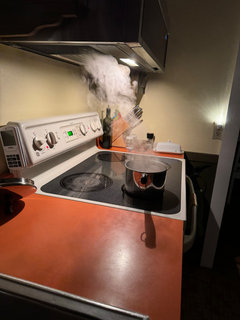
In my case, this was an improvement over the previous situation which was a very wimpy under-cabinet hood and a microwave on a cart in the dining room because there is no space for one in our tiny 1970s kitchen. Small kitchens necessitate compromises.
Kendrah thanked cerealcrispy - last year
cereal crispy, that's interesting. I'm glad you did that. Was there an open window nearby and if so, in what direction was it from the photo orientation?
Was the water in the pot doing a rolling boil or was it boiling more gently? My reaction is that steam is lighter and rises more gently than spatter, odor and ejecta (volcano term) from a saute pan. That stuff goes straight up doesn't float, so that hood would likely not be very effective in preventing those kind of cooking odors from spreading through the home.
I know like when hard boiling eggs either with a steamer basket or in boiling water, in a pot with a lid on, when removing the lid, a thick cloud of steam rises very quickly and all at once. It looks different than the lighter wisps your photo shows.
Also, if some of the steam is hitting in front of the air exhaust filter, that stuff will condense there and odors contained in it also won't be removed. The exhaust filters are right above the rear burners so that more cooking odor would be removal from pots on those.
Thanks for taking the time for the photo. I get that we all have to make the best of what we have. My comment to Kendrah is the same though. If there's room and it's possible to have a hood and run a duct to the outside, that's the best.Kendrah thanked Elmer J Fudd  last yearlast modified: last year
What the world needs is a flexible tube vent on an articulated arm so you can pull the vent over to sit right over the pot or pan that is generating the effluent. Imagine holding a vacuum cleaner over the pot. Use proximity to substitute for hood size or CFMs.
In principle something like this
Alternatively, drop-down side curtains that can go all the way from counter to hood. Substitute capture volume for CFMs.
Like a retractable, home scale version of this
(My hood has side curtains, though I’ve removed them as they are not necessary and sometimes get in the way. If they were easily retracted and extended . . . )
It would be interesting to give an engineering class this assignment: you have a 4” wall opening and a 400 cfm blower, design the most effective hood system possible.
It would be helpful for apartment and condo dwellers to find an alternative to the 1000 CFM MUA systems they cannot have.
Kendrah thanked John Liu- last year
John wrote: "It would be helpful for apartment and condo dwellers to find an alternative to the 1000 CFM MUA systems they cannot have."
The only solution to no MUA is recirculation, which demands adequate filtering. This topic is partially addressed in this thread: https://www.houzz.com/discussions/2347276/vent-a-hood-ductless-ars-range-hood-update#n=181. In such cases filtering may not be adequate for some combustion products, so induction cooking will be safer from an air quality point of view.
Also: "It would be interesting to give an engineering class this assignment: you have a 4” wall opening and a 400 cfm blower, design the most effective hood system possible." Better include some performance requirements and noise requirements. The 400 CFM blower typically used likely won't achieve more than 200 CFM with mesh filters, even with a direct through-the-wall path and perfect MUA. 400 CFM might be achieved with a 400-CFM positive displacement blower; good luck on the noise.
In any case the 400 CFM no MUA limit is an arbitrary value intended to [hope] that house wall leakage will be sufficient to avoid combustion appliance back-drafting. But the real requirements that one needs to engineer for are given below. And one implication is that such appliances should be in their own spaces with their own MUA to isolate them from the potentially significant house pressure drops possible with large CFM kitchen ventilation hoods. Otherwise, active MUA control systems are needed for the lower back-draft values.
Viz. (mostly from a contributor here whose name I've lost; reformatted to text)
Heating systems with fan-powered exhaust systems can withstand higher negative pressures than natural-draft appliances. Some types of fan-powered systems are much better than others, however. In order of effectiveness, the choices are:
* Sealed-combustion. Also called “direct vent,” these appliances draw all combustion and dilution air from outside. These can typically tolerate negative pressures in the range from 25 to 50 Pa.
* Power-vented. These draw their makeup air from indoors and are also called fan-assisted, forced-draft, or mechanical-draft. These can typically tolerate up to 15 to 20 Pa of negative pressure.
* Induced-draft. These have a small fan added for energy performance, not to overcome house depressurization. These can typically tolerate 5 to 15 Pa of negative pressure.
By comparison, an atmospherically vented furnace can back-draft with as little as 5 Pa of negative pressure, and a gas water heater will have spillage at 2 or 3 Pa. Fireplaces can start having problems at about 3 Pa. Canadian codes limit negative pressures in homes with atmospherically vented equipment to 5 Pa. U.S. codes do not currently address the issue (in a plainly spelled out "prescriptive" number).
1 pascal = 0.00402 inches, water column
1 atmosphere = 407 inches, w.c.
- last yearlast modified: last year
kaseki, I think the “thou shalt have MUA” commandments in code really should consider if the dwelling has combustion appliances vulnerable to backdrafting. If a house has direct vent for all gas burning appliances - excluding the range itself, obviously - why should we care if the mega-cfm hood is or is not paired with MUA? Sure, the hood may not work as well without it, but what’s the actual danger? The occupant can open a window or door when turning the hood dial to eleven.
I’m away from home, but when I’m making greasy smoke again I’ll do some experiments with a shopvac and a wok . . .
- last year
Even with no susceptible combustion appliances, the hood system is capable of pulling outside air through wall cracks. This introduces moisture into the walls, depending on humidity, and wood and fiberglass dust into the living space. Building codes assume that people will not open windows or will later add combustion appliances, so they strive to protect the occupants from themselves.
The point I try to make w.r.t. combustion appliances having integrated MUA is that the hood MUA system can be simplified, probably operated without blower or control system, rather than having a differential pressure-based MUA motor drive, barometric damper controls, or MUA blower control tied to hood blower motor current measurement. This is relevant because the Code doesn't demand an MUA system based on pressure drop, but just requires a controlled damper and at least equal sized duct, and heating in some climates.
Building practices that do not require MUA:

- last yearlast modified: last year
Returning to Kendrah’s question a few posts back --- Is it better to accomplish nothing (no venting) for a different layout than have vent location be the stumbling block to layout if it isn't accomplishing much? --- turns out that Elmer’s comments and cerealcripsy’s test & photo have confirmation in recent engineering studies such as this one from the U.S. Dept. of Energy’s Lawrence-Berkely Lab (under DOE’s Office of Scientific and Technical Information):
This study's testing found that at least six popular vented OTRs performed as well as basic range hoods that meet the minimum standards to qualify for certification under California’s current building code requirements for kitchen ventilation in new construction. Of course, those with 400 CFM ratings had improved capture, which answers another of Kendrah's questions. So, while OTRs are not great, they are worthwhile.
Basically, in this instance, “better than nothing” is more than “so negligibly better as to not matter at all.”
- last yearlast modified: last year
"Do you have any household combustion appliances that have an air path to the kitchen? The complexity of an MUA system can depend on whether back-drafted CO is a risk."
@kaseki. The only two combustible appliances are LP:- Backup heat - furnace is in the utility room off the garage and
- Whole-house generator - generator is located outside next to the shed around 20' away from the house).
Everything else is electric -- induction cooktop, electric ovens, electric heat pump, electric dryer, & electric pool heater (the swim spa is inside). - last year
Regarding if it's worth it, I think it is. Even if you don't get the best venting, you get some and some is definitely better than none! Cooking on back burners will certainly help as well. (If there are small children in the home, cooking on back burners is recommended anyway!)
The one that cerealcrispy posted appears to have two outlets, so that would also make it better. Most I've seen have just one.
Kendrah thanked Buehl - last year
John Liu, what you describe is called task exhaust and is used in manufacturing all the time
- last yearlast modified: last year
" Sure, the hood may not work as well without it, but what’s the actual danger? The occupant can open a window or door when turning the hood dial to eleven. "
Simple. The danger is that some people or a new owner may not know they need to open a window or door when turning on the exhaust fan. Or, if they do. don't always do so.
We always open a window or door when using the exhaust fan because, not unexpectedly, they don't work as well (and maybe not at all) when relying simply on the air leakiness of the structure for make up air.
Our gas burning appliances - water heaters and furnaces that all vent atmospherically (hot combustion air rises through metal exhaust ducts and exit through roof stacks)- are not contained in the structures' envelopes so there's no risk of backdrafting in our homes. But I know in many homes it is a risk, including homes where such equipment is in basements or closets in locations without access to outside air, that are not air-sealed from interior living spaces. .
- last year
@Buehl: I think your original question was the undetermined cost of your future MUA system. With no combustion appliances in your house, an external cap of some sort connected to a duct with a damper (I think it needs to be electrically driven), and a filter (some 2 x 2 pleated type in a cassette adapted to the duct), and possibly a heater (electric will be easier than a hydronic heat exchanger in most cases), and a diffuser directed away from the hood, or toward it if some distance away, should suffice. Cost should be significantly less than Fantech and other more complex designs that regulate house pressure. Pressure loss should be less than the baffles in the hood system, and this should keep the house pressure up enough to minimize any leakage through the walls.
This comment, while directed at Buehl, is hoped to potentially also apply to the OP and other visitors, where applicable.
- last year
- 550 CFM so more powerful than typical 400 CFM
- Slim at 12" high
- 19" deep so it covers more of the cooktop than standard 15"
- CR-recommended
- Reasonably priced at $550
- Owners like it
- last year
“John Liu, what you describe is called task exhaust and is used in manufacturing all the time”
Thanks, I didn’t know the term. Hmm, maybe a solution for island cooktops.


cerealcrispy