Software
Houzz Logo Print
webuser_63432924616

bonus room above garage

last month

Hello all,
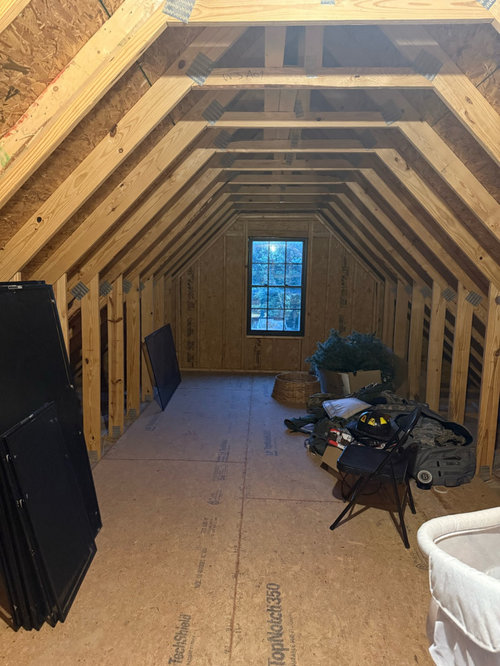
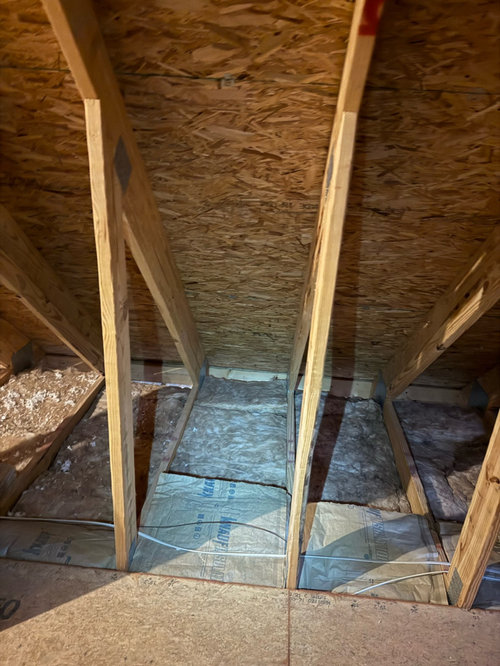
Finally getting around to finishing my bonus room. Builder laid sub flooring but only has R19 in the bays. 2x10 joists and I’d like to get some R30 in there as my garage below is not conditioned. Anyone had any luck trying to pull bays through ? It’s a ten ft wide run. Only other option I can see that doesn’t involve pulling up the subfloor is renting a blown in machine. Pics of the space attached.

Comments (29)

  • PRO
    last month

    That's not going to be legally habitable. Only light storage. No need to insulate for storage.

  • last month

    Why is that ? I intended on using it at a personal office space. Not for a bedroom or anything.

  • PRO
    last month

    Light storage trusses are not live load rated. Window and egress are an issue. Access pathways and egress. An unvented attic assembly would be needed here, with a bunch of electrical alterations, and everything else.


    This is storage.

  • PRO
    last month

    I think the floor insulation is the least of your insulation concerns. The insulation between the office space and the great outdoors is where greater heat loss will take place. Install wool carpet.

    Ask the truss supplier if the attic trusses you have can handle an office space, if you can. If you can not, keep your prayer life intact.

  • last month

    It seems there is confusion about the construction of the building. From the Picture it looks like the rafters are at least 2 X 8". Based on the picture the joists are at least that, and you said they were 2X10.


    I think they are seeing what appear to be trusses, which in most modern construction are made of 2X4. 2X4 trusses would NOT be suitable to support an office, as they are not strong enough.


    HOWEVER As I understand your question you want to insulate the floor which has with 2X10 joists. Assume this is correct, I would go ahead with your plan, as 2X10 floor joists are more that adequate to support you office. Most house have 2X10 floor joist under the living spaces, some less.


    The first consideration is a building permit, to understand what you can legally do. Next I would consider access space. Do you have space to for a stair way to the new office. Some area will accept curricular metal stairs.


    Putting the insulation under the floor is something else. 10 feet is not that long. you may be able to slowly work them through as is, or attach a rope with tape and use it to pull the bat through. If you consider placing the bat between very heavy strips of plastic an pull the plastic to get them through. The pulling the plastic away from the bats.


    In the long run if they are not glued it may be easier to lift the boars.

  • PRO
    last month

    "From the Picture it looks like the rafters are at least 2 X 8". Based on the picture the joists are at least that, and you said they were 2X10."

    There are no rafters. There are no joists. It is a truss, an attic truss. Each cord or web of the truss is in compression or tension. Crowd sourcing has no place in structural determination.


    Compressed fiberglass insulation loses its insulation value.

  • last month

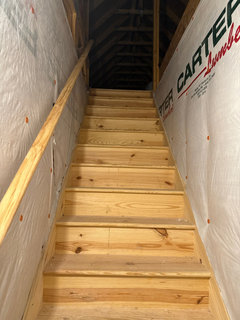
    So the space has adequate access. Picture attached, truss design is 2x10 joists, everything else is a 2x8. I plan to insulate the deck by leaving a 1 inch air gap for ventilation and then either r19 faced or rigid foam. I know it’s not the best for insulation but aside from closed cell the best I can do on my own. Then covered in drywall or pine tounge and groove. Back to the floor insulation. Unfortunately the builder used nails for the subfloor. Not in the whole house. Just the bonus room for some reason. So pulling it up would likely ruin all the subfloor. Which isn’t out of the question because it’s not that large of space but would like to leave it in place if possible while getting better R value then what is currently in there.

  • PRO
    last month

    Hire a local professional that answer your structural and insulation questions and protect you from you.

  • last month

    I dont have any structural questions or concerns with the space. Was just simply looking for some opinions on best way to insulate with the sub floor down.

  • PRO
    last month

    Heat rises, insulate the office ceiling and walls; the floor is sufficiently insulated as it is.

  • last month

    In the summer Cold sinks, insulate the floors to save on air conditioning

  • last month

    Remember you would not have to pull up the entire floor, just enough to reach the bat and pull it through.. Possibly cut an 18"(?) wide slot down the middle and pull each side toward the center

  • last month

    Is the subfloor glued? If not I think you can pull it up. I'm insulating right now and I can't see pulling fiberglass very far. You might get a reasonable job with blown in cellulose.

  • last month

    Subfloor does not appear to be glued. However it was put down with nails instead of screws.

  • last month

    I'd try to pull it up. Should only be 12" o.c. in field, more at edges.

  • last month

    Im going to give pulling r30 faced a chance but i dont think its going to go smooth. If that doesnt work, im between dense packing cellulose or pulling up half the floor to where i can damn near shove the bats throiugh the other half of the bay and then replace half the sub flooring. Lucklily only to bays have any wiring at all and its just for two garage lights and an outlet for my garage door opener.

  • PRO
    last month

    What does your local building code require for r-value of floors of heated spaces above unheated spaces?

    What does your local building code require for r-value of exterior walls and ceilings of heated spaces?

  • last month

    R25-r30 floor. R19-21 walls and r38-60 in attic space.

  • PRO
    last month

    How much will you be compressing the batt insulation in the attempt to achieve the R30 value?

  • last month

    I won’t be in the floor much if any as it’s a 2x10. Walls are good for r19 being 2x6 and. Ceiling is another story.

  • PRO
    last month

    Michigan code requires R30 in floors with a footnote of "Or insulation sufficient to fill the framing cavity, R-19 minimum." If you want to increase the insulation it will have to be on the office space floor or garage space ceiling or insulate the garage walls or heat the garage or replace the existing insulation (that probably meets minimal code in your area) with insulation of a greater R-value.

  • last month

    Thanks. garage walls are already insulated with r19 and code requirements are not met current insulation as listed above.

  • PRO
    last month

    Energy codes change over time. Some of the current prescriptive code requirements for attic insulation are just plain silly. If your state's building code adopts the International Energy Conservation Code (IECC,) you may be able to get by with the existing R-19 insulation in the floor. The IECC has three options for meeting code requirements: the prescriptive method (installing insulation to the code-prescribed R-values;) the trade-off method (installing better-than-prescriptive code insulation in some areas and/or higher-efficiency systems to make up for deficiencies in others,) and the performance method (which considers actual performance based on historical energy use.)

    I suggest you talk to an knowledgeable insulation contractor about your options before undertaking what may be unnecessary surgery on your home.

  • last month

    Thread is a crazy read.

    I see attic trusses, a specific style and method designed for a habitable floor.

    The subfloor should be taken up. It will not be ruined if you use a cat's claw. You lift 1,2,3 or so edge nails, then pry up the board to lift the others, then pull all the nails out.

    The reason the subfloor should be removed (as one choice), is a garage ceiling is a huge weak spot for habitable rooms above garages. Air infiltration is easy, and batt insulation does not guard against that, and certainly pulling long batts underneath the subfloor will result in large air gaps and crushed/stretched/compressed sections of batts. Blown-in is no better.

    The garage ceiling should have air sealing performed. Whether that is by installing rigid foam board, spray foaming, can spray foaming, flash-n-batt, and whether from the topside attic floor or from the bottom side garage ceiling, is your choice.

    The portion of angled roof follows ceiling R values. So if you need R60, you have to account for the baffle space you intend to have and the thickness of your choice of insulation to fit the 2x8 top chord ("rafter") or sister the top chord for more thickness.

    The portion of kneewalls can follow wall R values. That indicates your plan to have unconditioned knee attic spaces. It is important to understand how to air seal and block those spaces, look up "FineHomebuilding kneewall insulation section drawing."

  • last month
    last modified: last month

    On a past build, a bedroom over the heated garage was always cold in winter, despite the HVAC engineer specing heat vents and a return in the joist space above the garage ceiling.


    Batts on the drywall above the garage. Then the cavity under the bedroom floor was heated, including a return. Still cold floors and discomfort in the winter.

    Next build, we simply sprayfoamed directly under the floor, then drywalled the garage ceiling. Cozy and warm!

    For a diy approach, I've seen taped Zip R recommended.


  • last month
    last modified: last month

    3onthetree thanks for the reply. My garage cieling below is finished drywall. so pulling subfloor, air sealing around the two lights SHOULD be the only penetrations i have. Then placing R30 faced side up then follwoing the fine homebulding drawing for kneewalls and getting as mich R value in the roof as i can should be my best bet IMO. sound decent ?

  • PRO
    last month

    Should have spray foamed the garage ceiling. And you still need to sprayfoam the roof.

  • PRO
    last month

    Hi, Michael,

    I think you'll be better served by insulating under the roof deck all the way to the plate and incorporating the knee wall spaces in the thermal envelope. That approach eliminates the need to insulate the knee walls and air seal penetrations in them.

Sponsored
DryHome Roofing & Siding, Inc.
Average rating: 4.9 out of 5 stars84 Reviews
Loudon Co. Roofing, Siding & Exterior Remodeler Best of Houzz 5 times!