Software
Houzz Logo Print
heeman_wong

Back at it with another project, this time I'm more confused than ever

11 months ago

So I re-did my kitchen countertops with quartz like 3 years ago and got the exact look I envisioned. The quartz has held up great and looks like it did on day 1. Now I went back to the same supplier, and they seem to have moved on a bit from quartz and are recommending me to use "the new quartz" or quartz 2.0. I love how simple, affordable, and fast my quartz countertops in my kitchen were done initially, was hoping to have the same outcome. Does anyone have real experience with this new product called Sintered Stone? I'll link it here: Sintered Stone


Don't get me wrong, I love the look and feel of these slabs; however, I've never heard of them before. Seems like these stones just came out...


IF YOU HAVE EXPERIENCE WITH SINTERED STONE, PLEASE HELP!

Like, how does it fabricate and install? Cost Differences?


Comments (19)

  • PRO
    11 months ago

    Are you looking for a new way to burn money? I'd suggest a boat, or a horse. Not new counters. Why would you replace what you just put in?

  • 11 months ago

    Start from the beginning. You got new counters three years ago, love the look, and they are performing just as you want them to. Why are you getting new counters? Or are you getting them for another home?

  • 11 months ago

    Where will the stone be used?

  • PRO
    11 months ago


    "NEW project? He moved........he bought a flipper, he bought a second home? He's bored?

    Honestly, if we could just find that sweet spot of enough info to keep us from guessing, yet without a Library of Congress description,( sans pictures, usually ) we'd be in Houzzy Heaven lol

  • 11 months ago

    Just get soapstone.

  • 11 months ago
    last modified: 11 months ago

    FYI - sintered stone is not a new product. It has been around for almost 20 years - Dekton is the name brand version of sintered stone sold by Cosentino Group - they started offering it back in 2013 -14.

    I've never heard anyone refer to it as "Quartz 2.0" - they are two different products. Also, it seems odd that your countertop supplier referred to it as "the new quartz" - it was available three years ago when you purchased your quartz countertops.

    There are quite a few threads on Houzz re: Dekton/sintered stone/ultra-compact countertops. Some people have been happy - while others have had very negative experiences with it. One issue was due to the difficulty re: fabrication - slabs were cracking/breaking. I remember reading posts where people commented that they had to purchase an additional slab if their slab cracked/broke during fabrication or installation.

    Sintered stone can chip also - some type of epoxy is used to "fix" it - but my understanding is that it will still be visible once "fixed."

    It takes special tools in order to fabricate it = fabrication costs more $$. I don't know if in 2025 the fabrication process has become easier. It does have some advantages over quartz - superior heat resistance + UV stability.

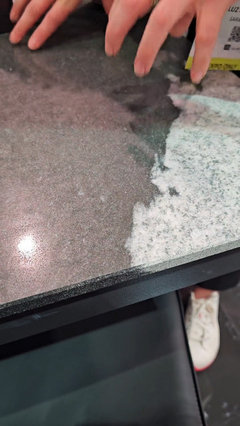
    Sintered stone can be either surface-only or through-body color, depending on the manufacturer and product line. This means that the cutout area for your sink will be white (unless you purchase through body colored sintered stone). Also, if your countertop chips, the inside will be white - unlike the printed surface (if you have surface-only color).

    FYI - Sintered stone and ultra-compact countertops are the same material.


    There is a new material that is on the market that wasn't available the last time you purchased countertops (at least I don't think it was around three years ago). It is an engineered slab - and is fabricated using the same tools as used for quartz countertops. However, it used crystalline-silica free materials, including up to 70% recycled materials like glass. The core material is called RGS (Recycled Glass Surfaces). This means that it is much safer for the people who work with the material.


    I've recently viewed slabs by Aurea Stone - their Symphony Stone Collection which is made out of this new type of engineered countertop material. Aurea Stone's Symphony slabs advanced printed surfaces that use high-definition patterns created using proprietary Nano-Ink Technology.


    Their faux stone slabs look much more like real stone slabs than ANY of the quartz slabs I've seen over the past several years. Aurea Stone also recently released a new version of this countertop material that uses ZERO crystaline-silica.


    I believe that MSI also has a similar product - I don't remember the name of the specific "collection" - however, there is a long thread on Houzz re: MSI Calacatta Castana which is one of these new engineered slabs.

  • 11 months ago
    last modified: 11 months ago

    Quartz is 66% stone and 34% resin by volume. Skip the weight measurement. . The resin content can scorch. Sintered stone differs.

    No resins or binders are used in the manufacturing process, which makes sintered stone different from engineered quartz. The components are compacted under extreme pressure and fired at very high temperatures (over 1,200°C), fusing them into a solid, ultra-compact material.

    Where is the country of origin?

    • European manufacturers were pioneers in the development of sintered stone and are still known for their high-quality products. Major brands include:

      • Spain: Neolith and Dekton
      • Italy: Laminam, Lapitec, and Granulati Zandobbio

    Chinese factories have also become a major source of sintered stone, with many manufacturers in regions like Foshan. They offer competitive prices and a wide variety of patterns. Who knows about history or composition.

    Identify the manufacturer and where it's made. Find examples from the major manufacturers. Compare quality and price.

  • 11 months ago

    Hi Guys,


    Pardon me, I thought I made it clear this is for another project (as mentioned in the title). We are building out our ADU kitchen now. Thank you, @dan1888 for the pointers

    And thank you @dani_m08 for the deep dive. However, I'm looking for people who have used the stone before who can clarify if the slight price difference is worth it, like @JAN MOYER pointed out

  • PRO
    11 months ago
    last modified: 11 months ago

    The slight price difference seems not to so"slight".

    The worth of any counter is how the stone works in the room you are using it, for looks and function. You could have a ten thousand person 50/50 or 30 30 30 response here and get I love mine, or I hate it or its the stone I loved for MY room, so I paid for it despite nearly double the quartz price which I also liked a lot.

    I never understand this type of question. You know its qualities, price seems no issue, so you pick the look you love! I don't see the problem : )

    It's no different than a quartz/marble/granite/quartzite/soapstone/Corian/buther block /etc........conversation

  • 11 months ago

    The first thing to do is determine who makes the product and where it's made. All 'sintered stone are not the same thing. The site you've linked has almost no hard information. That's not the best sign.

  • 11 months ago

    @JAN MOYER Agreed! It's all debatable, I get that. I'd love it if it were that simple for me. I worry about possible chipping and possible cracks/fractures from settling.

  • 11 months ago

    @dan1888 It's made in Spain, just like Cosentino, and I think Neolith

  • PRO
    11 months ago

    You just answered your OWN question! Good grief! You had a product you had zero issues with!

    It IS THAT SIMPLE! Do a quartz, and move on! Really, at some point it is simply nuts. But? It's the internet so keep asking?

  • 11 months ago

    I love how simple, affordable, and fast my quartz countertops in my kitchen were


    When I built an ADU kitchenette, I copied exactly what was in my kitchen because I knew I had made great purchases the first time around. I advise you do the same.


    The counter 2.0 is likely just a way to tempt people into ripping out what they currently have because it is the 1.0. (You'd be surprised how often a "new project" is really just people ripping out parts of an older project they are now second guessing.)

  • 11 months ago
    last modified: 11 months ago


    If you pick a 12 or 20mm Neolith product with color and pattern all the way through and your fabricator/installers are talented and capable you could mainly consider whether your use might subject it to chipping damage through misuse. Test a sample to see how easily you can chip it.

    Their 25 year warranty does not include-

    12 Transportation, production, assembly and/or dismantling costs to repair or reinstall a countertop.

    Have you guys seen Neolith's new Victoria color with that full-body veining yet? What do you think? : r/CounterTops

  • 11 months ago

    Everything I have heard about sintered stone is it is brittle and very chippy at the edges (regardless of the profile). You loved your quartz, go for that again. Personally your fabricator is trying to upsell a product that very well may be a downgrade from a durability standpoint. I would not, but then again I would not use quartz either. I have granite (white so most likely a marble in that it etches quite a bit), that is perfect in my mind.


    " I thought I made it clear this is for another project "


    You said that but replacing your countertops could be considered a "new project" as well, so context is key.

  • PRO
    11 months ago

    IMO neither are better than granite that is tried and true for eons/

  • PRO
    11 months ago

    I'm not a fan of sintered material. And I have only sold one since it came out many, many years ago. I'd go with quartz again. I've had mine for 13 years a still love mine too!