Software
Houzz Logo Print
central_valley

All new sheathing replacing redwood siding: does this make sense?

last month
last modified: last month

I'm looking for opinions/information on some advice that my contractor is giving me.

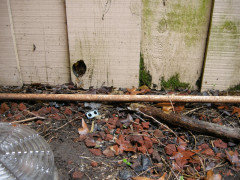
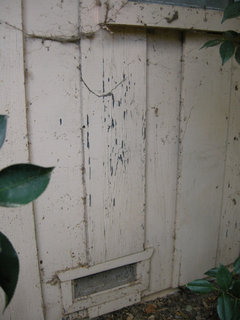
Background: I live in a single-story house in north central California, about 2400 sq ft, built about 1965. It currently has vertical board redwood siding, using 12 inch boards. Some boards are rotting because their ends are in contact with soil, some are badly split, a few are warped, and many have old paint in poor condition.

I also have old single-pane windows in poor condition.

I asked a contractor (a general contractor whom I've worked with before) for a quote on replacing the windows. We also discussed the condition of the siding, and he said that replacing the windows and dealing with the siding at the same time would cost about $5000 less than doing them separately. So far, so good.

But he also said that because redwood has become so expensive, I'd be better off replacing all of the redwood with fiber concrete siding. And while the house is naked, he wants to install a completely new vapor barrier.

I've asked him for more explanation of why this would be less expensive than replacing about 240 board feet of redwood, or at least not much more expensive, and also of why he thinks it's necessary to install a new vapor barrier when the house presumably has one already. But I'd also like to get opinions here. He's proposing that I spend a lot more money this year than I want planning on, and I want to have a clear understanding of the pros and cons of each approach.

Comments (13)

  • last month

    Just ask for the quotes separately. I would presume a vapor barrier from 1965 might not be in the greatest shape, particularly after the siding has been removed.


    You can get a quote from another contractor.

  • last month
    last modified: last month

    If there is a vapor barrier, it is already full of holes from the siding being put on, and it would also be very old, so yes, you would need a new vapor barrier.

  • PRO
    last month

    Could you post a few pictures of the house and problem areas?


    Redwood is expensive and quality stock like what's probably on your house will likely be difficult to find, unless it has been salvaged.

    Redwood is best stained, not painted.

    Your house will not have a vapor barrier, at least not a modern one.

    A change to fiber cement siding will change the character of the house -- probably in a bad way, but it doesn't burn like redwood.

    A good carpenter may be able to reuse some of the problem materials. Split boards can be cut and glued back together -- same with warped boards, preserving the original material.

  • last month

    If it's painted use cedar instead of redwood. No one will know the difference.

    After 60 years why do you now feel the need for a vapor barrier? Not sure about your climate details, but putting one on the outside of the house may be the "wrong" side in terms of keeping insulation dry. It would be a terrible error where I live; with cold winters the vapor barrier goes on the heated side of the wall to prevent higher humidity from inside the house condensing inside the cold wall.

  • last month

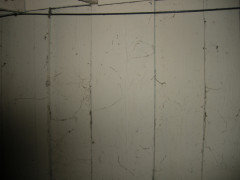
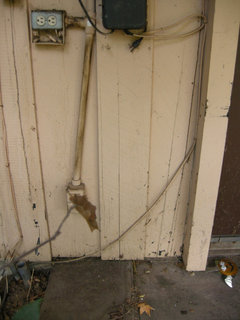
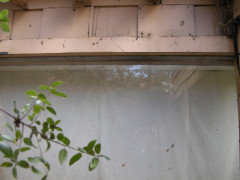
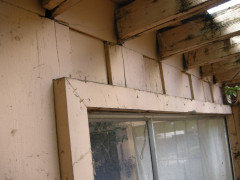
    I'm attaching several pictures that show siding in several places and different conditions. Despite appearances, the whole house is painted the same color. The 2nd, 4th, and 6th pictures reflect it most accurately. The others were taken under the eaves in different light conditions.


    It's not really relevant that redwood is better stained than painted (I agree that staining is more attractive). The redwood is painted, and I don't think it's feasible to remove the old paint well enough to "show." Replacement boards will have to be painted, too, unless they all go, in which case the replacement probably will be cement board.


    It's useful information that the appearance of cement board will probably be poorer, but I live in an area where fire is a serious issue. My neighborhood is only semi-rural, but parts of it are heavily wooded, and fires are a constant threat here in the dry season.


    Also, I vividly remember the 1991 Oakland fire... the mandatory evacuation zone ended a half mile from the house I lived in at the time. After the fire we visited the site of the place my then-wife lived before she moved in with me. It was just a few blocks from the place where the fire started. There was nothing left but the foundation and the concrete steps up from the street.


    Yes, cedar sounds less expensive than redwood, but the cost of labor will dwarf both, so it doesn't make that much difference.


    I never heard of putting a vapor barrier on the inside wall. I looked it up and found that it's customary in cold climates. I live in an area where the outside temperature only occasionally goes below freezing, so I think it would always go on the outside here. In the winter the interior humidity is very low.


  • PRO
    last month

    I was thinking that if you were removing all the siding, there would be the possibility to reuse it, either turning it around (back to front) so the unpainted side is exposed, or running it through a planer to remove the paint and clean up the face prior to reinstall.

    You could then stain instead of paint.

    If you do choose to replace with fiber cement, you might find someone to salvage it -- remove it for free, or maybe even pay you something for the material.

    Here is a tool that I've used to help remove existing siding. It simply pushes the nail through the material. There are less expensive ones -- this was the first search result.

    https://www.amazon.com/dp/B01H5RNHPA?ref_=ppx_hzsearch_conn_dt_b_fed_asin_title_18


  • last month

    Turning the siding around sounds feasible as a DIY project, but I doubt that any contractor would be willing to do it. Even the boards that look salvageable could have defects that would cause problems down the road, for which the contractor would probably be liable. And when the work was done, even if the boards were otherwise in perfect condition, they'd all have nailhead-size holes in them.


    Also, the labor of removing the boards cleanly, triaging them, and cleaning up the edges that will be exposed on the reinstalled forward boards, could easily cost more than all-new boards!


    So I thank you for an interesting idea, but I don't think it's one I can pursue.


    Salvage is an interesting idea that I can pursue. There are several local dealers in used building materials who might be willing to cart the stuff away for free, which would at least save me $1000 or so for a dump box.

  • last month

    Have you contacted any other contractors in order to receive some more bids for the work? Make sure that a detailed scope of work is included with each bid - otherwise, you won't be able to accurately compare the bids.

  • last month

    I contacted a specialty window-and-door contractor first. Their bid for the windows and doors was somewhat higher, but they didn't even touch the issues with the siding. I've known all along that there are serious issues there; the new information is that my neighbor contractor says I can save money by addressing them at the same time.


    And as I thought about it, I realized there are other issues that would be much cheaper to address at the same time as the siding:

    • Several electrical outlets on exterior walls that need to be grounded
    • A long-standing desire for a hot water recirculation system to the kitchen
    • Any other bits of hinkiness that I don't know about but might find hidden in the walls. On the strength of issues I have found, I suspect there are at least a few.

    Bottom line is: yes, I have another estimate, but it's so different that comparing the two is not meaningful. I could go to other general contractors with a list of things I want. The Rules say I should, but I'm pretty sure I'd get comparable quotes.

  • last month

    If you're spending a lot of money, getting two quotes is always a good idea.

  • last month

    " I have another estimate, but it's so different that comparing the two is not meaningful. "


    Then you have not articulated well enough what the scope of work needs to be to the contractor.


    " I could go to other general contractors with a list of things I want. The Rules say I should, but I'm pretty sure I'd get comparable quotes. "


    Or not if the scopes not spelled out properly they will decide on thier own.


    This is where you need to dictate what YOU WANT DONE> That can be taking a quote from a contractor you trust and sharing the exact scope that is listed with several other contractors.

  • last month

    «Then you have not articulated well enough what the scope of work needs to be to the contractor.»


    No, I have not predicted the future well enough to foresee my evolving needs from the start.


    I first went to a window contractor because I wanted windows, and I got a quote on windows.


    Then I went to my neighbor and asked him for a second quote on windows. He gave me the quote, which was substantially lower, but also pointed out that new siding, which I know I need, will be cheaper if I have him do it at the same time. That got me thinking about other things I'd like to have that would be much cheaper to do when the siding is off. He gave me a separate quote for windows and siding together, with separate numbers for each of the additional things I suggested.


    So l've now got two quotes on the windows I originally wanted, one of them accompanied by a second quote for windows plus siding, and additional figures for other items that I should have him do at the same time if I want them at all.


    I could go back to the window contractor and ask him for a quote with a precisely articulated scope of work, and he'd reply that he's a window contractor, not a general contractor. Or I could dig up another general contractor and get a quote, but I don't see the point. I know my neighbor is competent and honest because I've lived across the street and one door down from him for 15 years, and I've had him do work for me before. Now I've got comparable quotes on windows which only confirm what I already know. I don't need comparable quotes on the whole scope of work to confirm it again. I need to get this done this before the end of the year to get a tax credit for the windows, and I want to get started.