Software
Houzz Logo Print
gfreedy

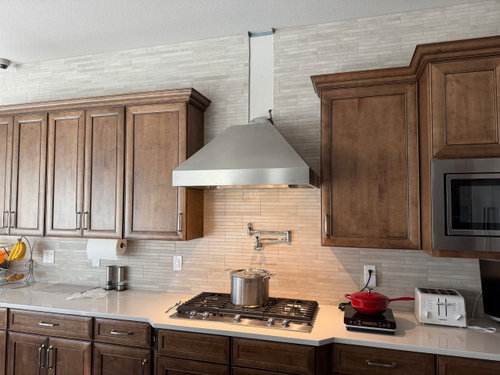
Just installed a VAH

2 months ago
last modified: 2 months ago

I really want to talk about static and indoor/outdoor pressure differential but first a little story of getting to this point.

After reading just about every post I could find over the last few months on people's experience with Ventahood Magic Lung I decided what I really wanted is a 36" EPH-18 for easy cleaning and the effective CFM due to no filters or baffles. What held me back was the cost of $4,844 out the door for the hood and a custom duct cover. I got very lucky and found a floor model at an appliance store of the older version with the rocker switches and GU-10 bulbs but the same unit otherwise. That was $900 + another $500 for a duct cover that's being made at a local stainless steel fabricator.

I know there are plenty of people that aren't happy with VAH so there is an element of risk. It's interesting though that there are plenty of people that think VAH the best thing since sliced bread and I hope that's how I'll feel. It's been pointed out that the squirrel cage fans are sensitive to static pressure. Having read and digested so much about people's experience, I seriously wonder how many of the problems people have could be related to various pressure or flow issues which I don't think I will have. So that's why I decided to take the plunge. So far it works great but will take some time to get it dirty to see if I really got what I hope for.

As for pressure issues, the first thing I wanted to do is get a static pressure reading. I've done this many times on various parts of HVAC systems but I'm not really sure where to put the probes on a hood since the the only plenum so to speak is (in my case) about 8" of duct and a single adjustable elbow. It seems where I want to measure is before and after the whole system but both sides are totally open to the atmosphere. How to measure this on a hood?

I did measure pressure differential in the house vs outdoors and it seems to me very low but I don't know what is good or not. I'm seeing .02 to .03 in of h2o. On one hand I'm not surprised it's quite low because it's a big envelope with 3400sf, 10' ceilings, a 2300sf basement and another 1200 sf crawl space that you can nearly stand up in. The pressure goes up to the .02 - .03 level in a matter of seconds and is stable regardless of how long the fans run. On the other hand it's a pretty tight house with a HERS rating of 65. It makes me wonder if they close off the two fresh air intakes when they do the HERS testing (one is a 7" unbaffled duct for the HVAC and a smaller one with a tiny inline fan that runs continuously).

We use a 16" wok almost daily and the 400cfm kitchenaid hood was becoming extremely burdensome to keep clean. Now that I have the ventillation taken care of relatively inexpensively I can rationalize buying the 36" Bluestar rangetop I've always wanted.


I'd love to hear people's thoughts or insight on any of this.


Comments (18)

  • PRO
    2 months ago
    last modified: 2 months ago

    What is your code required MUA plan for this tight house? It must work in conjunction with the operation of the hood. That is going to have the biggest effect on the hood’s ability to do it’s job

  • PRO
    2 months ago

    Pressure, yadda yadda. Yawn. MUA is where to improve venting performance with high CFM. No air can leave without air to replace it

  • 2 months ago

    Code is the usual one size fits all. I chose to start with the logic of ASHRAE residential ventilation standard 62.2 which in simple terms allows 15 CFM of exhaust per 100sf of occupiable space. Based on that a very conservative upper limit is 850 CFM. My installation is 2/3 of that at most so I felt comfortable trying it before assuming I actually need MUA. And as you read one of the first things I'm doing is measuring the pressure differential to get a sense of where things actually stand. If I really need MUA then I'll put it in.

  • 2 months ago

    @Monique I can tell you it's like a hurricane coming out the exhaust and that air is coming from somewhere which I suspect is the MUA that was built into the house via fresh air intakes. That's one of the reasons I posted this thread is to hopefully get some insight on that.

  • PRO
    2 months ago

    So, you are going yo be a scofflaw and expect it to not endanger your family’s health. Got it.


  • 2 months ago
    last modified: 2 months ago

    Well, there is always MUA, else no air would exit the hood systems duct to the outside. I think it likely, given the properties of VaH Magic Lung hoods' fan curves, that the hood flow rate has adjusted itself to the available MUA.

    As for safety, here are some pressure differences that different mechanical draft combustion appliances can back-draft at.

    Heating systems with fan-powered exhaust systems can withstand higher negative pressures than natural-draft appliances. Some types of fan-powered systems are much better than others, however. In order of effectiveness, the choices are:

    * Sealed-combustion. Also called “direct vent,” these appliances draw all combustion and dilution air from outside. These can typically tolerate negative pressures in the range from 25 to 50 Pa.

    * Power-vented. These draw their makeup air from indoors and are also called fan-assisted, forced-draft, or mechanical-draft. These can typically tolerate up to 15 to 20 Pa of negative pressure.

    * Induced-draft. These have a small fan added for energy performance, not to overcome house depressurization. These can typically tolerate 5 to 15 Pa of negative pressure.

    By comparison, an atmospherically vented furnace can back-draft with as little as 5 Pa of negative pressure, and a gas water heater will have spillage at 2 or 3 Pa. Fireplaces can start having problems at about 3 Pa. Canadian codes limit negative pressures in homes with atmospherically vented equipment to 5 Pa. U.S. codes do not currently address the issue (in a plainly spelled out "prescriptive" number).

    1 pascal = 0.00402 inches, water column

    1 atmosphere = 407 inches, w.c.

  • 2 months ago

    @kaseki Thank you, that's very useful information of the sort I was hoping for! The negative pressure I'm measuring in inches of h2o is .02 - .03 or 5 to 7.5 pascals. That would put me in the danger zone if I had atmospherically vented equipment but this home doesn't have anything that is not power vented. Both the HVAC and the water heater are in the basement with fans in the exhaust to push it outside. The cooktop is the only other gas appliance inside the house.


    In the meantime I am looking deeper at the code and it appears there are some updates in many jurisdictions. Here is an important one directly related to the info you sent:


    "Exception: Where all appliances in the house are direct-vent, power-

    vent, unvented, or electric makeup air shall be provided where exhaust

    fans are capable of exhausting more than 600cfm. Exhaust hood

    system capable of exhausting more than 600cfm shall be provided with

    makeup air at a rate approximately equal to the exhaust rate that is in

    excess of 600 cfm."


    I'm also seeing an option for "naturally provided" make-up air which is basically a passive system much like what I have for my HVAC. However, a kitchen hood using this approach would require a dedicated duct with a motorized damper controlled by the hood.


    So still some learning to do and digging into my own local code. But even if I have to add MUA it seems fairly straight forward.

  • PRO
    2 months ago

    Physics do not lie. Get the MUA.

  • 2 months ago

    @gfreedy you said: I'm also seeing an option for "naturally provided" make-up air which is basically a passive system much like what I have for my HVAC. However, a kitchen hood using this approach would require a dedicated duct with a motorized damper controlled by the hood.


    This is what we have for our MUA. There is a switch assembly which activates a motorized damper to allow fresh air in when the hood is in operation. It is by CCB Innovations.

  • 2 months ago

    Thanks @Clyde Kalvin that's a nice simple kit.

  • 2 months ago

    @KT Builders said: "Physics do not lie. Get the MUA."


    I spent quite a bit of time last night and earlier today delving into the code for make-up air and it seems the IRC is the most frequently adopted including where I live. 2021 IRC M1503.6 states:


    M1503.6 Makeup air required.


    Where one or more gas, liquid or solid fuel-burning appliance that is neither direct-vent nor uses a mechanical draft venting system is located within a dwelling unit's air barrier, each exhaust system capable of exhausting in excess of 400 cubic feet per minute (0.19 m/s) shall be mechanically or passively provided with makeup air at a rate approximately equal to the exhaust air rate. Such makeup air systems shall be equipped with not fewer than one damper complying with Section M1503.6.2.


    https://codes.iccsafe.org/content/IRC2021P3/chapter-15-exhaust-systems#IRC2021P3_Pt05_Ch15_SecM1503.6.2


    In my house all the combustion type appliances use either a mechanical draft system or are direct-vented. This code is very clear as to what it says so I want to be sure I completely understand it before deciding I need to put in a MUA system. Perhaps you or someone else here can explain why that code doesn't mean I can't go over 400 CFM without MUA.

  • 2 months ago
    last modified: 2 months ago

    The person (name forgotten) who originally provided this forum with the back-draft pressure comments I provided up-stream included this sentence: "Canadian codes limit negative pressures in homes with atmospherically vented equipment to 5 Pa. U.S. codes do not currently address the issue (in a plainly spelled out "prescriptive" number)." By prescriptive he meant, I think, without setting a pressure drop value based on the combustion appliance configuration present in the residence.

    The OP's reported pressure drop is safe for the OP's situation, because the VaH blowers significantly drop their flow rate with back pressure. This is why the Magic Lung equivalent flow rate claims don't apply in actual installations; only the actual fan curve vs. pressure loss applies. "The negative pressure I'm measuring in inches of h2o is .02 - .03 or 5 to 7.5 pascals." This means the actual flow is established at that back pressure on the fan curve.

    The OP could get into a discussion with the code enforcement officer about what the flow rate actually is and that the measurement doesn't lie. Offsetting arguments are: (a) What if someone in the future installs an atmospherically vented combustion appliance? or (b) Nonetheless, you are depending on house leakage which has its own hazards w.r.t. dust, mold, etc. If the residence has an HRV or some significant sized exterior intake to the HVAC system, that may do for MUA.

    From a ventilation point of view, the question is: Given a pan of oil heated to its smoke point, is all the visible plume captured and contained by the hood.

  • PRO
    2 months ago

    Why would you even consider limiting yourself when you are going to put in a Bluestar???? You are setting yourself up for an unhealthy and filthy disaster, just like you currently have. You have more than 400 CFM so you require MUA. PERIOD. Or, do you just like arguing just to argue.


    " We use a 16" wok almost daily and the 400cfm kitchenaid hood was becoming extremely burdensome to keep clean. Now that I have the ventillation taken care of relatively inexpensively I can rationalize buying the 36" Bluestar rangetop I've always wanted."

  • PRO
    2 months ago
    last modified: 2 months ago

    Some people outsmart themselves when they try to be smarter than the average bear. Just get the makeup air. If you have a gas anything, it's required.

  • 2 months ago

    While I appreciate everyone that took the time to read and respond to this thread, I found it interesting that without exception all four of the "Pro's" that responded on this thread : 1) were very negative towards my effort to understand and solve the MUA issue; 2) only offered emotional feelings and opinions with absolutely no supporting information whatsoever; and 3) obviously have no clue of the current code and the direction it's going. Simply put, none of them know what they're talking about.


    The problem is solved and no MUA is necessary.


    I went to the building department this morning and had what turned out to be a very short discussion with the supervising engineer. In 2021 my jurisdiction adopted the 2021 IRC and one of the amendments they made in the adoption process was to section M1503.6 which I quoted a couple of messages ago in this thread. They replaced 400 CFM with 600 CFM and that was it.


    @kaseki thank you again for all the good information. You mentioned the fan curves in both of your posts but I am unable to find that information online for anything VaH. I am very curious to compare the fan curves with the pressure differential and exhaust output in my house.


    Also, that's another good point about a smoke plume test to validate the hood performs as I need it to. It will be interesting to test that with the house sealed and then with nearby windows open. This also gave me an idea to use some sort of smoke test to see where my make up air is coming from and how it's delivered.

  • 2 months ago

    @gfreedy I forgot to mention I have a 48 inch Platinum Bluestar range and a VAH. VAH model is PRH18-448. We have been happy with it. Much quieter than the Wolf hood we had in our previous house. That thing sounded like a freight train. We also wok and the hood does a good job handling that.


    As far as cleaning the hood most of the time it is just removing the trays to clean but several times a year I do a full clean. I take all the parts out of the hood and clean them in the sink. The squirrel cages go in the dishwasher. The worst part for me is getting way up in the actual hood to clean that. We have the high shelf so that makes it awkward. I am also only 5ft tall so its a reach for me. But I manage to get it done.


  • 2 months ago

    I don't have time to thoroughly investigate VaH products, but here is an example "fan curve" in the form of a table. Just plot it to get a curve. 600 CFM at zero pressure loss, 531 CFM at 0.1 inches, etc.

    https://ventahood.com/index.php/support/specifications?id=361&view=article&model=EPH18-236


    Keep in mind that for conventional hood systems with adequate MUA, the dominant pressure loss is likely to be the baffles, while for VaH Magic Lungs it is likely to be the MUA if limited to house leakage.

    Compare this VaH fan curve to one you can find at Broan for a 900 CFM blower, VaH's claimed equivalent blower size. E.g., the 332H (Wolf 801641) has only dropped about 50 CFM from zero static pressure flow when operated at 0.2 inches, and by 150 CFM at 0.6 inches which might represent a modest baffled hood used with that blower. So the VaH equivalence claim seems itself to be magically determined.

  • 2 months ago

    @Clyde Kalvin First, the picture of your beautiful kitchen is a real treat to see. The word impeccable comes to mind. I appreciate reading about your experience with the VaH and how you clean it. I can imagine how that shelf makes it difficult to get way up in there. When I looked at a VaH like mine in the showroom it seemed kind of loud for some reason. But when I turned mine on for the first time after installing it I was very pleasantly surprised especially how it barely gets any louder at full blast. As for the bluestar, I'm looking forward to using our wok with the integrated wok burner.