

Furnace/Air Replacement Quote and Sizing Help
Hello! My 25 year old 2 stage Trane furnace (TXC043C4HPC0) started blowing cold air. I had a company come out and look at it. They said $1200 for a new control board or replace my furnace and air conditioner (also 25 years old).
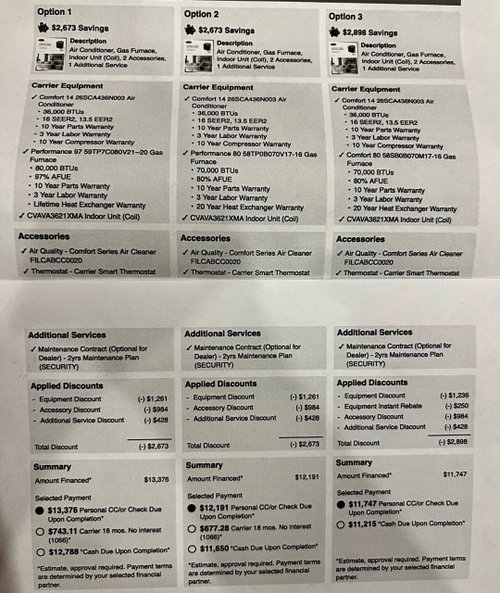
I received 3 quotes to replace my furnace and AC. My current furnace is 80,000 BTU , and my current AC is 3.5 ton. I’m attaching the one that we are most likely looking at. We live in NE Ohio. Our home is 2200 sq. feet. Each person that came out gave me different sized AC units (2.5, 3, and 4). The quote that I have attached did go through and measure windows and count vents if that matters, but I am still confused about the size discrepancy vs what I already have.
I’m wondering if it’s worth it to replace everything or just have the control board fixed?
If I replace everything is there a best option here, does the sizing sound correct, and should I do 1” or 4” air filter?
Thank you!
Comments (100)
 9 months ago
" resulting in more or less a guess "
Be sure to inform your customers that you really don't know what you're doing and what the results will be of your work. You can only guess.
 9 months ago
It's not unusual that posts/questions in HVAC remain unresolved and the OP flees. Berating, confusion, and criticism are common, both toward the OP and between the contributing professionals who take over the discussions (see above).
Related Professionals
Annapolis General Contractors · Sugar Land General Contractors · Toledo General Contractors · Sheboygan General Contractors · Victorville General Contractors · Dickinson General Contractors · Calgary General Contractors · Springfield Home Remodeling · Chambersburg Home Remodeling · Scranton Home Remodeling · Cape Coral Bathroom Remodelers · Fort Myers Bathroom Remodelers · Lexington Bathroom Remodelers · Janesville Bathroom Remodelers · Stockton Bathroom Remodelers- 9 months ago
I think highlighting known attitudes and shortcomings of participants helps the OP validate or invalidate what some say.
 PRO9 months ago
You can only guess.
Ok then, what are the participants in this thread doing then if not guessing?
An HVAC system is 25 years old, the replacements are all different sizes from the original.The HVAC system sat there for 25 years, heating / cooling that house all this time. Then the furnace breaks down is going to cost $1200 to fix it.
No Wait... it's the wrong size! oh no? Well we're not going to provide a quote to replace the furnace, because it's the wrong size after 25 years so we can get a full system replacement?
We don't know that either... but? Is this about money or the wrong size? I'm guessing, you're guessing. But based on 25 years, my guess is more of a statistical advantage. Playing the odds as they say in Vegas. What happens in Vegas stays in Vegas.
Well we are not guessing? Then what are you really doing?
I think highlighting known 'short comings' in the process helps the OP see how much or how little sizing is a part of process of getting it right versus getting sold for the sake of it.
Well -- you can only guess. You could also try thinking just a wee little bit, in addition to taking a guess.
---------5:55 AM
 PRO9 months ago
No one here is advocating guessing, except the two contractors who didn't invest the time to check the equipment sizing following industry best practices (and code requirements depending on the locale.) The ACCA manual J is a prescribed load calculation process which was developed by your industry trade group and which has been in place for decades. That's more than adequate time to prove its usefulness. The manual J calculated loads are approximations--not exact solutions--but they're far removed from guesses. Exact solutions are pretty rare in the sciences, engineering, and tax accounting. We don't throw our hands up because we can't calculate an exact solution when an approximation is adequate for the purpose.
- PRO9 months agolast modified: 9 months ago
No one here is advocating guessing, except the two contractors who didn't invest the time to check the equipment sizing following industry best practices (and code requirements depending on the locale.)
So how was the original size determined 25 years ago? guess it was wrong.
The two who didn't do the calculation took a stab? those are wrong? ok sure I could agree with that.
The one who did do it -- is different than the original size that sat there for 25 years and the only reason we are having this debate is that the furnace broke down and is going to cost $1200 to repair.
You can argue go around in circles, flap your arms like a bird, do the hokey pokey turn yourself around... it still does little to explain how a broken furnace is leading a few to believe the sizing is all wrong.
I'm the only one suggesting that has a problem with this process? Yeah because I've seen this slight of hand trick before in person and the equipment it involved was much younger at only 5 1/2 years old.
Not saying this is what is going on here, but 25 years is a long time for the original equipment to sit there year after year (according to this story as presented here by OP) --- not saying anything in regard to them even having a smidgen of evidence the current system is not sized right.
How many cold winters that unit went thru? 3 month AC seasons? Not a single ounce of thought by the OP suggesting any sizing problems? none.
The heat load calculation is a tool, but not the only one.
-------
6:10 AM
- PRO9 months ago
We don't know how the size of the 25-year old furnace and air conditioner currently installed were determined nor does it matter. The OP's been presented with three different proposals from three different contractors. They asked for help to determine the proper size of replacement systems. That task is well scripted by the ACCA following the procedures in manuals J and S. I advocate a thorough inspection and testing of the duct system, too. Some or all of a 25-year old duct system likely needs to be replaced. Code requirements for duct systems have change a lot in the past 25 years. Sealing to meet current code requirements may decrease the required size of both the furnace and A/C reducing the replacement cost and operating costs as well.
- 9 months agolast modified: 9 months ago
I don't believe a HVAC company would last long telling clients they need to pay to test and inspect their 25 year old duct work, and certainly after telling them the 25 year old duct system needs replaced when all they wanted was a A/C unit replaced. If I wanted my roof replaced and the roofer told me I also needed to replace the trusses because the code changed I'd tell them to take a hike.
Wasting time to do a full blown load calculation including testing the duct work for a replacement job is rare, and almost never done by any HVAC contractor, this is reality. - PRO9 months agolast modified: 9 months ago
Diagnosis before prescription is always a good approach. Doing so can make a replacement contractor stand out from the crowd. Performance testing of duct work is required by code in most municipalities for new construction. It's also required by a number of states including California for replacement systems. It's required in Texas for replacement systems if any of the duct work is in unconditioned spaces like garages or attics. It's required in Ohio if the air handler is replaced and it's installed in an unconditioned space. Of course, if your work is performed exclusively without permits and inspections, who'll know?
- 9 months ago
"CRH: Performance testing of duct work is required by code in most municipalities for new construction. It's also required by a number of states including California for replacement systems. It's required in Texas for replacement systems if any of the duct work is in unconditioned spaces like garages or attics."
When did the TX requirement go into effect? There was no apparent/obvious "performance testing of duct work" done when my system was replaced in January 2022, other than running the new system while it was charged with refrigerant*. All the duct work, including the two return paths, are in the attic.
*There was a valve leak that became apparent in April 2022 by way of a fault code F7 that I discovered when I just happened to open the service panel on the outdoor unit for a look-see at what service info is in there. ...Yeah, homeowner overstepping the bounds of amateur/idiot vs. professional/genius. I've continued to check it periodically.
- PRO9 months ago
@dadoes,
My understanding is that duct leakage testing has been required at least since the 2018 International Energy Conservation Code (IECC) was adopted by Texas in September 2019. The testing requirement applies only if ducts are installed in unconditioned spaces (i.e., outside the thermal envelope.) The 2021 IECC has not yet been adopted statewide in Texas; it requires duct leakage testing for ducts both inside and outside the thermal envelope. However, some Texas cities including Houston have their own energy codes. Houston adopted the 2021 IECC (in effect since January 1, 2024,) with some specific local amendments and additions.
- 9 months ago
" Wasting time to do a full blown load calculation including testing the duct work for a replacement job is rare "
Load calcs are increasingly required when pulling a building permit for a new install or replacement of existing equipment, along with HERS testing. What's a waste of time is reading your uninformed views.
- PRO9 months ago
It's remarkable how quickly our HVAC "pros" retreat from the conversation when it becomes apparent to everyone that they aren't aware of code requirements and aren't doing what is required by code.
- 9 months agolast modified: 9 months ago
I don't think it's just a code compliance thing. When an industry association recommends that particular steps should be done as accepted and required standards of proper professional trade practices, and when those recommendations are not controversial or disputed, it's telling that someone in the business still disputes the credibility and value of what to so many others is just another step that's always done. Done because it's a requirement of doing a proper job. Whether or not it's required for building permit and whether or not a building permit is even required.
 9 months agolast modified: 9 months ago
"Wasting time to do a full blown load calculation including testing the duct work for a replacement job is rare, and almost never done by any HVAC contractor, this is reality."
Sadly, I think this statement is true. Unless it's a code requirement (and "best practices" be damned), I don't think any HVAC contractor:
a) wants/has the knowledge to do a meaningful Manual J/Manual D calculation,
B) wants/has the knowledge to do a meaningful duct leakage evaluation
C) wants to include this in their bid for fear of "sticker shock" by the homeowner
Remember, these guys aren't rocket scientists!
- 9 months agolast modified: 9 months ago
Elmer, I find it interesting that you complained about Ray’s long and rambling comment, yet your own response suffers from major flaws. Your sentences run far too long and pile on clauses until the main point becomes almost impossible to follow. Repetition does not strengthen an argument, and using the word “required” multiple times in the same breath does not make the idea clear or correct. I have copied your original comment below so you can look at it again with a fresh perspective encase you accidentally delete it, like the one where you said you have all your teeth when confused on a big word.
- 📷Elmer J Fudd1 hour ago last modified: 1 hour ago: I don't think it's just a code compliance thing. When an industry association recommends that particular steps should be done as accepted and required standards of proper professional trade practices, and when those recommendations are not controversial or disputed, it's telling that someone in the business still disputes the credibility and value of what to so many others is just another step that's always done. Done because it's a requirement of doing a proper job. Whether or not it's required for building permit and whether or not a building permit is even required.
This one didn't come across as a meltdown, but it does read as if you're frustrated or defensive, and worked up about something else. If something else is bothering you, you are welcome to explain. Were the other women on another thread mean to you again? If so just apologize and ask forgiveness. As for this discussion where professionals usually know best, comments should be clear and smooth, so maybe it's to far above your pay grade to understand.
- 9 months ago
"Remember, these guys aren't rocket scientists!"
Of course not, comparing HVAC to rockets, our job is to pull out a new rocket, set it on the launching pad, hook up the lines and plug her in. We're not in the business to re-engineer a rocket or a condensing unit, just install it.
The time to gather the data and create a loss/gain calculation, and when the average win for a HVAC bid is only 15% to 35% the time adds up. An accurate and correct calculation takes at least 45 minutes and up to 2 hours not including travel time. The expense to keep a tech on the clock is around 150/hr if all expenses were calculated in, even if the tech was generating no income for the company. That one bid will cost a company $300 to $400 and isn't reality in the field. The customer is going to get a rule of thumb bid.
People looking through a window with the illusion these calculations will be done correct and with precision are delusional when getting a bid. Even in the two dozen states requiring a Manual J calculation, for a bid it isn't going to happen. And even after the bid is accepted the J manual inputs are going to be a lot of defaults stuck into the program. Percentage of shaded glass, really? oh maybe 20% sounds good--click. I suggest those who haven't done one should limit their comments with a curious tone.
But....But California has a Hers rater checkout the work!! Yea, and if the system works right, and the square footage and window sizes look close compared to the submitted Manual J report it gets the green light. And he or she isn't going to replicate the original report to find out. If it doesn't work right, if or if not the manual J report was right on the mark the contractor must still make it right. So for a replacement, a full gain/loss calculation is hogwash.
- PRO9 months ago
Haven't retreated... at some point one must make the choice to check the horse and see if he's dead. (If you're a builder, this situation is similar to beating a nail... when to stop pounding?)
I'm patient to let the thread percolate so it's not just me beating the dead horse.
Much of what you write are codes that pertain to new construction and only kick into older construction when into a full on renovation, then those codes are implemented / required because of the renovation. Some areas may be different in terms of various requirements so this isn't to suggest anything illegal.
Replacing an HVAC system in many areas around me is not cause for pulling a permit unless within the city limits AND as I have stated previously further up the conversation chain of my rambling is often used as a tool to upsize equipment here outside the city limits, not because it's correct but because that gives a company full reign to replace the whole system as opposed to just repairing it. (certainly not repairing it which is upwards of 95% of my job -- no let's suggest I've retreated? -- the horse died maybe a week ago?) one last prod....
It takes very little slight of hand to increase an AC by half ton size especially when R-values are an estimation / guess if you prefer. Half ton is 6,000 Btu's (about the size of a low end window shaker)
It's not rocket science, in terms of sizing you can keep right on arguing best practices and so on and sure you're right to argue that just not to the point that what you're arguing is actual right.
According to this thread the price is 25 years, but only when the system is broken does this come to light. Well that's not rocket science either. - PRO9 months agolast modified: 9 months ago
Houston adopted rules for "NEW CONSTRUCTION" it helps to understand what you're reading...
Yes, Houston adopted the 2021 International Energy Conservation Code (IECC) with amendments, making it effective for new construction starting January 1, 2024, to enhance building resilience, energy efficiency (better insulation, windows, HVAC), and water conservation, aligning with stricter safety and climate goals. The city council approved these updates in late 2023, bringing Houston's standards to match recent national models for better performance against extreme weather. Key Aspects of the Adoption:
- Effective Date: January 1, 2024, for new construction.
- Based on 2021 Codes: The city adopted the 2021 editions of the International Building Codes, including the IECC, with local amendments.
- Focus on Resilience: Codes aim to protect against fire, flooding, wind, and extreme temperatures.
- Energy & Water Savings: Mandates more efficient windows, insulation, electrical systems, and water fixtures (like 1.2 GPF toilets).
Residential Building Changes
- Mandatory Additional Efficiency Options: A major structural change requires builders to select an "additional efficiency package" from a defined list (e.g., enhanced envelope insulation, high-efficiency HVAC, or ducts within conditioned space) to achieve an extra 5% efficiency beyond the base code requirements.
- Increased Insulation Requirements: Prescriptive R-values have increased for various components, including attic insulation (up to R-49 or R-60 in many climate zones) and wall continuous insulation in some climate zones.
- Tighter Air Sealing and Testing:
- Duct Testing: The exemption for testing ducts located entirely within conditioned space has been removed; all ducts now require testing to confirm minimal air leakage.
Keywords: A major structural change requires BUILDERS to... all to achieve a 5% efficiency bump.
Yeah, still not rocket science. But builders have trouble doing it... because 25 years later we'll have to do it all again when the HVAC system breaks.
Now guess how much this adds to the cost of a home? Oh we have an affordability crisis. This isn't rocket science either, btw. All so you could entertain a 5% discount on your utility bill.
Congratulations. You win. LOL, there's only a few people that know better it seems.
- PRO9 months ago
So what does it actually change for retrofit market in Houston?
When replacing an HVAC system in an older structure under the 2021 IECC adopted by Houston, the new components and associated work generally must meet current energy code standards, while the rest of the existing building is not required to be retrofitted to the new code. Key effects of these changes on HVAC replacements:1. New Equipment Efficiency Standards- Minimum Efficiency Ratings: Any new heating or cooling equipment installed must meet or exceed the stricter minimum efficiency ratings (e.g., updated SEER for AC units, AFUE for furnaces) that are effective at the time of permit application in Houston.
- Compliance is Mandatory: The new equipment itself must comply with the 2021 IECC standards, regardless of the age of the structure it is installed in.
Largely this is in play already with SEER 2 changes, so it largely changes nothing for what I do outside the city limits. SEER 2 just implemented changes to make it harder to determine how much more efficient the equipment is versus the older SEER rating system.
So let's arue some more? You choose -- all of it is argumentative. - PRO9 months ago
Hey, Ray,
You went Ray-D-O silent for a while. Glad you're still on the right side of the grass.
Texas adopted the 2018 IECC statewide It has implications for both new construction and HVAC replacements. If you ever pulled a permit or performed an installation subject to inspections you'd know that. Houston (and some other cities in Texas) went above and beyond those requirements by adopting the 2024 IECC. It requires leakage testing of ducts both inside and outside conditioned spaces.
I needed a dose of humor recently, so I stopped by your company's website, Ray. It's always good entertainment value. I was surprised to see a NATE (North American Technician Excellence) logo featued on your site. I've always held NATE certification to mean something and your posts aren't consistent with that level of expertise. So, I checked on the NATE website to locate a NATE certified contractor in the Katy, TX area. They didn't list any. Surely that was in error, because featuring a NATE logo on your website without being NATE certified would be false and misleading advertising. So, I invested the extra effort to contact NATE to clear things up. Much to my surprise (not) here's their reply:
"Austin Air Company is not registered with us as a C3 contractor. Ray Austin is not currently a NATE certified technician." That's perCharlie Maline, NATE customer service representative.
I'm guessing if you'll eliminate all the false information on your website, you can condense it down to a single page. Time to get to work!
- PRO9 months ago
So what does the code actually change?
Houston adopting the 2024 IECC for HVAC replacements in older homes means you'll likely need more efficient equipment, smart controls (like thermostats) for new systems, mandatory duct testing if ducts are accessed, and potentially right-sizing of new units, all aiming for better energy savings, though the code offers more flexibility through trade-offs than older rules, reducing upfront cost burdens while improving performance for new and altered systems. Key Changes for HVAC Replacements in Older Homes:- Mandatory Controls: New HVAC equipment replacing old units in existing buildings must have code-compliant controls, like smart thermostats that adjust to occupancy.
- Duct Testing: If your replacement involves accessing ductwork, those ducts will likely need to be tested for leakage to meet standards.
- Correct Sizing: New HVAC units must be correctly sized for the space, preventing oversized systems that waste energy and dehumidify poorly.
- Energy Credits & Trade-offs: The code offers flexibility through energy credits; you can meet requirements by choosing from various efficiency upgrades (like better insulation or ventilation) instead of just focusing on the HVAC unit.
- Focus on Efficiency: While the 2024 code is more stringent overall, it provides more paths (prescriptive, performance, ERI) for compliance, making it easier to achieve energy savings without massive overhauls.
What This Means for Homeowners:
- Higher Efficiency: Expect lower energy bills over time from more efficient systems and controls.
- Potential for Lower Costs: Increased flexibility allows for cost-effective compliance through a mix of upgrades, not just expensive equipment.
- Repairs vs. Replacements: Experts confirm that older AC units are still repairable; the code primarily impacts replacements or major alterations.
- Future-Proofing: These changes help align older homes with modern energy standards, increasing their long-term value and resilience.
In short, expect smarter, more efficient HVAC replacements in Houston with specific control and testing requirements, but with more options to comply cost-effectively.
-------------------
--- Sorry Charlie, Repairs vs. Replacements: Experts confirm that older AC units ARE STILL REPAIRABLE... THE CODE primarily impacts replacements OR major alterations.
It changes nothing for me. I know how to read Charles. - PRO9 months ago
I can read, too, Ray. The IECC speaks to replacement--not repair.
What about the NATE logo on your website?
- 9 months agolast modified: 9 months ago
" but it does read as if you're frustrated or defensive, and worked up about something else "
Nope, not at all. Not even your always weak and unsuccessful efforts to get in my face. They never bother me a stich.
I don't feel sorry for you though I'm sure many do. I find your comments usually most ignorable and that's what I usually do. I thought this one could be one I could use to help you recalibrate your misperceptions as a public service. But, those are your problems, not mine.
- 9 months ago
Wow, Austin falsely claiming to be a NATE Certified Technician when he's not?
Why am I not surprised?
- PRO9 months ago
All so I can prove I can pass a test? Wait break out the hammer and look for a nail to beat on?
I hate to break it to you.... I can take and pass a test.
I am not an HVAC Technician... I am a Texas Licensed HVAC contractor.
I've taken the NATE exam more than once... you'd be really surprized to see what is actually in the exam to prove you can take an exam and pass it.
click to enlarge (sticker on the truck)
Certificate proving I can take a test and pass it....(click to enlarge)
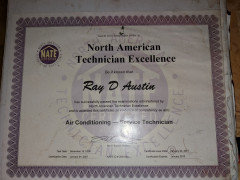
Well the folks at NATE have to keep getting paid to make up another test that by an large most don't take anyway because they know it's just a test scam / scheme to keep chasing that dollar.
I can take a test and pass it... oh big secret you've found here.
It changes nothing... How many changes has there been since 2012? Many, yet I'm still here.
How many of you went to high school? issued a diploma. How many of you gone back to take a test to prove that you're smart enough now, paid a fee to prove it?
How many of you went to college? issued a degree. How many of you gone back to take a test to prove that degree isn't phony, paid a fee to prove it?
No, no, no... NATE exists to take that degree away from you even after you passed the exam, got the stickers.
Seriously? This is what you want to talk about?
Why am I not surprised. - PRO9 months ago
Your certification expired (as of 2012) before you did, Ray. Most licenses and certifications require continuing education and renewals. If you're not a current member in good standing, displaying the NATE logo on your website is false and misleading advertising. I recommend you remove it before you get contacted by either NATE or the office of the Texas Attorney General-- either of which will end up with you filling out lots of paperwork including a big check.
- 9 months ago
I made a comment around this spot that had two "Likes". But it seems to have been tagged and is no longer visible. Grow up, people. Here's what I said:
---------------------------------------------------------------------
Ray, if you think the NATE certification is meaningless and of no value, why do you falsely display it (website AND truck?) implying that your certification is current?
- PRO9 months ago
"I am not an HVAC Technician... I am a Texas Licensed HVAC contractor." No worries. I'm optimistic you can work something out with the folks at NATE, Ray. NATE's C3 Contractor program requires only that you have 1/4 of your technicians NATE certified. Since you're a one-man show, you'd only need to commit to 3 months/year! The rest of the year you could be your uncertified, unprofessional self.
- PRO9 months ago
See told ya folks Charles Ross Homes is not going to enlighten anyone with proof he's a failed chemical engineer.
He probably lost that Nigerian Print Certificate a long time ago.
---------AI OverviewThere are approximately 400,000 to 420,000 HVAC (Heating, Ventilation, and Air Conditioning) technicians in the U.S., with figures varying slightly by source and year (e.g., around 415,800 in 2022 according to the BLS, and nearly 400,000 in May 2023). This workforce is experiencing growth and faces a significant shortage, with estimates suggesting over 100,000 positions could be unfilled soon due to retiring workers and a lack of new recruits, despite high demand. Key Figures & Trends:
- Total Number: Around 400,000 - 420,000.
- Growth: The field is growing by about 5-6% annually, indicating strong demand.
- Shortage: The industry is facing a major labor gap, with some predicting 200,000 unfilled roles by 2027.
- Demographics: The workforce is predominantly male (around 98%), with an average age near 40.
The NATE EXAM NUMBERS --- quoted from their own link
Today, there are over 34,000 NATE-certified HVACR technicians providing world class service and installations throughout North America and the numbers continue ...
FROM AIWhile exact, real-time numbers fluctuate, NATE (North American Technician Excellence) has certified tens of thousands of technicians, with numbers around 41,000-42,000 recently cited, making it the largest non-profit HVACR certification body in the U.S., signifying a broad base of trained professionals ensuring quality in installation and service. Key Figures & Context:
- Recent Count: Around 41,759 technicians are listed as NATE certified by NATE themselves, with similar figures (e.g., over 34,000 in 2025) appearing on other industry sites.
- Industry Standard: NATE certification is highly respected by manufacturers, utilities, and contractors as proof of competence.
--------
So if we were to use the AI numbers as those who have passed the test or care to even take the exam?
Likely less than 10% of the techs who work in the USA.
The other 90%, not to mention home owners and others?Hmm how eloquently can I put this?
Ray, if you think the NATE certification is meaningless and of no value, why do you falsely display it (website AND truck?) implying that your certification is current?
Me waiting for the day it will finally pay off to show I actually took the test more than once and draw attention to it like a rabid dog... far and above what the majority of HVAC techs in this country do. (less than 10% of HVAC techs in USA)
AND nearly 10 years after the fact I am still here doing it everyday.
To be on cue, none of this is *ROCKET SCIENCE* either.
I refer you to President Trumps "clue you in clip" a few posts back if you are struggling to make sense of it all, my condolences. - PRO8 months ago
"AND nearly 10 years after the fact I am still here doing it everyday." A lot has changed since your NATE certification expired 13 years ago, Ray. Maintaining a certification that requires continuing education and periodic recertification is a marketable point of difference. The problem is you can't market the difference if you don't have it. It's called false and misleading advertising.
- 8 months ago
"A lot has changed since your NATE certification expired 13 years ago"
I don't think so but curious what you think changed. The last I checked the basic principles of refrigeration have not changed in at least a 100 years, or the core concept of transferring thermal energy. I haven't seen any changes to the the physics of psychrometrics and enthalpy is still defined as H=U+PV. So what would Ray be missing out on?
As I see it as the gizmos and gadgets have change that control the basic principles, and with any new gizmo just reading the instructions should be sufficient. NATE has been losing steam the last several years based on yearly revenue figures, and to me it's like a boy scout earning the newest merit badge a eagle scout made up. The number of people who would even know what NATE is or means is in the single digits, and those who even care are less then a quarter of that.
I haven't been active in the profession for over 20 years but I can assure you I could walk up to the newest most advanced system made and fix it, no certification required, and won't take me 16 hours of continuing education to understand.
- PRO8 months ago
Good for you, Kevin. Maybe you should put a NATE decal on your truck. It would mean the same as Ray's.
- PRO8 months agolast modified: 8 months ago
Good for you, Kevin. Maybe you should put a NATE decal on your truck. It would mean the same as Ray's.
"AND nearly 10 years after the fact I am still here doing it everyday." A lot has changed since your NATE certification expired 13 years ago, Ray.
Yeah like Math became racist and people like you forgot how to do simple addition?
2025 - 2017 = roughly 9 years currenly as were going to be flipping the calendar in 2026.
How you get 13 Charles is beyond me. (maybe show your work so we can help you Charles?)
It's ok for you Charles to say you're a washed up chemical engineer without no proof at all. Heck you may not even be a builder for all we know, because what builder would sit in an HVAC forum board for?
So what does it mean for you Charles? little to nothing.
What has changed since the printer ink dried on your engineering bubble gum certificate? If you even have one? all we can do is question it? It's got to be eating at you Charles why wouldn't you want to show it? You must be embarrased?
- PRO8 months ago
Ray,
Your NATE certification expired in 2012. It's 2025. 2025-2012 = 13 years. Next month it will increment to 14 years since your certification expired. The copyright notice on your company website is circa 2014-2015. So, you featured the NATE logo on your site fully two years (2014-2012) after it expired.
It doesn't matter what you think about NATE certification nor what you think about me. The issue is that your individual NATE certification expired before you did. You can't feature it on your truck or website without it being false and misleading advertising. Leaving it on either speaks volumes.
- 8 months ago
" Leaving it on either speaks volumes. "
Nothing not already well known and demonstrated here again and again.
- PRO8 months agolast modified: 8 months ago
Ray,
You posted a picture above of the NATE decal on your truck and your NATE certification, which expired in 2012. I didn't choose which certificate to post; you did. In either case, your certification has long since expired, but you continue to feature the NATE logo on your truck and website. That's false advertising which is misleading to customers who might choose a company based on their professional certification(s.) Just wondering what other false and misleading claims there are on your truck and website. Inquiring minds want to know....
ETA: this post responded to a post by Austin Air Companie which has since been deleted. - 8 months agolast modified: 8 months ago
Maybe ray is just showcasing his accomplishment of what he once achieved by keeping a memory alive to commemorate a past life event, there is nothing wrong with that.
- PRO8 months ago
Professionals can't advertise-- whether implied or stated-- that they hold licenses and certifications which are no longer valid. Ray's NATE certifications expired a long time ago even if he didn't. Penalties for false advertising may include civil penalties and disciplinary actions by the state's licensing board for contractors.
- 8 months ago
I think you're on to something CR Homes.
Maybe he doesn't have a contractor's license either?
- PRO8 months ago
Homeowners are always well served to get a copy of a contractor's license and current insurance certificates to avoid "surprises." Where permits and inspections are required, homeowners should get copies of the permit placard and copies of all inspection reports.
- PRO8 months agolast modified: 8 months ago
Charles, the original post I posted in rebuttal was in reference to me taking the first test.
I don't see anything that has been deleted so I don't know what you're talking about. You often have trouble reading things so maybe check your medication levels Charles.
In 2012 I took (TWO) new tests from Nate and passed them both, because the original was expiring and I was contacted by Nate. In 2017, never contacted by them again.I have taken 3 tests, where 90% of techs in this country do not take the tests at all.
A Nate test is not required, it is merely extra curricular.
Today (2025) it's not nearly as important as it once was. < my opinion.
It was never my intention to mislead anyone, the logo / nate stuff is old news. I plan to delete it from the website to make you happy Charles.
To settle the argument the nate logo is going to be removed from the 1 website it is displayed on. I don't use it for anything anyway, to you maybe it's a big deal Charles, only truly because you don't know what is on that test as you've never taken it either along with over 90% of technicians in the field.
Nate would probably have higher numbers / retention if they changed course from the Let's make a test, so you can make another test. It's just about passing a test so you can take another test, that isn't required to do anything.
I've proven I can take it and pass it 3 times now. What more is there to prove?
The Nate lady contacted me and she said well the test is more for techs, rather than licensed contractors. Because normally it is a technician that goes on the call, and NOT a HVAC Licensed Contractor (TACLB28416E)
It's not as big of a deal as you think Charles.
There isn't a technician roulette wheel at Austin Air Companie, if you call me you get me and not a tech but a fully licensed Texas HVAC contractor with over 30 years experience who has taken and passed a multitude of tests.
I service the Katy, Texas area.
- PRO8 months ago
Maybe ray is just showcasing his accomplishment of what he once achieved by keeping a memory alive to commemorate a past life event, there is nothing wrong with that.
It wasn't anything like how the two knuckle heads of the morning are responding to it.
I even had it listed on the website as to when the certification expired, it's a Nate logo under an affiliate tab. It's not listed anywhere on my "Main Website" kinda tells you how important I've thought it was as the main website was reworked in 2019, so if I was trying to be mischievious I would have listed it there and I did not.
It's no big deal, I am in the process of getting the logo deleted so NATE can fall further down the totem pole of relevancy. Probably why the numbers are so low already if I had to fashion a guess. (less than 10% of HVAC techs in USA take the Nate exam) No one cares, as I have said before. (My opinion, you're free to have your own opinion just as much as I am free to have one as well... my opinion is more because I actually know what is on those tests.)
So let's move on and talk about more productive things. Like why a chemical engineer would become a builder and then spend his days in forum boards chasing a teeny tiny licensed HVAC contractor in Katy, Texas.
Make it make sense if you can. - PRO8 months ago
Ray,
Yesterday you posted photos of two additional NATE certifications with expirations in 2017. Once you bothered to check the original photo posted--which shows expiration in 2012-- I think you got embarrassed about your rant over simple math. The post of the additional certificates was promptly deleted and you know it.
If you're a one-person service provider, you're both the technician and contractor. The required competencies for each of those jobs are different. You'd be well served, as would any other HVAC contractor, to demonstrate technician competency verified by a third party such as NATE. It's a marketable point of difference, but you need a current certification to market it.
- PRO8 months ago
Yeah ok Charles I got embarrassed that I took the 3 different NATE tests and passed them all.
Because it's so embarrassing to take NATE exams (multiple) and pass them all When 90%+ don't take these exams at all.
Oh my I am so, so, so embarrassed Charles. A test that even you didn't take a single time?
Yeah I am so embarrassed Charles... the posts were not deleted.
first post 4 days ago...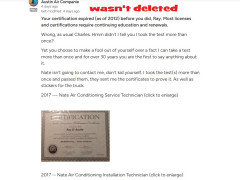
2nd post of the same certificates

Make it make sense IF YOU CAN. - PRO8 months ago
What the pros besides me (differing opinions of NATE)
It's good for you to know the information, but does little for you in the real world. - 8 months agolast modified: 8 months ago
Yesterday two posts were removed based on the comment count. One was Charles Ross homes and the other was mine in response to Charles now missing post. If you could have seen it Ray you would of snorted your coffee from you noise laughing so hard.
Here's half of it, the second part is what I believe got it axed.
"So are you thinking about lawyering up charlie? Maybe blowing a whistle? You got him now and he'll never be president, if your name isn't Tim, AKA - Snidely Whiplash."
- PRO8 months ago
No, Kevin, I didn't delete a comment yesterday. I deleted a "like" for one of my own comments. I had clicked on it to see who "liked" my comment and it registered as "liked" by mistake.
Ray, your certificate photos don't show in this thread except for the one which was posted with your truck decal and which expired in 2012.
If you don't believe the NATE certification adds value in your market, that's fine, but one has to wonder why you took the exam three times and still feature the NATE logo on your truck and website if that's the case.
- 19 hours ago
At 25 years old, sinking a lot of money into just repairing a control board is a gamble since other components like the heat exchanger or compressor could go next. Getting widely different AC sizes from different contractors usually means some are just guessing instead of doing a proper load calculation.











Elmer J Fudd