Software
Houzz Logo Print
darn_pottery

Dehumidifier and Heat Pump Integration

8 months ago
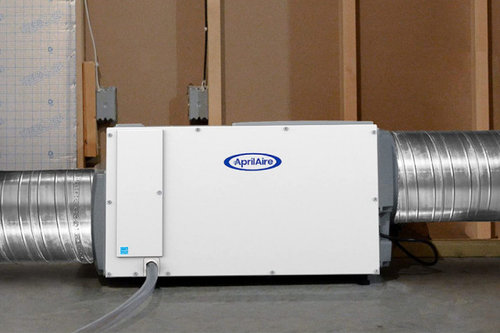
Very good morning friends

Here's my situation: New build home, 2 story 2700 sf house in Tennessee, zone 4

Per HVAC engineer's recommendation, we are installing an Aprilaire 70 pint dehumidifier in unconditioned attic with supply and returns into 2nd floor living space. This space is a loft area with direct draw from 1st floor via the large staircase. (This is all, of course, in addition to a properly sized heat pump system.) The dehu is NOT in line. The attic is vented, unconditioned....

Question 1: where would you put its humidistat? On the second floor where the supply and returns are? Or on the first floor, near the staircase, to sense the downstairs air?

Question 2: HVAC installer is planning on tying the dehu condensate line to the heat pump condensate with a switch that shuts off both units in case of a leak. Is that the right way to do this? Or do they each need a separate condensate drain line and separate switches?

Thank you, wise ones!


Comments (10)

  • PRO
    8 months ago

    Question 1: where would you put its humidistat? On the second floor where the supply and returns are? Or on the first floor, near the staircase, to sense the downstairs air?


    Question 2: HVAC installer is planning on tying the dehu condensate line to the heat pump condensate with a switch that shuts off both units in case of a leak. Is that the right way to do this? Or do they each need a separate condensate drain line and separate switches?


    First off any time I am going to recommend a dehumidifier I tell people that while a dehumidifier is the right approach to "control" humidity in the home this control is greatly dependant on sizing and how those controls are employed... also that using such a device will make your electrical bill go up depending largely on set points not to mention appropriate sizing. (For those reasons I am more likely to recommend an Inverter Heat Pump like the Bosch) while the Bosch Inverter won't control humidity like a dedicated dehumidifier will most of the time it's good enough and your electric bill goes down instead of up AND then you don't have yet another function of your HVAC system to replace / repair / maintain so often. (Bosch BOVA 2.0)


    This morning my office is 55% RH at 69F so a bit on the high side for humidity, but chilly running in heat mode currently. (usually during the summer my RH levels just running the Bosch only are almost always around 40-45% RH.


    Also warranties for these kinds of appliances is less than what some would think most of the time uusally 5 years. They rarely last much longer than 5 years... so you're never done paying for one of these.


    Question 1: Some units come with a set point control on the unit itself, although if it were me I would use a humidistat placed near the return (where your filters go) and near your thermostat that controls your HVAC system.


    Question 2: Heat pumps are only going to create condensate on the inside of the home during air conditioning mode, in heating mode all the condensation (usually in the form of ice if it's cold enough outside will form on the outdoor coil) otherwise it just drains off on the ground.


    Tying the humidifier drain to your heat pump's AC condensate drain / along with cut out protection in case the drain clogs would be appropriate in my opinion.


    Also the picture you show is wrong in my opinion, the unit should sit in a drain pan of some kind when being placed in an attic.


    I service the Katy, Texas area.

  • 8 months ago

    Thank you so much! I agree about the increased electric and that’s a concern. We’re running two, 2 ton Rheem inverter heat pumps so hopefully as you say they will do the majority of the work. The shoulder months here are mild but wet. So we hope to only have to use the dehus for two months a year. Thank you for the advice on my two questions. Very much appreciated

  • PRO
    8 months ago

    Aprilaire advertises the E70 unit for homes up to 2,200 SF. It may work fine in your 2,700 SF home, provided your engineer has run the calculations to ensure 70 pints/day of moisture removal will maintain the relative humidity in the desired range.

    To answer your question about controlling the unit, the humidistat should be installed on the 2nd floor level.


    Darn Pottery thanked Charles Ross Homes
  • 8 months ago

    I would question the need of a dehumidifier in a new constructed home with properly sized heat pumps. You would are better off investing the money spent on the dehumidifier on variable speed multi-stage. Here are some questions:

    1. What is the total conditioned space of the house?

    2. What model Rheem heat pumps are being installed?

    3. Did the HVAC engineer (is this a licensed Professional Engineer) do a heating and cooling load calculation?

    4. Does this house have a basement?

  • PRO
    8 months ago

    My home is also in IECC climate zone 4. I have dedicated dehumidifiers for each level which get exercised during shoulder seasons. Those are the times of the year when there is no call for air conditioning, but when dewpoints may be high.

  • 8 months ago

    Charles is the dehumidifier for the second of you house installed in the attic?

  • PRO
    8 months ago

    I have a Honeywell dehumidifier for the 1st floor which is installed in the (conditioned) crawl space and one for the 2nd floor which is installed in the (unconditioned) attic. The 2nd floor HVAC system is a two-stage compressor/variable speed air handler which does a pretty good job maintaining R.H. at or below 50% But it can't do that if there's no call for air conditioning. That's when it's nice to have a dehumidifier.

  • 8 months ago

    The reason I am asking is because the Aprilaire maximum intake air temperature is 104 °F. on some models. An unconditioned attic is likely to exceed the maximum operating temperature during the shoulder seasons. Perhaps if the air intake duct work is insulated the air temperature after the initial start up will be below the maximum temperature.

    My AC and thermostat has the cool to dehumidify feature. It works really well in my house.

  • PRO
    8 months ago

    The dehumidifier takes air from the 2nd floor level, dehumidifies it, and returns it back to the 2nd floor living space (continuous recycle when in operation.) The intake air temperature for the dehumidifier is nearly the same temperature of the air on the 2nd floor. That runs around 73F in summer. It would take a heat transfer miracle to get 73F air to 104F while being transported through a short length of insulated duct. Some dehumidifiers can be configured to introduce outside air for ventilation purposes. That would change the intake temperature and the dehumidification load.

  • PRO
    8 months ago

    Thank you so much! I agree about the increased electric and that’s a concern. We’re running two, 2 ton Rheem inverter heat pumps so hopefully as you say they will do the majority of the work.


    Luba, in the realm of "inverter driven" whatever it be either heat pump or air conditioning is greatly dependant on the algorithm of the drive.


    So with this in mind a manufacturer can say "inverter driven" even if the unit in question has more than 2 speeds to differeniate it from an older less efficient 2 speed unit. (this is typically referring to speeds of the compressor as all the other motors are variable speed already.


    Rheem makes a slew of different inverter driven heat pumps and their upper product lines (most efficient) specify operation of between 40 and 110% with no specification as to how that operation is achieved. (If they don't say it, then it's probably not true)


    Which was why when I stated the Bosch, I also included the model # BOVA 2.0 (because Bosch makes cheaper models that don't perform as well over cost / separation from the upper model. (you get what you pay for kind of stuff)


    So what I have found is good news bad news as it plays out with the Rheem brand. The highend model RP19AY is limited.

    In their words: Variable Speed Scroll Compressor & Inverter Drive:

    — Features variable speed operation from 40 to 100%

    capacity with the EcoNet ® Smart Thermostat

    — Offers overdrive capability up to 115% to maintain

    performance in extreme conditions

    — Provides precise temperature control, advanced humidity

    control and greater efficiency


    What all that doesn't say is how does it do it?, which is important as this could merely be a 5 staged "inverter driven" machine. Which isn't like bad, but no where near Bosch BOVA 2.0 with start up at around 20-25% and then 1% steps up and down. "Inverter driven is expensive in terms of components and the the drive is what determines how good it truly is"


    How much worse could it be with the Rheem if you have an even lower end model that is "Inverter driven"


    RP16AZ Inverter driven

    • Precise Comfort: Inverter driven, variable speed, twin rotary compressor technology features cooling operation between 45% and 70% of capacity (ramping up to 100% when required) to continuously meet your ever-changing heating and cooling needs. You’ll enjoy exact temperature and advanced humidity control that combine to exceed your optimal comfort expectations.

    The paragraph above is in the manufacturers words... what I know from years gone by is that Rheem, Ruud has mostly gone to inverter driven machines and the lower end of the model spectrum they offer is typically nothing more than a 3 speed machine.


    I suspect this RP16AZ is none other where the unit starts out at 45%, then switches to 70% and finally if the load is heavy enough ramps to 100% and that's it. Which essentially is "inverter 3 speed".


    In comparison to the Bosch? In a 2 ton? well the Bosch doesn't make a 2 ton, it's a 3 ton configured at install to run in 2 ton mode, from there upwards of 74 speeds, starting from about 20-25% at start up.


    In terms of dehumidification needs and the little "why can't my air conditioner" dehumidify? It's not that it can't it's just that due to how / how long it runs greatly influences how well or not so well it will dehumidify. (related to speeds of the compressor, less cooling (temp dropping) the more humidity gets removed. -- In air conditioning land, this isn't dehumidification control it is a by product of how the equipment runs. Because the faster the compressor runs in the case of an inverter driven machine, the less dehumidification will be performed as it will run into over cooling, rather than any real dehumidification.


    Today in my office I am sitting at 45% RH at 70F. So you can see the difference a few days make from where I was when I initially made my first post to this thread.


    There can be days where I run a bit elevated, this is normal when trying to achieve dehumidification from a "high end -- premium inverter driven AC / Heat pump" and it's just to tell you that just inverter driven terminology doesn't mean the same thing from one machine or even model of the machine in question.


    Carrier infinity is another famous example of 5 speed machine, inverter driven. Whether Carrier is still this way or not? I haven't looked in some time to see if they changed things up yet or not. (They came long before Bosch came to my market in 2019) Very few inverter models use 1% up and down stepping... which is the ultimate to live up to -- to have any real shot at better dehumidification without the added expense of a whole home dehumidifier.


    Hopefully this provides you with better understanding and so you'll realize any short comings your selected Model may have.