Software
Houzz Logo Print
webuser_622767647

Advice on open joist ceiling and plumbing chase.

last month
last modified: last month

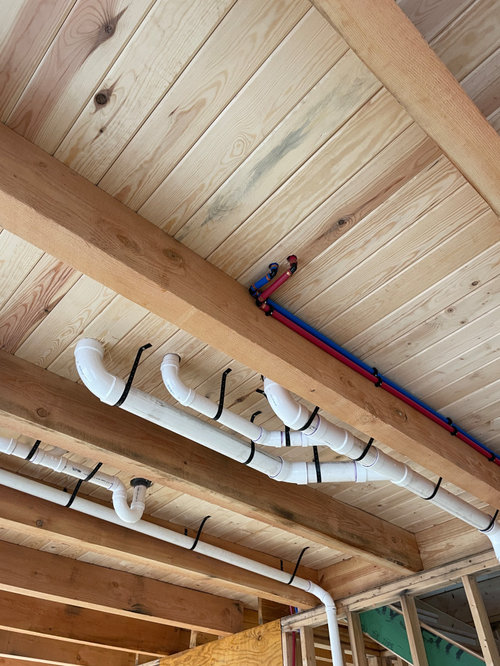
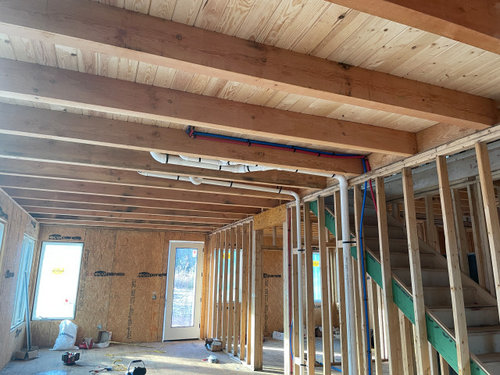
The house we're having built specifies an open joist ceiling and open floor plan for the southern half of the house. The architect planned for a chase between two sets of the douglas fir joists. The plumber misunderstood and put in water lines in the 2 adjoining runs (the one on this side in the photo and the one on the far side) outside of those two joists. Any suggestions how best to fix this? He can probably reroute the water pipes but now there are holes in the spruce ceiling.


Comments (33)

  • PRO
    last month

    Rely upon your architect's direction in solving the issue.

    denise thanked Mark Bischak, Architect
  • PRO
    last month

    I do not know all the facts, but it looks like the plumber misunderstood more than that.

  • PRO
    last month

    My advice is to not locate plumbing above spaces with an open joist ceiling, but I am a little late on that one.

  • last month

    Thanks. There were reasons we preferred the bathroom on the 2nd floor on this side of the house. Unfortunately, all the ramifications of that decision were not discussed. We thought the 2 "bay" chase would take care of the plumbing.

  • last month

    I also prefer that plumbing not be right over your main living areas. No one likes to be sitting to dinner and hear a toilet flush right over them!

  • last month

    Unfortunately, all the ramifications of that decision were not discussed.


    It was your architect's job to discuss the ramifications, and to create clear drawings and instructions for the builder. It is up to your architect and builder to fight it out and decide who pays for the remedy of replacing the ceiling planks of spruce with the holes in them. I would not accept any other remedy - no patching or building things to cover up the holes.

  • PRO
    last month

    Do you have any tan paint, like the color of spruce?

  • last month

    I agree with Kendrah - sometimes we get in the habit of jumping in and trying to fix things but in this case I would sit it out and let the architect hash it out with the builder

  • PRO
    last month

    See if you actually need all those pipes. You may be able to cut them all off at the floor and ceiling and get rid of them.


    (humor)

  • PRO
    last month

    architect, GC, plumber...

    very large drain lines with a toilet or shower directly above.

  • last month

    This is really unfortunate and looks terrible. When we were getting our plumbing lines put in everyone wanted to do dropped ceilings and all kinds of things that would have been easy for them and ugly for us. We ended up stopping the work on the house for several weeks until a solution was found. And that solution was rerouting it all so we had a beautiful ceiling without any drops or weird bump outs.

  • PRO
    last month

    THis is for sure an issue with the plumber and architect but of course was this written down somwhere so everyone knows what was suppossed to happen and signed off on I agree a poor placement for plumbing to bathrooms but if you insistd then the ramification should hav been discussed too

  • PRO
    last month

    I'm guessing a shower, two toilets and more. Post some floor plans.

  • last month

    Instructions for the chase were on the plans. I think Kendrah is correct. We need to sit back and see what solutions the builder comes up with. Thanks for all your comments.

  • PRO
    last month
    last modified: last month

    I think sound insulation may need to be included in the solution. See chispa's comment.

    denise thanked Mark Bischak, Architect
  • last month

    omg, people are so delicate. are you horrified when you can hear shower water too?


    anyway, the plan is to drywall in those two bays, or box with spruce? that part seems ok; sorry for the plumber et al . . .

    denise thanked acm
  • PRO
    last month

    If I understand correctly, the drain lines are not the issue--the PEX water lines are. I'd run copper water lines from the bathrooms above and run the lines through the joists to get them into the intended bays with the drains. Once they're in the proper joist bays, you can change them to PEX.

    In my experience, most noise in drain lines is in the vertical portions. Insulating those before drywall is a, well, sound investment.

  • PRO
    last month

    It appears those vertical drain lines are in the room and not in the wall. Maybe that is another discussion I missed.

  • PRO
    last month

    Who on earth designs several bathrooms directly above living space that you want to have a decorative ceiling like that? Who designs a decorative ceiling like that that isn't dropped and faux, so that you have room between the floors for the essentials??? This looks like some "home designer" off of Fivver. Or a software geek in a basement.

  • PRO
    last month
    last modified: last month

    I mis read the issue so parts of the ceiling are going to be covered and others not and your big issue is the water lines ,? Soryy IMO covering part and leaving parts open would be a much bigger issue for me alone with pipes outside the wall You have chases really oddly placed for the rest of the plumbing build a smaller one for the water lines and be done I do not think anyone will be checking the ceiling that close Poor planning for bathrooms was what caused this mess

  • PRO
    last month

    "omg, people are so delicate. are you horrified when you can hear shower water too?"

    That reminds me of the short lived water feature as part of the interior design of a urologist's office waiting room. They decided to get rid of the water feature instead of replacing all the seating fabric with something waterproof. Does the OP like vinyl seating?

  • PRO
    last month
    last modified: last month

    Edit.

  • PRO
    last month
    last modified: last month

    " I would not accept any other remedy - no patching or building things to cover up the holes."

    Kendrah:

    Take another gander at that ceiling please. There are hundreds of black knots that look identical to filled holes. Were I the repairperson, I'd sort through the scrap stack for just the right knots and dare you to find them.

  • last month

    So much money for that ceiling treatment and even boxing out 2 sections is, IMO, not good. It doesn't look like the ceiling overall is high enough to create a buffer zone and drop the ceiling to hide all the pipes and vents - but that should have been the answer.


    Move the lines - patch the holes with knots (smart, Joseph...)


    The other option is to ditch the ceiling treatment in the half of the room from the door "forward" in the pictures. but not sure if that would better define an open space housing two "rooms" or bifurcate a single room.

  • last month

    The plumber is going to move the water lines into the 2 chases with the drainlines. As someone mentioned, we can plug the holes left in a way that hopefully "disappears" with other knots. The bottom of those chases will be covered in spruce. The vertical drainpipes will be enclosed in bumpouts that we'll build into a bookcase. Good idea gleaned here to add some sound insulation. Thanks, all.

  • PRO
    last month

    ABS (black plastic) is loud & worthwhile considering cast iron risers.


    PVC (white plastic) is thicker and quieter. Haven't installed any cast iron since.

  • PRO
    last month
    last modified: last month

    Many years ago I worked for a cabinet company as a draftsman and designer. A remodeling contractor came to us to order cabinets for a remodeling project they were doing. The existing kitchen had ten feet high ceilings and the cabinets went up to seven feet with a Three foot soffit above them. The remodeling contractor designed a beautiful kitchen with cabinets going to the ceiling and a nice brass trimmed library ladder that traveled along a brass strip on the floor and a brass rail on the wall cabinets. The remodeling contractor determined the day the cabinets showed up on the site would be the day the demolition would begin. When they removed the soffit they discovered all of the plumbing for the level above filling the soffit.

    All the new cabinets above seven feet conceal pipes, open the cabinet doors and there are the pipes.

  • last month
    last modified: last month

    My parents also found drain pipes when they removed the kitchen soffit in their first house. The contractor had done exploratory holes, but just missed the pipes by a few inches! It took extra time and money, but they figured out a way to move the pipes into the walls to fit the upper cabinets that went to the ceiling.

  • PRO
    last month
    last modified: last month

    Is anyone else concerned that the plumber - looking at this ceiling and beams and framing - took it upon himself to run the plumbing as it is - out in the open and outside of the stud walls? And no one working in the house noticed this??

    I would put some critical eyeballs on what is happening everywhere!

  • PRO
    last month

    "Is anyone else concerned that . . . the plumbing as it is . . . outside of the stud walls?"

    What do we care? Its not our house.


    (a Friday comment)

  • last month
    last modified: last month

    "PVC (white plastic) is thicker and quieter."

    Now you tell me!

    At least, we wrapped the PVC in rock wool.

  • last month

    To the OP: For soundproofing take a look at Fat Mat. https://www.fatmat.com/

    we used this in an area of our house - I had DH put it on drain lines and the downstairs ceiling (before drywall) under a 2nd floor toilet and we have zero plumbing sound from that bathroom. Fat Mat is used for soundproofing in classic car restoration to deaden road noise.

    denise thanked Honu3421