Software
Houzz Logo Print
webuser_91566358680

Can this be fixed?

last month
last modified: last month

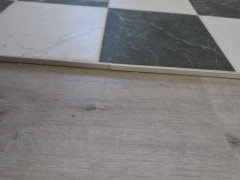
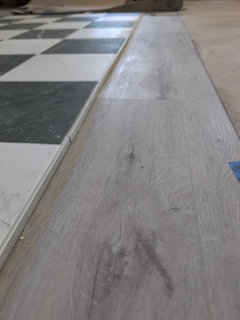
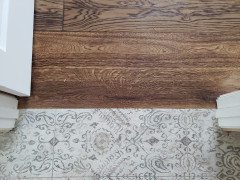
Shouldn't lvp and tile be flush and transition evenly in an open concept space? The lvp was laid first and then the tile was done in the kitchen. The tile is higher than the lvp on two sides. I need advice

Comments (22)

  • last month

    Post photos for best feedback.

  • last month

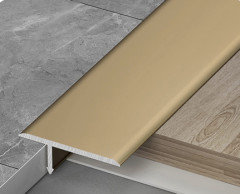
    If the two floors were not the exact same thickness, then yes, it will be uneven height where they join together requiring a transition strip to cover the joint.

    HU-91566358680 thanked bearbev
  • last month


    not m n

  • last month


  • PRO
    last month

    You need a transition strip that allowed for the 2 different thicknesses , not sure why tile at all since LVP is great in kitchens. But now you will need a fix with a proper transition or some one will trip and hurt themselves

  • last month

    I don't think the floor is done properly. My tile guy left it like this and they said it would be a seamless transition. I also think a transition strip will still create a trip hazard? I am wondering if this is a normal way to do flooring?

  • last month

    It would be a cost decision for most. A transition strip is to eliminate the trip hazard of what you have now. Yes the sub floor could have been built up--at a cost and perhaps the budget was exceeded. Also that would entail issues at other junctions no doubt. It's always a trade off.

  • last month
    last modified: last month

    I think this would be hard to live with in an open concept - it would be painful but if it were me I’d likely remove the tile and go with the same LVP in the kitchen and just have one type of flooring

  • last month

    What was discussed was a seamless transition and then I walked into this. I'm not sure what to do.

  • PRO
    last month

    What was discussed was a seamless transition and then I walked into this.


    If that's the case, and "seamless transition" was clearly defined ...


    I'm not sure what to do.


    Stand your ground. Look your contractor in the eye and ask how they will make the transition seamless.


  • PRO
    last month
    last modified: last month

    Perhaps a transition strip could work.


  • last month

    I feel as if a transition strip will ruin the design plan I had for this space. Plus it's still going to be slanted and a trip hazard

  • PRO
    last month
    last modified: last month

    The "design plan" for flush transitions had to originate WAY back when the home was designed by your architect. It involved knowing the exact finish materials being used for the floors. That means selecting those materials before the house was designed. Then the areas could have been designed with different subfloor heights, so that there would be a flush transition when using such different thickness materials.

    It's an unrealistic expectation to expect different thickness materials to meet and match way after the home design fact, at install time, and throwing that burden onto a flooring installer. It was you and your architect's job, wayback. On a budget project, especially, you are not getting flush transitions between different thicknesses and different expansion rates. If you had moved up a quality level and used engineered wood, you would have had much less height issues here. You would still have an expansion gap between wood and tile, filled with caulk. But plastic floors are going to always have issues with needing a threshold in order to hide the bigger expansion gap needed for them. Which you don't have, and which will result in buckling and tongue and groove breaking, starting this summer.

  • PRO
    last month

    "What was discussed was a seamless transition and then I walked into this.

    If that's the case, and "seamless transition" was clearly defined ...

    I'm not sure what to do.

    Stand your ground. Look your contractor in the eye and ask how they will make the transition seamless."


    Were I that contractor, I'd be asking for an email or contract, not someone's memory of a conversation.

  • last month

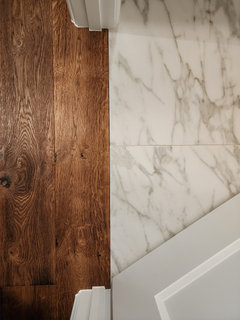
    My GC knew the thickness of the different tiles I was using and the thickness of the engineered wood floor I was using. All dimensions were given to the wood floor installer and the tile installer, expecting both materials to meet evenly with no difference in height and no transition strips.

    Everyone knew what the end result was supposed to look like and correct preparation was done to the cement slab so everything ended up at the same height.

    It can be done, but someone needs to be in charge of directing the orchestra!


  • last month

    Yes. I was told one thing and got another. I'm glad yours was well executed.

  • last month

    I would either remove the tile, and lay all lvp, or remove the lvp and put a thin sheet of plywood, so that when the lvp is laid back down, its all one level. Someone will trip and fall with a long transistion like that. Its your contractors job to make it right, and I sure wouldnt want a transistion piece right there.

  • last month

    I agree.

  • last month

    If a seamless layout was your discussion then the LVP floor area has to be raised so that it meets with the tile. Have a very strong discussion with your contractor to make sure this is what is going to be done.

  • PRO
    last month

    What is actually written into into contract? Because you are talking an upcharge here, if nothing is in writing.

  • PRO
    last month
    last modified: last month

    ^^

    As Monica, as Joe above. Where are the written documents? Those that explain to the builder the change in materials between the two rooms? Unless you possess those, with signature confirmation? Expect to pay.

    I'd rip the tile , add the lvp to the kitchen.

    Probably will be a WHOLE lot cheaper than the full dental implants when you stub a toe, go face down on a ceramic tile floor and knock your front teeth to smithereens.

    LVP is great with dogs, water splashes.

    The TILE is murder on your back, and total destruction of anything you drop. Or it's a crack in the ceramic tile.