

Trane or Daiken
My trane 15i is about 15 years old and I'm starting to think about a new model. At the time I purchased the trane it came with a 10-year parts and labor warranty and I did have some sort of major issue early on something about coils and they were made of two different kind of metals and it affected a lot of units and it was replaced under warranty and has been trouble-free since then.
Installer in my area continues to sell trane but also sells daiken which they claim has a better warranty and is cheaper and heat's better... Those some initial reading indicates the opposite on the latter...not sure. I'm also told trane no longer offers their 10-year parts and labor warranty. I sort of start to question why they would give that up if their product is still so great but I have no idea. Perhaps that was the installed warranty of the dealer and not trane at the time I have no idea.
I believe I have three ton unit. I'm just curious the thoughts now 15 years later and what I should perhaps be looking at and how this daiken compares. I'm also curious if there are any federal tax credits or rebates etc and how they work.
Comments (46)
 PRO6 months ago
My trane 15i is about 15 years old and I'm starting to think about a new model. At the time I purchased the trane it came with a 10-year parts and labor warranty and I did have some sort of major issue early on something about coils and they were made of two different kind of metals and it affected a lot of units and it was replaced under warranty and has been trouble-free since then.
So there's a number of things that have changed since 15 years ago. Now that we've entered 2026 even more as the previously used refrigerant (R410a) has been banned for use in new equipment. There are no restrictions at the national level for repairing an R410a system, provided of course you can get parts for it. (Some states have restrictions in place to ban the sale of this refrigerant soon whether that happens or not? hard to say) The refrigerant (R410a) is still in ample supply and usually marginally cheaper than the newer R32 A2L (mildly flammable) refrigerant that is being used "opposing" new equipment in 2026.
R454b is the other mildly flammable A2L refrigerant being used in upwards of 95% of the "opposition" Equipment. Trane is within that group. R454b is at least twice the cost of R410a currently / has had production issues to the point in which supplies were very hard to get if at all just last year's summer.
Daikin, Amana, Goodman are the three major brands that have selected R32. R32 has never encountered yet any supply related problems and likely will not because R32 is the common denominator among all 3 refrigerants (R410a (older), R454b -- these two are refrigerant mixes that contain R32) Where as R32 is single component.
How does or can this effect "Extended Warranties"(click to enlarge)
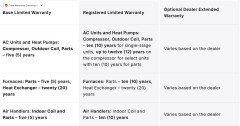
So as you can see here Optional Dealer Extended warranties exist, but will depend on the dealer. So it's on you to read any and all fine print. Why?
Because refrigerants are not covered by any warranty that I am aware of. AND at double the cost (possibly more under some unforeseen circumstance) it's not likely any one is going to be willing to "stick their neck out".
If you find a dealer that does stick his neck out -- a lot of unforeseen failures happen -- the dealer goes broke and then the warranty he offered is essentially not worth much. This doesn't mean you won't get any warranty at all, just that it won't be entirely free.
Exclusions also include DIY maintenance. Manufacturers appear to be getting more sticky on things of this nature. Maintenance contracts can be both good and bad, as it largely depends on "whom" is doing the maintenance / how / how well etc. There are provisions within Trane documentation that will void the manufacturer warranty if DIY maintenance has been performed. -- This is also primarily dependant on the dealer -- with extended warranties the dealer (your provider) is on the hook. So to be on the hook many of them will require periodic maintenance for any kind of extended warranty they may offer. (if they offer one at all)
Daikin, Goodman, Amana -- these all offer extended warranties as well but again the coverage as to what is covered is largely going to depend on the dealer (servicer who installed it) -- as again there are no restrictions to get warranty parts, but labor costs among others will depend on the servicer who offered the contract.
Typically these kinds of extended warranties are limited thru who sold the contract. So they are different than just the base warranty from the manufacturer.
If you care to know more about the A2L mildly flammable refrigerant conundrum I have a 5 part series or so on my You Tube channel that I started discussing these changes way back in 2021, ridiculed heavily here on this website and here we are in 2026.
I break it down for you like no other... if you choose to ignore it that is your right to do so. The opposing group will argue all sorts of non-sense claiming that R454b will last longer than R32 because it has less GWP. But you cannot make R454b without R32 AND R454b contains PFAS chemical component that has already been banned in Europe.
Truth be is that when the day comes for R32 banning, R454b will be included in that. 2036 is the time frame currently. HVAC is changing and it doesn't always change in good ways....
I service the Katy, Texas area. PRO6 months ago
"But you cannot make R454b without R32 AND R454b contains PFAS chemical component that has already been banned in Europe.""
While a ban on PFAS is being considered by the European Union, there is no such ban currently in place which affects chemical refrigerants for HVAC applications. The regulations under consideration will involve a gradual PFAS phase out. They include exemptions for use in stationary air conditioners and heat pumps which would be allowed for 5-12 years. That allows sufficient time for a transition to alternative refrigerants. Adoption in the U.S. will be slower so I don't think you need to defer replacement of your HVAC system if you need to.
Houzzers who are interested in European regulations should consult a more intelligent source than a 5-part cartoon. https://echa.europa.eu/hot-topics/perfluoroalkyl-chemicals-pfas
Related Professionals
Vidalia General Contractors · Natchitoches General Contractors · Mason City General Contractors · Kankakee General Contractors · Albany General Contractors · Elizabeth City Home Remodeling · Oklahoma City Home Remodeling · Fort Dodge Home Remodeling · Salem Home Remodeling · Paducah Bathroom Remodelers · Kissimmee Bathroom Remodelers · Somerset Bathroom Remodelers · Tyler Bathroom Remodelers · Everett Bathroom Remodelers · Anchorage Bathroom RemodelersAndre Laplume
Original Author6 months agoOh boy...and the average homeowner can make heads or tails out of this? Back to my original question. Trane or daiken and why?
 6 months agolast modified: 6 months ago
Daiken and Goodman heat pumps are the same except the Daiken warranty is longer and the Goodman is probably priced lower.
There are single-stage, dual-stage, and variable-speed heat pumps. Dual-stage heat pumps are more efficient than single-stage, and variable-speed are more expensive than dual-stage. However I believe that variable-speed heat pumps are significantly more expensive than either single- or dual-stage. I have a dual-stage package heat pump and really like that the unit generally operates in stage one which reduces the blower speed making operation significantly quieter (less "woosh" from the registers).
Trane XL15i Heat Pump: Specs, Issues, and Replacement (article)
Best Air Conditioner Brands (2026) (article)
Goodman GLZT7C Heat Pump*
*These are the same
Andre Laplume thanked wdccruise 6 months agolast modified: 6 months ago
" the average homeowner can make heads or tails out of this? "
You can ignore the verbose guy. None of what he ever says is enlightening. He has plenty of time to post overly long and repetitive comments because apparently he's never very busy. Surprise?
Find an HVAC contractor you can trust (word of mouth and other means) and move forward. The equipment is merely a tool, it functions to provide HVAC services. The installer is what matters, not the badge on the equpment. Go with what a trusted tradesman chooses to use to provide their service, that's all you need to know.
- PRO6 months ago
From the link Charles posted
The very first page explains what PFAS chemicals are. (There is no hiding it)Per- and polyfluoroalkyl substances (PFAS)
Per- and polyfluoroalkyl substances (PFAS) are a large class of thousands of synthetic chemicals that are used throughout society. However, they are increasingly detected as environmental pollutants and some are linked to negative effects on human health.
They all contain carbon-fluorine bonds, which are one of the strongest chemical bonds in organic chemistry. This means that they resist degradation when used and also in the environment. Most PFAS are also easily transported in the environment covering long distances away from the source of their release.
PFAS have been frequently observed to contaminate groundwater, surface water and soil. Cleaning up polluted sites is technically difficult and costly. If releases continue, they will continue to accumulate in the environment, drinking water and food.
So with that said...Is there really a need to dig deeper than that? If so watch my video and tell me that I am not "spot on".
OR If you honestly think that contaminating ground water is a good thing & the cost thereof is currently double that of R410a as well as R32? Do what ever you want. Ignore my warning... it's only MONEY.
Yeah I've been making it all up since 2021... and here we are.
Daikin or Trane? Daikin uses R32 / Trane uses R454b. (You can't mix and match) once you choose you've attached your wagon to whatever you chose.
Want to buy another new air conditioner?
The others don't do HVAC for a living. The builder has a swath of people he calls when HVAC is involved. The Mr. Fudd guy is a home owner in California that will probably be put on mute once 2030 gets here and he has very little if he even still lives there at that time.
If you think California or all the other states that blindly follow California's lead IS NOT going to ban R454b? Fine. Money can solve that problem. Rip it all out start over.
Want to buy another new air conditioner?
Warranties do not cover refrigerant nor do they cover uninformed decision making. The decision is more than just a brand name any more. The fan boy's of yesteryears are gone.
I don't make the rules... the people you vote for do. Well I didn't vote? um, you voted by not voting. Oh, why make this about politics?
Nothing gets done in this country without voting... Nationally, at state level and locally. - PRO6 months ago
Ray,
Your comments about the planned phase out of particular refrigerants in Europe were just as unhelpful to answering the OP's question as they have been to dozens of others here on houzz.com The OP doesn't need to get wrapped up in the evolution of refrigerants--which is a process that's been ongoing since the advent of mechanical refrigeration more than a century ago.
The world didn't end with the phase down of R410a despite your fearmongering. It won't end due to PFAS regulations, either. And AI information dumps don't substitute for subject matter expertise no matter their volume.
Before pedaling your "chemical expertise" in the future, please make it clear to houzzers that you've never taken a high school chemistry class, that your trade school closed its doors because the curriculum taught didn't meet the minimum standards for reimbursement of veterans under the GI bill, and that your uninformed opinions are not sought out by the industry in the refrigerant evaluation and regulatory process. Equipped with that information, houzzers can make an informed choice whether to source any information from one of your cartoon videos
- 6 months ago
My trane 15i is about 15 years old and I'm starting to think about a new model.
Where are you located? Are you more concerned about heating versus cooling?
If you have kept up with annual maintenance and have had no problems then I don't see a need to replace your HVAC system. Have your gotten any quotes on so far? The prices will be 2-3 times what you paid 15 years ago. You can do many repairs with the money you would pay for new equipment.
Installer in my area continues to sell trane but also sells daiken which they claim has a better warranty and is cheaper and heat's better...
If you are comparing Trane versus Daiken for price, then you have to compare models with similar features. The manufacturer parts warranty are typically 10 years and a longer warranty for the heat exchanger. Warranties may vary by model so review this carefully. I am not sure what "heat's better" means in this case. Does this mean single stage versus multi-stage equipment or something else.
I can't give an opinion on Trane vs. Daiken without knowing more details on which models you are considering. I would advise staying away for the entry level models of either brand. Models are constantly changing and new problems are created. The most important thing is to hire a competent installer who you trust.
Andre Laplume
Original Author6 months agoWdcruise..thanks.
I was looking at a 15i replacement...essentially what I have...I will get details on that and the 17i. He said the daiken they sold was also variable and did a better job of heating ...whatever that means. We were at a home show and they were a bit busy. I guess I should get more details.
Do I need one? Not sure it's been making a reving noise since we have had to sub zero temps here in eastern PA the last month or so. It seems to work. House yemp is at 68 and maintained and I can tell the temp coming out of the vents carries from say 74 to 84 to 99 degrees...I assume 99 is when backup up heat kicks in...which does not seem to be all the time. It's 15 years old...just worry about being left stranded at an inopportune time
At the very least I'd like to have picked out what I want for my next unit so when the time comes I am not fumbling around.
I'll
I'll- 6 months ago
"He said the daiken they sold was also variable and did a better job of heating"
Goodman (remember Daiken and Goodman are the same) also sells Variable (aka inverter) heat pumps but they cost more than two stage. For example, the uninstalled inverter Goodman GSZV903610 sells for $6183 while the two-stage GLZT7CA3610 is $4333. The inverter model is more efficient and has a better warranty but be sure to understand whether the inverter model would be compatible with your existing HVAC equipment or require upgrades.
- PRO6 months agolast modified: 6 months ago
The phase down and banning of refrigerants history channel... (this topic is widely covered in the "so called" cartoon video from 2021 and each year after as it was updated... it's a playlist that covers the whole topic.)
R22 - Freon, phased out / down and banned. -- The world did not end. Charles likes to think I am proclaiming the end of the world due to refrigerant phase outs.
Can I still get Virgin R22? Yes. End of the world? NO. Cost >up >up >up and away. Come on come on love me for the money. (if you're not using Virgin R22 and you need it to get your unit to work? End of the world, not for you! Your poor R22 Freon AC or Heatpump!
R410a - still called freon in various circles. Phased out / down / New equipment banned.
The world did not end in 2025. 2026 came the world still did not end. Did it Charles? BUT you can't get R410a equipment. (This complicates repairs, drives up cost and in certain cases may cause you to think the world is ending, but that is Charles logic. My logic > if you got the money (loaded equation) given the right person, the right plan -- that money can solve any problem. Can I still get R410a refrigerant, yes. Right now it's the cheapest refrigerant. Probably not for long once new phase down requirements take over expected in 2028-2029. Tick tock. The world is not going to end ok Charles... but the price (cost) is going up, maybe up up and possibly away? TBC
R32 -- still called Freon (people understand these peon level words) sure engineering has it's space too. This one however is mildly flammable which will require 1) all new equipment 2) possibly a new furnace if you have one 3) definately will require a new air handler. Cost? only marginally more than R410a right now. (negligable in end of the world parameters for Charles to understand. If your wallet is flat, the end of the world is probably the better bet LOL) Charles loves a straw man argument. He'll present all these claims the world is not ending only to suggest? But if you live in the left, they have been proclaiming the end of the world by 2030 if we don't do xyz and abc. I live in the right, in Texas. Katy, Texas that is. Approximately 3 clicks west of the gates of hell. (Yeah I know what it's like to live in the left too.) Outside it's nothing but a sea of RED.
R454b -- guess what this one is called? PFAS Freon. The whole reason for these phase outs/ and bans is for what? What is the reason they have been phasing these other two? Think long and hard on that one?
R22 reason: It's burning holes in the Ozone layer in the sky.
R410a: It's a miracle the ozone layer is healing, but now we see this thing is making too much GWP over 2000. (Glowbal Warming Potential) potential is we don't know exactly. This is science ok.
R32: GWP 475 (better but not great) yeah it will be banned too. 2036 is an estimated guess. No, it's been proclaimed in a little document called the Kigali Amendment to the Montreal Protocol >> where a group of nations agreed on a variety of things. Guess what EUROPE is apart of the group of so called nations. Wow, imagine this level of cartoon animation!
Another shocker! Europe has been using what for the past decade? None other than R32. No guinea pig show here. (get my name out your mouth! ~ the guinea pig)
Logical conclusion, what Europe tend to choose... the USA largely will fall in line at some point? The HVAC manufacturers of the world are USA only manufacturers. Um, NO.
R454b: GWP 466 (better than both R32 and R410a but?) Due to PFAS chemicals it pollutes the water supply. Take a look at Charles post claiming the world is not going to end and this pollution has not yet been banned until it reaches a crisis level and let's take the blue pill and pretend every thing is A-OK?
Cost for R454b? Currently / roughly double what R32 costs and you get 5lbs less too. Under some recent scenarios you'd be lucky to find it at all at any price. (summer 2025)
Well there's no logical argument to compete with what a home builder says. Because everyone knows home builders never get anything wrong, give you extended warranties that will cover all mechanicals for more than 10 years, perform maintenance repairs and whatever you need.
Yeah let's see if Charles cares to tell us how long he guarantees your HVAC system for a house he builds for you. (Sounds like an end of the world assurance for you Charles) Step up, don't be shy... tell us.
The world isn't ending. But if you're broke? It's probably going to feel like it.
Money can solve this problem... if you make a mistake? more money.
Easy Peasy. Well as long as you don't run out of m-m-money.
------It's 5:08 AM -- no one has my work ethic. Mr. Fudd ~ shutters.
- PRO6 months agolast modified: 6 months ago
Ray,
This thread wasn't about refrigerants until you inserted that in the discussion. The OP simply wants advice about one brand vs. another with regard to replacing their existing 15-year old system. They can replace their system knowing that refrigerants are constantly evolving and that it will need to be replaced in the future or they can live without HVAC until that evolution stops. That is likely to be a long, long time.
If houzzers have questions about chemical refrigerants, there are better sources to consult than an HVAC repair man's not-ready-for-prime-time videos (to be fair, they do have some entertainment value.). If houzzers have questions about the regulatory process affecting refrigerants, they should direct them to groups or individuals actually involved in the regulatory process. Again, that's not you, Ray.
- PRO6 months agolast modified: 6 months ago
Ray,
This thread wasn't about refrigerants until you inserted that in the discussion. The OP simply wants advice about one brand vs. another with regard to replacing their existing 15-year old system.
Charles, It's not important to know which choice uses which refrigerant when considering a new HVAC system?
Did you miss this Charles?
Yeah let's see if Charles cares to tell us how long he guarantees your HVAC system for a house he builds for you. (Sounds like an end of the world assurance for you Charles) Step up, don't be shy... tell us.
No, no, no... it's only about what Ray does. Let's not consider the ramification of your choices beyond 1 to 2 years. Isn't that right Charles?
You won't get any answers to those kinds of questions from Charles. He doesn't have any. Let's not discuss the chemical fluid that is critical to making your system work.
-----
4:35 AM
----------Differing Opinions are "HEATING" Up!
Watch this take for end of the world... no not quite. Not even close....4:45 AM....
- PRO6 months ago
Ray,
The OP wants a recommendation of one HVAC brand over another for their replacement system. Unless I missed something, you haven't offered one. Instead, you're hijacking this thread to spread more of your refrigerant fear mongering.
While Daiken and Trane have chosen different refrigerants for their next generation refrigerants, past history suggests that any phase out or phase down of either in the U.S. would be gradual enough to cover the life expectancy of a system purchased in 2026. Houzzers will do well to keep in mind that the folks who design HVAC equipment and the folks who regulate chemical refrigerants have HVAC systems in their own homes. I'm guessing they're not planning to go without them in the future.
- 6 months ago
Back to my original question. Trane or daiken and why?
As usual this thread has gone off the rails. I am reposting the original question for those who care to answer it.
- PRO6 months ago
Back to my original question. Trane or daiken and why?
As usual this thread has gone off the rails. I am reposting the original question for those who care to answer it.
Back to my original answer...
Trane = R454b Daikin = R32
R454b has PFAS chemicals and costs double of R32.
R32 is easier to make and always will be. It's single component, with no PFAS.
R454b is made up of 69% of R32 and 31% R1234yf = PFAS chemical / patented / costly to make.
----------The refrigerant is responsible for making the equipment work. Just because you don't like the answer provided, does not make it go away.
If you get this wrong? It will be like setting money on fire.
------5:11 AM
- 6 months ago
If I were in the market for a new heat pump the cost of the refrigerant would be at the top of my criteria selection list.
- PRO6 months ago
"R454b has PFAS chemicals and costs double of R32. " It's not logical that a major HVAC equipment manufacturer would design around a refrigerant that is twice the cost of alternatives--at least if the cost of refrigerant is indeed a consideration for potential customers. Based on a quick internet query, it seems you can purchase a single 20 lb. cylinder of R454b for just under $200 https://thermaline.shop/product/r-454b-20-lb-refrigerant-tank-hvac-cooling-service-use/?attribute_quantity=1+Cylinder&utm_source=Google%20Shopping&utm_campaign=thermaline&utm_medium=cpc&utm_term=adtribes&gad_source=1&gad_campaignid=23546620015&gbraid=0AAAABCZKwd79NZTs-6PTnCLSrTceMJy9K&gclid=CjwKCAiAtLvMBhB_EiwA1u6_Pi8eNYeCja3RnJJ3BvF36CN2yUgFj1gz729oxVJ7CCgn4ZOCkt3FMhoC3wkQAvD_BwE , while the same 20 lb. cylinder of R32 costs around $230 https://coolmategas.com/products/r-32-refrigerant-20-lb-coolmategas-refrigerant?currency=USD&variant=48481179795751&utm_source=google&utm_medium=cpc&utm_campaign=Google%20Shopping&stkn=543868327d14&gad_source=1&gad_campaignid=23552195166&gbraid=0AAAAAqEUJnqZj4MJ6NZUnfzPPfrEl-7t-&gclid=CjwKCAiAtLvMBhB_EiwA1u6_PgE1hiAjGnoWVV1DGRpGiJSPSly73XY_Mi0I4afHLn3vOdc-qMicNxoCWdsQAvD_BwE
- PRO6 months agolast modified: 6 months ago
Charles this is nothing new, there are often times flash sales and such when demand is at it's weakest (before summer). -- It's February right now... we're just getting started.
I've seen prices as low as $80 per 20 lb cylinder for R454b. (wow that's cheap) but to get that price you have to buy 40 of them... $3200.00 then have a place to store them. Then you spent all that money.... is fine if you have a plan to move it. Otherwise you're sitting on a smallish fortune in PFAS chemicals.
Right now... R454b equipment is probably at best less than 1% of HVAC. Maybe it cracks 3% in the next couple of years? That's a long time to sit on a refrigerant stash... not for a bigger HVAC company they might go thru a pallet or more in a few weeks to a month. But they also have higher over head costs on top of everything else. mmm---Money!
So $200 per single isn't bad either, comparable to R32, except 5lbs less per jug and just as much even R410a. But prices this low often times disappear really quick and many times just after a sale like this prices go up higher than they were before. Pre summer sales. Nothing new.
You can also still see many places selling this for well over $200... some up near $500 some marginally higher than that.... so where do you think (the real price is?) no one knows. It's like the price at the gas pump... no two places sometimes have the same price.
I know because? I buy refrigerants all the time.
If you're "banking" on these low R454b prices to remain for longer than a few weeks, a month? GOOD LUCK. ~ that is not the nature of the HVAC business since about 2021 or so.
- PRO6 months ago
Keeping a couple of thousand dollars worth of parts and refrigerant in inventory shouldn't be a problem for a professional HVAC company, but it may be for a one-man show. As with most things, there are economies of scale. Caveat emptor.
- 6 months ago
R454b has PFAS chemicals and costs double of R32
So in 2026 if a 20lb cyclineder of R32 costs about $200 and 20lb cyclinder of R454b costs $400 then based on this extra cost you are telling your customers to choose equipment using R32 regrigerant?
- PRO6 months ago
"Right now... R454b equipment is probably at best less than 1% of HVAC. Maybe it cracks 3% in the next couple of years? That's a long time to sit on a refrigerant stash..." I think your forecast is off, Ray. Maybe you'll need to take your shoes and socks off for this calculation. Trane, Carrier, and Lennox--which, collectively, have 50% or more share of the residential HVAC market--have all picked R454b as their refrigerant of choice (it's noted that Lennox has chosen R32 for their ductless mini splits.) We won't need to wait a couple of years for R454b equipment to hit 3%. They should exceed that this year.
- PRO6 months agolast modified: 6 months ago
Yeah sure my forecast is off. Sure thing.
They all have picked R454b... and 50% market share... ok. But it's going to take time for the make-up of "new HVAC systems" what is seen out there on a day to day basis.
Now if someone is building a new sub-division the primary blend within that subdivision? how many homes in a sub-division? how long does it take Charles to build out an entire subdivision? Let's say 1,000 homes. From very start --- getting permits, laying the streets, running the pipes (sewer, water (gas if any), electric.)
Once the streets are established and put in -- yeah that takes time doesn't it Charles?
Then the plot lines are drawn, how long does it take? Someone pours a foundation, that's gonna take some time. It's not done in 15 minutes. It's not done in an hour is it Charles?
So maybe if everything falls into place like dominoes... that 1,000 home might fully come on line in 1 year?
Forget about asking Charles a question he will never, ever answer! Let's Ask AI!
A 1,000-home subdivision typically takes between 5 and 10+ years to be fully developed, engineered, platted, and built out, depending on market demand, location, and the builder's capacity. While individual homes may take only 6–8 months to build, a project of this magnitude is almost always completed in phases rather than all at once. Here is a breakdown of the timeline:Key Timeline Drivers
- Phasing: Developers rarely build 1,000 homes simultaneously. They break the project into phases (e.g., 100-200 homes per phase) to manage infrastructure costs and match sales speed.
- Infrastructure (Subdivision Prep): Before home construction begins, the land must be graded, sewer/water/storm systems installed, and roads paved. This alone can take 8 months to a year, or even longer depending on environmental studies.
- Sales Rate: If demand is high, the development can move faster. If demand is low or a recession occurs, a project of this size can stall for years.
The 1,000-Home Development Cycle
- Planning, Permitting, & Zoning (1-3+ Years): Obtaining approvals from local governments for a 1,000-unit development is time-intensive.
- Infrastructure Development (1-2 Years): Preparing the land, roads, and utilities.
- Construction Build-Out (3-7+ Years): Assuming a large national builder, they might complete 100–200+ homes a year, meaning at least 5 years of construction.
Factors Affecting Completion Time
- Builder Type: Large national builders have more capacity to build faster, whereas smaller builders may stretch the project over a decade.
- Government Delays: The speed of municipal approvals for plats and building permits is a major factor, often causing significant delays.
- Terrain/Site Conditions: Environmental challenges, such as steep terrain or wetlands, can add years to the development phase.
For a 1,000-home subdivision, it is rarely "all homes completed" at once, but rather a community that grows in phases over several years.
---------------Yeah My Forecast is OFF they said ------ LOL ----- LOL -----
Not likely. Why >>> Take a look at the real estate picture, home prices are higher than ever, interest rates are still elevated.
To start getting service calls from a newer neighborhood? how long does that typically take when the new stuff starts to break? What is the average breakdown rule for HVAC equipment?
Well my forecast is off? The kettle calling itself black.
Well in our area... The first 3 rules of real estate 1. Location 2. Location 3. Location.
Most of my work isn't coming from new neighborhoods. The first two years at least I will probably tell them to call you Charles.
A couple thousand in refrigerant shouldn't be too much... yeah if you need it. What would I need a couple thousand worth of PFAS chemicals for? For equipment that I don't sell or install? I work on and repair it, but that is entirely a different conversation to be had.
Mike Home --- R32 comes in 25 lb jugs. So does R410a.
It's R454b that has inflated 5 lbs away due to shrink flation.
They said the same thing about R22 Freon about stocking that stuff to the moon. But you have to have a plan to sell it, otherwise you're sitting on a pile of stuff you never sell. Do I have R22 Freon... yes. It costs mega bucks -- for 1 single jug.
Well that shouldn't be too much for a broke flat wallet person. If you're spending money on something that could just evaporate into thin air? You're probably going to try to find a cheaper liquid to heat or cool yourself with... but, but, but.
Yeah even to this day I still sell R22 Freon. But only for equipment that requires it, which aren't very many but I have a number of customers with this type of HVAC equipment.
Don't worry though, my forecast is off. Don't worry I adjust as the winds dictate. Again this is nothing new. For over 30 years I've navigated it. Easy Peasy Peppermint Squeazy.
But not for the "We don't actually do HVAC fan club of the morning".
How dare you! yes, of course.
- PRO6 months ago
Ray,
The folks at Trane, Carrier, and Lennox didn't achieve their collective 50% U.S. market share by making bad business decisions or bad equipment. It's not logical that they would, after considering a variety of alternatives, hitch their corporate wagons to a bad refrigerant. Consumers shouldn't be afraid of R454b. Houzzers shouldn't tolerate your fear mongering. The math is straightforward.
If the average residential HVAC system's life expectancy is 15 years, then around 1/15 of the installed base would get replaced annually. That's 1/15 or 6.7% of existing systems. Assuming zero demand from new construction, no growth in demand from folks switching from furnaces to heat pumps, and that the market leaders maintain their collective 50% market share, that works out to be 50% x 6.7% or 3.4% each year. It won't take long for new systems with R454b to "crack" 3%, Ray. It's more likley they do that in year one.
Andre Laplume
Original Author6 months agoForgive me but this is a bit crazy. Which brand refrigerant are you recommending? Is the fear R32 being the cheapest is going to be phased out but then there's another one that's in the trane unit which is partially comprised of R32 but then there's some other one that's not heavily used right now and most expensive?
I kind of feel like I can't be worrying about this because things change every 15 years or so anyway but maybe I am crazy.
I want to line up a new unit in case mine goes. I want to have that in my back pocket ready to go when mine fails so I'm not fumbling around without heat or air conditioning while trying to make a decision.Be it carrier trane or dakin or something else and I'm really just looking for brand recommendations... I said I don't know if trane is still the leader of the pack as it was 15 years ago and I keep hearing things about daiken now...
Now my brother got a rheem.. It was dirt cheap a few years back maybe 7K for a three-tonunit installed. That's probably going up since this was right at the tail end of covid. It's not as efficient as my unit I think a 14 seer. But he is nuts and keeps his house set on 66 all winter so the sucker probably isn't working as hard as mine would be. He expects to get 10 to 12 years out of it but maybe more since he doesn't use it as hard as say I do. Of course it's less efficient so he's paying more each month too. We will see if his little experiment works out and I suspect he may have more frequent repairs than I have had. That is stress and nuisance is what I'm looking to avoid. If I'm going to be spending over 10K and it sounds like it likely could be 14k especially since the government has removed incentives I want something that I don't have to worry about for at least 10 years.... something with proven technology and well made.I used to think that was what a trane was. Is it still I don't know?- 6 months ago
Mike Home --- R32 comes in 25 lb jugs. So does R410a.
It's R454b that has inflated 5 lbs away due to shrink flation.
When I do a Google search I am only seeing 20 lb jugs of R32. Your distributor may carry 25 gallon R32 jugs. I will defer to you since you buy refrigerants all the time.
I will restate my question with the correction:So in 2026 if a 25lb cyclineder of R32 costs about $200 and 20lb cyclinder of R454b costs $400 then based on this extra cost you are telling your customers to choose equipment using R32 regrigerant?
- 6 months ago
Andre Laplume, there's no reasonable need to be concerned about refrigerants. How long are you willing to wait on choosing a replacement system (or a system for a new-build home), for the brands you are considering or the industry as a whole to settle on refrigerants that make Austin Air happy? There have always been a variety of refrigerants used in home and commercial and automobile air conditioners, home refrigerators and freezers, commercial refrigeration (coolers and freezers in grocery stores), etc. Did you have concerns and investigate the details on that in the past when you bought a refrigerator, new car, your current A/C system, or a house that already had A/C in place?
- PRO6 months agolast modified: 6 months ago
I will restate my question with the correction:
So in 2026 if a 25lb cyclineder of R32 costs about $200 and 20lb cyclinder of R454b costs $400 then based on this extra cost you are telling your customers to choose equipment using R32 regrigerant?
Cost plus PFAS chemicals. I don't want polluted water do you? The whole reason "they" phased out R410a was over climate concerns. (GWP)-- there is no other reason.
So now there will be a new climate concern when this so called "new stuff" gets banned.
What's even harder to believe is that you and others --- don't show any real concern for the climate at all. Just being blindly led to???
If you don't think it will get banned? I recommend you look at some of California policies and then the slew of states that just follow their lead. I've said it before so it also won't surprise me if you just skim over this as usual.
Never waste a crisis, this one is of our own making. (It's Feb 2026 in case someone finds this post in the future and wonders when, what, why and how it all went wrong.)
BTW, it's not about making me happy. It's about informing people to make better choices rather than just being blindly led to??? _________________.
----------------------------------Forgive me but this is a bit crazy. Which brand refrigerant are you recommending? Is the fear R32 being the cheapest is going to be phased out but then there's another one that's in the trane unit which is partially comprised of R32 but then there's some other one that's not heavily used right now and most expensive?
I kind of feel like I can't be worrying about this because things change every 15 years or so anyway but maybe I am crazy.
I am recommending R32 -- it's cheaper, more efficient, single component refrigerant and more importantly does not contain PFAS chemicals.
IF a catastrophe happens -- a crisis that is found to be endangering wild life, human life etc. and those properties are leading bad to PFAS substances. Do you honestly think they won't outright ban it? If you want to gamble go ahead.
While R32 will be banned at some point... it's life is longer than R454b. It's far easier to disrupt the production chain of R454b because it is a two component refrigerant, there is also refrigerant glide problems to be aware of as well, but this problem is mostly mitigated to some degree because it's an A2L that has the requirement of mitigation controls.
Refrigerant Glide occurs when the "so called" blended refrigerants bleed off (due to micro leaks) at different rates changing the refrigerant mixture to the point in which the "glide" will make the unit perform poor. The hotter or colder it gets outside (in the case of a heat pump) the worse the performance will be with a unit effected by glide problems. The cure for which is to remove all the costly refrigerant and recharge it with more than likely expensive virgin refrigerant if it hasn't been banned yet.
---- there is about a 2.7F degree glide for R454b ----- 0F glide for R32.
Complaints when it's hot? the unit runs all the time and never reaches set point.
Complaints when it's cold and a heat pump? the unit runs all the time never reaches set point (without emergency heat) or the unit runs fine but my electric bills are high while in heating mode.
Given that this situation is largely due to bleed off rates, it will likely be detected by A2L mitigation control. The controversy may come if your provider isn't aware of refrigerant glide or to get the job they quote it cheaper and just reuse the refrigerant mixture in your system. - PRO6 months ago
Ray,
The folks at Trane, Carrier, and Lennox didn't achieve their collective 50% U.S. market share by making bad business decisions or bad equipment.
One day hasn't passed yet since the "builder" said the above. Keep this in mind folks.
Bad equipment?Aged faster than fine wine, ironically.
- PRO6 months ago
The choice of R454b by major U.S. manufacturers was made by balancing a variety of considerations: system performance, safety, and environmental impacts among them. R454b might be around for a long time or it may be another refrigerant subject to phase out like R22 or phase down like R410a. Fortunately, we have the benefit of past history when trying to infer a timeline for any potential phase out/phase down of R454b. Phase out of R22 occured over a roughly 40 year period; R410a phase down spans around 20 years. Given a 15 year +/- life expectancy for residential HVAC systems, I wouldn't be concerned about purchasing a system utilizing R454b today. In fact, I'd choose it over R32 for its lower compressor operating pressure (and attendant improved longevity) and its broader operating temperature range (it performs well in cold climate heat pumps.)
- 6 months ago
Austin Air Companie said:
I am recommending R32 -- it's cheaper, more efficient, single component refrigerant and more importantly does not contain PFAS chemicals.
This is going to limit the choices of residential HVAC equipment to Daiken (Goodman and Amana) and most mini split type equipment.
- PRO6 months ago
This is going to limit the choices
Spend less money OR spend more money and pollute water systems.
Then by 2036 maybe you get the opportunity to rip it all out and maybe just maybe be presented with a far better choice with R290. While there are complications in that, it's a far greater choice for the sake of not having to do the tango with refrigerant phaseouts and bans any more.
Because? R290 is a natural refrigerant known as propane.
So the other choice among the limit to choices?
Fix and repair the system you got. R410a is still available. R22 Freon is also still available. The cost to do so with R22 Freon isn't cheap, but neither is replacement to something else.
If you want to believe the next refrigerant phase out is long way off like 15, 20 years. Just realize the agreement known as the Kigali Amendment to the Montreal Protocol doesn't lay it out like that.
The warranty terms of the new equipment? doesn't lay it out like that.
We saw first hand how crazy prices can get with R454b just last summer. Putting yourself in that position is a choice, not a good one though.
I service the Katy, Texas area. - PRO6 months ago
"We saw first hand how crazy prices can get with R454b just last summer. Putting yourself in that position is a choice, not a good one though." It's not unusual to have issues during an industry-wide changeover period. My understanding is that the supply issues with R454b last year were due to supply chain issues in the manufacture of the special small capacity storage cylinders for R454b and hoarding. My HVAC trade partner didn't have any issues getting refrigerant, but they buy them in larger quantities than a one-man company. I understand the cylinder supply issue has been remedied so availability shouldn't force a choice of one manufacturer over another in 2026.
- 6 months ago
If your Trane lasted 15 years that’s honestly a good run. Both Trane and Daikin make decent systems, so I’d worry more about the installer than the brand. Make sure they do a proper load calc and don’t just swap in the same size by default. Most 10 year warranties now are parts only and labor depends on the contractor so definitely read the fine print. As for tax credits, high efficiency heat pumps can qualify, but it depends on the model and ratingsso ask for the AHRI number and check Energy Star. A good install will matter more than the logo on the unit.
- 6 months ago
The federal tax credit for heat pumps and other HVAC expired on December 31, 2025. There may be credits available at the state level.
Andre Laplume
Original Author6 months agoYes. This with the thousands of dollars gone I guess I could wait and see if prices come down because with high rebates no doubt extra profit was being made I mean they're in business I can't blame them butI don't know how people can afford this. I think the result of lowering the rebates is just going to encourage people to buy less efficient cheaper units which really doesn't help the problem any.
- 6 months ago
Car manufacturers lowered prices when the $7500 federal tax credit for electric vehicles ended. The HVAC equipment manufacturers may also choose to lower prices or offer their own incentives and rebates. New equipment prices and the cost of labor has made new installations very expensive. The HVAC industry talking point of buying more efficient will quickly pay for itself if over in my opinion.
- 6 months ago
" I’d worry more about the installer than the brand. Make sure they do a proper load calc and don’t just swap in the same size by default. "
Good advice. This can be a special problem if the OP is in Katy, TX, where load calculations aren't relevant and rarely done.
- PRO6 months ago
For over 30 years in Katy, Tx. ~ yeah that's a special kind of problem.
If you don't like what I say now, you surely won't like what I say if our paths cross.
Load calcs won't solve all your misery. If you want one, willing to pay for it. I can do it, but it will require a load of the whole house. So if you have 2 or 3 HVAC systems, the cost can get quite sticky.
Time to take a few long time ago ATTA BOY's I got off the fridge from a few customers.
These are all specials kinds of problems. (What Mr. Fudd knows, isn't much.)
(click to enlarge)
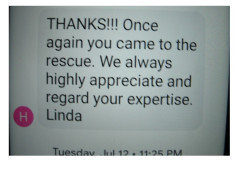
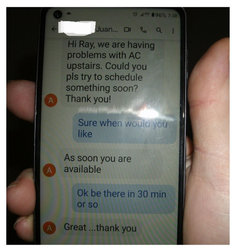
Many try.... few come even close to what I do.
Those outside the loop will never understand or even come close to it.
This isn't to suggest what I do is perfect. You'd have a hard time if you were looking for perfection in this industry. Good luck, if it's not me doing it. - PRO6 months ago
"... but it will require a load of the whole house. So if you have 2 or 3 HVAC systems, the cost can get quite sticky."
I suspect it's been a while since you performed a cooling load calculation, Ray. It is not necessary to do a whole-house cooling load calculation if you're replacing only a single system in a home which has multiple systems. You only need to do the calcs for the rooms served by the particular system.
Load calculations following the methodology in ACCA manual J and equipment sizing using manual S are just as appropriate prior to replacing a HVAC system as they are for new construction. It's a minimal amount of work to ensure the replacement system will perform as intended--especially if the one it replaces was over or under-sized-- as is often the case. Many states have adopted requirements including load calculations and system performance (e.g., duct blaster) testing prior to replacing HVAC equipment. Some Texas municipalities, such as Houston, require calculations for replacement systems. Of course, if you avoid areas which require permits and inspections, who'll know?
- PRO6 months agolast modified: 6 months ago
It is not necessary to do a whole-house cooling load calculation if you're replacing only a single system in a home which has multiple systems.
How are you going to know then that the whole load is calculated as proper?
If you need to do 1, why would you then not do the other?
If 1 of the systems was improperly sized? What is the likelihood the other(s) is not properly sized either?
The argument is always lopsided from the "we don't actually do HVAC crew of the morning".
Well around these parts we too do it the way we want to do it, void of any real rules?
I'm just here pointing out the con game for which 9 times out of 10 it is, just that... a con game.
I can't tell you how many times I come across some other contractor suggesting the problem to a less than 5 year old home in my area was because the unit was too small. (Guess who they blame it on, Charles? Ironically your same profession... oh darn I gave the surprise away.)
This is the easiest way here to sell complete systems is to suggest the units are too small. Well sorry we can't reuse your 5 year old furnace either it is too small. You need a whole new HVAC system, lookie here our heat load calc says so....
I suppose it would be very easy to say the same thing elsewhere? a fool and their money are soon parted. (even though that heat load calc sizing is the proper way to do it, imagine that.)
HVAC File log 102: The cost of "properly" sizing a home's heat load. Proper would be to size the whole home, not just certain parts of it.
If 1 system was wrong, the other(s) are probably wrong too. If you're not about "properly doing anything"? The builder has gone for breakfast... fine dining and fine accommodations loop hole.
Imagine if you only did the heat load of 1 system and the sizing showed it too small, you upsize that system. The other system is "for whatever reason" grossly oversized... but you don't know this because you chose only to do the heat load for only a part of the structure. - PRO6 months ago
Ray,
Each HVAC system in a home with multiple systems should be designed to meet the heating/cooling load of the area served by the particular unit. If you're replacing only the 1st floor system in a home that has separate systems for the 1st and 2nd floors, it doesn't matter whether the 2nd floor system is over/under sized because the systems shouldn't interact with one another.
Performing heating/cooling load calculation and selecting the proper size equipment when replacing a system is a best practice and is required by code in many areas, just not the areas where you work.
- 6 months ago
I wonder how many load calcs our HVAC warrior from Katy could have done, that each would have improved the quality of the service provided to his customers, in the time he's spent with long and mindless posts in this and other threads?
I'm assuming he knows how to do them but from his comments, he's waaay out of practice.
- PRO5 months ago
it doesn't matter whether the 2nd floor system is over/under sized
Oh, I have heard it all now. Folks, you've reached the fringe end of the internet turn back.
Elmer Fudd, must be a pecking key board typist can't imagine someone that actually knows how to type + do HVAC.
Yeah I'm way out of practice.------
5:51 AM


mike_home