

New Range/Cooktop: 18'' minimum vertical clearance to upper cabinets?
Hi, all..working on finding a replacement for our ancient GE Profile Gas Range as we can no longer get parts to fix it, & it's on it's last legs.
Every range, range top or cooktop I've looked at specifies an 18'' minimum clearance between the countertop and upper (eg: to the left and right of the hood range) cabinets.
We don't have 18''. Our cabinets are tall and we only have 16.5'' between countertops and bottom of cabinets.
The ancient GE Profile install doc does specify min 30'' from cooktop to combustible surface above (such as a wood range hood) and 6'' from combustible side walls, which seems standard & logical. But absolutely nothing about min distance between countertops and bottom of upper cabinets.
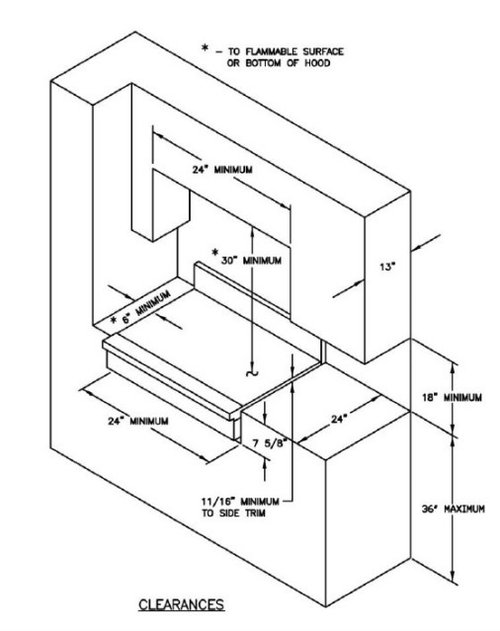
Interestingly, the 30'' Bluestar Rangetop install doc shows min distances to "combustible" surfaces including wood hood range (30'') and side walls (6''). It also shows "minimum" distances to other surfaces including upper cabinets but oddly does not denote ANY other surface (including upper cabinets) as a "min COMBUSTIBLE" clearance. Here's the clearances diagram from the doc..note the "*" indicates "to flammable surface or bottom of hood" and that the 18'' to upper cabinets does NOT have the "*" where the hood range and side wall do. So, why the heck is there an 18'' "minimum" shown if the issue is NOT for clearance to flammable/combustible materials?
Same thing with Wolf 30'' induction cooktop. 30'' to combustible hood range and 18'' between countertop and upper cabinets, but the 18'' is not denoted as a combustible clearance minimum while the hood range 30'' is denoted that way.
Since Bluestar, Wolf (and maybe others) don't indicate that the upper cabinet clearance minimum is because of gap needed to COMBUSTIBLE materials, I can't fathom why any of these docs show an 18'' "minimum" vertical clearance to upper cabinets.
Did something change in a more recent version of the IRC that introduced this 18'' clearance between countertop and upper cabinets? I've searched (& searched) and have not been able to find anything.
I'm actually wondering if all these 18'' distances shown on install docs are because that's "most" cabinets nowadays but it's not an actual REQUIREMENT, as none of the install docs show the upper cabinets to either side of the hood range as being a "combustible" clearance spec.
Would sincerely appreciate any & all help as we're retired and without regular paychecks any longer/limited piggy bank can't be redoing our entire kitchen just to replace the ancient GE Range.
Thanks..
Comments (35)
 PRO6 months ago
It's a fire issue.
Can you post an image of your conditions?Are the requirements the same if you switch to an electric range?
retiredinmi
Original Author6 months agoI'm confused..all the install docs I've seen (from pretty much every manufacturer) show both clearance requirements to combustible surfaces along with other clearance requirements. They all have some pretty clear indication (either the "*" shown on the Bluestar diagram above or a shaded area in Wolf and others) as to which clearances are to combustible surfaces - and none of them show the upper cabinets having any kind of denotation that they are clearance requirements for reasons of flammability/combustion.
Here's a clip from the Bosch 800 induction range install docs. It mentions combustion clearances (eg: to wood hood range above), but for some inexplicable reason still shows 18'' to side cabinets next to it. Interestingly, the text says "the unit is designed for installation near adjacent walls and projecting surfaces constructed of combustible materials. NO CLEARANCE is required from unit walls to adjacent vertical combustible walls on rear, right, or left sides" (which makes perfect sense, as it's an induction range and there's no risk of fire spreading to those surfaces). All that said..it STILL shows the 18'' from countertop to bottom of upper cabinet..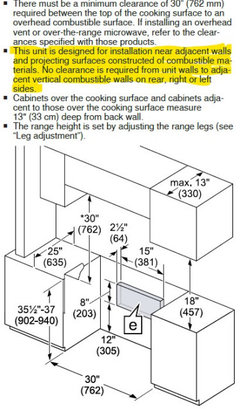
None of this makes a lick of sense aside from the diagrams that do show clearance requirements to clearly marked combustible surfaces. But when there's a surface (like bottom of upper side cabinets) that is NOT marked as a combustible clearance, it's inexplicable as to why these clearances are often shown as a minimum.
Related Professionals
Dothan Kitchen & Bathroom Designers · Fort Dodge Kitchen & Bathroom Designers · Albuquerque Kitchen & Bathroom Designers · Roanoke Bathroom Remodelers · Denver Bathroom Remodelers · Huntsville Kitchen Remodelers · Springfield Kitchen Remodelers · Hempstead Kitchen Remodelers · Sioux City Kitchen & Bathroom Designers · Augusta Kitchen & Bathroom Designers · Winston-Salem Kitchen Remodelers · Virginia Beach Kitchen Remodelers · Fort Collins Kitchen Remodelers · Elizabethtown Custom Countertops · Rutland Custom Countertops 6 months agolast modified: 6 months ago
Protecting the cabinet undersides from CoPilot AI:
What You Can Do to Protect Cabinet Undersides Near a Range?
1. Install a Metal Heat Shield (Most Common + Code-Friendly)
A thin sheet of stainless steel or aluminum, mounted with a small air gap, is the standard approach.
Why it works
- Metal reflects radiant heat
- The air gap dissipates heat
- It’s easy to clean
- It looks intentional in a modern kitchen
How to do it
- Use 1/16"–1/8" stainless steel or aluminum sheet
- Mount it with spacers (⅛"–¼") to create an air gap
- Run it the full width of the cabinet bottom
- Seal edges with high‑temp silicone for grease control
This is the same principle used in commercial kitchens.
2. Use a UL‑Listed Heat Shield Panel
Several manufacturers make UL‑listed, heat‑resistant panels specifically for cabinetry near ranges.
These are typically:
- Fiber‑cement–based
- Mica‑reinforced
- Or ceramic‑backed
They’re designed to be:
- Noncombustible
- Grease-resistant
- Cuttable with standard tools
They mount directly to the underside of the cabinet.
retiredinmi thanked wdccruise- 6 months agolast modified: 6 months ago
- I would ignore the 16-1/2" problem which isn't fixable.
- Follow #1 above to install a heat shield to the underside of the cabinets.
- Not put a range closer than 6-7" from a side wall.
- Consider an induction range but remember that you will have to add a 240 volt, 50 amp circuit to support it AND THE OUTLET HAS TO BE IN THE RIGHT PLACE AS SPECIFIED IN THE RANGE INSTALLATION INSTRUCTIONS.
- Check Consumer Reports for range recommendations and read owner reviews on sites such as Home Depot, Lowes, and Best Buy.
retiredinmi
Original Author6 months agolast modified: 6 months agoThanks..what about the inside edge of the upper wall cabinets to either side of the hood range? Hood range would be mounted with bottom at 30 or 36'' above cooktop. So that would mean the ~13 1/2'' (30 - 16 1/2'') of vertical inside edge of the cabinets would be exposed. That said, they're on the very outer edge of the cooktop so not directly above any flame..
That said, same problem would happen with 18'' to bottom of cabinets. Just 11 1/2'' (30 - 18 1/2) of exposed inside edge of Left/Right uppers instead of 13 1/2''.
Hard to see where there's any real difference in 2 more vertical inches of exposed combustible material. There's still exposed material either way, just 2'' more of it.- 6 months agolast modified: 6 months ago
"working on finding a replacement for our ancient GE Profile Gas Range"
You could buy an induction range for as little as $800 (or $1000 for slide-in) and put some money into a 240 volt 50 amp circuit to power it. No flame = less risk.
retiredinmi
Original Author6 months agoYeah, I know. Have looked at induction. I cook a LOT. And need consistent heat from my burners. Not convinced induction gets me there due to coil size being significantly smaller than marked surface areas on cooktop.
For eg..GE has a ~11'' "burner". Coil size is something like 7 3/4. So all the heat goes to the center of the pan, none to edges.
Saw a post here where someone tried to cook a fish filet. Center of fish got done. Neither end did.
I don't think induction is ready for prime time, as much as some people love it. I'm too much of a semi-pro cook for it to work for us AFAIK.- PRO6 months ago
Some induction cooktops are better than others. You have to check the specs. But even professional chefs are switching to induction.
 6 months ago
There are induction cooktops by Thermador, Gaggenau, and Bosh that allow you the freedom to place a pan anywhere on the surface and get a reliably consistent heat. they use many smaller transducers instead of 5 larger ones. It’s a technology that is much more consistent than gas, and it is far from new. Induction cooking has been around since the 1900s, and commercially available since the 1970s. It is ready for prime time, that doesn’t mean it’s the right surface for you.
It sounds like you’ve been cooking on gas for a long time. Change can be difficult.
retiredinmi
Original Author6 months ago@Phyllis - AFAIK, it is not a fire or building code issue. There does not appear to be anything in the IRC, IBC, NFPA, etc that requires a minimum 18'' from countertop to cabinet bottom. I realize it's an AI answer, but see below for what ChatGPT has to say when asked.
If anyone knows otherwise and can point me to a listed code that says otherwise, I'd appreciate it.
Notably, our house was built in 1996 (we're the 3rd owners) and passed both the original building inspections plus a couple other inspections along the way by both us and the 2nd buyers. I'm reasonably confident if it WAS a code violation that at least one of these inspections if not all of them would have failed.
From ChatGPT:
retiredinmi
Original Author6 months agoSo for those who have suggested induction might be a solution..unbelievably, the install docs for most induction cooktops and ranges STILL specify wall cabinets to be a minimum of 18'' above the counter.
Go explain that one.
There's no fire (obviously).
So, how is this a "fire" issue? I don't believe it is, as I replied to @Phyllis above.
Here's the install requirements for a Thermador 30'' Pro Harmony Induction Range.
BTW, I started this whole process WANTING to go induction as I have asthma and other lung issues.
Then I learned through a LOT of research (over a month, probably two) that residential induction has...issues..with coil sizes. All except for Wolf far as I can tell. But Wolf as many of you know has OTHER issues (flaking/chipping porcelain in their oven liners that have led to class action lawsuits. So as we don't want to risk ingesting sharp shards of porcelain, decided against the Wolf induction range).
I did look at Bosch, Thermador and every other major brand of induction and am not convinced based on user reviews and forum comments that there are ANY Residential ranges or range tops that will perform to the level of gas. Because there are a lot of comments from people that have tried and find that there is not evenly distributed heat across the bottom of the pan no matter what of the recommended cookwares they've tried. And for Pro chefs, they're most likely cooking on totally different commercial units than any of us can buy..
Anyway..check out these install requirements for Thermador Pro Harmony INDUCTION range.
Inexplicable.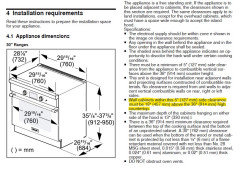
retiredinmi
Original Author6 months agoAnd here's the install requirements for Wolf's 30'' Pro Induction Range..
Again..no fire. So, WHY are they insisting on 18'' from countertops as there's nothing in code anywhere that requires this? And there's no fire, so zero risk to any cabinets.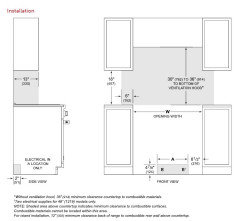
 6 months ago
It’s due to the fire that can happen in your pan from cooking - induction or not.
 6 months ago
The manufacturer is not requiring 18" clear height adjacent to the appliance. They specifically state and use the term "required" when it must be followed:
- 30" directly above appliance;
- adjacent surface width or wall, when it applies to that particular model number;
- wall behind the appliance, when it applies to that particular model number.
On the Bosch example, note there are other dimensions listed on the diagrams that you have not keyed in on. For instance the 25" counter depth or the 13" upper depth.- 6 months ago
Just get rid of those two cabinets. Replace them with the right size or live without them.
retiredinmi
Original Author6 months ago@thinkdesignlive - hmmm..in 40+ years of daily cooking, I can honestly say there have been exactly zero times I've ever had a fire in my pan during food prep.
I guess if one is Greek and cooking Saganaki or something..but I'm Irish and AFAIK there are zero Irish dishes where we intentionally set our food on fire in a pan..or where our food could spontaneously burst into flame :)
It's also very strange that the install doc for my ancient (circa 2010) GE Profile range says NODDA about clearance to cabinets. Yet the roughly similar 30'' GE CAFE dual fuel does. The two ranges are VERY similar.
My gut tells me this is just manufacturers have become more lawsuit-avoidance happy in more recent years so are covering every possible scenario including those who want to cook Saganaki or similar..because how would they know?retiredinmi
Original Author6 months agolast modified: 6 months ago@eam44 - not a chance. It would make our kitchen look ridiculous as the cabinets are quite large and would create a giant hole on our appliance wall. Nor can I change the cabinets out for something else as it wouldn't match.
Quotes to redo the kitchen with even low grade cabinets are > $65K. Not doing that, either, just to change a range out.
Bottom line..I've determined through all this that it is NOT an IRC or fire code issue and is simply manufacturers going overboard in recent years (vs not doing so back in 2010 when my GE Profile was made) to protect themselves from people that DO set their food on fire (eg: Saganaki cooking Greeks). I'm not one of them, so am not gonna worry about it now that I've confirmed it is not an IRC or fire code issue.
 6 months ago
Cabinets are a “combustible surface” unless yours are made of metal.
I wouldn’t worry about it. Your previous range didn’t cause any issues, why should the new one? Okay, the new one might be higher BTU. But the person standing in front of the burner doing the cooking is going to receive almost as much heat as the upper cabinet to the side of the burner, while being a lot quicker to burn, so I expect BTUs will be self-regulating.retiredinmi
Original Author6 months ago@John Liu Exactly. Has never been an issue. Won't be an issue going forward as I've never cooked anything that spontaneously burst into flame :) Just manufacturers now being more lawsuit avoidance happy than they were in 2010 is my best guess.
retiredinmi
Original Author6 months agolast modified: 6 months agoOur house has stood intact for 30+ years across 3 different owners with 16 1/2'' from counter upper cabinets (approved by multiple city building inspectors, BTW).
Pretty sure we'll be TOTALLY fine.
I wondered if something had changed in the IRC or fire code, but have now confirmed through all this that it has not.
Appreciate everyone's input.- 6 months agolast modified: 6 months ago
Probably promoted by the tile industry to sell more tile to fill the taller backsplash space! ;-)
In my parents first house, I remember the original late 1960's cabinets being lower. My MIL's house built by them in 1965, still has the original cabinets and they are set at 15-16" above the counter.
These days if you don't do a minimum of 18", you won't be able to fit many of the countertop appliances being sold.
- 6 months ago
You know, it might just be prudent for the homeowner to reach out to your insurance agent. I’m not sure about the “tile manufacturer, conspiracy theory“, but I do know that insurance companies have serious influence because their underwriters will often push for changes in codes. Since your home may have been built before any recent changes to insurance policies, you “might“ be OK, but yes, God forbid, the worst case scenario occurs, the last thing you want is to be having to hire lawyers to debate with insurance representatives. In spite of the warm and fuzzy commercials that insurance companies use, claim adjusters can be incredibly cold and calculating when it comes time to pay
claims.  PRO6 months agolast modified: 6 months ago
The IRC incorporates the NFPA's NEC AND manufacturer requirements into the building code. "As per manufacturer". If that is their requirements, it's code by reference, even though not explicity mentioned or diagramed by code. It's mentioned and diagramed by the manufacturer. So you do want to check with your insurance company here and see if they will pay if your house burns down. A grease fire is a lot more common than you think. Those new to induction or pro style gas tend to have more burnt pan disasters and fires. They aren't used to the power capabilities.
 6 months ago
While I am still getting used to my induction top, I would not go back to gas again. I had a pro style rangetop (Thermador) for 20+ years. Cleaning the burners and grates, etc was easy in the beginning but a PITA over time - or I got lazier. Not ruling out the latter. Little things accumulate, the feet on the grates fell off, etc. )Yes I know - thing was (is) 28 years old and stll works so stop complaining)
Anywho..
New induction with all the small coils that detect and match the size of the pan making any size / shape a cooking zone is far superior. Any size pot / pan. No not spots like with gas- even large pots are consistent out to the edges. My 14" fry pan heats evenly. Not so when the burner size is the same for any pan. Reaction is instantaneous. We're not degrading indoor air quality. I've heated up things without running the hood. I would have NEVER done that with the gas rangetop. And cleanup is a breeze. I still boil over my frozen vegetables but 1) the pan always sits on a thin silicone disc and 2) the rest of the cooktop is not hot so nothing "bakes" on. Quick wipe with the dishrag when the thing is still on - and it's wiped up.
Bonus - I often wear things with droopy sleeves, or have a dishtowel in my hand. No (or at least very little - I have talents...) chance of me catching myself on fire.
I can't see a reason you couldn't put this type of induction closer. And I assume it's a statement of cooking flambe's but the number of times I considered Cherries Jubilee is pretty small.retiredinmi
Original Author6 months agolast modified: 6 months agoThanks. What induction top do you have?
I did literally months of research TRYING to find an induction range or rangetop that gave me confidence that I could indeed get edge to edge heating (assuming good quality induction cookware). Even the Bosch, Thermador, etc that appeared to have "better coils" had reports from people saying that even with "good" quality (All Clad, Le Cresuet, Cast Iron, etc) cookware that they did not get the even heating they expected.
One person (can't remember what brand they were using but it was supposedly one of the better induction cooktops) tried to cook fish filets and reported the middle of the fish was cooked but each end was raw.
Similar reports on other high-end cooktops with the "right" cookware where people tried cooking pancakes or similar and found that things in center cooked much more through than the ones on the edges of the pan.
Then, there's the flour tests. People put a bunch of flour down..turn on the burner. Flour in center of pan gets browned, but not flour on edges of pan..
Don't get me wrong - I'd LOVE to find an induction cooker that I have confidence in as I want to get away from gas. But after literally two months or so of going in circles on not only this but other related issues...haven't, and I've looked at literally every single brand made (AFAIK).
- 6 months ago
As long as the sizes are standard, you can always pull out and sell the induction and replace with gas if desired. Sometimes you gotta swing and see.
- 6 months ago
Going from 16.5 inches to 18 inches is only 1.5 inches. Possibly the cabinets could be raised (if there is space above) or cut down. If it was my house, I would be concerned about coverage in the event of fire. Today's insurance companies will look for anything to avoid paying a claim!
 6 months ago
@HU-16168550092 Don't blame the claims adjusters. They are just doing what they are told to do by the higher ups. Trust me they get scolded and get stripped of bonuses and rasies for not following protocall. They get their files reviewed and one slip up and all hell breaks loose. If they could pay it they would. It is not their money they are paying out so why would they care? They care because they want to keep their job, get bonuses and get raises. It affects them more then you know.
- 6 months ago
Clyde Kalvin. You will have to forgive me if I do not shed a tear for the insurance industry nor their claims adjusters. Of course they are incentivized to reduce paying as many claims as possible. There is a good reason why every US state and Canadian province have “insurance commissioners’s offices“. A claims adjusters’ bonus is cold comfort to those who have faithfully paid their premiums only to have to hire, legal council and file formal complaints with government insurance authorities in order to get insurance companies to follow the law. And this is not unique to homeowners insurance policies either. Insurers have very deep pockets, and, ironically, just like appliance manufacturers with their warranty policies, will often attempt to wait it out and strategize to “wear down the customer’s willpower“ until the customer simply gives up and moves on. You don’t have to search very far to find numerous examples of this today as well as historically. “Cry Me a River” 🙄
- 6 months ago
@HU-16168550092 they are not incentivized with bonuses by not paying claims. They have protocalls they have to follow. They dont make up those protocalls. Many times claimants have no clue what their policies even say. My comment is more about auto insurance than home owners insurance. The adjuster is the low man on the totem pole. They dont make the rules but they do have to follow them.
Have you ever been a claims adjuster? Do you know how many unreasonable people they have to deal with on the daily? A claimant wants 10k for a car worth 2k. They want OEM parts to fix their car meanwhile if they actually knew what their policy said theyd see the insurance company can use aftermarket parts and even used parts. But they will moan and groan about getting ripped off. If an adjuster goes and writes for an OEM part when an aftermarket part is available they get their butt reamed out.
I am not saying there is never shady stuff that goes on but do not throw all adjusters under the bus.
And there are just as many complaints filed where the insured is proven wrong.






Phyllis