

Aging in Place
13 years ago
last modified: 13 years ago
As our population ages and stays independent longer into their lives, the ability to "Age in Place" has become a strong motivator for people entering into remodeling projects.
Have you added features to your home to allow you to stay there as you age? Are you thinking about it?
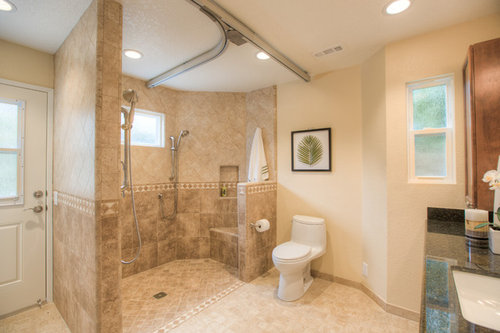
Have you added features to your home to allow you to stay there as you age? Are you thinking about it?
Irvine Special Needs Bathroom Addition · More Info
Featured Answer
Sort by:Oldest
Comments (98)
 13 years agoOther things we can do to postpone an early aged disability is to continue to eat organic and whole foods (not processed foods), limit our alcohol (bones issues), do not smoke, practice yoga (for bone health and flexibility) and keep up with our medical and dental care. Not every issue is in our own hands but we can do a number of concrete things while we are young and sound to keep our bodies flexible and strong and our minds sharp for many years to come. I for one take advantage of every "proactive" option I can.
Related Professionals
Cookeville Bathroom Remodelers · Ithaca Bathroom Remodelers · Boise Bathroom Remodelers · Everett Bathroom Remodelers · Hot Springs General Contractors · Dalton General Contractors · Hays General Contractors · McAllen General Contractors · New London General Contractors · Sault Ste. Marie General Contractors · Platteville General Contractors · Amherstburg General Contractors · Middlesboro Interior Designers & Decorators · Chambersburg Interior Designers & Decorators · Georgetown Interior Designers & Decorators 13 years agoSo many sinarios, so much pain and suffering...I guess as long as I know that The Lord is waiting for me on the otherside with all my loved ones with HIM, then I'll be happy. I'll take HIM at HIS WORD any day and live with Hope, Faith and Love till then. God bless you all and may you find your way and solution before your time comes. We all have to go down that road and I want to be prepared. A few steps this side of the divide is better than knocking on a door that will never open. Serious stuff...even when we laugh in order to keep our sanity (when the going gets tough)! Let's not give up the good fight, lets keep those chins up (I know I have two LOL) so you may as well join me and let's laugh together.
 13 years agoWendy, that was a great post! Thanks for enlightening us on cutting edge technology. That was awesome. I'm sure it is very expensive.
- 13 years ago@Wendy - that looks like dignity to me. Hope we start seeing these replace wheelchairs in large numbers -- soon!
 13 years agoI was impressed at the quality of life it affords. It was interesting how a person's health deteriorates in a wheelchair and this prevents that. Look at how much easier getting into it is from a bed. My dad is in a wheelchair and this would be so much better had he had it immediately after his stroke. Yes - I am sure it is expensive, but I am sure it would be worth it if you were 30!
 13 years agoThat "wheelchair" is totally non-practical for use anywhere outside the home, and looks very unstable when fully upright. It is also outrageously expensive for what you get. It has been widely panned on a website for those who have spinal cord injuries. Robotic exoskelatens are in existence too, but not usable by most, very expensive, and not covered by insurance.
Remember that any of us could be disabled in the next minute from a fall, auto or bike accident, or other trauma or medical emergency. It is not just people who are elderly who need visitable homes. It could be you, your spouse, your son, daughter, grandson or granddaughter...in an instant.Emily Hurley thanked Kathy Dunn PRO13 years agoI remember hurting my back a few years ago...I would have benefited from a readily accessible grab bar. As it happened, I ended up using my powder room toilet for a week or so as I could use the nearby radiator cover for stability. The main toilet has so much of that wonderful open space around it so nothing to hold on to when moving around.
However, it is always easier to add in grab bars than to remove obstructionsEmily Hurley thanked Linda PRO13 years agoI have a daughter who now copes with rheumatoid arthritis symptoms which she has from Lyme disease. This thread has made me think differently about lever door handles, as something easier for my daughter to use.
We are starting to think about some modifications to age in place. The biggest challenge however is getting into the house. It's one step from the garage so when my mother used a walker, we could get her up the one step, but the last year of her life, when she was in a wheelchair, neither my sister nor I had a house which was wheelchair accessible. Thank you for the pictures of attractive ramps.Emily Hurley thanked Masterworks Window Fashions & Design, LLC 12 years agoI rather like the non-wheelchair Wendy posted the link to and can see the benefits of it for those able to use it. It looked stable (very!) in the video, and the way it mechanically lifts the user to an upright, standing position is something many confined to conventional wheelchairs say they miss the most. It surely restores a sense of normality for users whilst eliminating many of the home adaptation issues and costs. Imagine not needing to retrofit lifts from bed to chair, replacing shower and bathing facilities to make them wheelchair accessible, etc. This device clearly restores independence to the user.
What interested me most after the accommodation to a fully upright position was the narrowness of it - users wouldn't have to adapt door WIDTH using one of these. Even the most narrow device used by seniors with mobility issues is generally too wide for standard door widths in most of the countries I've lived in. With this device it looks as though that problem is solved.
Hopefully this will become affordable for those with the upper body mobility need to use it, it's a brilliant idea and I could see older people using this - we're not our parents 60+ types, we're much more willing to try things like this to maintain dignity and mobility as we age. (No offense Mum!)
I have a close friend with increasingly debilitating lower back pain after being thrown from a horse 25 years ago - her upper body strength is amazing and as we push closer to the big 60 (gulp, 3 years to go!) she would love to be able to have one of these devices. She'd be using it into her late 90s!- 12 years agoAs I was planning my new home, I had a fortuitous experience on an airplane A man in his early 40's was wheeled down the aisle and lifted himself into the seat next to me. We spent the entire trip talking about home design. He had been in an accident in his mid-twenties, and couldn't return home until his house was remodeled. All these years later, he still has to sit on the ground and use his (really strong) arms to lift himself, step-by-step, up the stairs whenever he visits friends and relatives -- even his parents. Although I had already been thinking about age-in-place design, he opened my eyes -- and heart. it's not just about aging, and it's not just about me. Any friend or relative could suddenly need a walker or wheelchair. To ignore this reality when building or remodeling is a wasteful and inconsiderate lack of planning.
For me, there was even an immediate payoff. It turned out that instead of building a small home, I bought a condo in an 1880 building. By removing a partition with a narrow doorway and replacing the tub/shower enclosure with a roll-in shower, the dark, crowded bathroom is now light, airy, and spacious! - 12 years agoI like the idea of doing it because you WANT to and not because you are forced to. Big difference.
 12 years agoYou are right, kroze..My husband and I are looking to downsize to a ranch house or one level condo. The way he talks, we won't be able to walk up or down steps in a very short period of time. One floor living would be nice but when I hear my husband "predicting my future", I get a little depressed. By the way, we have no health problems. Feel free to call my husband Dr. Doom.
- 12 years ago:) That was funny!
We just bought our retirement home last summer. Would have liked a one story but building lots are a premium so we bought a two story. However, everything my husband and I will ever need is on the ground level. Only the visiting kids and grandkids will inhabit the upper level. When I get too old to climb the stairs to clean it, I'll hire it done. I love the layout of the rooms and there is only a very, very small step up from the garage to the house. Same for the front door. We have already remodeled the kitchen and living areas and are in the design stages of remodeling the master bedroom and bath. I am keeping in mind that we will likely grow infirmed here, so am replacing the spa tub with a walk in shower. I am making it as accessible as possible but not to obviously look like a handicap facility. Some people don't want that when they buy a home. Young people are not concerned with things like that and I live in a yuppie community. - 12 years agoI still think having two stories keeps you young and walking up stairs into your 90's.
My mother in law kept fit into her 90s that way. It was her mind that went and so we sent her to assisted living and they HAD STAIRS FROM THE DINING ROOM TO THE ROOMS. Kept the old folks mobile! Those that had wheelchairs just took the elevator.
When you are single or your mind tends to go, good idea to go to assisted living. but living in your own home with a spouse into your late 90's is the best way to go.. Just have Meals on Wheels deliver and vons grocery will deliver and have someone come in once a week to clean.
If you need more care...do what my 98 year old aunt did, hire someone a few hours a day to help you get dressed and go to the bathroom in the morning and again in the evening. Her husband of 96 isn't strong enough anymore to help her. She has been wheelchair bound for years. Had polio when young. Still in her own home..
However I do believe a wheel in shower is a good idea for anyone. I like the kind that is all stone with no doors. The water doesn't spray out, and is private. The only open area is the wheel in area. I'm not handicapped yet...but it was more fun to have a shower in that shower than any glass enclosed with a door shower I've ever seen. the non slip stone was beautiful!
when my mom broke her hip and we were moving into a new home, we had the walkway slant up so we could bring her in the wheel chair to visit.
Naturally ramps work well designed into homes and wider doorways, latch handles rather than knobs, and walk in showers all make sense for every home.
Also a vegetarian diet does seem to help many as the oldest living people in the US seem to live in Loma Linda, California, home of the Adventist hospital and University...and most of the people there are vegans or vegetarians. - 12 years agoOur biggest aging-gracefully-in-place plan is for staircases wide enough for a decent stairlift, appliances like fridge, freezer, washer/dryers raised, power points at waist height all through the house, and wheel-walk in showers. There are other items on the list but these are the biggies for us.
We're in our mid-fifties and have led very active lives so there are already mobility issues creeping in from wear and tear on knees and hips. We're ok with stairs now, for example, but to be honest there are times when the thought of trudging up makes my knees ache in advance.
And grab bars are not going to be enough for us as the years go on - even now stepping into the bath-shower combo is difficult because of where grab bars have had to be located in our temporary home (sold our house thinking our 'new' home was a done deal only to find the done deal wasn't, had to find something on the quick and it's not ideal).
The sold house was on one level, appliances and power points raised, and with easy mobility device access through the side and back garden. Lol, the buyers were especially pleased with these upgrades and are a young couple in their early 30s.Emily Hurley thanked sunnie2day  12 years agoForget "ageing in place" ... these features come in handy for anyone who has broken a leg or had any temporarily disabling event at any age.
Try staying clean with a busted leg (or post surgery for a broken Achilles tendon) and a sunken tiled tub with no grab bars.
Try plugging in the computer's power brick when you wrecked your back at judo or overdid the lawn raking and it hurts to move around.
Try turning a knob if both your wrists are en-casted because you were snowboarding without wrist guards and landed on them and broke them (a broken wrist was the most common preventable snowboard injury I saw as a ski patroller: $40 pair of wrist guards could prevent an $800+ trip to the ER)
Try wrestling the new washing machine up the stylish multi-step entrance walkway.
Now do it in an "accessible" house. You can crutch yourself into the low or no-curb shower, plug in the computer at the elevated outlet, push down on the lever door handle, and roll the handtruck up the ramp.
PS: Our main problem is that the @^!@#$ cat has learned to pull down the levers and open the doors, so we have to have toddler locks on all the doors.Emily Hurley thanked tsudhonimh- Emily HurleyOriginal Author12 years agoMy cat would be a disaster with the lever doors too. I'm not so sure he won't learn how to open the knobs too with as much as he practices.
- PRO12 years agoI too have a cat who learned how to leap down on the lever door handles from his cat tower in my Studio, and managed to escape several times before I realized it was not my husband forgetting to close the door, but a very smart cat... So now I keep the atrium door locked unless we are using it.
- 12 years agoI knew our Si-Abby wasn't the only lever-able cat on the planet! He is a large muscular cat so he uses his body weight and physical strength to lunge up and whoosh, he's gone!

 12 years agohey, regarding your aging issue, I would like to share something that I came across.
Check out the link below.
http://www.isenbergdesign.de/usa/
They look classy with elegance and a promise of no leakage issues if your thinking long term.- 12 years agoHave been SLOWLY remodeling my 2-story home. (MS)
Got a stair lift, could NOT go up stairs to bedroom without it.
Re: earlier comment about bed height-my son finally took off casters (wheels) so I could "climb" in -mattress height was above my knee, I am 5'2".
Bathroom: walk/roll in shower with shower seat with things on it so seat is not slippery when wet; non-slip tile; a regular height shower head and a handheld shower head; bidet-type toilet seat (regular height , not ADA since I am short); sink I can roll under (soed cabinet doors to add if/when I sell); grab bars everywhere
I have a porch: added ramp to porch so I can go in that door, no steps
Kitchen (in process): microwave in island, 2 " lower installation and roll under sink; high arch faucet with pull-down spayer; pull out drawers/baskets in lower cabinets for my every day uses
Also wider door (36") from kitchen to dining room.Emily Hurley thanked Mary Marros  12 years agoGreat topic! I purchased my house at age 61, following my husband's death. It moved me within three miles of my only child and her family. I was able to have the three kids get off at my school bus stop everyday after school and they spent summer day times with me for about five years. Due to bad hips, arthritis, house bought had first floor, large,j master bedroom with double door entry, laundry room next to it, walk-in shower with built in bench, hand held shower head, grab bar, space enough for a wheel chair to turn around in. All doors have lever handles. The upstairs has two bedrooms, loft-sitting room, full bathroom, and walk-in attic storage. Would work well for a grandchild who would give me small amounts of help until I need a caretaker. There are no ramps to enter or leave, but there are few (two or one) steps and bars to steady yourself. When time to replace carpeting, will put in hardwood floors on first floor. Have considered changing living room or dining room into crafts room (now in basement). Listing items others mentioned. Keeping in mind that social needs may make solo living unfeasible, for now have various club memberships. Then there are special medical care that may eventually be needed. Thanks for posting comments and ideas.
- 12 years agoWe are just finishing an 22 month project building a new house that will be our last. It was hard to build a house that suits now AND in 20 years when I am really old! I almost made a very bad mistake: http://lesliehobson.wordpress.com/2013/04/22/what-does-life-look-like-in-my-future/
- 12 years agoWe just bought our "last" house last year and have been remodeling it to suit us as we age. You are right. The things to take into consideration are endless!
- 12 years agoWendy, thank you for sharing that link. What a wonderful invention. My mother had MS; how wonderful it would have been if this had been available back then. Hopefully many will benefit from it and that the price will be such that it is obtainable for many and one day insurance may cover it.
 PRO12 years agoI have read many of these threads, but not all. I like what I am hearing. I believe that folks are becoming aware of the economics and the advantages of planning ahead and staying in their own homes, long term. In my business, I work often with families who are dealing with mobility issues. My own mother opted to build an accessible home 9 years ago, and I designed it to address her then present and future needs. As she nears her 90th birthday, my siblings and I couldn't be more happy with the benefits for her and for us. For her, it is peace of mind to reside in a safe, functional and accessible environment, and for her children, this home offers a great space for family visits and holiday celebrations--touchstones for the benefit of all family generations. This home is four blocks from the public school, so my mother gets to experience the daily visits of any number of her 24 great grand children, who visit their "Gommy" daily. Rather than having to drive to visit their great grandmother, my great nieces and nephews lives are enriched because they can walk to her door any day of the week. This choice may be the best decision we have made as a family.
In 2009, I helped to design and install an elevator in a lake front view home owned by a master furniture builder. This elevator helped the owner to safely move between the floors of his multi-level home, when he had been going up and down a spiral staircase, for a number of years, against the advice of his orthopaedist and cardiologist. This elevator modification allowed the owner to stay active in his craft unitil 6 months before his death. The owner got to experience the sunrise over Lake Washington beaming into the Owner's Suite for an additional four years of his life, because he chose to install an elevator, as opposed to moving into a diffferent home, or an assisted living facility. When he passed away, he did so in his own home in his own bed. At his memorial, I was told by his close friends that he was so glad that he made this decision that allowed him to remain in his home. I was happy to have made a small contribution in this process.
I feel that one of the best benefits of this decision has been that both my mother and my lake front client maintain an equity position in her domicile. For many families that are at a crossroads of helping their parents make a decision of whether to remain in their homes or not, this is very important. It is important to weigh the economics of what our parents decisions to remain in their homes or to move into an independent or assisted living facility means. In most major cities, especially those in the northern tier, residents in ILF or ALF facilities can expect to pay $5000-9000/mo. for couples, with the average stay being at least five (5) years. That is $60-80k/yr & $300-450k over a five year period. This is average, and the costs will go up, depending on the level of service required by the residents. The question becomes, what is it worth to you and yours to address your long term living arrangements sooner than later, so that you have the benefit of choice in the future? Do you want to take the necessary steps (for your parents) to remain in the community, in the home that you love, or do you want to move (your parents) into a facility, where they are likely to know very few people, and would be required to give away most of their posessions and heirlooms, furnishings and other intangibles that made their home special to them, and to the rest of the family? These are important considerations, and they should not be made for expediency, but out of love and in the interest of what will promote our (parents) health and positive attitude over the long term.
Design is a catalyst, a promoter and a protector of everyone's long term best interest of remaining in their homes, regardless of age or physical limitations. Let us know if we can help you in this decision making process.- 12 years agoGreat post. Most people are under the mis-perception that nursing home and assisted living institutional living is covered by Medicare and other insurances. Rarely is this the case. Being able to stay in your own home, in your own neighborhood, with your own belongings, and to pass on in your own bed is very important to many people. It's not morbid to make plans ahead so that you can do this if that is what you desire. I myself made sure I took out long-term care insurance years ago that will pay equally for in-home care as for skilled nursing (nursing home) care so that I can remain in my own home if I should be disabled and/or at the end of my life...and my current home will also accommodate this.
- 12 years agoDMH Design, when my son and his wife built their Alabama USA home their design included a MIL flat for me with not only a stairlift inside but one from the deck to the back garden. If I ever move back to the US I will move in with them.
They actually worked with their architect particularly to implement 'aging-in-place' features for the entire property. Even during the worst of the housing bust in the US the house retained it's value and had they needed to sell there were no shortages of buyers. Multi-generational, 'universal design' homes seem to be making a comeback even on modest scales. - 12 years agoWhere do you live sunnie? You said, "If I ever move back to the US....". Are you an American citizen?
- 12 years agoKroze, I'm a dualie (expat British parents raised me in the US Desert-Southwest). I raised my son in the US then several years after my divorce, remarried a Scotsman and moved countries from the US to the UK. When my son built his house we had no idea that I'd not be moving in on retirement which was the original plan. Funny how things work out!
- 12 years ago@sunnie2day: You must be well-loved! Kudos to your for raising a son who is so wise and kind.
- 12 years agoLol, Pgeis, not sure if I'm well loved so much as my son was raised (as I was) in a multi-generational home so he couldn't conceive of anything else for when he married and had his son.
He has very happy memories of being able to pop into my dad's 'cabin' or his paternal great-gran's MIL wing (another lol, it was nothing more grand than a conversion - double garage to a comfortable one bedroom apartment with open plan kitchen-lounge) and wanted that for his son. His wife was also raised in a multi-generational home so she was also well on board for having me there. - 12 years agoSunnie, we raised our kids as ex-pats and they are very international. Our daughter married an Irishman and immigrated to the U.K. They live in Edinburgh. Our son has been living in Brazil.
Sounds like you have a wonderful family support network. Good for you! - 12 years agoOh, your daughter lives only a little south of us, we're in Angus:) We love Edinburgh, what a lovely city!
I miss my son and his family, who knows, perhaps one day they'll come over and stay. He's a master chef, it's not out of the realm of possibility. - 12 years agoI agree. Edinburgh is a stunning city...... very unique!
We have traveled throughout the U.K. and love the charm of Scotland. My genetic roots trace back to Scotland. - 12 years agoMy dad's family was from Caithness (the very northern part of mainland Scotland) but never in my wildest dreams did I think I'd live over here in my retirement! I think I'll stay in Angus, far enough north for me:)
- 12 years agolast modified: 12 years agoI love driving the coastline of Scotland and stopping at the small fishing villages to buy very old books in their used book shops. It is amazing what I have found! Our daughter went to school at St. Andrews, so we have spent a lot of time in Scotland! :)
Her wedding was at a church in St. Andrews built in the 12th Century!  12 years agoTo adapt architecture AND the routines of daily life to accommodate aging in place, consult an occupational therapist and architect together.
- 12 years agoWe are now in our new completely accessible home and love it. We spent 13 months in a very nice, expensive senior lodge located about 1/4 mile from our home site. I am so very grateful that we had the option of moving "home". There are social advantages to the independent senior living facilities and if one did not have family and friends nearby, it could be a very good choice. The "rent" in our one-bedroom unit increased by $1,000 the last month we were there. We were told that normally annual increases are in the 5% area. When we left we were paying well over $4k (not quite 5K) for a one-bedroom unit which included meals and minimal weekly housekeeping along with some activities. We enjoyed meeting all the people but were too busy to participate in many of the activities as we worked with our insurance company following a home fire and then with the builder. We do have LTC insurance which covers in-home care as well as long term care facilities. Our hope is to remain in our home. The decision is one that requires considerable thought. I remember speaking with one very active woman who said she moved to the sr. facility too soon and wished she had stayed in her home which she had given to her grandchildren. She was able to visit and spent many long weekends at her old home. Just a note, get the details as to when the next increase takes place in writing/contrcat. I was not in a state of mind to do this following the fire and my husband's hospitalization and learned later that some residents had negotiated a 2 yr. rent freeze.
- PRO12 years agoFranklin. Thanks for sharing. It sounds like you have embraced a thoughtful, strategic solution for your senior years. It makes me very happy to hear about folks being proactive in this regard. When you look at the cost and lifestyle benefits of moving into your own accessible home, and what advantages you now have to host family and guests, along with living life on your own terms, your example is one that more people need to understand and embrace. Happy Houzzing!
 PRO12 years agoIf you really want to learn a lot about aging in place products you may want to go to Columbus Ohio and check out the home of Rosemarie Rossetti and Mark Leder - also known as the universal design living laboratory -
http://udll.com/
This home is not only beautiful to look at but it is a great exhibit of universal design practices.- 12 years agoYes we bought a smaller home and yard, have already installed raised vegetable garden beds and have plans for a ramp for elderly relatives.
 12 years agoanother thought on a previous post....everybody thinks they need to go to hardwood floors but that is not always the best choice. You can also opt for a commercial style carpet which is firm enough to not impede wheelchairs and walkers but would be better insulation for warmer toes as well as a warmer space. I have hardwood flooring in my living room and, while I like the look, I freeze in there and if I put down an area rug, then there is the tripping issue. To do it over again, I would opt for the low nap berber-style you see in restaurants, offices, and the like. If you shop around you can often get it as a remnant and save considerable cost. It also tends to have a longer life as it is made for high traffic. For a luxurious option, some of it even has fiber-optic woven into it so you can actually see the floor when the lights are out...great for steps if you can't avoid them.
 12 years agoAdding a thought to Kathy Grassley's post. One might also consider hospital-grade carpet. Similar to commercial carpet, but able to be cleaned better.
- 12 years agoPlease remember aging in place designs for loss of visual acuity (for example: increase contrast between the edge of the counter and the surface, reduce glare).
If one has loss of hearing, consider having the doorbell, phone, fire alarm and carbon monoxide alarms on flashing or strobe light systems. - 12 years agoNasmijati, thank-you - hadn't thought about audio-visual aspects, and I should have seeing as I'm in trifocals (and have been since aged 45) and have hearing loss as well!
- 12 years ago@sunnie2day. There are many resources on the Internet for people with vision and hearing issues. Try Google. Best wishes!
- PRO12 years agolast modified: 12 years agoNasmijati makes a very good point about increasing contrast to help with visual acuity. I hadn't thought about the edge of the counters, but this added contrast is critical when you have just one or two steps down or up into a room. A contrast border of carpet, or lighting just under the lip of the tread, or at the sides of the stairs, or even contrast color stains in hardwood to make that edge more easily perceived is a great help.
- 12 years agoAs my 91 year old Dad was losing his eyesight we taped white towels to the corners of the walkways in his apartment. That kept him from running into walls with his walker. So I understand the need for extreme contrast for some people. Unfortunately he is now completely blind. No need for the towels.

Related Stories
KITCHEN DESIGN10 Ways to Design a Kitchen for Aging in Place
By Sam Ferris
Design choices that prevent stooping, reaching and falling help keep the space safe and accessible as you get older
Full Story
UNIVERSAL DESIGN12 Must-Haves for Aging in Place
Design a home that will continue to be accessible, safe and stylish as the years go by
Full Story
UNIVERSAL DESIGNAging-in-Place Resolutions for the New Year
How to make your home help you age gracefully right where you are
Full Story
GUESTHOUSESA Hideaway for All Ages Perched Among the Trees in Maine
By Becky Harris
A modern Adirondack ‘treehouse’ is designed as a place for playing games, reading, sleeping over and enjoying forest views
Full Story
BASEMENTSRoom of the Day: A Playful Basement Makeover Suits All Ages
By Becky Harris
Fun decor creates comfy places for watching movies, playing pool, letting loose and having fun
Full Story
UNIVERSAL DESIGN11 Ways to Age-Proof Your Bathroom
By Sam Ferris
Create a safe and accessible bathroom without sacrificing style
Full Story
BATHROOM DESIGNUniversal Bath Design: Light Your Bathroom for All Ages and Abilities
Learn about uplighting, downlighting, visual cueing and avoiding glare for a bathroom that's safe and works for all
Full Story
MORE ROOMSPlay-Space Secrets for All-Ages Homes
By Houzz
Don't let a generation gap put holes in your interior design. These tips from family-friendly businesses can give your rooms all-ages appeal
Full Story
SHOP HOUZZShop Houzz: Dr. Seuss Decor for Kids of All Ages
By Houzz
Celebrate the creative author’s March 2 birthday with fanciful and vivid decor
Full Story
LIFEAge Is Just a Number: Houzzers’ Homes Old and New
Hear the stories behind homes ages 1 to 171, then share yours
Full Story



Wendy Stout