Software
Houzz Logo Print
jane_seto

New appliances, old venting situation … any recommendations.

last month
last modified: last month

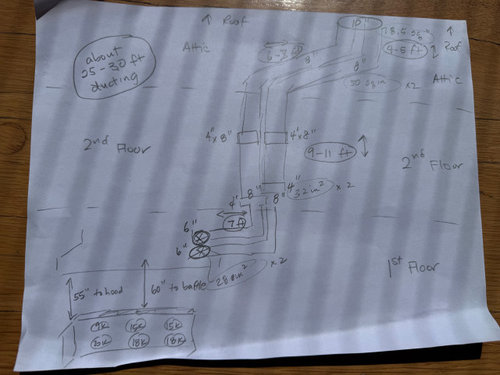
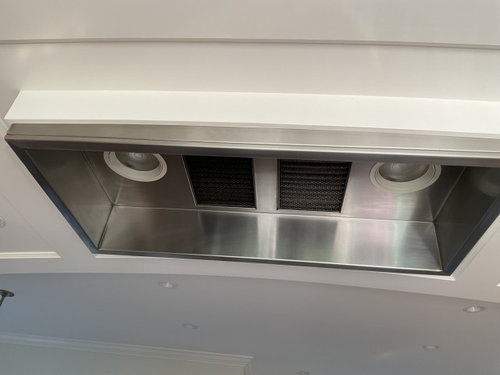
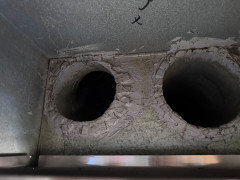
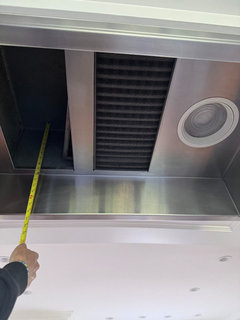
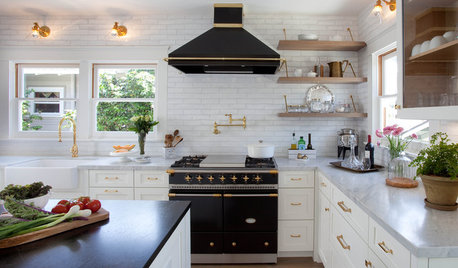
Hi - Looking for advice … we recently replaced our range top and ovens … issue is the old vent hood set up. Previous owner remodeled and had a custom vent hood installed. Truthfully, the kitchen remodel/setup was/is fantastic and the vent hood is beautiful …. but, it’s just not very effective for high heat (wok or pan frying protein) cooking. The new rangetop is 36” (6 burners), c 95kBTU (Wolf). Custom vent hood is located 55” above the range top, baffles about 60”. Two x 6” pipes enter into the hood space, these connect to two x 4”x8” rectangular ducting that snake through the second floor walls leading into the attic. in the attic, the two 4”x8” ducting connect into two 8” round ducting that then merge / connect to the 10” duct that connects to the external remote blower (1000CFM).


This was the original set up and when we purchased the house, the vent was never strong enough, but we thought that when we changed all the appliances (they’re all 30 years old), that we’d replace the remote blower and it would be stronger since it was new. Total ducting from the vent hood to roof top is probably 25ft to 30ft with a 90 degree turn at the beginning and a couple 45 degree turns in the attic (if not more).


Long story, short …. it doesnt work well and turns out the new remote blower seems a little weaker than the old loud, oily one that we removed!!! Both blowers were/are Thermador.


So, wondering if we should:


a) Replace the 1000 CFM blower with a 1500 CFM blower (but would it make any difference with the network of ducting)? The appliance store guy said the difference would only be marginal because of the ducting.


b) My contractor thinks we should add another blower right above the range top, but reading through the history of posts here … that might cause static pressure issues. Would that still be the case, with the distance between the two blowers (over 25 feet)?


c) Obvious answer is to lower the hood (per contractor as well), but that would be A LOT of work and new wiring because everything was custom built back in 1997. I’m trying to avoid this option, but know it’s probably the right answer. however, I still question how effective the remote blower is. Testing a tissue near it, it’ll only suction the tissue when its about 4-6” from the baffles. (and the baffles were custom made and might not be the best for suction either). 🤷🏻‍♀️


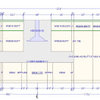
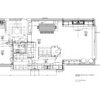
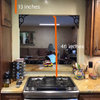
I tried to illustrate the situation. Open to any ideas. I’m literally (and figuratively) billowing in fumes!) Thanks, J


Comments (8)

  • last month
    last modified: last month

    It will never work well as the distance is to great. The hood should be 30" max, preferable closer to 26-28".

    Janie thanked millworkman
  • last month
    last modified: last month

    Thank you Kaseki. The vent internal aperature is 44” x 20” and it is over an island (albeit not really centered, offset over the back of the range more). Looking at the architect’s website, this was a signature look they did back in the late 1990’s/early 2000’s. I can see why it was done, for aesthetics and the view. I was hoping to find a solution to maintain the ”open air” concept but see your points on cross draft, turbulence and all (and fact restaurants aren't as ”open” as I thought, and still have hoods positioned lower than mine).


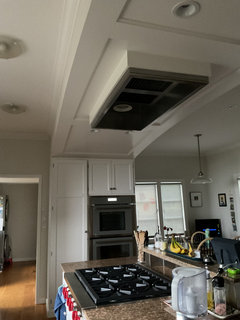
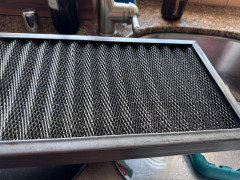
    Sounds like the only solution is to lower the hood? this might entail a brand new hood, and if so, should I install a lower CFM hood to work in tandem with the external blower? or will lowering the hood, hopefully solve the problem? picture of the island and custom baffles included (which leak oil when too full, which i guess mean they work). 🤷🏻‍♀️


  • last month

    Continuing then --- 44 x 20 is kinda small for such a height. But lets analyze it first. 44 x 20 = 880 sq. in. or 6.1 sq. ft. We desire an actual 90 CFM/sq. ft. or 550 CFM. Your 1000 CFM blower might be able to achieve that through the somewhat strangled (for a residential hood) baffle restrictions plus all that ducting. It would depend on its fan curve (and I don't have any from Thermador but a Broan-NuTone one for a 1000 CFM blower hints at that potential). It would also depend on nearly perfect make-up air; meaning no pressure loss. This would require a lot of open windows or a proper MUA system with a blower. (I think the Fantech one might work.)

    Using, for example, a model 336 Wolf/Broan 1500 CFM blower (about 1.7 inches w.c. at 550 CFM) would allow more pressure loss at 550 CFM and maybe a passive (no blower) MUA. (Screened duct with heater if needed. A powered damper is also required.)

    An additional duct (in-line) blower would add a lot of wiring complexity (where are your hood controls, by the way?) and there is a possibility that the two blowers would be "unstable," that is, hunt for their combined flow rate stability point. And you don't have a single duct until the attic, so long duct isolation wouldn't be available.

    In principle, one could weld up a stainless steel shell ~44 x 20 and slide it over the edges of your existing hood and screw it to the hood. One would have to check on how well supported the existing hood is with respect to carrying that load. So if you add MUA, and extend the entry aperture downward -- by, say, 18-inches -- you might salvage the present setup.

    How much gap is there between the baffles and the two 6-inch duct openings? Some plenum depth is needed there of the order of 6 inches I would guess.

    Your baffles look similar to those available from Flame Gard, so they likely were bought from a commercial source.

    Janie thanked kaseki
  • last month

    Hi again.


    The plenum depth/height is 11” from the baffles to the top of the internal area. I would say the far right baffle edge is about 12” from the 6” openings.


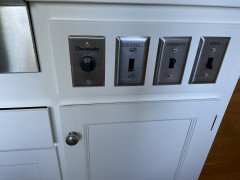
    The blower vent is controlled by a 4 way switch on the counter. The lights on the vent are on the same circuit as the other island lights.


    Oddly, the system semi-worked in the past. We’ve lived with this setup since 2018 and it was installed in 1997. Definitely not ideal but we managed with open windows and additional air purifiers in the room. We live in NorCal and have a 100 year old house, so opening windows is not a problem (as don't think MUA was taken into consideration). plus, the windows are old and leaky too.


    I’m thinking of … maybe doing the following:


    A - replace the 1000 CFM with the 1500 CFM remote blower (just need to change the 4 way switch to an infinite switch (which should be easy with existing wiring)). Thinking the Wolf as you mentioned.🤞


    and/or


    B - replace existing hood shell with a new vent shell (or move current hood shell down) to about 36” above the range top (and position as best as we can above the range top). not sure if the hood is strong enough to add more weight … and aesthetically would look better with a standard setup (with a metal chimney above it).


    We can do this in one step (both changes) or two steps (maybe A first to see if that’s enough?) Ugh … wished we installed a 1500 in the first place. Literally, 2 steps forward (new ovens and new range top) one step back (new subpar blower)! :(


    btw, do we have to take into account oven fumes in this setup? maybe i shouldn’t ask!


  • last month
    last modified: last month

    The plume from an oven under the cooktop will be partially evacuated as one opens the door and the effluent pours outward. Ovens are the one type of appliance that are difficult to ventilate unless a full-kitchen porous ceiling ventilation system is used. (Big $$$)

    If you are going to replace the hood and set the entry aperture at 36 inches, make sure the hood overlaps the cooktop by at least 3-inches all around, more if there is a directional air current, such as from an split a/c head or a heating/cooling vent. My Wolf Pro Island hood has a 26-inch front-to-back capture distance, with some further contribution from flow over the control panel/lamp surface.

    As you noticed, the hood air flow at the cooktop will be slight, so any breeze will cause an angled plume. Kitchen cooktop ventilation depends on the plume rising to the hood.

    My 1500 CFM (nominal at zero pressure loss) roof blower from Wolf is a Broan-NuTone 336. This operates with an induction motor suitable for control from a continuous motor controller. (The one in my Wolf hood is a simple diac/triac type.)

    Note that up-blast commercial blowers can be sized and sheaved for whatever flow rate vs. pressure loss one wants, but professional help should be used for selection.

    Note2: Some insights can be gleaned from the first dozen or so pages of the "Greenheck Guide" available from:https://www.tagengineering.ca/wp-content/uploads/2015/02/KVSApplDesign_catalog.pdf

    Janie thanked kaseki
  • last month

    Thank you Kaseki. Super helpful information, really appreciate it. We’re going to look at upsizing the blower then look at options of loweing the shell and maybe in the future rerouting the duct work if we have the stomach to open the ceilings up. So much for wanting a simole ”remove and replace.” We actuallly wanted to upgrade to an induction range top but didn’t want to create extra work. 🤷🏻‍♀️ btw, noticed you have an induction setup …. how do you like it?

  • last month

    Induction is fast, efficient, trivial to clean, responsive, powerful. Thermal inertia is only that of the pan being used. The cooking plume will not include gas combustion products. In many cases the minimum induction heating will be lower than can be easily achieved with gas while the maximum will be greater than gas (excluding commercial wok burners). An induction cooktop will need a 40 to 50A 240V circuit.