

Tankless hot water tank...never again.
Comments (284)
 PRO11 years ago
@conecaster, yes, that's right-- the units can operate with a dedicated return line or you can install a cross over valve and use the cold water supply line to serve as a return. Here's a link to a page that explains how Rinnai's unit works:
http://www.rinnai.us/tankless-water-heater/ultra-series
 11 years agolast modified: 11 years ago
The units will continue to improve. but the same result could be achieved by adding on to any tankless. I know my Grundfos pump is much stronger than the internal here. It says it has dual stage burners. I suspect that is to heat the recirculation at lower vol. flow.
Related Professionals
Carbondale Interior Designers & Decorators · Louisville Interior Designers & Decorators · Gaithersburg Interior Designers & Decorators · Waco Interior Designers & Decorators · Kenosha Interior Designers & Decorators · Lancaster Interior Designers & Decorators · Clovis Interior Designers & Decorators · Carson City Interior Designers & Decorators · Albert Lea Architects & Building Designers · Wausau Architects & Building Designers · Dothan Kitchen & Bathroom Designers · Lake City Kitchen & Bathroom Designers · Cincinnati Kitchen & Bathroom Designers · South Sioux City Kitchen & Bathroom Designers · Juneau Kitchen & Bathroom Designers 11 years ago
Obviously, I serve multiple purpose with my electric tankless. You can clearly understand that I am not only concerned with space maximization, but also adamant about conserving natural resources (which includes use of natural or propane gas.) Not getting off topic again, but we can generate electricity without using fossil fuel, so I'm also keen on being green; using minimal electricity. That said, I do believe my electric tank already has an onboard tank which acts as a buffer; which would explain why I have been so pleased with (nearly) immediate heat at the farthest reach.
- 11 years ago
Yes Elizabeth,
That could be the reason you are getting better results. It would prevent the fluctuations most other tankless heaters have. But if you do an energy calculation on recirculation or a buffer tank heater there is so little consumption its probably no worse than the energy used to pump cold water down your drain until it heats up. Most of the heat in the buffer tank will be provided by the tankless. Your heater should be compatible with a cross over valve between hot and cold under the furthest sink in the house from the heater. You would have instant hot water if you installed some additional recirculation, most tankless heaters will not allow low volume recirculation into the cold pipe below a half gallon per minute.I would be more adamant about fossil fuels being reduced when we have logic in finding other sources of energy. Solar is a nice supplement but the fossil fuels used to mine the minerals for them largely negates any benefit. Wind is good but is more maintenance intensive, which is more expensive. A Prius takes as much energy to build as I would use driving my now 29 year old BMW 70,000 miles.
If we could bring the country on board around the latest source of endless clean energy, buried in the western cave reserves of spent nuclear materials , we could have electric cars that truly do not pollute, endless hot water and heat/cool every home with out a bit of fuel burning. Its called mini nuclear technology, invented by Hyperion.
But if your tankless is using the amounts of KWhs to heat water I think it is, my 120k btus is equal to about 35 KWs, we must consider the friction in the transfer and voltage loss just getting the current to your home. If your getting power from the grid its largely coal unless you pay more for wind power available in some places, you could have a solar array but 35KWs is way more than any solar grid will provide. Solar is ultimately only 1 kwh per square meter if you could get 100% of the energy which we can't.
The nuclear fear mongers will say look at Fukishima and what about the waste. If we want to end oil dependence, Coal and NG dependence is sitting right here. Its cheap and abundant with no effect on ground water or air quality.
DR is not a fission type nuclear technology. It does not need to be cooled and instead of dumping waste it uses the waste we already have for generations to come. Zero pollution. The only risk is transporting the depleted uranium fuel which is in rods and not particularly dangerous unless its air born. These power plants will power 10-20,000 homes on one load of DR which has been report to last 20 years before refueling. The power plants can be located in residential areas so there is less transfer loss and they are designed to be buried 50 feet in the ground so there is no risk of being tampered with.
But my Noritz NG heater is 92% efficient, I doubt if we factor in all energy production issues supplying an electric tankless into the equation I doubt the efficiency of any electric heater can match 92% and given the high load on a circuit they produce I think they create a higher risk of there being over heating and potential fire damage.
- 11 years ago
This is a long way down the thread and I apologize for that but it is to comment about many ppl that said they didn't need to do anything to their tank type hot water heater. I just wanted to say that it is really important to visually inspect your HWH and check the TPR (temperature pressure release) valve once a year-(like when you change your smoke detector batteries).
The TPR valve is a stainless toggle valve on top-once a year flip it and see where the water goes and make sure it works correctly. And if it fails don't let anyone just take it off-replace it-it's what keeps your hot water tank from being a rocket propelled bomb when the element goes. And make sure the water goes outside (not in another room) and low to the ground-not shooting out-your local code will say how low to the ground it needs to be.
 11 years ago
The more I see comments here, the more confused I get. We put in our tankless over 14 years ago and it operates perfectly with no upgrades, buffers, workarounds or Maintenance of any kind. I must be the luckiest person on Earth. :-)
- 11 years agolast modified: 11 years ago
Less,
Most comments here are directed at complaints about how Tankless units function. Anyone like you or Elizabeth who have accepted there are differences will be happy.
I love the tankless unit I installed but was not happy with the variation in start up temperature these units have.
So I installed a recirculation system that provides heated water at start up and this gets rid of that short coming.
I could have lived with it the way it was but really like the improved function.
- 11 years ago
I've begun to wonder if I am carefree since I installed an electric unit as opposed to NG. Really, no problems at all...ever. No additional recirculation pumps, no storage tank, no special piping. Just ran the power to a separate breaker, hooked up the cold in and hot out, powered up, set the temp, then poof! Hot water.
- 11 years ago
Did you said your unit had built in recirculation Elizabeth?
If you do have a pump and a small tank built into your unit, this would explain your satisfaction and lack of temp variables that Kristin is so unhappy with. it would not get heat to a tap any faster though and that is pumping water down the drain, I believe yours would supply heat to your taps if you installed a cross over valve in that longest run you mentioned. Then the pump would push a little hot water into the cold and you will not wait for hot water at all.
I have no experience with them But Charles described it above.
P - 11 years ago
No, I didn't say, because I don't rightly know! The small inner tank, I'm confident exists, but the recirculation and cross-over additions are definitely not there. If there's a pump, it works. If there's not a pump, it works. But, I'm sure you're right that if I added a cross-over valve, it would tweak it just right!
- 11 years agolast modified: 11 years ago
If there is tank inside your unit there would be a small pump to circulate heated water into the tank, this heated water buffers the cold water that usually gets past the heater core before it rises to full temp. It sounds like you have a recirculation pump in your heater, if I'm right it sounds like the design Charles mentioned above where you might be able to use that pump to push heated water out thru the pipes to a cross over valve. You would need to check the specifications of your heater to know. I'm very curios about these new heater designs. They would eliminate the need for extra plumbing and additional buffer tanks. They also would provide the same supply a tank would with out the short comings of the tankless technolgy.
 11 years ago
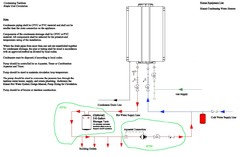
Maybe Conecaster can help me (or anyone that might know). I'm having a problem figuring out how my system is plumbed (I think per diagram below). I have 2 "Attic" loops (see diagram). I just replaced a 6 gallon "optional" aux. tank/heater with a 2.5 gallon. I just moved the "C" to "C" and "H" to "H". When the recirculator is running (no taps on), the "out" line of the aux heater is hot, "in" line is cool. What's odd is the "out" line is on the "C" port of the tank. I have added a sediment filter after the "H" thinking the water was flowing from "C" to "H" (like a normal heater). Just checking to see if there is any reason the hot water is coming out of the "C"? I need to move my filter to the other line if so. Even with a clear bottle on the sediment filter I can't see which way the water is moving, but if I turn on a tap, the "H" side starts getting hotter until they are both hot. Getting hot water quickly at farthest point, so it seems to be plumbed correctly (except my filter). I could change the "C" and "H" if that would help anything.
- 11 years ago
Tcat, from my understanding of your configuration c on your tank means inlet. h means outlet. I do not see 2 loops. It seems the tank was labeled for a cold water supply and you are supplying it with hot water because its a loop.
Having all that piping in the attic would concern me. I would think there would be increased possibility of freezing pipes. What safe guards are there for preventing freezing in case of a power outage, are your cold lines up there as well?
P - 11 years ago
oh, I think the difference between H and C is what half of the tank the water is flowing from, I believe the H outlet is at the top of the tank and it makes sense that cold water would be fed at the bottom.
- 11 years ago
It's all the same "loop", it's just that 4 insulated pex pipes go off into the main attic. The 2 circles on the drawing are above my garage (attic access area), so the 4 pipes from this access area go to fairly inaccessible attic area (the Rinnai diagram is really a guess as to how it's all connected). I just wanted to make sure hot water into the "C" side was normal, and to confirm water is traveling "out" of the "C" port.
I'm in Texas, if my attic freezes (with insulated pipes), I'm in trouble.
- 11 years agolast modified: 11 years ago
PS: after your comment, that's what I "thought" was the norm. But since it's really hot water from the Rinnai, it probably makes no difference, and original plumbers didn't care (or have a clue).
I changed the in and out to proper "C" and "H", no real effect other than I have the filter in the right line now. Also added a shut off on either side of the aux tank (there was none), since I have a feeling the 2.5g tank may not last that long (Bosch). Next step... change out the old Taco pump with the new Grunfos I bought, and the old corroded check valve.
edit: Pump changed, no leaks! This thing is soooooo much quieter than the Taco. So far, hot water working good.
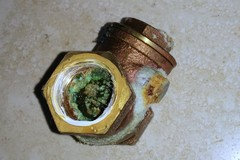
edit2: Here's a picture of the check valve I replaced. Flapper doesn't budge, lets a "drizzle" of water by. What's amazing is I really wasn't have any issues with the system. I just knew the check valve looked bad on the outside and aux tank was probably gunked up inside (because of all the crap coming through to faucet filters).
- 11 years ago
One more question for Conecaster. You had mentioned you weren't happy with the 85 degree aquastat, me either. My attic is above 85, so the pump never goes on (once it's off at 105). Takes about 3 minutes to get hot water with the pump off, about 5 seconds when its running. I'm thinking if I removed the check valve, cold water would back through the pump and turn it on. Or just remove the stat and use the timer. Your thoughts?
- 11 years ago
I believe the Bosch 2.5 gallon is glass lined and made to not rust out.
I think ling term I will install a honeywell aquastat and put a well in an elbow so I can get complete transfer of temp instantly. The model is L6006. They make in both clip on and well type designs. The 6006 can be adjusted and I think I want to have only a 5 degree range in my pipes. I'd like it to keep between 110-115 degrees. If you set your tank at 120 and you put the aquastat before the tank it will heat up at the end of the loop so you'll have pretty close to tank temp through out the loop. I am actually having good results looping through my Tankless to heat my pipes. I am still using the 85-105 but I put a piece of masking tape on the pipe where its mounted and I rotated the contact so I get part of the aquastat on metal and part on tape. I played with until I got the pipe temp where I wanted it. it works fine but I really think I'd prefer a Honeywell aquastat with a well emersion sensor.
- PRO10 years ago
Woke up in the morning and tried to take a shower and noticed no hot water. Went to the basement and heard the water leak alarm going off. I called a local plumber that I got off of Angie's List and used several times before. They always gave me a good price.
He came around 12:00pm and turned off the water to the house which stopped the water from leaking from the water heater that I was spending all morning trying to clean up.... He gave me a quote of around $1000 and would be back around 1:30pm to complete the job. Looking back it seems a little high. Especially since people were telling us that it should have cost around $450-$600. I think they used a handyman and did not get permits. - 10 years ago
Hello all! We are building an addition and are considering a tankless water heater for a new shower and jacuzzi tub as well as a shower on the bottom floor of the addition. We have a traditional gas water tank for the rest of the house. Does it make more sense to do the tankless water heater than the traditional because it will only cover two new bathrooms and won't have miles of pipe to cover?
- 10 years ago
I have a Noritz 661-DV model installed Oct of 2014.
It should do the job beautifully. I recommend you install recirculation piping to keep the pipes warm. I installed mine so I have 30 ft of warm piping before my Tankless to prevent cold water from passing bye the heater before it gets up to temp. This stops the insult of a cold blast after the warm water in the pipe clears when you turn on a tap, it also provides instant hot water when you open a tap and you can trickle hot water below the min. water flow to keep the heater lit which is useful sitting in a tub for some people.This heater with a recirc system is the most enjoyable hot water experience.
They also take up very little space so you do not have to have a tank sitting around or springing a leak flooding the basement.
- 10 years ago
So I have had a tankless water heater for 1 and 1/2 years. It sucks. 18 months later I still cannot get a consistent temperature out of my hot water heater. Shower goes cold at least once if not more while I am in it (and I only take about a 5 minute shower...). The installer has been here dozens of times and his solution now is to install a tank backup to keep the pressure regulated in the entire house. WHAT IS THE POINT OF THAT? I would have him take it out except that we have it tied into our furnace and it would require an entire new furnace system. I don't have the money for that! I already replaced it once. AND - we have not saved one single penny in our utility costs. So now, I get a backup tank which will cost us more than what we are paying in gas costs now. I WISH I had done some research before I had this stupid system installed. I will never make that mistake again. I have a small house and this shouldn't be that unreliable. What a disappointment and waste of money.
- 10 years ago
Wow, that is unfortunate,
I understand there are systems out there that are used to heat your house as well as heat your hot water.
I can under stand the water going cold once, that is to be expected unless there is either recirculation or a buffer tank. Sounds like your installer is advising a Buffer tank. A small 2 gallon tank will even out any temperature fluctuations.
The mistake people make in installing tankless heaters is they do not work like a tank. I spent $650 on a Noritz DV 661 tankless, I got it at a really low price. I also spent another $1000 on all the related materials to install a recirculation pump, a new set of of pipes for recirculation. I designed it so there is always hot water coming into the heater. from the recirculation line. I have no fluctuation.
A tank is a thermal expansion reservoir. A tankless is a cold device until its used. Then the water heats from cold every time the water is turned on so the heater can not get hot enough to heat cold water for a few seconds and cold water will follow the hot water in the pipes. This is to be expected. The heater has a flow meter in it. Mine is .5 gallons so if your shower head is a water saver it could be the heater is turning off, some tankless units require a gallon per minute flow rate to heat.If you install a small 2 gallon tank and add a recirculation pump so water circulates back to the inlet of the heater the flow meter will not turn off the heater.
My system will trickle hot water with out the heater cutting off. This is because as soon as cold water gets to the heater at a very low flow rate the pump kicks in and increased the water flow so it stays lit. with the excess hot water recirculating that is not trickling out of the tap.
The same will happen with a buffer tank. The only difference is the pipes stay hot to the taps in a recir system and with a buffer tank the pipes go cold like a tank system will.
You just can't install a Tankless like its a tank.
Its unfortunate that installers do not educate people about the difference between the two so they can make an informed decision about how to install a Tankless. If done right tankless systems are a really great way to go. I will never install a tank again. I had to go bad and flood my basement in a 6 year span. I will never worry about that with my Tankless.
- 10 years agoHELP!!! Direct vent hazard
Any suggestions for making a fireplace vent onto deck safer? It is about the height of toddlers and has sharp metal around it. I've been told by manufacturer that it can't be vented through the top of the housing surrounding the fireplace due to lack of space. (Fireplace is flush with wall inside house. )
This is a real problem. Thanks!  10 years agoSbs, you should probably start a new thread for your question rather than asking on a thread with a different topic. You will likely get better answers.
 10 years ago
We've had a Rinnai tankless heater for 5 years now and have not had a minute of worry-free heat and hot water. It is without a doubt the worst household purchase I have ever made. I wish I could get back the huge amount of money it cost to purchase, install, and maintain.
- 10 years ago
Sorry to hear that Helen, in the course of this thread going back a long time here are reports like yours. I installed a Noritz going on 2 years ago and would never install a tank heater again . After reading here that Rinnai will not give tech support to a home owner I would ever recommend them to anyone unless its a super cheap deal to be had and the risk is worth it. It seems in the Plumbing world there are few who understand Tankless systems and some of the reports I have read here are more an issue with plumbers who have never taken the time to understand the technology.
Replacing a tank with a tankless is not going to provide the same results. Installing tankless properly to function adequately in my opinion yield better results. The best way to use tankless is with a recirculation system which I was able to do with the exposed basement plumbing in my house. In many houses the pipes are in walls and installing record is not practical, but a buffer tank heater will provide results as if you had a tank heater by adding thermal expansion and buffering the cold water variable when the heater comes on.
I did the recirculation work and it still was $1500 total. I got my Noritz for only $650. My heater is 120k btus, Its very adequate even in the winter when the water supply temp drops. The only thing I notice is my tub fills slower in the winter because the heater has to restrict flow to heat the colder water. That is no big deal and is off set by the fact that in the past filling the tub in the winter would use so much of the hot water available and you could not heat the tub extra heat when full, or run cloths in the washer or another person take a bath right away.
Sorry you've had a bad experience, I think its sad that such a fantastic technology is not being enjoyed like it should. It does work if installed properly, If they are flushed yearly, the water supply is not so hard scaling builds up to quickly if there is compensation for the time it takes to build up heat when the water flows through them. My taps are hot instantly. Its a really nice thing. - 10 years ago
I came across this site because I noticed my Rinnai cycled on without any usage for a few seconds. Found a few things I need to check. I have had the rinnai for 11 years and have not had any issues with it. I did not realize I had it that long as I have only flushed it once in that time :(. I have had no maintenance done to it. I had it installed when GA Power had a large rebate on installing a tankless water heater. It ended up costing about $1500 installed. I fill up our large jetted tub for two, while taking a shower and there is no hot water flow issue. We hare high volume shower head that is at least 5 gal per minute. The control says up to 15 gal a minute, but I don't think we have that kind of pressure as we are on a well. The rinnai is installed probably 50 feet from the shower. Next to the rinnai, I have a recirculating pump. Instead of a tank I have a small 4 gal high efficiency elect water heater that is mostly for the recirculating pump. So to recirculate water in the house, it only goes through the pipes, recirc pump, and elect water heater. When I have demand for hot water the Rinnai kicks in and feeds into the small elect water heater which then goes to the house hot water line. I did have backflow valves and some other cutoff ball valves installed. Not sure if I designed correctly, but when the guy who installed the Rinnai...looked for awhile, then said, ok, you have it all correct, and he put in the Rinnai replacing my old gas water heater. The small hot water heater is on a timer and the recirculating pump is also, and the pump only starts when below set temperature.
I noticed my gas bill went down during summer time. Usually I would have a $45 gas bill, and with the Rinnai, it dropped to about $25. (Gas service fees :( ). I do keep the Rinnai at higher temp as It is only wife and I and no kids to get hurt with hot water. I am sure since I installed most of the system, I saved a lot. I think the Rinnai was about $2400 installed. I found place where I could get myself, but parts for unit, exhaust etc, were about $1500. I had a Georgia Pacific rebate of $1000 which I could not understand as I am on EMC and do not have Georgia Pacific for power.
I am happy with it as never any issue with water with multiple showers, laundry, dishwasher running. And have not had any maintenance other than me running vinegar to flush it 1 time in 11 years.
- 9 years ago
I have a Rinnai RU98i that was installed by our builder in our newly built house in April of 2014 - we have had nothing but problems. They started around a year after it was installed, then about 9 months later, then 2 more times a few months later. Their customer support team is extremely nice and helpful but the product and the parts department are equally terrible. Not only have I had 4 problems in about 2.5 years but each time they send me a part for my plumber to install they either send the wrong part or don't send enough parts that they say they are going to send when I talk to them on the phone. Which has resulted in my family of 5 not having hot water for at least a week each time it is down. The last time I had a support call, the company offered to pay my plumber to install the parts they sent (the 2nd time they sent the correct parts, not the first) because I complained so much and it was the 3rd problem in 2 years. But when my plumber sent them the bill the way Rinnai asked him to, they sent a letter and a check for about 10% of the bill and said they refused to pay the rest. I then called back and they didn't have any record on file of that offer. I currently have a complaint filed today - it stopped working again. No hot water and it is 19 degrees outside. I have asked repeatedly for a new unit but they refuse to send me anything but parts. I AM DONE WITH RINNAI. DO NOT BUY ANY RINNAI UNIT.
 PRO9 years ago
I will not feel a morsel of guilt for my tank, here near the Great Lakes, nor the fact that of the three percent of the earth's water that is fresh, we're hogging a chunk of it. My shower is short and HOT. I apologize not!! . I muttered leaving a client's home last week, the same where a routine hand washing is a toe tapping wait for warmth. Sorry......loop, no loop, give me a tank. Hot.
- 9 years ago
Our tankless takes forever to heat up and sometimes water stops completely when I'm in the shower and them resumes flowing after several seconds! Anyone else have this problem?
- 9 years ago
Jan,
I installed my Noritz tankless two plus years ago. I also installed a recirculation loop that supplies hot water to my taps.I smile every time I turn on a tap and hot water flows out instantly. I never wait for it and it has never malfunctioned. I have discussed tankless heaters with many people who have had one installed for as long as 18 years and still going strong.
I di not install a tankless to save money, I installed it because over 20 years I have had 3 tanks blow out and flood my basement. I happened to be there to shut off the water each time, had it happened in the middle of the night the water would have run for ever and I would have had a really big mess to clean up and likely major damage to repair.
But the two heaters are not the same and a tankless requires a greater installation process to perform like mine. If installed properly you will never know the difference accept the hot water never drops in temp the longer it runs. It never runs out. In the cold of winter the tank does not go cold and require a wait to reheat. But the fact is, if you have a 30 gallon tank at 120 degrees, by the time 15 gallons is used cold water has replaced the hot water and its getting cold rapidly. There are advantages to tankless if installed properly they have advantages over tank heaters, The down side to Tankless is installation, Tanks are easy to install. But my last 2 tanks lasted 6 years each. The average budget tank heater at Home Depot is not as long lasting as they once where. We are the last place on the planet where tanks are used.
I could not be more impressed with Noritz and the results I got installing this system.
- 9 years ago
Our tankless takes forever to heat up and sometimes water stops completely when I'm in the shower and them resumes flowing after several seconds! Anyone else have this problem?
Who made your tankless?How i it installed?
How long has it been installed and has it been flushed to remove scaling yearly.
If its restricting water flow it sounds like there is a malfunction restricting water going through the heater. Tankless heaters restrict water to control temperature. The colder the water coming into the heater the less hot water vol. comes out. I'm just guessing but it sounds like your unit is over restricting the water flow for some reason.
If it has not been flushed it could be that simple.  8 years ago
I have a new house with a brand new Rinnai top of the line tankless water heater. I have only been living in the house for a few weeks and hate this water heater. We get no hot water at night. I just spent $500 today to have a plumber look at it and he thought he fixed it. Everything works fine in the daytime, but not at night. I now want to replace it with a normal water heater. This is so frustrating and expensive and I don't know who to call at this point....
 8 years agoJillshop, I have been following this thread since it first started up 3 or 4 years ago....at that time, we had been living with a new tankless heater and weren't too pleased with ours either. We have finally decided to have it replaced with the old style hot water tank. Hopefully, that will be done by summer. I've had it with this tankless piece of junk - same brand as yours, too!
- 8 years ago
Every once in a while a new comment from this thread comes to me and I wish I could help those unhappy tankless owners enjoy the technology.
Unless the full installation design is known its hard to comment.
If you have a tankless in a newly built home and it was not plumbed for recirculation that was a builder just going cheap.
I posted everything about how I installed my tankless system back in 14 and it works better than any hot water supply from a tank unless it has recirculation added.
Basically hot water tanks are thermal expansion devices. Tankless heaters are not thermal expansion devices until they turn on. Many without recirculation install a small tank to buffer the temp variations that occur when cold water follows hot water as the heaters gets hot.
I installed my tankless with a cross over manifold that will feed cold water into the tankless recirculation line. I have about 30 feet of hot water in advance of the heater. This is the return line for the recirculating hot water. In my system there is always hot water in my pipes so the tankless begins heating with hot water, then as the cold water arrives there is no temperature drop.It simply has a pump controlled by an aquastat which turns the pump on when ever the pipe temp drops below 115 degrees. Hot water is instant at every tap.
Seems like when ever there is a complaint here its usually a Rinnai. I understand they will not support their product unless you are a professional. No thanks. I own a Noritz and they are very good about technical help. It was 3 years last fall that I installed the Noritz. I could not be happier. I found the unit for a very good price and with all parts and materials I had about $1500 in the installation.
I installed this system because I had 3 hot water tanks completely flood my basement over 13 years. I believe that unless you buy an expensive tank heater they won't last very long these days. I feel like my tankless will serve us well for years to come and so far has had no issues.as for the heater that is only hot during the day? there must be a timer shutting it off at night. There is no reason it would run all day but not work at night. either that or at night your water flow drops below the minimum required to start the heater. That is an interesting issue though.
 PRO8 years ago
We have started using the Navien brand tankless and use models that have recirculating features built in. We have also installed Rinnai. They are not for everyone and we install more standard tanks than tankless, but in 15 years we have never had an issue that could not be resolved by a competent plumber and/or assistance by a manufacturer's rep. People who seem to be the most dissatisfied are those that don't opt to have recirculating features added to the system. Having said that, I would not install tankless in climates where there are weather extremes. We generally use units installed in a crawl space or outdoor units if there is no crawl space. If outdoors, the lines are subject to freezing.
 8 years agoWe bought a newly built home 10 years ago and it had two Rinnais installed, one for each end of the house. I don't want to jinx them, but we've never had one issue with them, ever. I absolutely love them. Once you've had tankless that work correctly, you really won't want to go back to regular water heaters again. I'm sorry some of you are having so many problems with yours. It has to be due to incorrect installation, I believe.
- 8 years ago
Brickwood describes out door and crawl space installs. Personally I would never install an out door unit. They require heat to prevent freezing and I would be leery of them failing. Or not firing, or if electric power goes out.
In new construction why not install standard on location electric heaters. I could not do it this way in my house without putting in a new higher amperage service but in new construction it could be built in and wired for the 220 volt heaters fairly efficiently from the ground up.
I think the new tankless heaters with built in recirculation are much less of an advantage than having a plumbing system installed to bring hit water into the tankless. This could also be easily built into new construction . How much extra does it cost to run a return pipe and check valves with a recirc pump and aquastat control. It's hundreds not thousands and it pays back in longevity.
For those who do not understand the idea of a recriculating tankless unit, they have a built in pump and internal tank. So they store hot water in the heater to buffer the cold water passing through while firing the core. But your pipes are still cold And the thermal expansion not as great so hot water is still not as immediate.
Having done it myself I really think if you want a tankless in a new construction home you should have the hot water laided out so a return line combines to feed cold water as far from the heater as you can get. You do this by making a cross over passed the last fixture located at the end of the hot water lines after all fixtures are supplied. This way the heater puts hot water in the pipes and you have instant hot water at ever tap. An inexpensive pump pushes water in a circle through the heater until the pipes are heated then it turns off..
The new heaters with built in recirulation have their own pump that will operate without any additional hardware or Aquastat control.After having this kind of supply in the house for over 3 years it still dawns on me how many years I stood waiting for hot water.
So while I agree that there should be no issues with tankless systems if installed correctly and if the heaters are high quality units, I question not using whole house recirculation or onsite local undersink heaters.
I'm sure your customers are pinching pennies but if your specing a house a full house install would be a selling point.
For new home buyers. Go tankless. Have the builder install a true whole house recirculation system or on location system. On site heaters use cold water so you only need to install cold pipes greatly reducing the plumbing needed. I would think running wiring instead might be a less expensive option that hot water pipes.
In my older house I was fortunate to have basement access to my pipes making it easy enough to plumb in a recirculation line.
I think it is safe to say most existing homes will have different installation issues and in some cases the internal recirculation heaters are going to be the only viable option unless you install a small tank heater.
Another big advantage is space and you will not have a tank rupture and flood. - 7 years ago
We can’t really know the issues that could arise after buying a certain device. The only thing we can do is to look for an in depth review before getting one. But not all blogs include a section where they include customer reviews. This website is one of the few that you can find a “user critics” section on :
- 7 years ago
It's funny that I just found this blog today. I don't agree with Mr. conecaster who's constantly singing praises about his on-demand water heater at all. Matter-of-fact, today I just got my new tank heater that I picked up yesterday into the basement. I friend is going to do the swap for me hopefully next week.
The on-demand water heater sitting on my basement wall right now is a Bosch AquaStar Model GWH 2700 ES LP, that is it's powered by propane, installed in February 2009 by the builder of my house. It was supposedly a high-quality & premium on-demand unit. I paid extra for it, a lot extra (a tank heater would have been a no extra-cost item in the house build). It was installed by plumbers & gas technicians, everything done to code & per Bosch instructions etc. etc. Because I had been hearing for years about how great these on-demand water heaters are.
It was never good, never mind great. But since I had heard all the stuff about these water heaters it must have just been me, right? Right from the start one had to turn taps to full hot & then play with the cold tap to adjust for correct temperature. I was NEVER able to set the water temperature to what I wanted while showering. I always had to play with the tap so the water was too cool & then it would get too hot....repeat. The tap that was really driving me nuts though, especially for the past year or so is the kitchen tap which is located almost exactly above the heater, the hot water line looks to be less that 10-feet long. That tap has a single handle so of course full hot would be selected as described. It would take about 5-minutes, timed more than once, to get warm & then hot. If washing a glass or dish I'd adjust the tap to comfortable-on-the-hands temperature, less than hot. After a few minutes, three or four, the water would start to get cold so I'd move the tap back to the full hot position.....the water would continue cooling, to ice cold temperature or watever the temp is at 295-feet deep, & stay like that for about four minutes before it would slowly start to warm up again until it got hot. If anyone doesn't think that's enough to drive one nuts look at your watch & time three minutes. Then put your hand under some running water & time that for three or four minutes....try five. Feels really long, doesn't it?
The people at the local service provider, who used to be Bosch dealers, have been in my house about five times in the past three years & have done this & that to this thing. Whatever they suggested I did. A house call was $95 right off the bat, before 13% tax After an hour it was their hourly rate in 1/2 hour increments. I had the plumbing altered per their suggestion to install a backwash line. The unit was cleaned & heater lines "de-scaled" (in quotes since there was no scaling). Real long story shorter, I've spent a fair bit of hard-earned on this item. The builder has nothing to do with any of this since any new house warranty had long expired by the time I figured I was going to sort this out. Whan I went to the retailer that supplied the unit they just gave me Bosch's phone number & told me to call them myself (as in "shove off"). I won't bother describing that experience but you all can use your imaginations about trying to talk to a human at some outfit that's spent big bucks to try to make that as difficult as possible. I think it was my third time when I decided I better jump through all the hoops & do all the waiting in order to get help. Suffice to say they were no help at all, but I did get a customer number. No one carries Bosch around here any more. No one.
I was considering another brand of these things, ones that required less flow to activate the heater since I thought that might be the problem, when I heard the strangest thing. Working overnight one time I was moaning about the water heater to my workmate, & mentioned about how these are so well-liked in Europe. My workmate was Dutch...... & he said that in Holland they don't use them any more. Apparently he had talked to his father who lives there & yes, he'd replaced his on-demand heater with a tank & most of his neighbours had as well & that on-demand heaters were kind of passe there. I don't know what the person that said that we're the last ones that still use tanks is talking about. After talking with a propane expert about the propane requirement difference between a tank heater & an on-demand heater I got another bit of information that got me thinking. And I don't believe that it's just a "Bosch" thing. I could be wrong but after crunching the numbers & determining BTU's consumed, to me it doesn't appear so.
My wife suggested we just change to the brand of on-demand heater at Home Depot with their warranty etc. but I was having none of it. And for conecaster's advice? I'm done with throwing good money after bad. So I'm not going to be installing recirculating lines & buffer tanks or anything else to try & get this to work properly. After all wasn't simplicity one of the on-demand water heater's selling points? Think about it for three seconds. Right now I'm looking at my new tank heater sitting beside that on-demand unit & I get a really good feeling. Tank rupturing? You've got to be kidding me if you think I'm going to worry about that. To my mind that's a non-issue. Matter-of -fact the first I've heard of it is a few posts up, & I know tons of people that have tank water heaters....TONS.
When I get that on-demand heater off my wall I'm going to try to get $10 for it on Kijiji. If no luck with that I'm going to use it for target practice.
Sorry about the novella. - PRO7 years ago
Oh, no. Just when you thought it was safe to go back in the (hot) water....
- 7 years ago
Mr Hu, The difference between a wigwam and a tepee is they are both Tents.
There are so many issues here to respond to but I think I covered most in previous posts.
Your builder installed a Tankless and did not give you either a buffer tank or a recirc system?
I know nothing about Bosch or the BTUs you would need. I have a 1400 sqft house and a 120,000 btu heater serving a kitchen, Washer and Bath. We always have hot water, never have to wait for it to reheat the tank.
Ground water temp makes a difference, my heater does not put out as much water in the winter for this reason but I have massive water pressure which could be reduce and have balanced hot and cold year round. My winter output is more typical water flow.
Its been 4 years since I put my system in, Every time I open a tap and hot water immediately flows out I am amazed. There have been NO mechanical, electrical or plumbing issues.
I have cleaned out the system 3 times and after reading about this from Noritz I will likely not clean every year from now on.
But If you had nothing to buffer heat your tankless would take time to heat your pipes, be inconsistent in temp and generally be undesirable. If I was your neighbor I would have been happy to help you get it right and if you had come seen my system you would have confidence in the technology, which is very good.
I have talked to people who have gotten as much as 18 years out of their tankless.
I got 6 years each out on my last two tanks. I had two floods in my basement and I can not afford to have that happen.
In foreign countries they generally use 220 voltage and put heaters on each tap under sink. In the US this requires special wiring during construction but if I was building a house It would be my first choice.
I was fortunate that My plumbing was easily accessible and I could route a recirculation pipe to my heater. My install required a cross over manifold with check valves stopping cold water from back flowing into the hot water line and hot water from crossing back into the cold water. I keep my pipes at 110 degrees with a honeywell Aquastat.
Sounds like you got a bad install, or not enough BTUs, or the Bosch unit was just junk.
But its not a consumer product, its an engineered system.
The technology is well proven, - 7 years ago
Several people, going back to the beginning of this thread have complained about fluctuating temperature problems with their tankless units. In a standard tankless installation, people must understand that there is a minimum flow rate required to trigger the tankless unit and keep it running, and that minimum flow is only what's coming from the hot water pipe...not necessarily what you see coming out your faucet. In most cases a faucet or shower valve is mixing water from both the hot and cold water line. While it is certainly possible that a percentage of these tankless units have faulty electronics causing a problem, in most cases of this happening the likely issue is the flow or water pressure is too low to keep the unit running. In some of these cases the problem might be resolved by lowering the output temperature of the tankless water heater to 120 degrees. That should be plenty hot for 99% of peoples uses and doing so will require more of the output water to come from the hot water pipe and therefore keep the unit running continuously at normal user hot water temperatures. You cannot continuously trickle hot water with a tankless water heater.
There is a good article about poor tankless temperature regulation here... https://www.hot-water-heaters-reviews.com/temperature-fluctuates.html
- 7 years ago
Right on Mark,
But I can trickle water. My aquastat is on the inlet side of the Heater. In my system I have 30 feet of return pipe fed from the street or the recirculation pump keeping it hot at all times, that is the reservoir needed to prevent temp fluctuation.
I don't have recirc built into my Noritz DV-661 like some later heater have, but its not as good anyway.
So as soon as the inlet temp drops from street supply my pump kicks in and adds pressure to my hot water lines recirculating any excess hot water not tricking from a tap. If the Heater recirc can not deal with a trickle a full system recirc pump can, any over supply simply circulates back to the heater as the cold water supply volume is maintained above .5 gallons by the pump constantly pushing water at a high rate of volume.
Once you have lived with recirculation its not something you want to give up. It would be the same with a tank if you had recrirc. The difference is a tank thermally expands and better heats the hot water supply pipes connected to the tank. But having instant hot water is really nice. No waiting.
How much trouble is it in construction to run returns from the furthest ends of the water lines back to the heater. My two return pipes combine above the Heater into one line. The pump pushes water to the split on the hot supply lines and it runs back through the heater when ever the Aquastat temp drops to low. The Street supply must connect to the Return line at one end of a Hot water line, past the last tap. When the pump is running it pushes a check valve closed to prevent cold water from getting into the hot pipes. when a hot water tap is open it drops between the tap and cold supply closing a second check valve. to prevent cold back flow. But if the water is trickling the excess hot water pushes through and combines with the cold as they both enter the return pipe simultaneously.
So the amount of the trickle is equal to the street supply volume as both valves blend hot and cold in the supply pipe back to the Heater., until the cold water replaced by trickling cools off the Aquastat the pump is off, then the pump kicks in and starts to push hot water around until the aquastat warms up and shuts down again.
This is why Recirc is so good for tankless. It over comes the minimum flow requirement to turn on the heater, it keeps heat in insulated pipes and not in a tank. In short heating 30-45 gallons of water is not as good as heating the water in the pipes, especially for the taps far away from the heater. You want the heat at the tap not 40 feet away in a tank. Its a no brainer.
So why don't contractors do it the right way during construction and give the home owner a superior experience instead of treating an on demand heater like a tank and provide a sub standard result which leads to Mr Hu and so many others being so dissatisfied.
Done properly you can have a far superior hot water supply, dropped one in like a tank and you have a constant battle with temp flux. You take a shower, you turn off the water leaving hot water in the lines, someone else follows you in the shower, they turn on the hot water and for 10 seconds its bending until the cold water passing through the heater, before it gets hot enough to be hot at the tap hits and someone screams G@d Damn !t, I hate this tankless.
If you don't have a buffer tank full of hot water all the time. or if you don't have recirculation feeding hot water back into the heater every time it starts you will have fluctuation issue do the the time and vol of water during the firing of the heat exchanger in the Tankless.
If the Tankless is in good working order, Its the INSTALLER, The DESIGN or BOTH!
P - 7 years ago
Your right on Mark,
Why is it that in construction these heaters are not installed to a well engineered code I struggle to understand. Consumers are being poorly served by bad installs, the codes are not up to date on this and the result is a lot of unhappy consumers, finger pointing, bad advise and lack of knowledge being exploited at the consumers expense.
My system lets us trickle water. The recirc pump simply pushes hot water past the check valve at the end of the line past the last tap. The lost trickle volume is made up by the street supply trickling water back into the return pipe past its check valve at very low volume. The Recirculation pump maintains enough volume that the Heater will fire during low volume usage and the excess just keeps circling around in the pipes maintaining water temp through the heater. This is especially needed in a kitchen tap as cold is blended limiting the use of hot water below the required flow to turn on the heater. Or if you are sitting in the tub and want to trickle hot water to keep the water hot. It works great!!!!!!!
If we had codes for new construction that required return piping, a pump and an Aquastat to activate the pump, people would be more than thrilled with their Tankless heaters.
But so long as the contractors keep doing what was done with Mr Hu, No buffer and no Recirculation, there will be no end to the complaints about the function of Tankless heaters.
The cold water getting past the Heat exchanger in the unit every time cold water enters will case ceaseless screams by people in the shower when the remaining hot water in the pipes is followed by a blast of cold.
G@d Damn !t
I hate the Tankless heater
If the heater is working properly and is adequate in size, The Problem is the INSTALLER, The DESIGN or BOTH!!!!!!!!!!!!!  7 years ago
I'm glad this thread popped up - it's been very informative.
We've been in our new (very old) house for a few months now, and one thing we knew going in was that the hot water heater is 20 years old and well past the end of its intended lifespan, so it could kick the bucket any time. Which means... new water heater!
My husband and I have considered a tankless option because the promise of endless hot water sure is nice, but after reading through this thread, I think we'll stick with a dumb tank with a pilot light for a brain.
Why? Our house is over a hundred years old, we don't fully know the plumbing schematics, it's a cold climate with multiple floors to have to pipe water to. The city water is hard and we don't want to have to deal with softeners and filters. I also really don't like the idea of electronic ignition and computerized controls - more points of failure and you're SOL for hot water during a power outage (we get those, including during winter), moreso than an electric tank, which at least leaves you with a supply of hot water. The leak/flood/water damage potential with tank heaters doesn't concern me because it's in an unfinished basement with a floor drain. Space saving doesn't concern me because the basement is enormous. Energy savings would be nice, but I can save energy by getting a more efficient tank heater. Also, the only time we've ever actually drained the tank and run out of hot water was a special circumstance. Doesn't happen normally.- 7 years ago
The spark issue is no bigger threat than your furnace ignition. Its not a threat.
You can acquire a Heater that starts the flame with D size batteries, You will never run out of hot water when the power is out if you have a gas unit. My unit is not a battery unit but I have been considering installing something to provide spark when the power is out.
Hard water is a problem but the solution is good filtering and a schedule to change them. Sediment from hard water is an issue with metal tanks snd you might invest in a Glass lined Tank.
The Plumbing in an old house can be an obstacle and best dealt with by install a small electric buffer tank to solve the temp issues.
But again, if you want hot water when the power is out a Tankless can be a better option with battery spark to light the heater when activated.
P - 5 years ago
<<It's funny that I just found this blog today. I don't agree with Mr. conecaster who's constantly singing praises about his on-demand water heater at all. Matter-of-fact, today I just got my new tank heater that I picked up yesterday into the basement. I friend is going to do the swap for me hopefully next week.>>
6 years now and immediate HW with out one single issue. I figure by now the savings on energy have mostly paulid for my cost in mayetials to install it.
I am helping two friends with their houses.
One install is all copper using 3/4 inch pipe for storage. I am removing the pex tubing which is what builders use these days as it is so inexpensive. This is a 158k btu noritz 711, I found it for $600. The house has two baths, kitchen and Washing machine.
The second install is for larger capacity. They built an addition for renting out with kitchen, bath and clothes washer. All together 3 baths, two kitchens, two laundries. I am Putting in a 200,000 btu Noritz.
Because the contractor used pex and the original house is copper I am leaving the pex, just insulating it. Its all half inch so I am installing 3/4 pipe in advance of the tankless to provide hot warer return vol. to prevent temperature fluctuations.
The recirculation loop is probably 180 ft. Not as efficient to keep warm. But putting a tank in this situtation would take forever to supply hot water at a distance of 80 feet, even with a tank.
Its all about how the technology is deployed.
Its not about what it costs, its about the end result.









sunnie2day