Software
Houzz Logo Print
kat3906

Window trim in 1700's Georgian Colonial in PA?

12 years ago
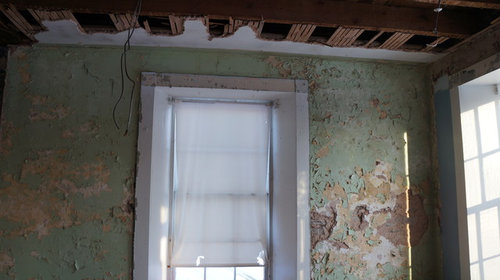
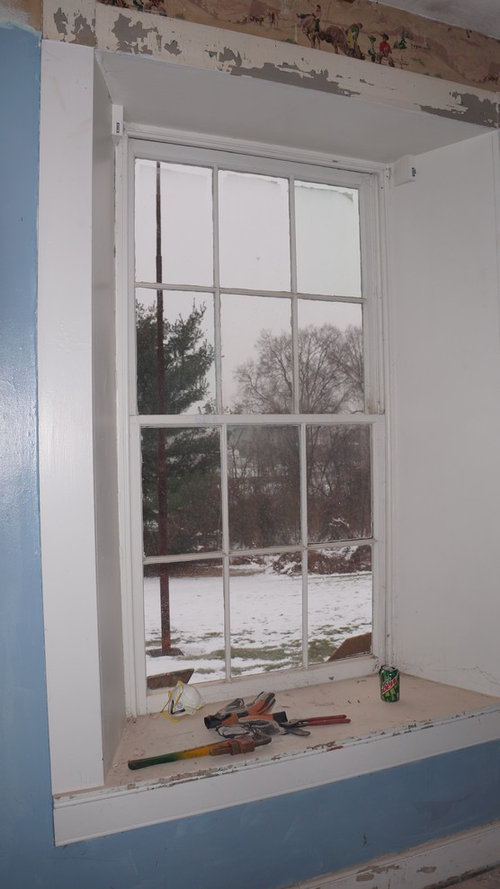
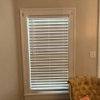
Is this the original window trim for a 1700's Georgian Colonial in PA?

Was wood trim usually stained or painted?

Comments (12)

  • PRO
    12 years ago
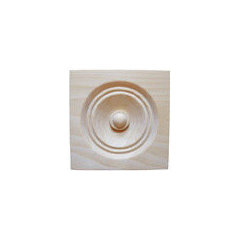
    Paint it WHITE and add corners
  • 12 years ago
    last modified: 12 years ago
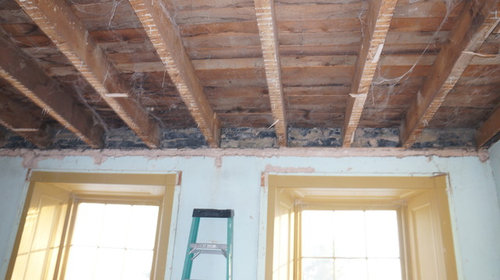
    Painted was the style back then in most homes. I'm wondering if the floor joists are somewhat later. And perhaps the trim--do I see corner blocks there?--that is Victorian. Not that you should change it, but it reflects the history of the building. Exposed beams were not the norm then either BTW, especially in the public areas.

    I hope you have a really good builder or designer with experience in these sort of homes to help guide you. Love the thick walls and large windows.
  • 12 years ago
    Do you have a local historical society or expert in your town or neighboring town? Often a local library will have information or be able to steer you to an authority for authentication of your architectural elements.
  • 12 years ago
    Corner blocks would definitely be of a much later period. I'm surprised the deep windows have smooth sides and not raised panel.
  • 12 years ago
    Bluenan,
    Thank you, yes we have consulted with two local preservation architects and have spent months researching the history of the home. We have compiled a nice size binder but have hit a dead end and are stuck on the particulars of the home. We have general information about the styles used but they are so varied we are a bit overwhelmed with which is the most accurate.
  • 12 years ago
    The windows on the east side have raised panels and the windows on the west side are flat.
  • 12 years ago
    Gorgeous facade...are you putting a porch on?
  • 12 years ago
    You really have a wonderful gem there! I understand and admire your desire to get it right. It sounds like you're doing everything you can to research the style and period. Are there any homes in your area that are of similar age and style to yours that you might be able to visit? Perhaps strike up a friendship with owners of like homes with whom you could share information?
  • 12 years ago
    last modified: 12 years ago
    I took a look through your ideabooks and posts and you have a nice gem of a house there that has seen some hard times. What terrific post and beam and masonry construction. I believe that this was a fairly simple Georgian home and that the original moldings were quite simple from what I can see, and it has lost a fairly large portico with a second floor entrance to the roof (which might have been a later addition).

    The thing is, a house in this condition probably cannot be restored to "original" condition, especially if it isn't going to be a museum. Unless you can find old photos or drawings of the place, whatever you do will be an educated guess. However, that doesn't mean you have to tear out all the doors and window casings because they probably were replaced around 100 years or so after it was built. The Victorian changes have acquired their own historic importance and are simple enough to fit into the earlier architecture.

    I would advise that you take lots of pictures of homes from a similar period in the mid-Atlantic, and adapt a simple version of what you see with a very good finish carpenter and plasterer, preferably one who knows how to use hand tools.

    Proportion is very important to get this style of home right, not just the details. Here is a good source on traditional moldings: http://www.thisiscarpentry.com/2010/12/03/misused-confused-chair-rail/
    http://www.kuikenbrothers.com/products/moulding-and-millwork/kuiken-brothers-moulding-design-guide
    http://www.thisiscarpentry.com/2008/10/01/terminating-versus-supporting-moldings/

    And "Get Your House Right" is a good basic guide to the basics of traditional design and proportion. Carpenters, architects and builders used to study and work with proportion and design and spent years refining the details, but now it is all off the shelf and we have lost the art of doing it right for the most part. The blog Enron Hall can give you some clues about someone who really cared and taught himself the craft to repair the original, although the addition he built is out of scale to the rest of the house IMHO. but the quality of construction and detailing is high.

    Rather than trying to rebuild or duplicate what isn't there, you could go completely contemporary with very simple finishes, and keeping what detail that is left as a contrast.. It is rather a detective hunt to figure out what's what in a house like this, and you can even have some "windows" to leave bare some of the structure. And whatever you do, the guide should be can this be reversed? Am I keeping as much of the original as I can?

    And I certainly hope you kept most of the wood from that skip--old handsawn wood is nearly irreplaceable, even the lathe is worth keeping. Incidentally, I believe the marks on the beams are from a pit saw, but I'm not an expert on this period of home.

    There are lots of consultants in the Philly and Eastern seaboard area who are experts and you should consult with them, and get the building listed for tax credits--which could be as much as 45% of qualified expenses, combined Pennsylvania and federal for commercial property. http://www.portal.state.pa.us/portal/server.pt/community/rehabilitation_investment_tax_credit_program/2646
    http://www.preservationpa.org/uploads/Advocacy/Act85.pdf pp103-105

    Plus the state office can offer lots of advice, lists of qualified consultants, and so forth, perhaps put you in touch with similar developments in the area you can consult with and answer your questions like, should I keep the front door, what color should I stain the floor, what kind of light fixtures should I use, etc... that you have posted.

    Mount Vernon and Monticello are excellent sources of information and research on colonial architecture and building practices, and could be helpful as well. John Leeke's website and blog is a terrific resource, and he works a lot with Colonial-era homes. http://www.historichomeworks.com/hhw/reports/reports.htm

    At any rate, this is a project that requires expert guidance and craftsmanship to bring to fruition.
  • 12 years ago
    Excellent post, victorianbungalowranch.
  • 12 years ago
    Thank you for all your helpful tips. I think my mother just picked up "Get Your House Right" from the local library. I will most certainly check out all your suggests.