
Search results for "Rate too" in Home Design Ideas
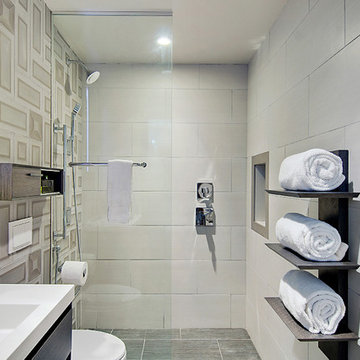
Example of a small trendy stone tile porcelain tile walk-in shower design in New Orleans with a wall-mount sink and a wall-mount toilet

 Addition Building & Design, Inc.
Relationship: Client
Project Date: March 2014
Project Price Range: more than $100,000
Having purchased our first house in Valley Glen, North Hollywood, we were aware it was in need of serious remodeling. A 1950s Ranch-style home, it came complete with peeling wallpaper, musty carpeting, and even some dilapidated walls. As first-time homeowners we were prepared to spend more money to improve it, but weary when we began meeting contractors. Buyer’s remorse already set in when we interviewed several contractors who were either aloof or unscrupulous.
Then we were fortunate enough to find Mike Ross. He immediately allayed our stress with his professional and forthright demeanor and his integrity was as rock solid from the day we met him through the several months it took to complete our large renovation.
While we had some specific things we wanted in our house, Mike and his team took our wish list and far exceeded our expectations to help truly realize the vision of our dream. Originally a three-bedroom, fourteen-hundred square foot home, our remodel brought an addition of a thousand square feet as well as an overhaul of the landscape; this prospect was particularly daunting for uninitiated owners such as us, but Mike’s consummate professionalism shone through and made the task exponentially less stressful for us.
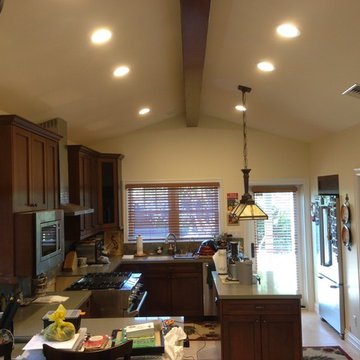
As well as a new 850 sf Master Bedroom, including a fireplace, and a steam unit in the bath, we added a cozy home theater room, laundry room, and the once forgotten backyard brought a new deck and patio with a trellis. Furthermore, because we went green and made it a smart home, we’re already more energy efficient. In several rooms, as well as the main hallway, for example, Mike installed solar tubes and the amount of natural light that bathes the house is amazing. Even my mom, when she came to visit, was always looking for a light-switch.
As our contractor, Mike Ross took the reins to steer the project and keep it on course and he did so exceptionally. Mike and his team were as attentive to the quality of every nook and corner and he always sought our approval and happiness. Consistently communicative, he always kept us in the loop about progress and was always there to answer any questions and concerns. When an unforeseen contingency did arise, Mike assuaged our concerns by taking action ASAP to rectify the problem. Mike’s team, too, all take pleasure in their efforts. An eclectic group of skilled artisans and craftsmen, they are all polite, punctual, and proud of their work.
Thank you, Mike Ross, for your outstanding leadership, your impeccable standards, and your commitment to our happiness.
Dale & Helen Keis
 Addition Building & Design, Inc.
Relationship: Client
Project Date: March 2014
Project Price Range: more than $100,000
Having purchased our first house in Valley Glen, North Hollywood, we were aware it was in need of serious remodeling. A 1950s Ranch-style home, it came complete with peeling wallpaper, musty carpeting, and even some dilapidated walls. As first-time homeowners we were prepared to spend more money to improve it, but weary when we began meeting contractors. Buyer’s remorse already set in when we interviewed several contractors who were either aloof or unscrupulous.
Then we were fortunate enough to find Mike Ross. He immediately allayed our stress with his professional and forthright demeanor and his integrity was as rock solid from the day we met him through the several months it took to complete our large renovation.
While we had some specific things we wanted in our house, Mike and his team took our wish list and far exceeded our expectations to help truly realize the vision of our dream. Originally a three-bedroom, fourteen-hundred square foot home, our remodel brought an addition of a thousand square feet as well as an overhaul of the landscape; this prospect was particularly daunting for uninitiated owners such as us, but Mike’s consummate professionalism shone through and made the task exponentially less stressful for us.
As well as a new 850 sf Master Bedroom, including a fireplace, and a steam unit in the bath, we added a cozy home theater room, laundry room, and the once forgotten backyard brought a new deck and patio with a trellis. Furthermore, because we went green and made it a smart home, we’re already more energy efficient. In several rooms, as well as the main hallway, for example, Mike installed solar tubes and the amount of natural light that bathes the house is amazing. Even my mom, when she came to visit, was always looking for a light-switch.
As our contractor, Mike Ross took the reins to steer the project and keep it on course and he did so exceptionally. Mike and his team were as attentive to the quality of every nook and corner and he always sought our approval and happiness. Consistently communicative, he always kept us in the loop about progress and was always there to answer any questions and concerns. When an unforeseen contingency did arise, Mike assuaged our concerns by taking action ASAP to rectify the problem. Mike’s team, too, all take pleasure in their efforts. An eclectic group of skilled artisans and craftsmen, they are all polite, punctual, and proud of their work.
Thank you, Mike Ross, for your outstanding leadership, your impeccable standards, and your commitment to our happiness.
Dale & Helen Keis
Find the right local pro for your project
 Ravenwood Developers LTD
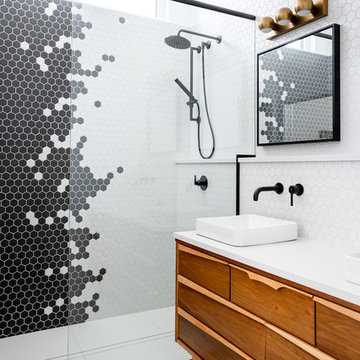
A full view of the ensuite bathroom showing the hex tile detail, curb less shower, custom vanity and fixtures
Example of a mid-century modern 3/4 black tile, black and white tile, multicolored tile, white tile and mosaic tile white floor bathroom design in Calgary with medium tone wood cabinets, white walls, a vessel sink, white countertops and flat-panel cabinets
Example of a mid-century modern 3/4 black tile, black and white tile, multicolored tile, white tile and mosaic tile white floor bathroom design in Calgary with medium tone wood cabinets, white walls, a vessel sink, white countertops and flat-panel cabinets

 safe ZOnea
If you’re active on GardenWeb sharing plant photos, asking for advice, tracking seasonal progress you already understand how much detail goes into gardening. Soil pH, rainfall, emerging leaves, bloom counts, fertilizer schedules it adds up fast. But all that rich information often remains buried in posts, lists or memory. What if you could visualize that data and turn it into clear quick insights? That’s where a graph maker becomes a game-changer for your gardening workflow.
1. Why garden data belongs on a graph
On GardenWeb, you’ll find forums for everything from perennial care, vegetable gardening, patios, herbs, even cooking and craft projects. While plant lovers share observations and ask questions, many track progress manually in spreadsheets or memory. A graph maker flips that around:
Instead of a list of numbers (e.g., “Soil test: pH 6.4 in May, 6.1 in October”), you get a line graph showing the decline over time.
Instead of guessing which plant bloomed most, you see a bar chart comparing counts across plants.
Instead of manually calculating average rainfall effect, you plot scatter points of bloom count vs. rainfall.
By turning your data into visuals, you’re not just recording—you’re analysing, learning and improving. For GardenWeb users this means smarter decisions: Which fertilizer actually improves bloom count? Which shady spot recovers slower? A graph maker gives clarity.
2. What is a graph maker and how to use one
A graph maker is a web tool or software that lets you input raw data (numbers, dates, categories) and output visual charts like line graphs, bar charts, scatter plots, etc. It might allow you to import a spreadsheet, select chart type, customize colours, label axes, and export the image for your blog, forum post or personal log.
Here’s how you could apply it for gardening:
Log blooms per week for each rose plant.
Using the graph maker, choose line graph to track changes over weeks.
Label your y-axis “Number of Blooms”, x-axis “Week of Year”.
Add colour lines for each plant for easy comparison.
Export as PNG and embed it in a GardenWeb forum post: “See bloom trend for my ‘Peace’ vs ‘Knock Out’ roses”.
This isn’t just pretty-to-look-at: it makes the trend obvious, invites discussion (“Hey, your ‘Knock Out’ line dips after week 28—what changed?”) and helps you refine your routine.
3. Use these specific scenarios on GardenWeb
A. Soil pH and plant health tracking
After multiple tests you have pH values over time and bloom results. Upload both datasets into the graph maker, produce a dual-axis line graph: soil pH on one axis, bloom count on the other. Post your findings in the “Soil, Fertility & Nutrients” forum and get feedback.
B. Seasonal pest or disease appearance
Record number of aphids spotted each month and whether you used treatment. A bar chart via the graph maker can show pre- and post-treatment figures. Then ask the “Insect & Disease Control” forum for advice based on your visual data.
C. Yield comparison between varieties
You grow two zucchini varieties. You keep weekly yield in pounds. Use the graph maker for a side-by-side bar chart. Share in the “Vegetable Gardening” forum: “Which was better this year? See the chart”.
D. Rainfall vs growth rate
You log weekly rainfall and growth (in cm) of your tomato plants. Use scatter plot in graph maker. If a pattern emerges, you’re ready to post: “Is my growth plateau due to drought? Chart shows a clear correlation.”
4. Why this elevates your GardenWeb contributions
When you post with a chart made by a graph maker, you’re doing more than asking or showing off. You’re investigating. You’re analysing. You invite the community to give feedback on data, not just anecdotes. That elevates the discussion. Instead of “My plant died, any ideas?” you post “See this graph of pH drop and bloom count—what might be the limiting factor?” High-quality visuals raise your post’s value and garner more thoughtful responses.
Plus, your posts become useful references for others: someone else can say, “Cool graphic, can you share your data sheet?” You build credibility and help the forum become a learning hub—not just a Q&A board.
5. Tips for using a graph maker effectively in the GardenWeb context
Keep it simple: One chart, one insight. Don’t overcrowd.
Label clearly: Titles, axis labels, units (e.g., cm/week, mg/L, °F).
Use readable colours: Avoid faint tones that vanish on mobile.
Annotate when needed: Add notes like “Fertiliser switched week 12” or “Shade cloth added”.
Provide context in your post: Don’t leave the chart alone—write a few sentences explaining what it shows and what you’re seeking.
Embed carefully: Make sure your image displays properly in GardenWeb; check mobile view.
Share raw data: If possible link to your spreadsheet so others can replicate or comment.
Be open to feedback: The chart invites questions; embrace them.
6. Possible pitfalls and how to avoid them
Bad data = bad chart: If your measurements aren’t consistent, your graph will mislead. Use standardized data collection.
Too much complexity: Multi-axis charts, too many variables—confusing. Stick to one or two variables.
Overlooking mobile viewers: Many GardenWeb users browse via phones. Use large fonts and simple visuals.
Ignoring the narrative: Chart alone won’t answer. Explain what it means and what you need.
Outdated charts: If you update your data annually, keep your visuals current or label them clearly as “2024 data”.
7. Final thoughts
On GardenWeb you’ll find a vibrant community of gardeners, DIYers, cooks and design lovers.Using a graph maker for your posts and progress turns your experience from casual hobby-logging into smart data-driven gardening. You’ll not only learn more—your peers will learn more, too.
So next time you log your plant growth, record your yield, test your soil or track pests—don’t just note it. Plot it. Use a graph maker. Share it in the forum. Let your garden tell the story, and let the community help you write the next chapter.

 41 West
Here's what our clients from this project had to say:
We LOVE coming home to our newly remodeled and beautiful 41 West designed and built home! It was such a pleasure working with BJ Barone and especially Paul Widhalm and the entire 41 West team. Everyone in the organization is incredibly professional and extremely responsive. Personal service and strong attention to the client and details are hallmarks of the 41 West construction experience. Paul was with us every step of the way as was Ed Jordon (Gary David Designs), a 41 West highly recommended designer. When we were looking to build our dream home, we needed a builder who listened and understood how to bring our ideas and dreams to life. They succeeded this with the utmost honesty, integrity and quality!
41 West has exceeded our expectations every step of the way, and we have been overwhelmingly impressed in all aspects of the project. It has been an absolute pleasure working with such devoted, conscientious, professionals with expertise in their specific fields. Paul sets the tone for excellence and this level of dedication carries through the project. We so appreciated their commitment to perfection...So much so that we also hired them for two more remodeling projects.
We love our home and would highly recommend 41 West to anyone considering building or remodeling a home.

 Lighthouse Studios Residential Design
zoonmedia
Mid-sized trendy u-shaped medium tone wood floor and brown floor eat-in kitchen photo in Calgary with a single-bowl sink, flat-panel cabinets, quartz countertops, white backsplash, ceramic backsplash, stainless steel appliances, a peninsula and dark wood cabinets
Mid-sized trendy u-shaped medium tone wood floor and brown floor eat-in kitchen photo in Calgary with a single-bowl sink, flat-panel cabinets, quartz countertops, white backsplash, ceramic backsplash, stainless steel appliances, a peninsula and dark wood cabinets
Sponsored
Columbus, OH
Free consultation for landscape design!

Peabody Landscape Group
Franklin County's Reliable Landscape Design & Contracting

 Sparrow Lane Interiors Inc.
Transitional single-wall brown floor dedicated laundry room photo in Toronto with a farmhouse sink, shaker cabinets, gray cabinets, gray walls, a side-by-side washer/dryer and white countertops

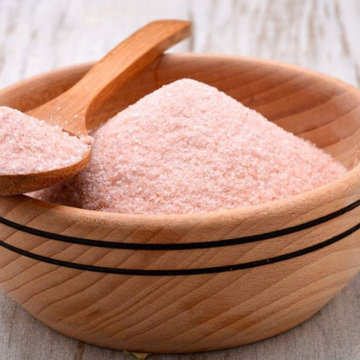 safe ZOnea
Every year, the same thing happens. The first real snowfall arrives, demand for de-icing materials spikes overnight, and the businesses that waited too long find themselves scrambling for supply at the worst possible moment. Facility managers, property owners, contractors, and municipalities all depend on a steady supply of salt and ice melt to keep their properties safe and operational through winter. The ones who plan ahead sail through. The ones who don't pay more, wait longer, and take on real risk.
Sourcing de-icing materials well is not complicated, but it does require thinking ahead and understanding the options. The choices you make about what to buy, how to buy it, and who to buy it from have a direct effect on your costs, your reliability, and your ability to keep people safe when conditions turn dangerous. This article lays out what matters.
Why Your Choice of Supplier Matters More Than You Think
It is easy to treat de-icing material as a commodity, something you grab whenever you need it without much thought about where it comes from. That works fine until the moment it doesn't, usually in the middle of a storm when everyone needs supply at once and the casual sources have run dry. At that point, the relationships you built before the season become the difference between staying stocked and being stuck.
Reliable supply is the whole game in winter operations. A property that runs out of ice melt during a storm faces safety hazards, liability exposure, and disruption, none of which can wait for a back-ordered shipment. This is why establishing relationships with dependable rock salt suppliers before the season starts is one of the smartest moves a facility manager or contractor can make. It locks in supply, often locks in better pricing, and removes a major source of mid-winter stress.
The lesson here is to treat sourcing as a planning decision rather than a last-minute errand. The businesses that come through winter smoothly are almost always the ones that secured their supply chain early, chose suppliers who could actually deliver when it counted, and never had to gamble on finding material during a shortage. Reliability bought in advance is far cheaper than scarcity paid for in a crisis.
Bagged or Bulk: Matching the Material to the Job
One of the first practical decisions is whether to buy de-icing material in bags or in bulk, and the right answer depends entirely on the operation. Each format has clear advantages, and many operations end up using both for different purposes.
Bagged material offers convenience, control, and easy storage. It is simple to handle, easy to distribute to different locations or crews, straightforward to store without special equipment, and convenient for spot application by hand. It suits smaller properties, businesses without bulk storage, and situations where portion control and tidiness matter. Bulk material, on the other hand, tends to make sense for large operations that go through high volumes, where buying in quantity lowers the per-unit cost and the operation has the equipment and space to store and handle it. The tradeoff is between the convenience and flexibility of bags and the volume economics of bulk.
For many operations, the right approach is a mix: bulk for the high-volume core of the work and bags for flexibility, spot treatment, and locations where bulk handling is impractical. The key is to match the format to how the material will actually be stored, moved, and applied, rather than defaulting to one or the other out of habit. Thinking this through in advance avoids both the waste of over-buying bulk you can't handle and the expense of relying entirely on bags for a large operation.
Rock Salt Is Not Your Only Option
Rock salt, or sodium chloride, is the workhorse of winter de-icing for good reason. It is effective, widely available, and cost-efficient, which makes it the default choice for most operations most of the time. But it has limits, and understanding the alternatives helps you choose the right material for the conditions you actually face.
The most important limitation is temperature. Rock salt becomes less effective as temperatures drop, and in genuinely cold conditions it can struggle to do the job at all. This is where alternatives come in. Calcium chloride, for instance, works at much lower temperatures than rock salt and acts quickly, which makes it valuable when conditions are severe or when fast melting matters. Operations that face hard freezes or need dependable performance in extreme cold often keep calcium chloride for sale on hand for exactly those situations, using it alongside rock salt rather than instead of it.
The practical approach is to understand the conditions your property faces and stock accordingly. For many operations, rock salt handles the bulk of the work while a faster, colder-rated material like calcium chloride covers the extreme days when ordinary salt falls short. Matching the material to the temperature and the urgency of the situation is what separates an operation that stays ahead of winter from one that is constantly reacting to it.
Securing Your Supply Before the Season
Knowing what to buy is only half the equation. The other half is making sure you can actually get it when you need it, which means securing your supply before winter arrives rather than after it has already started. Timing is one of the most underrated factors in winter operations.
The logic is simple. Demand for de-icing materials is highly seasonal and spikes sharply during storms, when everyone needs supply simultaneously. Prices and availability both move against the buyer at exactly those moments. By contrast, planning ahead, estimating your needs and arranging supply before the season, puts you in a far stronger position. Working with established rock salt suppliers ahead of time means your material is accounted for before the rush, often at better pricing and with the confidence that it will be there when the first storm hits.
This kind of planning also lets you think clearly rather than react under pressure. You can estimate your seasonal needs based on your property and past winters, decide on the right mix of materials and formats, and arrange storage in advance. Operations that do this consistently spend less, worry less, and never find themselves making frantic calls during a storm. The effort of planning ahead is modest, and the payoff in reliability and cost savings is substantial.
Storing and Handling What You Buy
Securing supply is not much use if the material degrades before you can use it, which makes proper storage and handling an important and often overlooked part of the equation. De-icing materials are sensitive to moisture, and poor storage can turn a good supply into a clumped, hardened mess that is difficult to apply.
The fundamentals are straightforward. Keep material dry and protected from moisture, since salt and ice melt readily absorb water and can harden if exposed. Store it in a way that suits the format, whether that means a proper bulk storage area or a dry space for stacked bags. Keep it accessible, so crews can get to it quickly when a storm hits and time is short. And handle it with the right equipment for the format and volume, which protects both the material and the people working with it. None of this is complicated, but neglecting it can undermine even a well-planned supply.
Good storage practices protect the investment you made in securing supply early. There is little point in arranging your materials ahead of the season only to have them degrade before use. Treating storage and handling as part of the overall plan, rather than an afterthought, ensures that the material you secured is actually usable when the moment comes. It is the final link in a supply chain built to perform under winter conditions.
Estimating How Much You Actually Need
One question trips up operations of every size: how much de-icing material to buy. Order too little and you risk running short during a storm. Order too much and you tie up money and storage space in material you may not use. Getting the estimate reasonably right is a meaningful part of sourcing well.
Several factors shape the answer. The size and type of the areas you treat, sidewalks, lots, entrances, and drive lanes, set the baseline for how much material each application consumes. The local climate matters too, since colder regions and those with frequent snowfall go through far more material than milder ones. Application frequency depends on how often storms hit and how quickly surfaces need to be cleared, which varies with the kind of property and the expectations of the people who use it. And the type of material plays a role, since different products are applied at different rates.
Past experience is often the best guide. Operations that track what they used in previous winters, adjusted for the size of the property and the severity of the season, can estimate their needs with reasonable confidence. For newer operations without that history, it helps to plan conservatively and to work with a supplier who can replenish stock reliably, so that a low estimate does not turn into a mid-storm shortage.
The goal is not perfect precision but a sound, slightly cautious estimate paired with a dependable supply relationship. That combination lets an operation keep enough material on hand to handle the season without over-committing to volume it cannot store or use. Thinking this through before winter, rather than guessing during it, is one more way that planning ahead pays off when the snow starts to fall.
The Bottom Line
Sourcing de-icing materials well comes down to a few straightforward principles: plan ahead, choose reliable suppliers before the season, match your materials and formats to your actual needs and conditions, and store what you buy properly. The operations that follow these principles move through winter with confidence, while those that improvise pay more and take on needless risk.
Winter is predictable in one respect: it arrives every year, and demand for de-icing material spikes the moment it does. The businesses that prepare for that reality, rather than being surprised by it, are the ones that keep their properties safe, their costs controlled, and their operations running no matter what the season throws at them. A little foresight before the first snowfall pays off through every storm that follows.

 Five Star Tree Care
In today’s society, people are used to things happening instantaneously, and they expect everything to happen at a fairly fast pace. However, when dealing with things like trees, there is no rushing mother nature and the natural growth process. If you are wanting your yard to instantly look the exact way you want it; lush and full, you might not be willing to wait and make your decisions based on what can grow the fastest in order to get your desired look of the end result. If you do this, you can potentially be selling yourself short on all the beautiful trees that are slower-growing. There are both pros and cons to slow-growing and fast-growing trees. We here at Five Star Tree Services would like to offer to take a look at the different growth rates of trees and help you understand what is best for your yard.
Tree Growth Rate Calculation
Tree growth rate can generally be calculated in a few different ways.
Continuously measure the stem diameter, crown spread, and height over time.
Measure the elongation of shoots annually. You can do this by finding the bud scars on the branch tips and measuring between them.
Average growth rate can be calculated by taking the change in size and dividing it by the elapsed time to date.
Fast Growing VS Moderate and Slow Growing- How to Choose?
There are different factors that go into why people choose certain trees, this could be due to wanting a quick privacy fence, or because of the colours, or their flowers, or the amount of shade they offer. There are advantages and disadvantages you need to think about before you go and only plant fast-growing trees.
Slow Growing Trees
Slow Tree Growth Rate- 12 inches or less every year. These trees end up being stronger than other trees for overall structure and strength. Since they are slow growing, these trees can end up living for more than 100 years, given the right growing conditions. You will also find that they can resist/have better defenses against things like disease and insects, as well as having stronger wood. Some examples are White Oak and Rocky Mountain Douglas Fir.
Moderate Growing Trees
Moderate Tree Growth Rate-13 – 24 inches every year. These trees usually have very similar traits to slow growing trees. Some examples are Sugar Maple, Coast Douglas Fir, and American Sweetgum.
Fast Growing Trees
Fast Tree Growth Rate- 25 inches or more every year. These trees do not typically live as long as the other trees due to them being weaker from growing so fast. An example is the Arborvitae “Green Giant”.
Reasons To Avoid Fast-Growing Trees
The unfortunate truth about these kinds of trees is that they tend to get more diseases and root rot than the other trees. Which brings us back to the point where you shouldn’t only buy a tree because it grows fast, especially since they have shorter life spans.
It is always a good idea to have a balance of plant life in your yard. Too much of one thing will throw off the balance, you don’t want all fast-growing trees simply because you wish to fill out your yard. This will only set you up for failure down the road. Not to mention you will need to spend more money on replacing them when they die sooner, as opposed to long living trees.
How Five Star Tree Service Can Help
Picking the right trees for your yard can take time. Balance is always good and even if you want everything to look perfect right away, you can’t sustain this if all you use are fast-growing trees. Let our team at Five Star Tree Service help you pick the best trees for your property! Our experts can offer you all the Toronto Tree Care you will need. Give us a call today at (416) 990-3355!
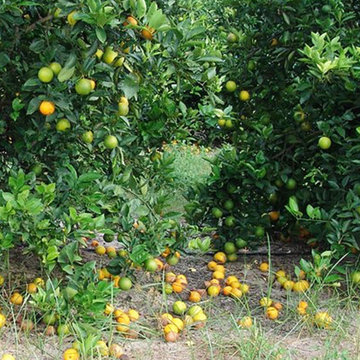
 gardenaar
Does your orange tree drop its fruit before it reaches full size, or worse, does it drop flowers before the fruit starts to form?
Trees photosynthesize to produce carbohydrates like sugar which they store as a source of energy. They can maintain a limited amount, which is used to drive the growth of new leaves, branches, roots and stem. Fruitfulness requires the tree to divert its limited energy sources away from these vital functions to the production of flowers, blossoms and fruits.
Fruit development involves maturity followed by fertilization, growth, maturity and maturity. This process takes between 6-7 months in warmer climates, which requires a large number of tree energy sources as a result.
Trees are able to manage their resources, and will also divert them to emergencies ...
Fruit Drop and Crop Depression
In regions where oranges produce one crop per year, they go through a series of growth stages as follows:
Sprout formation and flower launching (mid-winter)
Flowers and fruit set (early spring)
Fruit growth - cell division (late spring to early summer)
Fruit growth - cell proliferation (mid-summer to early autumn)
Fruit ripening (autumn to late winter)
The difference is in the regions where most citrus crops are produced year-round. In these cases, the different stages of development will take place simultaneously.
The orange tree can handle its plant load well, and it will bear as much fruit as we can support. It is natural for all citrus trees to produce too little fruit and too little flowers in early spring to prevent overproduction. There is no need to worry too much about flowering, as an orange tree needs only 1% to 2% of flowers to produce a good crop, and sometimes even less than 1% is enough.
If a tree is depressed because it does not get enough water in hot, dry weather, and if it dies of nitrogen starvation because it is not given enough fertilizer, fruit set will be very difficult in the spring. There may also be a small number of fruit losses in the summer under stressful conditions.
Solution: Provide enough water, and water often in hot weather and strong winds. Orange feed with moderate fertilizer in early spring (September in Southern hemisphere, March in the Northern Hemisphere)
Fruit Drop and Lack of Potassium Nutrient
When orange trees are heavy, the decline in fruit can be exacerbated by low potassium levels.
Potassium, also known as potash (represented by the chemical mark K on fertilizer labels meaning N-P-K or nitrogen-phosphorus-potassium ratio) is a major macronutrient needed for flowering and fruit formation. Next to nitrogen, plants absorb more potassium than any other nutrient. Without potassium, the trees stop flowering and fruiting, which is what happens if they are not fed regularly.
Before any smug horticulturist declares to you that potassium has no direct effect on flowering and fruit set, let me say that as a horticulturist and biochemist, plant chemistry, like the chemistry of all living things is complex, but some input it is necessary to produce certain results. , and the references I have made to the end of this article support what I am saying!
Entering science, Potassium (K) is essential for water, nutrients and the movement of carbohydrates in plant tissues. It also activates enzymes that facilitate the synthesis of complex chemicals within the plant - such as starch, protein and adenosine triphosphate (ATP) production. The role of ATP is to transport the energy needed for all cellular metabolic activities to all living things, and in plants ATP production can regulate the level of photosynthesis.
Potassium also helps regulate the opening and closing of stomata, holes or cavities under which oxygen and carbon dioxide are exchanged with the atmosphere, and respiratory losses are controlled. It increases root growth which increases the absorption of nutrients and improves drought resistance, and increases resistance to frost, pests and diseases. High potassium levels produce similar maturity and fruit growth rate, as well as better nutritional quality, taste and range.
Agricultural extension agencies suggest that large amounts of potash are needed in many crops, and that potassium deficiency or macronutrient deficiency leads to reduced crop growth and reduced yields, and that potassium levels not only affect yield, but fruit size, juice. quality and shelf life.
Since potassium plays an important role in water regulation, deficiency can clearly increase the pressures associated with the declining fruit mentioned in the previous section.
Solution: Make sure that the orange trees are fertilized with the right fertilizer as previously discussed. Extra potassium can be brought in using seaweed extract (which is not a fertilizer but contains a good amount of potassium), wood ash (used in small quantities only as it is very alkaline), or potash sulphate (potassium sulphate) - all this is guaranteed. as acceptable in a natural garden.
Never use potassium chloride as it can be harmful to plants, it is a very inexpensive alternative to fertilizer manufacturers to save money!
Even if there are sufficient levels of potassium in the soil, it may not be accessible to plants, unless we make some improvements.

 Clay Construction Inc.
Clay Construction | clayconstruction.ca | 604-560-8727 | Duy Nguyen Photography
Large transitional white two-story wood exterior home photo in Vancouver with a shingle roof
Large transitional white two-story wood exterior home photo in Vancouver with a shingle roof



 Webb Yates Engineers
Client: Private
Architect: Cousins & Cousins Architects
Contractor: Romark Projects Ltd
Photography: Jack Hobhouse
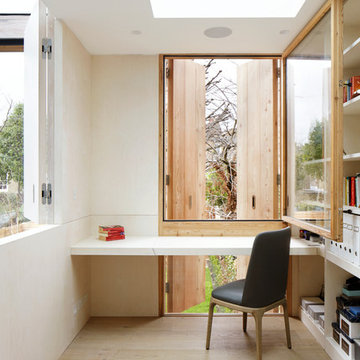
Inspiration for a small contemporary built-in desk light wood floor and beige floor home office library remodel in London with white walls
Inspiration for a small contemporary built-in desk light wood floor and beige floor home office library remodel in London with white walls

 Finchstudio
Alexandra Dermont
Trendy light wood floor bedroom photo in Other with white walls and no fireplace
Trendy light wood floor bedroom photo in Other with white walls and no fireplace
 Square Footage Inc.
Photo by Valerie Wilcox
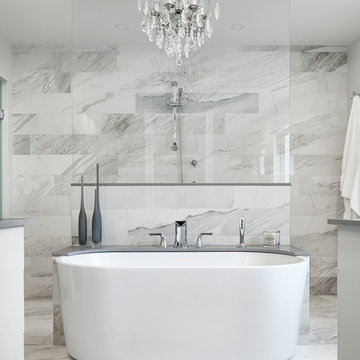
Inspiration for a transitional master gray tile, white tile and marble tile marble floor bathroom remodel in Toronto with flat-panel cabinets and white cabinets
Inspiration for a transitional master gray tile, white tile and marble tile marble floor bathroom remodel in Toronto with flat-panel cabinets and white cabinets
Sponsored
Columbus, OH

Hope Restoration & General Contracting
Columbus Design-Build, Kitchen & Bath Remodeling, Historic Renovations

 Michelle Graham Design
Photo Credits to Marc Fowler of Metropolis Studio
Example of a trendy white tile gray floor alcove shower design in Ottawa with flat-panel cabinets, white cabinets, a wall-mount toilet, purple walls, an integrated sink and white countertops
Example of a trendy white tile gray floor alcove shower design in Ottawa with flat-panel cabinets, white cabinets, a wall-mount toilet, purple walls, an integrated sink and white countertops
 Palmerston Design Consultants
Lisa Petrole
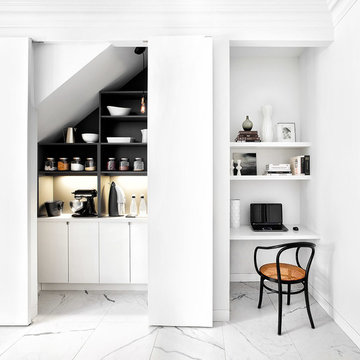
Example of a large trendy single-wall marble floor kitchen pantry design in Toronto with flat-panel cabinets, white cabinets, quartz countertops, an undermount sink, white backsplash, stone slab backsplash, stainless steel appliances and an island
Example of a large trendy single-wall marble floor kitchen pantry design in Toronto with flat-panel cabinets, white cabinets, quartz countertops, an undermount sink, white backsplash, stone slab backsplash, stainless steel appliances and an island

 Nathalie Priem Photography
Nathalie Priem
Mid-sized 1950s master carpeted and gray floor bedroom photo in London with white walls
Mid-sized 1950s master carpeted and gray floor bedroom photo in London with white walls
9