Software
Houzz Logo Print
ralph31558

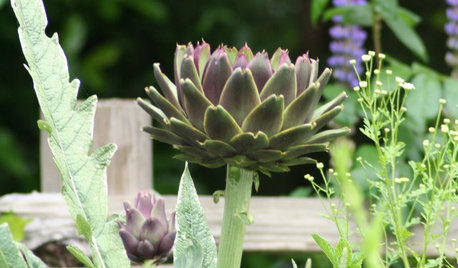
cardoon

16 years ago

Can i grow cardoon transplants in individual containers?

if so what size will do the trick?

Thank you

Comments (10)

  • 16 years ago

    A big one, and keep in mind that this is one plant that will want water. If you do not, the stems will become pithy and not even good for soup. Next year I will plant it with other thirsty plants, mulch heavily, and water more.

    I can not tell you how deep the root goes, but it is a big one, and the plant itself easily tops five feet. It is known to have a preference for clay soil, which is why I failed a few times. This year I did plant a few in heavier soil and had much better success, five feet in a cold summer in partial sun. Still, lots of pithy stems.

    All in all, a poor candidate for containers IMHO. It is otherwise a wonderful veggie, clearly the best looking there is, and providing lots of edible stuff. It supports the liver, and you can eat pounds just with a little bowl of olive oil, salt, balsamic, and herbs. The soup, Tuscan-style (garlic, parsley, bacon or sausage, and croutons), is amazing.

    This year I buried two under straw (I dug up whole plants with a chunk of root and some dirt around it), and in December when I finished them they were lily white, crisp as just picked, and not bitter at all. So I think i am getting my cardoon technique down pat, and next year I will plant a dozen plants to last me through the winter. The seeds have poor germination, and although it is cold-hardy in its mature stage (I picked a plant for Thanksgiving), it needs to be set out well after last frost.

  • 16 years ago

    Cardoons look a lot like thistles to me so i thought that they would be less thirsty plants. Intersting to hear that is not so.

    Did you bury them in straw for storage or is that a blanching technique?

    i understand the stalk is the edible part of the cardoon. Is that the entire stalk or only certain parts?

  • 16 years ago

    If you don't water them the plant will still look good (it does have a tap root, so it does what you expect it to do) but the stalks will be pithy. So you have to water them. Similar to celery, and in fact next year I plan to plant them together.

    I buried them for storage, but the blanching that resulted from it was better than any field blanching I had tried so far. They were well covered, in a trench with straw on top and hoophouse on top.

    The stalks are all edible, but:
    - not the part that has the leaf attached
    - you have to remove the white cuticle on the inside of the stalk and the fibers (and cuticle) on the outside. Easy to do, once you learn
    - the heart, a fist-sized part of the plant where all stalks come from, is the best part.

  • 16 years ago

    Thanks for the good clear info, glib. I am planning to grow cardoons this year. Unfortunately my soil is droughty but I can irrigate.

    Jim

  • 16 years ago

    Yes, thank you for the info.! I have 4 little guys in 3" pots and have removed an extra- that little root was about 3 inches long already and it just popped out of the seed a few days back. Sounds like when I get my dream farm(ette) across the river I'll have to bring some clay with me if I like growing these guys. Just a quick question on taste- does it really taste like artichoke? 'Cause I love me some artichoke, especially with homemade hollandaise! Also, is there any rule of thumb as to when you blanch and harvest them? I mean, if I get impatient to try them in August, could I? Cheers!

    Sunni

  • 16 years ago

    glib,

    You're saying you dug them up and trenched them to winter over? I wondered about trying to save them like endive or something.

  • 16 years ago

    Do you have to dig the whole plant up or can you just harvest pieces of it? I have grown them from seed before but they didn't make it through the hot summer. Probably didn't water them enough. Thanx for the info on how to prepare them. I'm going to try some more this year.

  • 16 years ago

    They are slightly bitter, like many winter vegetables. The more you blanch them, the less bitter they become. They are definitely like other winter vegetables, you don't touch them until two weeks after frost to develop the sugars. No August eating, and no eating at all if your garden does not frost.

    You have to blanch them and clean them, otherwise they are still too bitter, and stringier too. The stalks should have no hint of green. Standard method is to wrap the stalks well, with anything that blocks light (cardboard, black plastic, secured with a string), for 4 weeks or more before eating. You have to do the frosting and blanching and cleaning well. It has to be pitch dark inside the wrap. You can wrap the stalks already during the growing season, the leaves on top of the wrap will keep on photosynthesizing.

    Prepared this way, the stalks have a juicy, fresh, crisp texture, with just a hint of bitterness which plays well against other things. It is certainly one of the top veggies when it comes to pounds of food per square foot, as it grows straight up and you eat most of it. I saw no pests or diseases here. It occupies the same place as a large head of cabbage. Besides soup, the cardoon gratin is terrific and yet another Thanksgiving instant classic.

    We had many appetizers in Nov.-Dec., with the aforementioned olive oil, salt, vinegar, and minced herbs, just large plates of cardoon, radicchio hearts, carrots, and the last radishes, dipping away, and it was incredible to have such freshness in winter.

    In regard to trenching them, I was going to try to bend them to the ground and cover them in place (like with figs in the North), to see if they could get past deep freezes, but I realized that I could not bend them (they would break). So I tried plan B. I did get a good piece of the root and watered the root ball and covered them enough that I felt they would not freeze. I was careful (no leaves which could lead to mold, large, well watered root ball, thick insulation) and luckily it worked. Possibly not everything I did was important, I will find out next year.

    Obviously that is going to be plan A now, and one has to wonder if they can last all winter that way. Quantity and truly fresh taste in winter? This thing is a blessing.

  • 16 years ago

    glib
    You have given us a wealth of information and that is great. With preparing them for the table, after they are cleaned and ready to cook, you must try breading the stalk as you would prepair say, a chicken cutlet before you fry it. Egg, breadcrumb,salt, pepper,coat them and fry, tasts great.

  • 16 years ago

    Yes glib, thanks, it has been interesting reading about your experience even tho' it seems cardoons are not too well suited to my garden.