Software
Houzz Logo Print
mannabrenda

Tomato problems

19 years ago

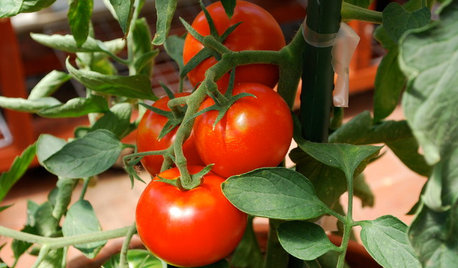
Hi, IÂm new here but I need some help with my container vegetable garden. I have 3 tomato plants that are "healthy" and full of fruit. My question isÂwhy are my ripening tomatoes turning black on the bottom? What do I need to do to resolve this? Also, IÂm having an issue w/ my feathered friends eating my ripening fruitÂI just attached long strips of foil to the tomato cages do you think this will be sufficient?

Thanks in AdvanceÂ.Brenda

Comments (12)

  • 19 years ago

    Sounds like blossom end rot. Fairly common. Google on blossom end rot and you will get a lot of info on it's possible causes and resolution.

    In many cases the fruits will do this for awhile and then the problem clears on it's own. The damaged fruit won't repair themselves, but the new fruit will often start developing normally.

  • 19 years ago

    Hello Mannabrenda,
    Justaguy2 is correct, it's blossom end rot. The disease is caused by a calcium deficiency. You can buy fertilizers to correct this, both man-made and organic. It wouldn't hurt to check the soil PH in your pots first, as PH imbalances can lock up calcium and other nutrients and make them unavailable to your plants. The soil for you tomatoes should be around 6-6.5.

    When I lived in California I had to add gypsum to the soil prior to planting to lower the PH. Alkaline soils lock up calcium and iron, making many plants chlorotic (green veins w/yellow leaves) and cause blossom end rot badly in tomatoes.

    Regards,
    Dan

  • 19 years ago

    RE: BLOSSOM END ROT

    This is a common disorder (physical) on tomatoes similarly for peppers and watermelons especially for containerized crops. BER is not pathogen associated, and the affected portion of the fruit can be cut out and the rest eaten.

    CAUSES: Researchers are not certain about the exact cause, but many think it is associated with a deficiency of calcium or plant water stress (excessive water loss, wet soils, dry soils, drying winds, and etc).

    PREVENTION & SOLUTIONS:
    1) Plant in well drained soil (not soggy or wet soils) for prevention.
    2) A good mulching program to reduce water loss from the soil during dry periods.
    3) Consistent watering to keep the potting mix sufficiently and adequately moist for good growth.
    4) Yearly application of gypsum - calcium sulfate in highly calcareous soils (soils containing calcium carbonate or limestone).
    5) The blemish looks worse than it actually is. You can either leave it and cut out the blemish when the affected BER-fruit matures, but it also makes sense to remove the affected fruit to allow for the development of additional blemish-free fruits once prevention and good soil moisture measures have been taken and adjusted.

    I'll leave the tomato problem related to feathered friends to someone with actual experience, but I believe some kind of netting should work.

  • 19 years ago

    Amending soil with gypsum does not change the soil pH (whereas liming does in raising the pH or alkalining the soil). Gypsum can supply calcium just as lime does, but unlike lime, its addition does not alter the pH of the soil. In fact, if a potting medium does not require liming, gypsum is preferred over dolomitic limestone in supplying calcium.

    To lower the pH of soil or potting mix to correct iron chlorosis, one could use elemental sulfur, aluminum sulfate, or iron sulfate. One would not use gypsum to acidify soil or potting mix.

    In addition to supplying supplemental calcium to restore nutritional balance as indicated by soil and water tests, gypsum is also correctly and effectively used to improve soil structure and drainage ONLY in sodic soil (soil structure and drainage affected by high Na+ content).

    For more in depth technical explanations, read articles at:
    The Use of Gypsum and Lime on Lawns and Gardens
    Applying Gypsum in Iowa - when is it really needed

  • 19 years ago

    Looks like I stand corrected.
    I dug a little further than just the two links you gave to see if what I knew was at least correct for the region where I gained it. Apparently in the Sacramento valley it was ( http://cesonoma.ucdavis.edu/hortic/pdf/changing_soil_ph.pdf ). I'm glad you pointed this out, this will be very useful info for me now that I'm living in the midwest.

    Regards,
    Dan

  • 19 years ago

    Brenda,

    I've grown container tomatoes many times in West Texas and blossom end rot is always a problem. There's nothing you can add to the soil to prevent it. Try to keep the moisture level consistent--use a really well drained potting soil and water often. Larger containers will help a lot--the only container tomatoes I've had that didn't get BER were half whiskey barrels (around 30 gallons).

    You don't need to add calcium--your water is likely very high in calcium.

    As for the birds, there's not much you can do besides surround the cages with bird netting. Your best bet otherwise is to pick the fruit just as it begins to turn color and let it ripen inside--the taste will be just as good.

    Jason

  • 19 years ago

    Jason...that was what I was afraid of. It is BER even if the black spot doesn't appear until after the fruit starts to rippen? Should I (heaven forbid) pick them green and let them rippen in the house?

  • 19 years ago

    Picking early to let them ripen off vine won't help.

    Let them ripen on the vine and cut the rotted portion off if BER isn't too severe otherwise discard the whole fruit.

    My own view is that a tomato plant has a finite amount of energy so as soon as I see a BER afflicted fruit I remove it. I am trying to conserve the plant's energy so it can put out another fruit and hopefully it won't have BER.

    Leaving a BER fruit on the vine is just a waste of plant time/energy in my experience.

  • 19 years ago

    Picking the fruit early won't help with BER, but it will help with the birds--they usually don't go after fruit until it turns red.

    I always discard fruit that has BER. One thing I've noticed is that it shows up the worst on the earliest ripening fruit but isn't as severe later in the season.

    Jason

  • 19 years ago

    Actually blossom end rot IS due to a calcium deficiency, and can be controlled via the use of soil additives.

    From Alabama Cooperative Extension System website:

    "Blossom-end rot is caused by calcium deficiency, usually due to fluctuations in water supply. Because calcium is not a highly "mobile" element in the plant, even brief changes in the water supply can cause blossom-end rot. Droughty soil or damage to the roots from excessive or improper cultivation, for example root pruning, restricts water intake and can prevent plants from getting the calcium they need from the soil. Also, if plants are growing in highly acidic soil or are getting too much water from heavy rain, over-irrigation or high relative humidity, they can develop calcium deficiency and blossom-end rot."

    The things that people do when growing tomatoes in containers that can contribute to BER are:

    1) use a lot of peat moss or a potting mixture with a lot of peat moss (Miracle Gro potting soil, I have noticed, is mostly peat moss), making for a highly acidic soil.

    2) over water or water unevenly, letting the plant dry out overly much between waterings, not using mulch. IMO, mulching plants in a container is even more important than mulching in the garden - container plants are much more susceptible to variations in moisture.

    3) OVER FERTILIZE!

    4) fail to plant BER resistant varieties and/or tomato varieties more suited to container growing.

    Some excellent resources about BER:

    University of Georgia:

    http://pubs.caes.uga.edu/caespubs/horticulture/blossom-rot.html

    The U of GA information is very thorough and very well-written, I highly recommend it if you want to know more about BER.

    GardenWeb FAQ on BER:

    http://faq.gardenweb.com/faq/lists/tomato/2000082444023571.html

    Anyone having repeated problems with BER in container grown plants can minimize, if not eradicate, the problem by using a potting mix with a pH of around 6 to 6.5; maintaining even soil moisture through the use of mulches and regular watering schedules; fertilizing only when a soil test indicates it is necessary (testing kits can be had fairly cheaply) or using a 5-10-10 granulated fertilizer SPARINGLY; and planting varieties that are less susceptible to BER to start with.

  • 19 years ago

    Thanks everyone for your tips and advise...I got some bird netting to close down my all you can eat buffet. And I'm delighted that some of my bigger tomatoes do not seem to have the BER!!! I will look into a pH kit to keep up on my soil's fert. needs
    Thanks Again and looking forward to a BLT feast :o)

  • 19 years ago

    You can skip the pH kit for containers, mannabrenda, the soil volume in a container is too small to even attempt to control pH.

    Are you using actual soil or a soiless mix?

    Something many container gardeners do is add a small amount of lime or gypsum to the potting mix to add calcium. If you are using a growing media you know to be very acidic then use the lime otherwise the gypsum.

    Beyond that I wouldn't worry about it.

    BER occurs even in EarthBoxes and these are self watering containers where the instructions require the use of a hefty amount of lime added to the mix. So, watering is even, fertilizer is consistent and pH is not acidic and still BER sometimes occurs.

    Some associate it with the weather, some associate it with the early fruit perhaps meaning the plant wasn't mature enough to support those first fruits etc.

    Unless it becomes a persistent problem year after year affecting a lot of your crop I would probably just accept it as one of those things that just happens sometimes.