Software
Houzz Logo Print
overcaffeinated

Container Mango Tree - size of pot/soil type

15 years ago

Hi there! I'm a very, very new gardener and have gone a bit overboard with my new pet projects.

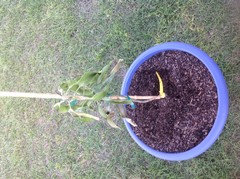
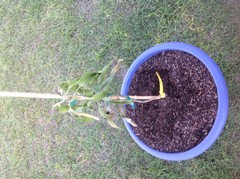
I have a Valencia Pride Mango tree (I think "grafted"--whatever that means) that I need to plant in a container ASAP.

Question 1: What is the recommended planter size container? I've heard 15 gallon, but then when I look for pots, they are not labelled by gallon size...rather in diameter.

Question 2: What is the best soil type to fill with. I've heard a lot of "No, no MiracleGro!" so I know to avoid that, but I've also heard that a volcanic-y soil is beneficial.

Suggestions?

Thanks in advance! I probably spent too much on this tree as a novice and really, really don't want to kill it!

Comments (19)

  • 15 years ago
    last modified: 11 years ago

    1) How large a container ‘can’ or ‘should’ be, depends on the relationship between the mass of the plant material you are working with and your choice of soil. We often concern ourselves with "over-potting" (using a container that is too large), but "over-potting" is a term that arises from a lack of a basic understanding about the relationship we will look at, which logically determines appropriate container size.

    It's often parroted that you should only move up one container size when "potting-up". The reasoning is, that when potting up to a container more than one size larger, the soil will remain wet too long and cause root rot issues, but it is the size/mass of the plant material you are working with, and the physical properties of the soil you choose that determines both the upper & lower limits of appropriate container size - not a formulaic upward progression of container sizes. In many cases, after root pruning a plant, it may even be appropriate to step down a container size or two, but as you will see, that also depends on the physical properties of the soil you choose.

    Plants grown in ‘slow’ (slow-draining/water-retentive) soils need to be grown in containers with smaller soil volumes so that the plant can use water quickly, allowing air to return to the soil before root issues beyond impaired root function/metabolism become a limiting factor. We know that the anaerobic (airless) conditions that accompany soggy soils quickly kill fine roots and impair root function/metabolism. We also know smaller soil volumes and the root constriction that accompany them cause plants to both extend branches and gain o/a mass much more slowly - a bane if rapid growth is the goal - a boon if growth restriction and a compact plant are what you have your sights set on.
    Conversely, rampant growth can be had by growing in very large containers and in very fast soils where frequent watering and fertilizing is required - so it's not that plants rebel at being potted into very large containers per se, but rather, they rebel at being potted into very large containers with a soil that is too slow and water-retentive. This is a key point.

    We know that there is an inverse relationship between soil particle size and the height of the perched water table (PWT) in containers. As particle size increases, the height of the PWT decreases, until at about a particle size of just under 1/8 inch, soils will no longer hold perched water. If there is no perched water, the soil is ALWAYS well aerated, even when the soil is at container capacity (fully saturated).

    So, if you aim for a soil (like the gritty mix) composed primarily of particles larger than 1/16", there is no upper limit to container size, other than what you can practically manage. The lower size limit will be determined by the soil volume's ability to allow room for roots to ’run’ and to furnish water enough to sustain the plant between irrigations. Bearing heavily on this ability is the ratio of fine roots to coarse roots. It takes a minimum amount of fine rootage to support the canopy under high water demand. If the container is full of large roots, there may not be room for a sufficient volume of the fine roots that do all the water/nutrient delivery work and the coarse roots, too. You can grow a very large plant in a very small container if the roots have been well managed and the lion's share of the rootage is fine. You can also grow very small plants, even seedlings, in very large containers if the soil is fast (free-draining and well-aerated) enough that the soil holds no, or very little perched water.

    I have just offered clear illustration that the oft repeated advice to ‘only pot up one size at a time’, only applies when using heavy, water-retentive soils. Those using well-aerated soils are not bound by the same restrictions.

    2) Re. your choice of soils: You may find that a thorough understanding of how container soils work will help you decide the best course. I grow everything woody in a soil others have named 'the gritty mix', which works extremely well. The principles behind why it works well can be found in the text at the embedded link I provided.

    Al

  • 15 years ago
    last modified: 11 years ago

    I really want to use the gritty mix iv read so much about but i dont even know what they really are let alone where to start looking for the ingredients. i have read the list of their names but dont actually know what they are or if there are common names for them... I live in Miami (south florida)and i have about a 4 foot carrie mango. Im about to pot-up and want to get a hold of the gritty mix before i do. if anyone lives in south florida that would know where to pick up the ingredients that would be amazing.

  • 15 years ago
    last modified: 11 years ago

    Strangely enough, I just left this reply on another thread, just minutes ago:

    Are you near one of these: Tampa, Sarasota, St. Petersburg, Miami, Fort Lauderdale, West Palm Beach?
    If so, Florida Silica Sand company has Turface MVP and a suitable gravel product (#10 filter gravel). I think I'd tend to shy away from limestone, but other inert types of rock would be suitable if the size is right. I actually prefer Cherrystone (quartzite).

    You might wish to consider adding your USDA zone and a large city you're near, + your state, to your user info. It will be helpful to folks replying to your posts.

    Al

  • 15 years ago
    last modified: 11 years ago

    Pug!!! Where are you?

    Maybe you could post a picture of your lovely Mango and let Overcaffinated know what you use...Your's is just beautiful!!

    Mike

  • 15 years ago
    last modified: 11 years ago

    Thanks Al. appreciate the help!

  • 15 years ago
    last modified: 11 years ago

    pug,

    do you mulch on top of the gritty mix? it doesnt seem as pebbley* as the pics of the gritty mix iv seen?

    your mango look great! hope my Carrie does as well with the gritty.

  • 15 years ago
    last modified: 11 years ago

    Wow! Those are lovely trees! The fruit looks awesome... and delicious! Great pictures!

  • 15 years ago
    last modified: 11 years ago

    The pictures of fruiting, containerized mangos has sold me. I will be buying at least one as soon as I decide on the right cultivar. Taste would be my primary concern, if its the right size but the fruit is of poor quality it would be pointless.
    Dan

  • 15 years ago
    last modified: 11 years ago

    Pug.....Gorgeous, gorgeous, gorgeous!! I am getting one next spring because of you.....Hey Pug,I dressed up my dog as a mailman this Hollowen, and he bit himself...lololol

    Hi Jodik!!! Hoping you are well and you are taking care of that back..I saw the latest rose pictures you posted and I must say, BEAUTIFUL...Thank you for that.

    Mike

  • 15 years ago
    last modified: 11 years ago

    Thank You everyone!

    Slane, NO, I do not mulch my trees...it is in the gritty mix. The smaller tree was under an Oak tree...and the leaves were "molting",lol...so there's a lot of dead oak leaves on top. I think part of what you're seeing on the top picture are some of the roots...I planted it a little higher. I potted it up to the(24") container in gritty mix also just this summer.

    Mike, You're hilarious!! "Bit himself",lol...

    Marcus, I couldn't agree with you more! If you're going to plant a Mango tree or any fruit tree...taste is very important! I will say one thing about taste though...it is subjective. What you love I may not and vise versa. I love all my Mango varieties that I've planted. Glenn, Cogshall, Pickering, Keitt and Lancetilla. I've researched and tasted all of them except Lancetilla...but I've heard/read very good results with that one as well.

  • 15 years ago
    last modified: 11 years ago

    You're very welcome, Mike... I'm glad you enjoyed them! :-) And yes, I have been very careful not to re-injure myself! I never want to have to go through that sciatic pain again! It was horrible! Good dog joke, Mike! LOL!

    Strangely, I'm not a huge fan of mangoes... but if I were to grow containerized miniature fruit trees, taste of the fruit would be a huge consideration. Why bother with a dwarf tree that produced tasteless or bitter fruits?

  • 11 years ago

    I recently bought Glenn mango tree and planted into bigger pot with miracle grow potting soil and seems to be dying what is reason for this


  • 11 years ago

    That pot is waaaay too big for such a small tree :o(...plus Miracle Grow potting soil is not recommended especially for mango trees.


    You can try to save it by moving it to a smaller pot and using a different potting mix...I would add some small pieces of Pine Bark or Orchid bark and Perlite or Crushed granite...mango trees prefer fast draining potting mix that keeps the soil moist not wet...let it dry out between waterings...Good luck!!

  • 11 years ago

    ..... agree with Nancy.

    Al

  • 10 years ago

    Have you given it any fertilizer ?

    often people grow mango from seed, and they will grow well while they are using the seeds energy. then, all of a sudden the growth stops when the seed runs out of energy, if it hasnt been fertilized

  • 9 years ago

    Hello,

    I live in Miami, Florida as well and I Fed-exed a few fruit trees from Puerto Rico, but I do not want to plant them on the ground as I do not want to scatter them around, cause the back yard will look messy and I want to build a pool. I am considering planting them in galvanized livestock bins...I have an orange tree, sour sop, guava, and acerola (its like a sweet sour cherry), also passion fruit. the back yard is going to be clean lines - modern industrial and the planters are "the one" for what I am trying to do. I also want to have control on how big the trees grow...any suggestions? thank you!

  • 9 years ago

    There is potential for zinc toxicity if you plant in galvanized pots ....... especially if soil/water pH are on the acidic side.

    There is plenty of potential for you to have complete control over your plants ht and width, but controlling its mass requires a little more finesse. IOW, your trunk is going to get thicker and thicker over time. You'll need to learn how to maintain your plants root system, because vitality, growth rate, and branch extension are all negatively affected by root congestion. At the approximate point where root congestion progresses to the stage where the entire root/soil mass can be lifted from the pot intact, limitations related to said congestion start affecting the plant and become progressively more limiting until there isn't much left of the plant. Usually, the plant succumbs to insect infestation or diseases as congestion worsens. BTW - potting up (as opposed to repotting, which includes root pruning) is not a cure for root congestion. It temporarily/partially leaves some of the associated limitations, but ensures those limitations will ALWAYS be in play until such time that you or someone familiar with root work actually gets their hands in the root mass and corrects the congestion.

    Al

  • 5 years ago
    last modified: 5 years ago

    I need help, trying to figure out potting mix for my mango trees I bought from Florida. I want to grow in pot in Charlotte, NC Zone 8; I have cogshall 4 feet, Pickering and Dwarf Hawaiian (1st year). I came up with a mix :

    1 part Sand,

    1 part Pumice,

    1 part peat moss,

    1/2 part perlite,

    1/4 part coco coir,

    1/10 part horticulture charcoal

    and already potted the cogshall and i am not liking it. Especially my sand is play sand. it does not seem right.

    Now I see there is Al's gritty mix and my materials are totally different. What should i do? Should I throw the ingredients I have and start from scratch? Al's mix has pine bark fines and I dont find it anywhere, I find only pine bark nuggets; Please suggest


    Also is it ok to replace play sand with this ? https://www.lowes.com/pd/EARTHESSENTIALS-BY-QUIKRETE-0-5-cu-ft/50437606?cm_mmc=shp--c--prd--lwn--google--lia--179--decorativestone--50437606-_-0&placeholder=null&ds_rl=1286981&gclid=EAIaIQobChMI9YGlgfjg8QIVGrrtCh1PDwyOEAQYASABEgJzYPD_BwE&gclsrc=aw.ds


    I am trying to see what should i replace with bark fine though i dont find it

Sponsored
Custom Home Works
Average rating: 4.6 out of 5 stars10 Reviews
Franklin County's Award-Winning Design, Build and Remodeling Expert