Software
Houzz Logo Print
paulns

from flat lawn to native shrub garden

18 years ago

Hi all,

The small local museum has hired my wife and myself to, among other things, turn a flat stretch of lawn about 60' long by 10-15' wide, on the side of the museum, into a native shrub garden. We're not professional landscapers but were hired on the strength of work we've done over the years on our own property. We have two strong teenagers helping us out.

A lot of challenges are presenting themselves and I was hoping you all might have some opinions and or advice.

One challenge is to make the area more interesting by creating contours. Another is killing all the lawn - and what do we replace it with? It seemed we could kill two birds with one stone by taking the thick circles of sod from digging holes for the shrubs, and the rectangles of sod from digging a 14" curved border (which we will line on the outer side with sunken plastic lawn edging, and then fill with sods of woodland groundcover alternating with newspaper/woodchip mulch) and arranging these sods, flipped over, to make gentle hills among the shrubs (no hill higher than two sods or about 1'). Then we would take nice rocks and boulders from the nearby woods, or that the boys dug up when making other holes, and arrange them amongst the hills.

There aren't enough sods to smother all the grass, and digging up every last piece of lawn would be a lot of work, so how to kill all the grass?

What to cover all those rolling hills of dirt with?

Would the newly transplanted shrubs have trouble growing roots into this changing topography?

I'm attached to the idea of doing the garden this way, but get stuck when I try to visualize the next steps.

Comments (8)

  • 18 years ago

    Sounds like a fun project.

    Your focus at the moment seems to be at ground levelÂeven taking into account the "contours" you're introducing. Maybe it's already in your mind, if not on the page, but there may be more in the site that needs to be addressed. This is basically a foundation bed? Are there windows to deal with? Sidewalks? Doors? Is it 10' or 15'? Small difference, but a 10' border is pretty narrow. That 5' difference could be useful.

    Just re-read your post. Maybe this bed is on one side of the museum but not at the foundation? Is it a bed that will be viewed from sidewalks and/or lawn?

    A picture would be helpfulÂnot to me, because I'm the "blink" poster, but my sightling friends like to see pics.

    Wellspring

  • 18 years ago

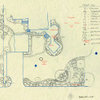
    Thanks Wellspring. You're an excellent visualizer. Here's the landscaper's plan. They're calling the whole thing a Settlers' Garden. Lots of design challenges, many of them to do with edging.

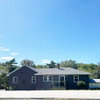
    The museum is on the right. The wall and garden face WNW which is a challenge in itself, as we planted some shrubs a few weeks ago almost into the teeth of a three day Arctic gale from that direction. Hope they survive.

    The widest part of the bed is more like 25'. There will be a ~3' space between the museum wall and any planting. There's only one window, and we're putting a low-growing shrub under it. I'll try to get some photos of the mess we're making today. :)

    {{gwi:52629}}

  • 18 years ago

    It may be more work, but ultimately it would be easier to maintain if you sod cut all the turf area, flipped it over to do your mounding, and then did the spaghetti mulch with cardboard thing to keep the grass dead, before starting any new plantings. This would also presume that you aren't dealing with any perennial invasive grass species such as Cynodon dactylon(Bermuda Grass), which would need several herbicide treatments to completely kill.

    If you haven't budgeted for this extra work, it may be difficult to go back and ask for more to cover it, but the end results will be much more manageable to maintain than just piecemeal removal of sod. Your intended approach sounds like a long term maintenance headache to me...

  • 18 years ago

    I understand there is a tool called a sod cutter which I hope you know about.

    KarinL

  • 18 years ago

    I took pictures but they're way overexposed - will try again.

    We have two sod cutters - Ryan and Jason. They're amazing - when they get their teeth into a project. Almost comatose when they don't.

    Bahia, you've expressed my concerns but I still couldn't see any alternative. What we have now is low mounds of flipped over overlapping sods arranged toward the back of the bed, among the shrubs there. We'll round out the mounds with topsoil, and then place among them the largest rocks the boys can move, and plant woodland groundcovers - we have a pretty generous budget for plants. Also try to establish some moss.

    The way I see it, grass is a perennial pest anyway (although no worries here about invasive species like Bermuda). So we'll deal with it as it rears its head - which it will do more than if we'd turned all the sod, but that seemed too daunting a task to tackle manually. The lawn that's left we'll try smothering under fine sawdust topped with eelgrass - a good natural lawn-killer.

    One of my favourite books is Landscaping with Nature by Jeff Cox (Rodale Books). He reinforces this idea with his description of Rock and Berm Designs p. 32

    It is a fun project, Wellspring. Really a dream job.

  • 18 years ago

    Hello,

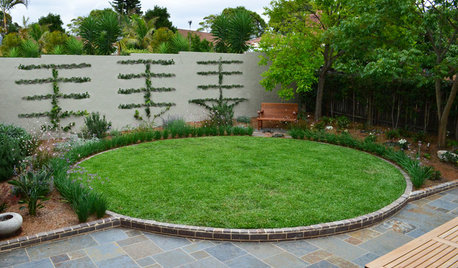
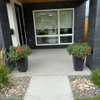
    I recently designed this Native Garden that was a flat lawn for 55 years. I bi-sected the space with an undulating low wall made from recycled broken concrete and the area nearest the house became 9 inches higher than the kerbside portion of the garden. Hope this might inspire you in some direction!

    {{gwi:52630}}

    John

    thewovengarden.com

  • 18 years ago

    25 -3 give 22 feet of width. From that it appears there are at least two sets of paths along any given length, so that leaves 12 feet (2 X 5 foot paths)of planting width. This planting width would be divided up into at least seveal areas bisected by paths, which leaves 4 foot wide beds.

    The oppulent plantings in your drawings, if planted en-masse will be great, but if planted as specimens in 4-feet wide beds, the design impact is diminished to a mere showcase.

    A scaled drawing with paths and building marked out to scale, will provide a realistic area that you have to work with. An easy beginners mistake is either too much in to little area or too little in to much area.

  • 18 years ago

    That's a really nice wall John. I share your philosophy of organic landscaping. No synthetic fertilizers, herbicides pesticides or landscape fabric will go into this garden. Nor manmade pavers. It's interesting how this fits so well with the 'settlers garden' idea. I do envy you your access to broken concrete, though - that would be tempting for encircling the herb garden.

    On the one hand we have wonderful natural materials close at hand here - eelgrass, beach stones, woods full of lumber for 6'x6's - on the other, getting them is so labour intensive that ordering and having mayerials delivered from the city, two hours away, sometimes seem simpler.

    That's a very good idea - planning paths into the border, if I understand what you're saying rhodium.

    There will be at least two of every shrub type in the border - hazelnut, mountain ash, highbush cranberry, viburnum cassinoides, witch hazel, elder - I'd rather have these fill in the bed the first few years and prune/dig some out later (finding their way to other people's gardens) than start out skimpy-looking.