Software
Houzz Logo Print
bwmilam_tn

Horseradish leaves getting eaten!

16 years ago

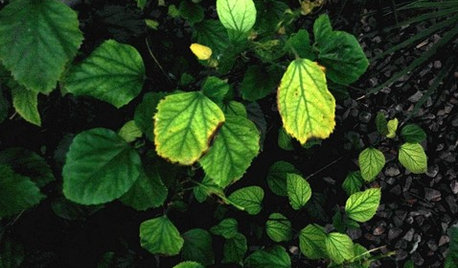
This is my first year for planting a horseradish plant. The plant has been growing well, but the leaves are getting eaten! Since I would prefer to eat them as opposed to another critter, what do you think is the best method to prevent this?

Here's a picture, if that helps.

{{gwi:144715}}

Comments (25)

  • 16 years ago
    last modified: 11 years ago

    what do you think is the best method to prevent this?

    Depends upon the critter eating it. ID the critter and take appropriate action against it.

    Dan

  • 16 years ago
    last modified: 11 years ago

    Probably caterpillars. Go out at night and look under the leaves.

    Is it in a pot? If so, will be less stressed if in the ground.

    Beyond that, I thot only the root was eaten. How do you use the leaves?

  • 16 years ago
    last modified: 11 years ago

    There is nothing during the day that I've been able to see eating the leaves. Perhaps it is caterpillars. I'll check during the night to see. If that is the case, what can be done to stop them?

    Good catch....it is not "in" a pot. What I did was cut the bottom off of a pot and set it into the ground. My thought is that this will keep the turf grass (aka bermuda) out plus it will keep it from spreading too large.

    I had read that you can eat the leaves as well as the root. I've got a veggie garden nearby and had hoped to include some leaves with a salad

  • 16 years ago
    last modified: 11 years ago

    If it were caterpillars, the larva of many different moths or butterflies, or the larva of sawflies or the Harlequin beetle you would see them since they would not leave those leaves once they hatched until the time for them to pupate. I would suspect slugs, and spraying those leaves with cold, caffienated coffee can help.

  • 16 years ago
    last modified: 11 years ago

    No offense, but the evidence on the effectiveness of coffee as a slug killer is pretty thin. Just don't want you to think that's a sure fire cure if, indeed, this is slug damage. Hand-picking, frankly, is likely to be more effective and no more time consuming if it comes to that.

  • 16 years ago
    last modified: 11 years ago

    the evidence on the effectiveness of coffee as a slug killer is pretty thin

    Yes, we've been over these...um...grounds before but some never learn.

    The lab results required caffeine concs be much higher than in your morning brew for effectiveness. IIRC I asked for direct evidence if this worked and got crickets chirping.

    Dan

  • 16 years ago
    last modified: 11 years ago

    Ah. It so happens I bookmarked the thread where kimmsr was caught fibbing making things up about caffeine and slugs.

    Apparently he advocates spraying caffeine on plants even though caffeine is phytotoxic to some plants and has not been shown to work at human ingestion concentrations.

    So disregard the false information about caffeine and slugs.

    Dan

  • 16 years ago
    last modified: 11 years ago

    If you find caterpillars during your night-time searches, dispatch them on the spot. Step on them; cut in half; or flick into slightly soapy water.

  • 16 years ago
    last modified: 11 years ago

    I have sprayed cold caffienated coffee on plants to repel slugs and find it is effective and have seen no problem with phytotoxicity. The USDA researchers that found cold caffienated coffee to be an effective slug repellent did not see any problems either. The one "study" I did see that indicated phytotoxicity apparently the "researcher" sprayed plants growing in full sun at midday, a time not recommended by anyone for spraying anything.

  • 16 years ago
    last modified: 11 years ago

    USDA paper being referenced:
    http://www.ars.usda.gov/research/publications/publications.htm?seq_no_115=148218

    Notes: The researchers killed slugs with a 2% solution, and repelled them with more dilute concentrations.
    Brewed coffee has a wide range of caffiene levels based on the varietal, post-harvest processing and brewing method and strength, but it is nowhere near the 2% level used to kill slugs in the study.

    This is the only peer-reviewed study I can find on the subject.

    In the other corner, there are numerous peer reviewed studies acknowledging the phytotoxicity of caffeine, which sterilizes seeds and affects mitosis. Caffiene is an allelochemical produced by the coffee plant specifically for this benefit (to the coffee plant) as well as to inhibit predation.

    Caffeine is also toxic to earthworms, aquatic life and amphibians as well as insects, including beneficials like spiders and bees.

    Personally, I say wanton home use of coffee is a bad idea, since it also indiscriminately kills beneficial life. Researchers may yet come up with a caffeine extract which specifically targets slugs which will be a safe, organic alternative.

    However, spraying concentrated caffinated coffee on walls, steps, cinderblocks and other places slugs hide during the day may take advantage of the beneficial aspects without the down side.

  • 16 years ago
    last modified: 11 years ago

    Kimmsr, we've already discussed your fibbing with the caffeine, yet here you are again. The OP should not be using caffeine, especially as it is phytotoxic to many plants and largely untested on garden crops. It was very irresponsible to advocate caffeine, esp as this was pointed out as irresponsible last year as well.

    Dan

  • 16 years ago
    last modified: 11 years ago

    Putting the OP dilemma aside for an instant, could we discuss, perhaps over a cup of coffee, what exactly can you do with the leaves? has anyone ever cooked them? Eaten them raw?...

  • 16 years ago
    last modified: 11 years ago

    First of all, I have not seen any critter on the leaves anytime I've checked them....both day and night. I am still perplexed. Any other thoughts?

    As far as the coffee is concerned, I will have to leave that debate to you folks. However, there does seem to be enough dissenting opinion that I will have to stay away from that.

    Chef on to you regarding eating the leavesÂÂwhy not? I read where you can, so why not?

    If anyone has any other ideas, please let me know.

    Thanks for your help  I really do appreciate it.

  • 16 years ago
    last modified: 11 years ago

    Well, you'll have to make a repellant then. Do a search on this forum and you'll find dozens of recipes, use the one that you have the ingredients at hand.

    Dan

  • 16 years ago
    last modified: 11 years ago

    AVERT YOUR EYES - BAD TASTE COMMENT COMING. Re: eating the leaves ... please ask your next-of-kin to inform us of any bad/deadly/sickening/life-altering affects.

    To move on .... do you suppose that this plant acts as a trap for critters that might otherwise eat your garden? Are nearby plants free of pest damage?

    Re: topical repellants ... I think I'd be tempted to sprinkls some cayenne pepper on ONE leaf to see if it remains un-eaten.

  • 16 years ago
    last modified: 11 years ago

    Re Border:...We can see from your post the effects of eating too many horseradish leaves..;o
    Re: what's eating my leaves...I have witnessed on my leaves (horseradish, chard, lettuces) a small yellow bird sitting there pecking away at it. The result is pretty much what the photo looks like

  • 16 years ago
    last modified: 11 years ago

    Goldfinch or whatever might be eating caterpillars, esp if they have young.

    Dan

  • 16 years ago
    last modified: 11 years ago

    Oh....forget about cayenne pepper....I would never, ever hurt our feathered bug-eating-brigade. I have Orioles in my yard and as a result didn't see one tomato horned worm last year [knock on wood] I let the bok choy go to seed, just to see those birds sway in the top, eating seeds.

  • 15 years ago
    last modified: 11 years ago

    kimmsr is right, dan, I have proved this every year for 5 year with my basil. In side by side test. I lost the link on the old kitchen gardener move to in platform. But Joy William had a link to a SCU study ion snails & slugs & coffee grounds.
    When I find the link I will send it to you.
    Do you want fries with that!

  • 15 years ago
    last modified: 11 years ago

    Caffeine Used to Fight
    Slugs and Snails

    July 25, 2002

    In October 2001, the US Environmental Protection Agency (EPA) announced that it had approved the use of caffeine to fight the infestation of Hawaiian coqui frogs. New research suggests that caffeine may be a weapon against other pests such as slugs and snails. As most gardeners know, slugs and snails cause significant damage to vegetable crops. However, many products used to eliminate slugs and snails contain chemicals that are dangerous to people and pets. Caffeine-containing products, therefore, may be a safe alternative to existing slug and snail poisons.

    Researchers at the US Pacific Basin Agricultural Research Center and National Wildlife Research Center in Hilo, Hawaii, conducted several experiments to demonstrate the effectiveness of caffeine to repel and kill slugs and snails.
    Experiment #1 - Will slugs avoid food with caffeine?
    Napa cabbage leaves were dipped in caffeine solutions or left untreated (the control condition). The researchers measured how much cabbage was eaten by the slugs.

    Results: Slugs did not eat as much cabbage when the leaves were dipped in caffeine (see Figure 1). This suggests that slugs can detect the caffeine and prefer cabbage without caffeine.
    Figure 1

    Orchid Snails
    Photo by Scott Bauer, USDA
    Experiment #2 - How does caffeine affect the heart rate of snails?
    Orchid snails (Zonitoides arboreus) were treated with caffeine. The researchers examined changes in the heart rate of the snails.

    Results: After one hour, weak (0.01%) caffeine solutions increased the snail's heart rate, but stronger solutions (0.1%, 0.5% and 2%) reduced the snail's heart rate. After 24 hours, the heart contractions of snails treated with a 0.1% or higher concentration of caffeine were weak and irregular. After 96 hours, all of the snails treated with a 0.5% or 2% caffeine solution were dead.
    Experiment #3 - Will caffeine kill snails when applied to material used to grow plants?
    Chips from coconut husks are used to grow orchids. These chips were sprayed with 1% or 2% caffeine solutions or with water (the control condition).

    Results: The 1% caffeine solution killed 60% of the snails. The 2% caffeine solution killed 95% of the snails. Only 10% of the snails died when the control solution was used. (See Figure 2)
    Figure 2
    The researchers are not sure how caffeine kills slugs and snails. They suggest that caffeine may change the shape of action potentials in snail neurons. In humans, caffeine is a central nervous system stimulant that interferes with adenosine, a neurotransmitter in the brain. Caffeine also acts at other places in the body to increase heart rate, constrict blood vessels, relax air passages, and affect muscles.

    Perhaps new, safer slug and snail repellents could be developed with caffeine. Who knows? Perhaps next time you buy a cup of coffee, you will also be able to pick up some slug and snail bait for your garden.

    References:

    1. Hollingsworth, R.G., Armstrong, J.W. and Campbell, E. Caffeine as a repellent for slugs and snails. Nature, 417:915-916, 2002.
    2. Wood, M. Caffeine foils snails. USDA Press Release

    GO TO: Neuroscience In The News Explore the Nervous System Table of Contents

    [email]
    Send E-mail
    Fill out survey
    Get Newsletter
    Search Pages
    Take Notes

  • 15 years ago
    last modified: 11 years ago

    Looks to me like damage from Imported Cabbage Worm. They are a bit hard to spot as they are small and green but if you look very carefully on the undersides of the leaves you might find one or two. They're very voracious. They morph into small white moths with a black spot on each wing. Hand picking works as does spraying BTK, an organic biological control.

  • 10 years ago

    OMG... What a Snarky bunch of people! Isn't gardening suppose to be Zen experience as well as frustrating one? I was hoping to get real help from this site...

  • 10 years ago

    kath10425,

    I am still gardening with "Coffee Chaff" & "Coffee waste" both green & roasted beans, ground & whole.

    I get the fresh waste that has never been brewed from a coffee plant/warehouse.

    I however also keep my garden clean of places for snails to hide & breed.

    This helps a lot.

    The best thing I do is let my South Carolina garden dry out before watering, it slows production, but snails hate dry sand.

    I wish I could send some of my chaff & chaff compost, I have 6 dump trucks loads & can get more any time I want.

    Here is a photo of my chaff dumped in the garden, look at the DATE, still have organic matter from that one load, without adding any new chaff.

    http://forums2.gardenweb.com/discussions/1703477/coffee-chaff-as-compost 

  • 4 years ago

    This has been fun