Software
Houzz Logo Print
mardon_gw

Tree Support Post-Hurricane ?

16 years ago

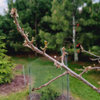
I live in Newfoundland. Hurricane Igor nearly uprooted a 20 foot tall maple tree in our front yard. As the storm began to intensify yesterday, I managed to stake the tree against the wind and was successful in keeping it from uprooting entirely. Unfortunately, it still lost enough support in its root system that the trunk is now tilted 6 degrees off of vertical. Here is a link to a photo of what it looks like this morning (the first day after the storm.)

http://www.JustUs.ca/post/tree.jpg

We have had lots of rain this summer so the ground was pretty wet prior to the storm. The ground is composed entirely of fill placed 20 years ago. The tree was planted 9 years ago. A hole was dug at that time and filled with soil to accommodate the tree. It was about 6 foot tall at the time.

My question is what can I do now to prevent us from losing this tree? All I can think of is to stake it similar to what I did during the storm but more orderly and less 'ugly'. Do I have to support it from all sides? How many support straps would I need to use? Should I make them tight at all times or keep them only snug? How high up the tree in this situation should I secure them and how from from the trunk should I place the stakes? The wind was only blowing from one direction yesterday.

How do I protect the tree bark so that the supports I wrap around the tree won't damage the bard? We occasionally get 80+ mph winds during winter storms but the ground is usually frozen then. Igor's wind's had gusts to 100+ mph. But we could easily get another tropical storm or hurricane this fall. It would probably not be as strong as Igor though. Igor did a lot of damage here that has never occurred before. It was very unusual in its strength.

Thanks for any help you can offer.

Mardon

Here is a link that might be useful: {{gwi:429673}}

Comments (11)

  • 16 years ago

    Your tree may be suffering from poor planting more than from Igor. It appears that there was no damage to the surrounding turf. If this is the case, it may indicate an improper root system supporting the tree. If the tree's roots were potbound when planted (possibly even internally to the rootball, from earlier potting up by the nursery), they may never develop properly to support the tree.

    Your mention of "A hole was dug at that time and filled with soil to accommodate the tree", sounds like you may have used amended soil (different drainage profile than surrounding soil). That's another no-no that could be contributing to a poorly developed root system.

    Finally, I don't see a root flair. The tree appears to be planted too deeply. Maples are often somewhat forgiving of this (especially if it's been there for 9 years), but it may still represent some disadvantage.

    If you want to save the tree, I'd have a certified arborist come out and take a look. An on-site inspection might give more info about exactly what happened (shifting soil, insufficient root system, root damage, etc). It's hard to say, without being there or getting such information, what needs to be done or even if the tree's root system will ever be sufficient for self-support.

  • 16 years ago

    if it were me .... i would be done with it.. no matter what the monetary nor emotional investment ...

    you can buy a 6 footer for what.. $30 ... and have a 20 footer in 4 years ...

    otherwise.. i would suggest that you spend the next decade HOPING that this one can be saved ...

    frankly.. best of both worlds.. buy the second.. and mess around with this one ... if it fails.. you already have the replacement ...

    i presume its an optical illusion.. but a maple should be 30 to 50 feet from the power lines .... if you replant.. increase the distance .... IMHO ...

    ken

  • 16 years ago

    My thoughts are along the lines of Brandon's - I see no root flare, the tree should be larger for being 9 years in the ground, the gravel probably makes it unhappy, I see no turf uprooting. I see proximity to utility wires.

    Also I see across the street some shrubs bent from the wind. This is what weather does to plants and in nature the weak ones go over, opening gaps in the canopy for other plants to exploit.

    If you are intent on keeping it, three stakes at 120 degrees to each other and proper nylon ties for the staking part, and maybe exposing root flare may help somewhat (Acer is kindasorta tolerant of too-deep planting, evidenced here). Nothing to do about poor rooting in compacted fill.

    Dan

  • 16 years ago

    If the tree needs support it is already compromised, be done with the problem before the problem gets to big.

  • 16 years ago

    Thanks to everyone for the replies. I'm not inclined to give up on the tree as easily as some of the posts suggest that I should. My reluctance stems from a combination of my advancing age and the very slow growth rate of trees here in Newfoundland. I wish a 6 foot maple could reach 20 feet in 4 years but that can't happen here. At age 70 I don't want to wait another decade to have a 20 foot tree. And there are no companies here that transplant large trees so that idea is out of consideration too. I've winched the damaged tree back to plumb and secured it with five, 1/4" stainless steel cables and nylon straps. If it dies now, at least I'll feel that I gave it my best shot. The power line is far enough away that it is not an issue. I've also exposed the root flare and gotten rid of the gravel. Thanks for those comments. BTW, the tree was originally planted by a professional nursery/landscaping company. I was out of the province when that occurred, so I don't know anything about how they did it or what kind of fill they used.

  • 16 years ago

    I'm not inclined to give up on the tree as easily as some of the posts suggest that I should.

    ===>>> as to my comments.. its not really about making you go out .. [or is that ooot ... lol] ... there and immediately chopping it down ...

    its about your expectations.. and it sounds like you want to try ... but you are fully aware that failure is an option ...

    and that is all that i was trying to accomplish ... eh ...

    now .. just 4 more hours to the first tv red wings game ... and a little more dan cleary ... lol ... i cant get that darn song out of my head ....

    you take care .. and let it do its own thing .. whatever that may be ...

    ken

  • 16 years ago

    BTW, the tree was originally planted by a professional nursery/landscaping company. I was out of the province when that occurred, so I don't know anything about how they did it or what kind of fill they used.

    I'm in the midst of a lawsuit with a professional landscaping company for planting over 1000 of our trees improperly. Good luck with your tree. Our climate zone is similar to yours (albeit much drier) and I'd expect more caliper by now.

    Dan

  • 16 years ago

    Although not a fan of staking, I can understand why you would like to save it. Down here (Southern Louisiana) I have 4 acer rubrum var. drummondii grown from seed last season that are taller than I am already.

  • 16 years ago

    Mardon, your tree doesn't look that bad. Now that you have winched it up and removed the gravel, just watch it and see what it does. I know there is not much soil on "the rock", and any you do have is apt to be trucked in fill, so its growth will be slow because of that. It is possible that the landscapers didn't take care of any circling roots, so if you are patient, you can dig carefully around a small area of the roots to see if any roots circle at about the original root ball diameter. If any do, just cut ONE right where the circling starts. It will be forced to try again, and will grow out into the surrounding soil, if it's not too compacted. One is all you need for now. I know what you mean about shallow soil, even though we live in PEI. We have 5 feet of soil over bedrock in the back, and 1 foot in the front.

  • 16 years ago

    If you do decide to do a root-collar inspection, post some pictures before cutting anything. I don't see anything magic about cutting one single root. Treatment should depend on what you find.

  • 16 years ago

    The issue of circling roots was raised. The only way to know if you didn't plant it yourself, is to dig carefully and look. If you are lucky, no roots circle. If they do, however, circle, just cut one and let it grow out for a few years. 3 to 5 years later, dig down again to see if there are more. If not, you are all done. If there are more, just cut ONE again. "The rock" can have dry spells, so you don't want to cut several roots at once. If you are able to get 3 or 4 roots growing off into the native soil, and a tap root, if you are lucky, it will do well. I used to buy little forestry plugs for planting in our woods....and they grew up to have awful root form...some blew over. They can be encouraged to grow out into the native soil, though, with a little root cutting as needed. It would be great if that is not the trouble, but you can fix it slowly, if it is.