Software
Houzz Logo Print
allison_proctor

how does stuff even grow here?

17 years ago

we are experiencing a major heat wave here in oregon, and my veggies and plants are looking very disgruntled about it(105 degrees). Last week I was driving to LA, and saw signs along the highway saying "Congress created dustbowl" alongside orchards of dead trees. I did see alot of crops that seemed to be thriving. I was just curious how farmers in California can grow peppers and tomatoes, even not so heat loving crops like lettuce in such dry heat, while mine (and others in the NW) are failing in this weather. Is it simply a matter of adaptation? Give me your secrets please! I remember thinking when I saw those signs " nature created this dustbowl, not congress" it was soooo hot!

Comments (12)

  • 17 years ago

    Congress created the death of the farmers trees in favor of a marine creature of doubtful value, by cutting off the farmers water. Nature had nothing to do with it unless you consider politics "natural". In California virtually no farm crops are grown without summer water. One hundred degree temperatures are not a problem for many crops if water is available. Al

  • 17 years ago

    Although they don't actually grow lettuce in the valley in summer, it definitely will bolt and get bitter when grown in such hot conditions. Lettuce is grown nearer the coast this time of year where the fog and ocean moderate the temperatures and keep it reasonably cool.

    The reduction of water supplies to valley farmers was made to protect habitat conditons for several marine creatures, including salmon. I doubt the commercial and sports fishermen consider salmon of doubtful value. There are always trade offs in life, and in addition irrigation of large parts of the San Joaquin Valley in particular has also resulted in selenium contamination of San Francisco Bay. There are in fact parts of the valley that probably should not be farmed intensively with summer irrigation because of the run off problems, and it may be time to consider that some lower value crops that require huge amounts of irrigation are better planted elsewhere where water isn't such an issue. The planting of cotton and alfalfa are two such crops that can be grown elsewhere just as easily, and may cost more to irrigate than these crops are actually worth, if water is given a more realistic cost that reflects the environmental tradeoffs. Wasteful flood irrigation will also probably be much reduced in the future when the cost of water better reflects the costs to impound, transport as well as drain it off afterwards.

    Al is quite right that high temperatures are not an issue for many hot season crops; corn, melons, tomatoes do equally well in even hotter Imperial Valley farms, where it can get up to 115F every day. Other California staple crops such as broccoli, cauliflower, brussel sprouts, artichokes, strawberries, lettuce, etc are more commonly grown nearer the coast where the temps are milder.

  • 17 years ago

    Hemp would be a good substitute for cotton since it needs little summer water or fertilizer. But then our ever efficient Congress out-lawed hemp -- in favor of cotton -- many years ago.

    Sorry Al, but I'm going to disagree with you on the fish issue: all native creatures/plants have a necessary place in any local ecosystem. If you remove even one part of that system it doesn't work properly. What doesn't belong is people growing water-necessary crops in a desert.

  • 17 years ago

    I couldn't keep my cucumbers or peppers alive in this heat. I'm only allowed to water them twice a week. I pulled them out.

    The problems with agriculture in the Valley predate the current water issue. One of my relatives was a soils engineer for agribusiness, and ten years ago he said that it was a miracle that the Valley was not already a dust-bowl.

    Al, I assume you were referring to federally subsidized water when you said it had been cut off. I believe that federal water deliveries are now at 85% of normal, not cut off, and local and other water was never cut off.

    The cut-backs in water that were designed to protect the Delta Smelt (or whatever it is) were only 15% of the water that went to the Central Valley.

    Farmers in California have it tough- between the salinity of the soil caused from fertilizer and flood-irrigation, competition from free-trade agreements (they grow it cheaper in Mexico and Chile), and the ridiculous growth and water demands of urban areas- they may find themselves out of work like the rest of us.

  • 17 years ago

    Although I was born in and have lived in California for over 80 years I have never lived or farmed in the central valley and so my knowledge is what I read in the paper regarding valley water problems. I did live for forty years on the coast where crops such as lettuce and strawberries are summer long crops. All the water for irrigating is from wells that are fast becoming salted as they are having to be drilled deeper and deeper. Ninety percent of our rain water is allowed to flow into the ocean because dams tend to flood valleys and so that is no longer allowed. I have noted that the Chinese are building dams both for electric generation and flood control. Perhaps in the future we will be eating Chinese grown fruit and vegetables as well as depending on them for most of our manufactured products. I tend to be concerned for my great grandchildrens future. Al

  • 17 years ago

    >> the Chinese are building dams both for electric generation and flood control. >>

    Water is a highly political issue and will only become more so as global weather patterns naturally shift, whether you believe/agree with global warming or not. It is now generally accepted that CA's rainfall averages over the last 100 yrs were unusually higher than the true long-term (read: thousand year weather patterns) average rainfall. CA is mostly desert and without imported water - whether from other parts of the state or other Western states - nothing would survive in summer except for a few trees and scrub plants. It's cheap irrigated water that gave rise to the eventual huge agribusiness corporations that have made agriculture CA's #1 industry.

    As for the Chinese, their dam building may very well cause huge ecological problems in the coming years. Many experts (both Chinese and Western) have postulated the devastating earthquake in Sichuan province in 2008 that killed 69,000 people was caused by the massive Three Gorges Dam, whose geological engineering was questionable and untested at the time. The villagers that were originally displaced have recently had to be moved yet again, for the new farms they were given have developed huge irreversible cracks in the ground (not-so-affectionately called 'pig killers').

    The government is now in the process of building another two dozen dams exactly like Three Gorges, almost all of them in earthquake-prone areas. Areas, in fact, very (geologically) similar to CA. The Chinese have even more serious water problems than we do; Beijing's ever-increasing water demands are destroying local agriculture around it.

    The North China Plain will be completely depleted of water by 2030, by US Dept. of Agriculture estimates (they conducted the study at the request of the Chinese government). In a reverse of what we see in CA, where water from the North goes down to the South, China is working on a $70 billion project to move water from their South provinces up to the North. Their ecological problems are beginning to mount ever higher as more and more of their critical river systems begin to collapse.

    Dams prevent flooding, but without sufficient fresh water releases there are more than just fish kills. Fresh water is the flushing system that prevents sea water from creeping ever further inland, reducing public water supplies and creating cesspools where pollution runoff collects and never gets dissipated.

  • 17 years ago

    To answer the question"how does stuff even grow here", many people can grow home gardens by using water wisely. Using drip irrigation on timers can let plants survive the hot temperatures with little water. We have 5 acres and a well that we worry will go dry in this drought. This spring we decided to prioritize our water needs. 1st we wanted to save our trees and perennials 2nd we wanted to have a garden. Two of my neighbors are finding air bubbles in their water. If I turn on the outside faucet at the same time my washer if filling I can here gurgling sounds from the well. We are careful. I try not to run the dishwasher within an hour of washing clothes. The drip emitters give water only to each individual plant or tree. We have used a lot of mulch over black plastic to prevent evaporation. We have no lawn. Our fruit trees get watered twice a week. The vegitable garden gets 1/2 hr early in the morning. We have a smaller garden then in the past. No corn, only tomatoes, cucumbers, peppers, squash and some herbs. We planted no new plants this year and my flower garden is alive but not thriving like in the past. The only time I use a hose if for just a few pots that I keep in a protected area away from the wind and hot sun.
    I's not easy but it does work. Our hope is that we will continue to keep our limited water supply over the summer.
    Donna

  • 17 years ago

    Like Donna said, underground water tables are ever decreasing. I have friends whose wells have already run dry. That's a terrible thought when so many central valley cities depend on well water. Even cities as large as Fresno depend on well water.

    Stuff does grow well here. And thrives too. You just have to be wise in what you grow. There are plenty of plants that originate from mediteranean regions throughout the world and feel just at home in our arid climate (South Africa, the Middle East, Northern Africa and Southern Europe, Chile, Australia...). The problem is when we try to grow plants that don't belong here. A great majority of plants available to the mass public (and also overplanted by developers) are water hogging plants that hail from regions with wet, humid summers. Lawns are another horrible idea for our climate, and unfortunately, have become the status quo. It'll take a major push to get people to understand that we aren't living in Florida or Georgia. Maybe this prolonged drought will be it.

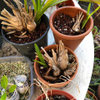
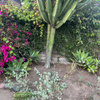
    Here is my recently converted lawn space. I have tons of plants that are thriving for me with only limited water delivered from a drip system. This is still a work in progress. The fruit trees to the left and the queen palm were pre-existing and are planted in water basins and watered once or twice a week. Everything else is on a drip system. Right now, because the plants are not yet established, the drip system goes on four times a week. Next year, everything (with the exception of the queen palm and the fruit trees) should be able to go two weeks at a time without water. By depriving them of water, I will be able to bring out the colors in the aloes, kalanchoes, crassula, manfreda, echeveria and the agaves since some are actually supposed to be bright red, orange, purple or powdery blue (extra water actually makes them lose the showy colors). Also, depriving them of water in the summer mimics their natural habitat and gets them ready to bloom in the winter and early spring time when we do get rain, and when little else in in bloom. The Aloes especially should put on a traffic stopping show. I have 3 Aloe Marlothii and 3 Aloe Ferox that are of blooming size, along with Aloe Cameronii, Aloe Barbadiensis, Aloe Alloides, Aloe Excelsa, Beschorneria Yuccoides, Callistemon, Manzanita, Grevillea, Erica Mammosa, Arbutus...the list goes on and on. Best of all, these plants are so care free!
    {{gwi:543743}}

  • 17 years ago

    Central cali- I wish I could garden with succulents the way you do! The reason I first posted , I guess was a two parter. I was wondering about those signs, but my tomatoes got sun scals while I was gone, and I was just thinking, " how do the tomatoes grown in california at this time not get cooked on the vine?" Mine are shot as are my peppers. My Oregon skin is too, from visiting Disneyland, but the produce there is great!

  • 17 years ago

    lalameija:

    The tomatoes you see in the fields have been bred and bred and bred to withstand those conditions, and are processsing tomatoes, too, so they will all be scooped up into huge semis, and driven to tomato processing plants and squished into tomato sauce. It doesn't matter if they have sunscald, even if they did get it. You don't say what kind of tomatoes you are growing, but they are most likely home varieties bred for looks and flavor, not the ability to withstand being tossed into a semi-truck, and they are probably ones that do well in normal Oregon weather, too.

    The dead trees you see along I-5 were intentionally either torn up, or the ranchers cut them down above the graft, so the tree will not need much water this year and will regrow into a producing tree in a few years, in the hopes there will be more water then.

    And although this thread has been a bit hijacked, I would like to add the fact that everyone seems to always forget--most of our environmental problems stem from the ever-increasing number of humans in California and in the world, including the decreasing amount of drinkable water. Why is it nobody ever uses the term "population explosion" anymore? Everyone always talks about "being green" nowadays, but nobody ever talks about choosing to only have one or no children, the biggest "carbon credit" of them all. Maybe now that hippie clothes are back in fashion, "population explosion" will come back into the vernacular again too. (Off my soapbox)

    Carla in Sac

  • 17 years ago

    It is definitely true that we can't just continue to endlessly grow larger with more people without making environmental trade-offs. What is also true is that even given the huge increase of population in the state, as a whole, we are getting more efficient at using water as a precious resource, but of course can still do a lot better.

    For water to be properly conserved as the precious resource that it really is, the price will need to be raised so that it is conserved, or at least not wasted as it often still is. I suspect that desalination plants are also the future for all of our major coastal cities here in the state, and definitely feel that waste water needs to be treated so that it can be reused for irrigation purposes, in all new developments which are being built from scratch and can easily accomodate double piping systems at initial installation.

    It make take further hikes in water rates, along with mandatory installation of water meters in all the central valley towns that don't yet have them, to make people realize that wall to wall lawns for residences and commercial developments need not be the default landscape.

    Unfortunately our current economy is based on the necessity for continued growth, and requires major tweaking to get such growth concentrated on improving what we already have built to make it more efficient, rather than endlessly expanding out into agricultural lands with housing and development. I fear that we also don't place a high enough value on our land for farms, let alone our water resources.

  • 17 years ago

    Changing the plumbing laws to allow for the use of waste water for irrigation is way overdue. It is not unusual for rural folks to re-configure their household plumbing to separate gray water from septic water. These changes are mostly illegal and they should not be. Dual systems in cities would make a lot of sense as bahia has suggested. Unfortunately the amount of energy required to desalinate sea water is prohibitive except for energy rich countries like Saudi Arabia. Unfortunately politicians do not think further ahead than their next election. Al