Software
Houzz Logo Print
fanelda

Kalancho??? Name Please!

16 years ago

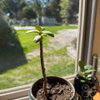
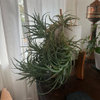
I was given this, but have no name. Can you help??

Thank you!

{{gwi:691598}}

{{gwi:691601}}

Comments (9)

  • 16 years ago

    Kalanchoe Serrata. It also looks like it's about to produce it's pretty pinkish-red bell shape flowers.
    Do a quick search and you'll find lots of pics and info ;-)

  • 16 years ago

    looks like typical K daigremontiana to me (Mother of Thousands). These spread quickly!

  • 16 years ago

    Not K. serrata, but I once believed it was that, too, Paulzie. :) It is Kalanchoe x houghtonii (previously named Bryophyllum 'Houghton's Hybrid').

    I took a quick look on the web to see what pix I would find, because it would not be common to see. All pix I found so far are pix of Kalanchoe x houghtonii. Someone has also given it the common name of Magic Tower. So now there is yet another misidentified plant spreading on the web. Yikes!

    BTW, Kalanchoe has an 'e' at the end and is pronounced ka-lÃÂn-'kÃÂ-ee (last 2 vowels of the word are long vowel sounds...it won't make the symbol for the long e at the end).

    Also note that your plant will form plantlets on the edges of all the leaves. They will fall off easily & grow wherever they land. So, if you don't want it to become a weed in your garden, take care to watch it. I can already see some of the babies growing in the bottom of your pot. :) Enjoy the beautiful flowers!

    The real K. serrata, previously Bryophyllum x serratifolium, can see seen at the link below.

    Here are pix of mine:
    {{gwi:530830}}{{gwi:502159}}

    and the flowers it will produce:
    {{gwi:502187}}

    Here is a link that might be useful: Bryophyllum x serratifolium

  • 16 years ago

    It is not K. serrata, a good example of the misinformation possible in googling; fanelda's plant has periolate leaves, not so in K. serrata. Yale

  • 16 years ago

    It's called "#^^!#$#% crap is growing in every pot, the gutters, cracks in the sidewalk #%%^^!!&&*^!!!!!!!!!!!"
    you never, never, never get rid of it once it starts to grow. I have some almost as tall as me in the yard. Good luck.
    Yours needs more sun.
    Tally HO!

  • 16 years ago

    I don't know the scientific on that one but here in Florida they are extremly common and we call them mother of thousands. They make never ending babies and there is a flat leaf like you have and another that the leaf is rolled up. Those things will take over the whole garden if you let them.

  • 16 years ago

    Fanelda, Did you come back to your post yet?

    I remembered another post that has more pix of this plant (& others) as well as warnings & tips about growing it. Please see the link below.

    Here is a link that might be useful: Post with various Kalanchoe

  • 16 years ago

    So Rosemarie, This plant is K. serrata?
    http://jardininfinito.com/product.php?id_product=148

    For years I've been referring to Faneldas plant as K. serrata.

    And mfyss are you saying that it can not be K. serrata because the Fanelda's plant has long petioles?
    I have a plant very similar to this plant under an eve where it get sun all day long, but only along the bottom of the pot... the top of the pot is shaded. In the pot is a plant looking like Fanelda's plant (leaves with Petioles but not quite as long). But three plantlets that fell off and took root in the pots drainage holes and growing along the outside bottom of the pot, are identical to the plants in Rosemarie's second picture (short or no petioles). This would lead be to believe Fanelda's plant is a bit etiolate and this is the reason for longer petioles.

    What do you think?

  • 16 years ago

    Yes, Paulzie, the plant pix you linked to are Kalanchoe serrata (Bryophyllum x serratifolium).

    I have many pix of this plant. The look of the plant/leaves depends on its growing conditions. The plant I showed pix of above are very compact, do, in fact have petioles. They are hidden by their compactness. :)

    Still, the shape of the leaves & pattern of serrations are different. You may notice that on the K. serrata leaf points... the pattern is large, small, large, etc. & those of K. x houghtonii are pretty much uniform. I'm not sure how else to describe the differences. Too bad I don't have both plants to show comparative leaves.

    Well, if you look at the 1st link I gave above, it has pix of a leaf from each plant. One is a side view & the other from the top, but I think you can discern the differences.

    I am not sure what Yale means by "periolate". I will leave it to him to give the meaning of the word. I believe it has a different meaning from petiolate.

    Here is an offspring (hybrid) of K. x houghtonii, named 'Pink Butterflies'.

    {{gwi:691604}}

    Here is one of my more stretched out plants of K. x houghtonii:

    {{gwi:502169}}