Software
Houzz Logo Print
conifers_gw

Clay-Tolerant Conifers

18 years ago

Well, so I buy 6 acres and drive a shovel into the earth last fall and it feels like slicing through butter that's been out of the fridge. Little did I know I was assuming ALL soils near me weren't the "black gold" we all love.

My mom did say though that since the property is shaped like a bowl, literally, that water will run down into the valley bottom. I think she has a good point. Common sense tells me that she's onto something...

Just for wasting 10 bucks I'm having it tested... what the heck.

The clay is medium brown and after a hard rain it's like walking through sticky bubble gum. When it's dry, it's a lighter chalkier brown. When not wet, Not wet, it takes a pick ax to hack a hole! Whew! I'm overwhelmed. lol

I need your help with what will not thrive and what, can thrive. This information should also help me choose rootstocks so I can grow others that normally would not be able to adapt to this soil.

Resin - Sorry I started threads in the past and you so kindly helped me and then I didn't further continue with that help/knowledge/suggestions you provided. I need your help desperately.

And everyone else!

Thanks,

Dax

Comments (70)

  • 18 years ago
    last modified: 10 years ago

    Got it!

    Later on.

    Dax

  • 18 years ago
    last modified: 10 years ago

    Resin:

    I would like to know your source of information about the wolly adelgid not tolerating Z5. Where my timberland is on the Allegheny Plateau of Western MD it is a Z5. Maybe not typical of some Z5 regions in that we get a lot of warm spells in winter. But in other respects it can be harsher, with more extremely cold temperatures on occasion. The wolly adelgid is going stong here and the foresters tell me that I can expect all my hemlocks to be killed within a few years--and I have, at this point, some magnificent trees with a number several hundred years old growing over and among many giant picturesque rocks--what a loss. And no one is giving me any hope of not having them wiped out.

    But anyway, tell me what you have heard. We have not had any extremely cold temps for several years, so maybe I can hope that a couple of days with -30 F(-34.5 C) will give me a reprieve?

    --Spruce

  • 18 years ago
    last modified: 10 years ago

    RE: but adding anything but an 'enormous' amount of sand to my situation would cause this driveway you're describing. It's a hundred percent true.

    Why? says who?

    And I said several inches. And you can only till it so many inches deep. I think I explained perfectly well why it makes zero sense to say that creates concrete or somehow makes matters worse.

  • 18 years ago
    last modified: 10 years ago

    Dax,
    you could also construct some raised beds possibly around the house area if you have the time and energy using either brick, stone or timber, whichever suits your budget.That way you can fill them with whatever type of soil and compost you require, very useful method for housing all those tiny treasures that often require a little TLC I'm sure you will want to collect in the future. Good luck.
    Bluespruce.

  • 18 years ago
    last modified: 10 years ago

    Yes sirs. Never mind tcharles - I refuse at this point to debate.

    (thanks)

    Dax

  • 18 years ago
    last modified: 10 years ago

    Hi Spruce,

    Going on the basis of the map in the USFS HWA website, with the failure of the HWA to spread west of the Appalachians despite having had 70-odd years to do so. Maybe the reason is something other than low temperatures, perhaps lower humidity or something, that is stopping it.

    Resin

  • 18 years ago
    last modified: 10 years ago

    Some nice tree there Justin.re the Pinus pinea,it rings a bell,what's its common name and native home?

  • 18 years ago
    last modified: 10 years ago

    The trouble with clay is in winter things are a lot wetter over here,and the soil just holds all that water in which starves the roots of oxygen. Also it gets cold and stays cold,nasty. Anyone tried double digging also known as b&stard trenching(no,really!) a method of working the soil thats quite heavy. Basically you dig out a trench about a spit and half deep(a spit being the depth of a spade),then put it in a barrow and move the barrow to the end of the bit you're digging. Then you work the bottom of the trench with a fork and maybe add some organic matter(we used to use straw). Then you start on the next trench behind the first one,this time dumping the soil into the first trench. Then again with the fork and straw routine before moving onto the next trench and so on. Then when finished you empty the first barrow load into the last trench. I've done this a few times,its hard work but great in winter for keeping warm-good exercise! I have been told that its best done in winter too as the frost will help break up the clods-not sure how effective that is tho.

  • 18 years ago
    last modified: 10 years ago

    "re the Pinus pinea,it rings a bell,what's its common name and native home?"

    Stone Pine, from Spain & Portugal, and widely cultivated throughout the Med.

    Resin

  • 18 years ago
    last modified: 10 years ago

    Stone Pine,of course! Cheers Resin!

  • 18 years ago
    last modified: 10 years ago

    Dax,
    RE: clodded boots - great excercise when your boots reach 20 lbs (each). ; - )

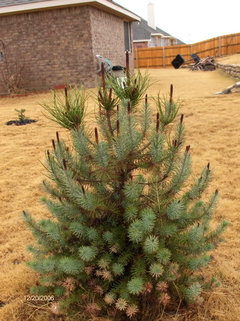
    King Larry - that little P. pinea (Stone Pine) has been fun to watch. Totally unplanned planting. Planted after Christmas 2005 in juvenile foliage (from indoor Christmas decoration). By the way, it smells GREAT! Not 'piney' almost 'flowery'!

    J.D.

  • 18 years ago
    last modified: 10 years ago

    Talking of christmas trees,won't be long you know! I won't go into the argument of using trees with no roots in pots etc,never had a real one,but i remember seeing some mini trees being sold last year,complete with yucky white spray on stuff,but I was thinking of buying one,cleaning it up and planting it out-will let you know if they have them this year but I think they were chamae types rather than Spruce types(I need the right lingo here guys!)

  • 18 years ago
    last modified: 10 years ago

    Dax,
    A couple of comments on your pine picks.
    The Loblolly, Virginia, and Shortleaf Pines can all grow in clay. I've repeatedly seen all three grow and even colonize in pure red clay and yellowish clay in ne Texas and Louisiana. The Loblolly sometimes has trouble in winter from snow and ice build-up and can lose limbs. Shortleaf is much more resistant to this. However Shortleaf is listed for acidic soils with pH ranging from 4-6. Loblolly is ok to 7 and Virginia pine to 7.5. I've only seen Virginia and Shortleaf in well drained areas. Loblolly doesn't seem to care.
    Not sure if any of this would make you not chose one, but at least keep it in mind. Good luck.

  • 18 years ago
    last modified: 10 years ago

    Right on scotjute.

    thanks!

    Dax

  • 18 years ago
    last modified: 10 years ago

    Yes, I do think the reason sand drains well is because of the particles lodging against each other. And the soil scientists that taught me this think so too. I'm not sure why you're so hostile tcharles, but organic matter IS good for what ails a soil. In sand, it helps to retain moisture. In clay, it improves drainage and porosity. I don't know why this information makes you angry.

    +oM

  • 18 years ago
    last modified: 10 years ago

    'i remember seeing some mini trees being sold last year'
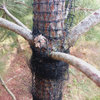
    greenlarry - that is exactly where that P. pinea came from. It was a natural color - no 'sparklies'. They smelled good when all 50-60 were together at the store but couldn't smell it much at home in the house. Didn't have the heart to 'chunk' it after Christmas, so I plunked it in the ground. Here it is after 1 year in the ground. Mostly juvenile foliage.

    I think the browning at the bottom must be the natural transition to mature foliage. Anybody got any other ideas?

    J.D.

  • 18 years ago
    last modified: 10 years ago

    Justin,I'm glad you gave the tree a second chance and also that you didn't buy one of those that have no roots and are destined to die-the worst thing about Christmas for me.

  • 18 years ago
    last modified: 10 years ago

    J.D.

    I planted italian stone pine a couple years ago but my dog killed it... LOL.

    Anyway, don't you think it'd be a good idea to provide wider mulch base for some of your conifer trees? I'd think they'd do a lot better. Bermuda is nutrient hog and you need to get rid of bermuda around the trees. Bermuda is PITA for sure.

    I have New Mexico Montezuma cypress that i just got and also montezuma-bald hybrid developed by China ca

  • 18 years ago
    last modified: 10 years ago

    Bermuda is nutrient hog and you need to get rid of bermuda around the trees. Bermuda is PITA for surecolor>

    Err, whats Bermuda?

  • 18 years ago
    last modified: 10 years ago

    bermuda is spreading grass. It is pretty invasive. it is also called devil's grass by gardeners because they take over plant beds, etc and they are almost impossible to get rid of completely. They grow very deep roots and spreads underground.

  • 18 years ago
    last modified: 10 years ago

    JD, I'd just wait on those browing tips to see if they push growth next year. Could be a dog that likes to urinate on it.

    Dax

  • 18 years ago
    last modified: 10 years ago

    "I think the browning at the bottom must be the natural transition to mature foliage. Anybody got any other ideas?"

    By comparison with the more recent pic higher up, they're just being shaded out naturally by the higher branches.

    Resin

  • 18 years ago
    last modified: 10 years ago

    Lou,thanks for that- i think we have something similar. We call it couch grass or switch. It has thick white roots and is almost impossible to get rid of. Our next door neighbour has it on her border and because she doesn't touch the garden it comes thru to our side. And if you leave a piece of root behind it grows again! BTW what is meant by PITA?

  • 18 years ago
    last modified: 10 years ago

    Yes I think couch grass is another name for it in australia that I am aware of. PITA = Pain in the ass. :) All it takes is a tiny piece of root and it'll take over the entire lawn in no time!

  • 18 years ago
    last modified: 10 years ago

    Thanks Lou,and I thought it was some highly technical term ;)

  • 18 years ago
    last modified: 10 years ago

    Bermuda grass = Cynodon dactylon
    Couch grass = Elymus repens

    PITA: see also below ;-)

  • 18 years ago
    last modified: 10 years ago

    My god Michael,you're like a bloody encyclopedia! ;) And I can't imagine a Pine being called a weed!But then my definition of a weed is a plant growing in the wrong place.

  • 18 years ago
    last modified: 10 years ago

    Lolloby pine... ahhh... Miss those pines... I grew up around them in Houston, Texas.

    Actually in Australia, couch grass is Cynodon dactylon. That is what I was referring to. Pretty much every country have different name for each grass.

  • 18 years ago
    last modified: 10 years ago

    Lou,
    I did widen my mulch ring this summer (as evidenced by the first pictures). I'll probably make them larger next year as the trees grow.

    That bermuda is a 'Tifton' strain and I must admit, I love it. The leaves are more fine than common bermuda. I've never had a sprinkler system and a nice yard until I moved here, so I've enjoyed the dense turf. Was a real 'PITA' (I like the acronym!!) to clear for flower beds this summer though. RoundUp is GOOD stuff for that!!
    J.D.

  • 18 years ago
    last modified: 10 years ago

    Lou,just wondering how Australia came into it as I'm in England and you're in Texas...I presume ;)

  • 18 years ago
    last modified: 10 years ago

    He probably knows something about Australia king.

    Dax

  • 18 years ago
    last modified: 10 years ago

    LOL. Perhaps, we should just stick to scientific names, common names are too confusing! Australia calls one of the grass buffalo as USA does but it turns out to be entirely different grass! LOL. OK Enough of Australia! :)

    J.D. - I usually keep around 3 feet wide mulch but I'm beginning to think 5 feet wide is a lot better for a lot of reasons. Like better establishment time with loosen up soil 5 feet across for roots to spread out rapidly, mulch would help support fungi population because grass doesn't really support fungi population very much, more of bacterial dominated environment which is what grass prefer while trees esp. conifers prefer very high fungi population in the soil. When you have very high fungi population, it brings pH soil down some while bacterially dominated will push pH soil up (more alkaline). It just takes a while to grow fungi population. It is a very slow process if you don't provide mulch and only rely on the leaves being dropped to the ground every fall to help grow fungi in the soil.

    In about 15 years, you'll need to grow different grass since bermuda cant tolerate shade with that many trees. :)

  • 18 years ago
    last modified: 10 years ago

    Thanks, Lou. I haven't heard that reasoning for the wide mulch ring. I have much to learn. I'm very interested about your T. mucro. I have a weeping variety, but really wish now it was the other. I'll let it grow and see what happens.

    Speaking of nutrients, is it better to avoid fertilizing under the young trees while fertilizing the yard? It is time for fall yard fertilizer application.

    J.D.

  • 18 years ago
    last modified: 10 years ago

    He probably knows something about Australia king.

    Funny, I keep thinking of Larry King for some reason. Have no idea who he is other than he's on american TV....;)

  • 18 years ago
    last modified: 10 years ago

    I think of Elvis king. ha ha! )(: ...I'm watching you!

    Dax

  • 18 years ago
    last modified: 10 years ago

    Oh god not Elvis,anybody but that overrated burger eater ;)

  • 18 years ago
    last modified: 10 years ago

    J.D.

    I only use organic fertilizer which is completely different from chemical. I just buy cheap stuff from animal feed store such as soybean meal (7-1-1), alfalfa meal/pellet (3-1-2) and corn meal (mainly for fungus control). If you want to learn about organic stuff, Teaming With Microbes by Jeff Lowenfels would be a great start, I haven't seen anything better as an introduction to organic program. Amazon has it.

    Ok back to organic, if you would think back to being in the middle of untouched forest, the floor is full of life with thick layer of mulch where earthworms, millions of bugs, etc. It is a massive nutrient cycling. Fungi,bacteria,bugs are your nitrogen and other nutrients which aids growth,etc. Protozoans and nematodes are the primary consumer on fungi and bacteria that help release nutrients.

    The problem with the lawn is that bacteria dominated soil will release nitrogen in the form of nitrate which feeds grass instead of trees. Trees prefer nitrogen in the form of ammonium which is released by fungi. Do you see why mulch is necessary for young trees in the middle of the lawn?

    You might want to mix soybean meal and alfalfa pellet/meal 50/50 and spread around the tree under the mulch. It will improve nitrogen content in the soil under the mulch to prepare for more growth in the spring. Plants will take whatever they need. Nutrients will just stay there being recycled over and over as long as you don't anything that will disrupt nutrient cycling like herbicide, fungicide, pesticide, anything chemical based stuff. I'd just use soybean meal for the lawn. Hybrid Bermuda is nitrogen hog big time.

  • 18 years ago
    last modified: 10 years ago

    Lou,
    I've already started sprigging the St. Augustine 'escapees' from my neighbors yard into mine. I know that bermuda won't make it in the shade I'll end up with. (I can hardly wait - for the shade that is). Have thought about some of the zoysia, too.
    J.D.

  • 17 years ago
    last modified: 10 years ago

    I have a Norway Spruce planted in a clay area on my property - it is just NOT doing well at all. Its barely candled while my other two dozen NS have candled and the new growth has already hardened. Could this be a problem with clay tolerance - or should I get the nursery to change the tree before it dies?

  • 17 years ago
    last modified: 10 years ago

    There's one conifer no one mentioned that is totally at home in clay, and in fact is probably the most indestructible conifer we have - Eastern Red Cedar. Some people consider them scrub, but properly shaped and cared for, they can be a beautiful tree. They become quite picturesque with age - similar to a miniature Sequoia. I have a number of nice ones on my property (see pic.)

    Regards,

    K4 {{gwi:802731}}Red Cedar

  • 17 years ago
    last modified: 10 years ago

    Nice tree, but it is of course a juniper, not a cedar.

    Resin

  • 17 years ago
    last modified: 10 years ago

    Abies
    Chamaecyparis
    Juniperus
    Larix
    Pinus
    Taxodium
    Taxus
    Thuja

    all grow in clay soils where climate and pH suitable.

    Loblolly pine refers to it being found in clay depressions called loblollies.

  • 17 years ago
    last modified: 10 years ago

    Yes, Resin. I do know that. The people who named it didn't!

    :-)

  • 17 years ago
    last modified: 10 years ago

    Strongly suggest the hybrid pitch x loblolly pines. I'm not one for favorties but these may take the cake. They are fairly new to many nurseries. I have planted several hundred seedlings in clay, and they have grown over six feet in just a couple yrs. They also have the cool properties of pitch pine in that they sprout from the trunk. This looks cool and it also allows the trees to continue growing after massive deer damage if it occurs. They have great form as well and are self pruning.

    These are not much talked about since they haven't been around for long, but I think they will become favorites in many future reforestaton projects (especially in the midwest were loblolly pines and other more southern yellow pines struggle).

    John

  • 17 years ago
    last modified: 10 years ago

    Hi Kaitain4 - "Yes, Resin. I do know that. The people who named it didn't!" - yep, sure you do, but does every reader of this forum? And we shouldn't be perpetuating the errors of the people who named it wrongly in the past!

    Resin

  • 17 years ago
    last modified: 10 years ago

    I'll second John's suggestion of Pitch x Loblolly pine -- mine is in "soil" that is little more than overlaid crushed limestone & still grows ~3' yr now (alittle over 8' tall planted in spring 2005). If it can do that well in high pH stone, it should do well in almost anything including pure clay. Might be hard to find tho -- Musserforests seems to have dropped them from their product list.

    Dunkeld hybrid larch (Japanese x European) also does well in similar "soil" -- Forestfarm has them.

  • 17 years ago
    last modified: 10 years ago

    Resin,

    I'm not sure I would call it an error of the past. People simply didn't have the knowledge, resources, etc. to be accurate back then, and a lot of names were given to things simply because they resembled something else back in the 'mother country'. I appreciate your sense of scientific accuracy, but if people want to use common names I'm perfectly fine with that. It's the COMMON name, right? Not the scientific name. If you want to try stop the world from using 'Eastern Red Cedar', well...good luck with that! ;D

    Personally, I'm happy with it...

    K4

  • 17 years ago
    last modified: 10 years ago

    Some common names for Juniperus virginiana are

    Eastern redcedar
    Pencil cedar
    Red juniper

  • 17 years ago
    last modified: 10 years ago

    That pitch X loblolly hybrid actually has a long record of use in reforestation in South Korea. It became the focus of an extensive tree breeding program in the late 50s/early 60s.

  • 17 years ago
    last modified: 10 years ago

    Exactly. Dr. S. K. Hyun of S. Korea provided many of the first seeds for US studies. I've been reading everything I can find published on this tree. There is not a lot out there other than a few papers.

    PxL are new to nurseries in the US. For instance the Missouri Dept of Conservation state nursery, one of the largest of all state state nurseries, just started providing them this year.

    They are hard to find in cheap quanties from other nurseries. I bought some from Indiana state nursery a couple yrs back, but I'm not sure of any other places that sell in bulk for cheap (by cheap, I mean around 25 cents each).