Software
Houzz Logo Print
corunum

Take a Closer Look

14 years ago
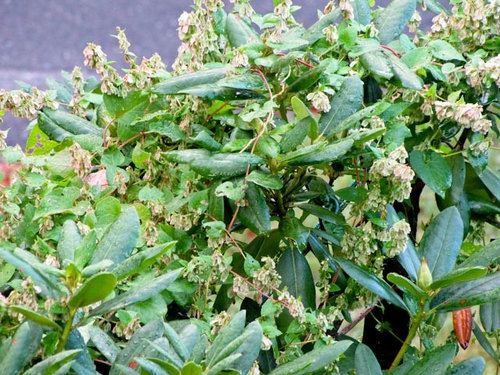
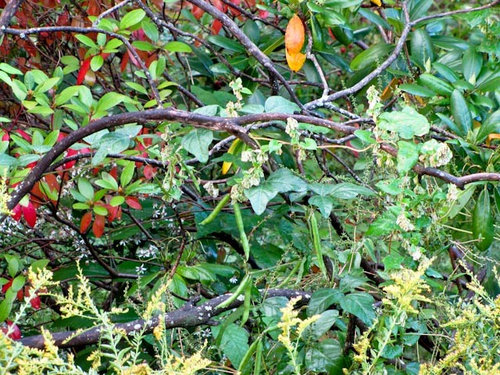
This is one of 'those' stories. I'm still shaking my head. This summer I lost 7 weeks of gardening due to various problems. A week or so ago I noticed what I thought was a very sudden appearance of a white, heavy blossoming vine crawling over the tops of my rhododendron border which is, after a pruning, about 7' tall. I took pictures of the invading vine from an upstairs bedroom window because I'm not 8' tall. First thought: OMG! Mile a Minute vine. Quickly got Google images up and saw Mile a Minute Vine Russian. It shouldn't deserve capital letters, but, the leaves look triangular, but slightly more rounded and in bloom, OMG! it looks like mine. Even the stems have a slightly reddish tinge. In my early morning head sans coffee, I thought, I'll have to notify UCONN hort. CTlady, our very own invasives sheriff surely will know for sure, ask her first for positive ID (she's more trustworthy than Google).

Thinking that my house cleaning, bird shooting day was shot because I was going to have to 'black bag' a lot of vines, I plugged the pictures into my computer for a closer look. No ocrea visible (saucer shaped discs in an open space on the vine) but, there are no bluish berries and it's fall. But it's grown SO fast. Those two storms last year blew in a lot of strange stuff, but this sure looks like mile a minute russian vine (no caps) and my heart continued to sink until my head felt just plain dumb.

This is the vine on the top of a rhododendron - and the vine covers more than 35' over and through 5 mature rhododendrons

Ever feel dumb and lucky at the same time?

Yup, it's String beans

For those who remember that this border was created after the felling of a row of old pinus strobus, I had 18 yards of soil delivered 4 years ago and who knows which farmer's field that came from. Had small, what I though were French string beans the second year growing in the rhodies, and now this. Forget the black bag, I'll get a basket and cook them. But, can anyone shed any light on what kind these beans may be and how do string beans grow 35'-40' through rhodies (other than quite easily). The leaves look different from those of wild string beans.

Jane (aka LUCKY)

Comments (22)

  • 14 years ago

    Jane, you are indeed LUCKY! That would be an awful lot of invasive weed to have to remove - and you can eat them too.

    I don't know squat about pole beans except what I just googled. Did you know GW has a Beans, Peas and other Legumes forum? Neither did I. Anyway, I googled "how tall do pole beans get?" and got various hits including this GardenWeb link. The answer seems to be that they'll grow as tall as you let them.

    Further googling brought me to another thread on the Beans, Peas and other Legumes forum called How do pole beans climb? that gets deep into the mysteries of left-handed and right-handed twining.

    UConn lists Romano, Blue Lake, Rust Resistant Kentucky Wonder, and French Horticultural pole beans as suitable for Ct, so maybe yours is one of these.

    Who needs trellises when you have rhododendrons?

    Bon appetit!
    Claire

  • 14 years ago

    Jane, can you post a closer picture of just the leaves? It looks very similar to something I had identified over on the perennials forum as american hog peanut. But I can't seem to find any images of its fruit, and also, the flowers on my vine did not look like yours. Of course, the flowers on yours don't look like any bean I've ever seen either, lol, but you do seem to have beans!

    I am going to check my yard later today. I'm sure I didn't get all the peanut vine eradicated, so maybe I have some fruits I can find. By the way, I also got manure from a local farmer, and with it got lots of new weeds!

    Dee

  • 14 years ago

    Dee - tried to get closer shots (favorite camera acting up) and found more ...sigh...vines that look like a morning glory leaf. Other than beans, I loathe most vines simply because they, well, vine. Been battling the same vine on my property for 37 years. Still can't get rid of it.

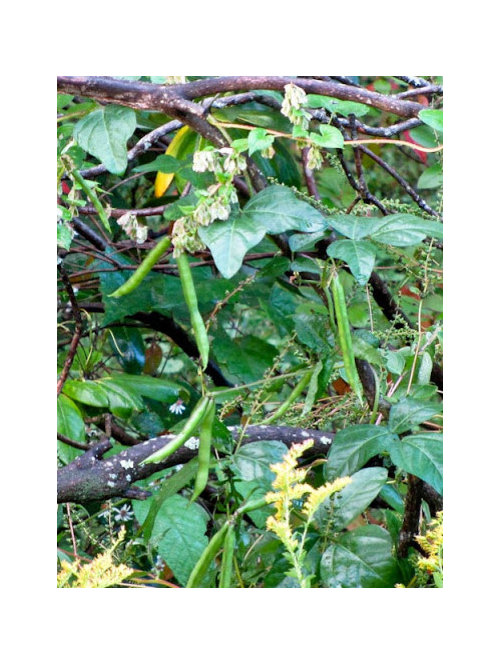
    The bean leaves look like this:

    The immature leaves don't have the 'hip' curve at the bottom which made me think mile a minute vine.

    The other entwined vine looks like this:

    Claire - yes, definitely lucky to harvest something edible. But trying to harvest in the middle of 80 feet of mature rhodies is bound to leave more seed for next year and more adventures in Jane's Jungle. Oy. It was supposed to be a nice, simple border. Other than hauling down the vines every year, I have no idea how to eradicate them. I'm open to suggestions that won't hurt the rhododendrons.
    Jane

  • 14 years ago

    Jane: I usually deal with Oriental bittersweet, black swallowwort, and bittersweet nightshade vines that all climb through shrubs and trees here.

    If it's too hard to pull them out of the shrub/tree I just pull the roots out of the ground and hang the roots (with the vine still attached) on the lower branches. That way the vine dies off and later on I pull off the dried vines or leave them there for the weather to deal with. Hopefully I get them before the seeds are ripened so they don't reproduce. You can also pull the roots and cut off the vine and let it die off, but then you have to do something with the live roots.

    It's generally easy to find the vine roots if you look around the shrub base or trace the vine back to its source. The dead vines shrivel and aren't very noticeable.

    I've never used Roundup-type products but you might be able to pull out the roots and brush them with Roundup, put the treated roots in a baggie, and then hang the baggie from a branch so the chemical is transported through the vine but doesn't touch the rhododendrons.

    Claire

  • 14 years ago

    You can try broadcasting corn gluten next spring at the right time to prevent the seeds from sprouting. It may not get all of them, but might get them to the point of you being able to pull the roots of the ones that do sprout and so get control of them that way.

  • 14 years ago

    You can try broadcasting corn gluten next spring at the right time to prevent the seeds from sprouting. It may not get 100% of them, but might get most of them, to the point that you could reasonably pull the roots of the ones that do sprout as Claire suggested and so get control of them that way.

  • 14 years ago

    There was a thread about wild beans (c 2005!) on the weeds forum -too bad the photos are mostly or all gone, but the description sounds very like your mystery bean to me.

    Here is a link that might be useful: wild bean thread

  • 14 years ago

    Jane, here is a link to the thread I posted about my vine (meant to put it above in my first post). I had been worried it was poison ivy. Your leaves look similar to my American hog peanut. I also have the other vine too, but its in the "wild" part of my yard, not in the garden (yet!) so I haven't paid too much attention.

    Didn't get a chance to go out and look for beans, lol. I'll have to try to remember tomorrow.

    Dee

    Here is a link that might be useful: thread from perennials forum

  • 14 years ago

    Here's a link to info on Amphicarpaea bracteata (American Hog Peanut). It looks like the "bean" pods are shorter and fatter than Jane's and the leaves a bit different in shape.

  • 14 years ago

    Jane - are you sure these are edible beans? Personnaly I would want a positive identification before eating them. That photo of the 3 lobed leaf does not look like any bean edible green bean leaf I have seen before.

  • 14 years ago

    I bet the Beans, Peas and other Legumes people would have information on your vine. Maybe post there? or in the Name that Plant forum?

    Claire

  • 14 years ago

    Well, guess what? I have beans! Well, bean-like pods, at least, on the vine that was ID'd as the American hog peanut vine. Mine seem to be in a later stage than yours, as many are purplish and also many are dried (which means I better get my butt out there and remove them before they burst open and re-seed!)

    I have to agree with Pixie Lou - I wouldn't eat these, because, as I mentioned above, the leaves of your plant don't look like bean leaves to me. I'm still leaning towards you having the Am. hog peanut vine as I do, or something similar. Either way, I would get a positve ID from a trustworthy source before eating anything.

    Let us know what you find out!
    Dee

  • 14 years ago

    Too late. I already tried one six hours ago - no ill effects. Unbelievably tough! Did boil them, but boy, I'm glad I didn't pay for those! Spat it out, but it did have that familiar after finish of string bean flavor. Now that I appear to be still among the living, I did send off a few pictures via email of both vines to UCONN for identification. The problem has worsened since my first inspection. There appear to be multiple vines involved in this invasion and naturally, they've all entwined themselves. My rhody border looks like the vine version of Woodstock in 1969. This vine invasion HAS to be gone.

    You all are very kind for responding and I certainly will report back if UCONN does ID the vines. And, I will ask the CT Botanical Society. Here's a picture of them prior to me getting all Julia Child like.

    Kindly,
    Jane

  • 14 years ago

    Dee, nhbabs - here is a good site for Amphicarpaea bracteata, Hog Peanut. You both are quite right about it but I'm still searching for the flowers on the invader vine I have.

    Here is a link that might be useful: Connecticut Botanical Society Plant ID

  • 14 years ago

    I'm pretty sure your vine is Climbing False Buckwheat/Polygonum scandens. It grows here (everywhere), too.

  • 14 years ago

    That's it! Thank you very much, Jaynine. And, according to one website, that's not a blossom, it's a fruit...oh, great. Best to pull as much out ASAP. I will remove all vines as best I can and will definitely research the spreading of corn gluten in the spring as nhbabs suggested.

    Very thankful for all the help.

    Jane

  • 14 years ago

    I saw the pictures at the website that showed the wafer-like fruit, but what about the beans? What vine produced the beans? How many different kinds of vines do you have growing there?

    Claire

  • 14 years ago

    heh, heh, last count was about 4 different kinds of vines all in that 35'-40' area of the rhody border - all where that 18 yards of new soil was dumped 4 years ago. Looks like I won the vine lottery. I did ask UCONN about the beans and sent pictures - awaiting a response. Same variety that grew in the same spot 2 years ago.(I had tried them at that time knowing they are string beans; just don't know which variety. It's not like I pop down wild berries or pods on a whim- no death wish here.)

  • 14 years ago

    Wow, weird vines. Never heard of hog peanut or false buckwheat. I'm curious what was the reason you brought in the loam?

  • 14 years ago

    Terrene - the loam was brought in to level the area after felling six 80' tall pine trees. After all the stump grinding was done, the area needed to be filled in with soil and raised.

  • 14 years ago

    To conclude, I did receive an email back from the UCONN Extension Program which confirmed the identification of the false buckwheat and identified the bean as trailing wild bean vine.

    In part, the answers:
    "The top photo shows climbing false buckwheat (Polygonum scandens), a native vine in the buckwheat family with heart-shaped leaves, yellow-green flowers and winged fruit (seeds). See http://www.illinoiswildflowers.info/savanna/plants/cl_buckwheat.htm

    The vine with three leaflets and string bean-like pods appears to be trailing wild bean (Strophostyles helvola), another native vine - see http://www.ct-botanical-society.org/galleries/strophostyleshelv.html.

    Native plants support wildlife and we encourage homeowners to grow natives wherever possible, but if you want to remove the vines in this area they can be hand-pulled. Try to remove seeds as much as you can to reduce new plants growing in the future."-- D. Ellis, Connecticut Invasive Plant Working Group, UCONN

    Thanks to all who responded. Perhaps the ID of these vines may be helpful to someone else in the future.

    Jane

    Here is a link that might be useful: Trailing wild bean -CT Botanical Society

  • 14 years ago

    Thanks for posting the results Jane. Actually, I'm thinking now that I may have the trailing wild bean, and not American hog peanut after all... Can't decide yet!

    Thanks,
    Dee