Software
Houzz Logo Print
mark_g_gw

Back-Up House Battery/Generator Conundrum

18 years ago

This is my first post to this particular forum, so pardon if it has been covered before.

We're building a home in NY State in an area known for short power outages and voltage sags. Most of our neighbors have installed back-up generators, and advise us to do likewise.

In my research, I have found whole-house battery backup units by Gaia, that, properly sized, claim to run all critical circuits for hours or even days. They claim brownout/low voltage protection, and instantaneous switchover in the event of a failure (neither of which a genset can do). So my understanding is that much like a computer UPS, home electronics are protected. An option is to connect the controller of that unit to a generator, and it will cycle the generator when the batteries need to be recharged (in the case of an extended outage). The battery option is expen$ive, and even more w/the generator.

A second option is to forego the battery bank and install a propane-fired generator, with a cutover switch that will automatically take the house off-line (to prevent dangerous backfeeds into elec co lines) w/in 30 sec of a failure, and run the house. A full-sized generator is a big user of propane, but no one has been able to correlate load to consumption. Certainly, demand on the generator wd be far less with the batteries supplying most needs, and history is that most outages are less than a day anyway, and maybe the generator would hardly be called for service.

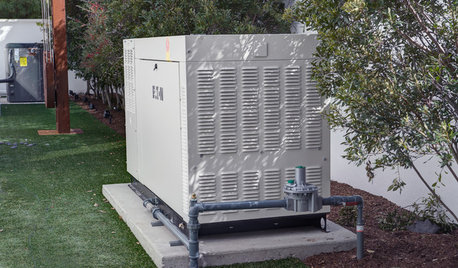
Then there's the issue of where to site the generator. We are burying a 1000 gal propane tank on the way from the utility drop to the house, and I wonder if that wd be the best place for the generator pad -- near the access road to the property (so it can be serviced), near the propane tank (for hi pressure fuel), and away from the house (for noise). But then, the generator would be 175' from the house, so I don't know if that wd affect the hookup between the generator, the service main drop, and the in-house panel.

I wd appreciate feedback from anyone with experience in this area.

Thank you! --Mark

Comments (25)

  • 18 years ago
    last modified: 11 years ago

    Your neighbors are probably right. Without seeing your house plans, it will be difficult to give much guidance about the set's location. Suffice to say that gas pipe is usually less costly than wire, and when the commercial power goes off the sound of a genset isn't objectionable compared to the silence of your refrigerator, freezer, and HVAC if you had no generator. The minute or so needed for the set to crank and transfer is nothing compared to a day without power.

    All reputable genset makers furnish fuel consumption data tables. If your vendor can't come up with that information, find another vendor. If you intend to run computers with UPS units, you may want to get a genset with "isochronous governing" to keep the UPS from tripping on and off line due to frequency issues.

    Be aware that many (if not most) of the standby generators sold for household use are not of the same quality as those you see behind police stations, hospitals and telephone companies. The residential grade units are fine if a power outage will merely cause discomfort or monetary loss. However if your need for standby power is at all critical (life safety issues, etc.), you should call Onan, Kohler or Caterpillar, and go from there.

  • 18 years ago
    last modified: 11 years ago

    We are a generator installer located in South Florida so I have some experience at this.
    1-Siting-Due to the cost of materials, I would reccommend that you put the generator as close as you can to your main electrical service. The transfer switch would tie in there.
    2-Noise-Most units are not much louder than an air conditioner so if you are putting it somewhere around the house, put up a barrier hedge and you will hardly know that it is there if you keep it a modest distance away.
    Look for units rated 3-Fuel Choice-If you are so inclined, I would consider a diesel unit with a skid mounted belly tank large enough to hold fuel sufficient for several days of continuous use. We favor the diesel units due to reliability and longevity and service records. There are several good brands of diesels out there.
    4-Operating and Maintenance Cost-I think that if you compare costs, the diesel will win out. Granted, it may cost more up front but in the long run, you will have a better installation. Keep in mind that you are going to spend somewhere around 6-7K to install the propane tank and fill it.
    5-Inverter Systems-The jury is still out on these. As you correctly stated, you need some way to charge the batteries when they are drained whether it be sun, wind, or a generator.If you move forward, the GAIA units are presently the state of the art. The owner has a 30kW system that he charges with solar. You may even qualify for net metering if you use solar or wind to charge it.
    Any other questions, please ask.

  • 18 years ago
    last modified: 11 years ago

    also keep in mind that you should size the generator for the loads you NEED, and then get it one size bigger. don't buy a 30kw generator if you need only a 10, but then again don't get a 10 if you think you may want to add things on the genny later.

    my house is setup to feed all teh 120v outlets from my genset, none of my 240 stuff will run during an outage due to the seperate panels we have. i only have a 5kw unit, but it runs my lights, fridge, deep freeze, washer and dryer. during the winter we use a fireplace with a blower as supplemental heat. if the power is out during the summer we open the windows and turn on some fans. ours is rarely out more than 15 minutes, so i usually don't even bother to fire it up.

    a local county 911 commission put in a new radio system a few years back. they have a 20kw UPS that provides 6 hours of standby at full load. this unit has 84 12v batteries in it, and they go bad about every 3 years. that means once every 3 years it will cost AT LEAST $9000.00 just to change out batteries. so the recurring maintenance cost is not feasible for home ownership. for that cost you could buy a new generator every 3 years!

  • 18 years ago
    last modified: 11 years ago

    RE: Fuel Consumption
    Standby generators are run once a week for about 15 minutes to keep the juices flowing.
    Try this site for some consumption figures:
    http://www.guardiangenerators.com/Products/Residential/Elite/LiquidCooled.aspx
    If you decide to go with the propane generator, spring a few extra bucks for the liquid cooled. Considerably less maintenance and much more reliable.

  • 18 years ago
    last modified: 11 years ago

    "you should call Onan, Kohler or Caterpillar, "

    Onan?? That sounds a little too much like it stops too early...

  • 18 years ago
    last modified: 11 years ago

    Outback Power Systems is another respected manufacturer of systems similar to what Gaia is selling.

    Here is a link that might be useful: Outback Power Systems

  • 18 years ago
    last modified: 11 years ago

    Assuming that the propane tank will be installed anyway for other uses such as heating and domestic hot water, the cost of running gas to the genset is not at all significant.

    The above post is one of the few times I have seen the words "Generac" or "Gaurdian" and reliable associated with each other. I wouldn't use one where a failure would potentially cause more than minor irritation.

  • 18 years ago
    last modified: 11 years ago

    Wayne,
    I'll go along with your assesment of Guardian.
    The site was offered so the poster could see what kind of fuel consumption to expect.
    I have however installed several Guardians in the last few months that have performed better than expected.
    Given the choice, I would spend a few extra dollars for a different brand but they seem to be getting better, especially when you look at the liquid cooled models.
    Control boards have been revamped to get rid of the bugs.
    The problem for the homeowner is that an $11K Guardian will cost close to $18K or $20K in one of the premium brands.

  • 18 years ago
    last modified: 11 years ago

    I will say that the newest ones seem to be improved over those of a few years ago. IMHO, the generator ends are pretty light for their ratings, not a good thing when a 16kw stator alone costs close to $2K.

  • 18 years ago
    last modified: 11 years ago

    Remember, if you have a battery/inverter system that is sized for your load, you don't need to have a generator that is sized for the full load--it only has to be big enough to charge the battery in a reasonable period of time.

    Caveat: Some (many/most?) battery systems use an unified inverter/charger that uses the same circuitry for both the inverter and charging functions. In that case, you do need a generator that is big enough to handle your full load, because the inverter is disabled during charging. (With a well-designed inverter/charger, though, you don't need a generator big enough to supply the combination of your max load and the charger, because it is designed to used "whatever is left over" for charging.)

  • 18 years ago
    last modified: 11 years ago

    Hi Mark,

    I live in Westchester county NY and two year ago installed a backup generator for my house. I also built my house from scratch including blasting rock.

    The best time to install is when you are building your home. Key things for siting the generator is:

    1) By code the gas line must be a continous piece underground, no underground joins. The gas line must be burried more than 18 inches. And finally the gas line must be no longer than 100 feet. So this means your tank and genertor must be no more than 100 feet apart.

    2) A propane tank must be sufficiently near access to where a large tanker truck can get to it. They have long gas hoses, but no more than say 200 feet.

    3) The propane tank looks much nicer burried. We missed out in that we installed our generator after we finished our build.

    4) Generators are noisy. 69 db. If you get a good one. I have a Cummins Onan RS 20,000 from Costco. It runs at 1,800 rpm. The cheaper ones run at 3,600 rpm. For a good gauge as to the noise, start your car in your driveway and rev it to 1,800 rpm. Then at 3,600 rpm. Now imagine that all night. If at all possible I would position the generator away from your house.

    5) Keep your generator away from trees, falling limbs, away from high ground - lightning strikes, and away from where it may get flooded.

    The distance from generator to home via electrical wires is limited no so much by power delivery but by the other lines. What other lines? Auto start up control lines, battery maintain charger line, generator coolant heater line. Typicaly your auto transfer switch is in your basement, NOT OUTSIDE. My transfer switch is next to my power panels. You want that thing there so that you can check to see what is going on when the power fails.

    Fuel source I recomend propane. Propane does not degrade with time. If you have a leak there are no EPA polution issues. Explosion risk is the flip side on the issue.

    A 1000 gallon tank is basically the biggest tank you can get easily unless you go commercial. A 1000 gallon tank will hold 800 gallons when full. Huh??? You need a 20% buffer gap for the propane gas to expand and contract. I have a 500 gallon tank and when full, 400 gallons, I guestimated would give us about 4 days continous run on the Onan RS 20,000 (20 kw).

    Note that your tank may not be full all the time. You use gas when the generator exercises, and for us we cook with it. Basically we use maybe 40 gallons a year. So when the power cut comes, your propane tank may not be full. Also the propane company may not want to come out to give you say 40 gallons of fuel.

    On the flip side you do not need to run your generator all the time. Propane is expensive. So on a power outage, we run for maybe four hours in the evening. If it is cold we boost up the heating etc. Then we shutdown for the night. In the morning we restart. The house typically will remain above freezing for the 8 hours of shutdown time and the fridges and freezers are O.K.

    The Onan we have is a 20 kw model. We do not power the whole house. We do power, well, ejector pump, fridge/freezer, oil boiler controls and ignitor, Air handlers and the smaller of the air conditioning units, garage doors and lights, washing machine. We do not power, jaccuzzi, dryer and some of the other rooms.

    I would not recomend the battery route, the number of batteries that you would need are huge). Having said that I would recommend buying a small (about the size of a room trash can) plug in UPS for any computer you have. Laptops do not need any UPS since they have their own battery...

    Finally install surge and lightning protection into your home elctrical protect your generator. You do not want a lighting sttike in a storm to take out the generator just when you need it. I have whole house surge supressors at the hookup to the mains power and also other surge supressors around the house, TV's etc.

    Hope this helps.

    Warmest regards, Mike.

  • 18 years ago
    last modified: 11 years ago

    mark

    I live in the Blueridge Mtns of VA and just finished having a genset installed for the same reasons you need one. Here is what I learned:

    1) Think about what worst case scenario you want to protect against and what things to you really need backed up - bare bones for survival - and design your generator for that. In our case it is a winter outage and no power - and that knocks our our geothermal (electric) heat.. so we use fireplaces as backup heat, need water too so we backup the well pump..Secondary sceario was mid summer outage and backing up refrig's. If you try to back up the whole house the genset can get awefully large and might be overkill - it depends on what you want backed up.

    2) I went with a 12kw (100 amp @ 120 volts) Kohler which at 50% of max output (50 amps) consumes 2.5 gallons of propane per hour. You can download the spec sheets on the generators to see what their fuel consumption is. Remember that with gennies you have to account for both 120V and 240V cicuits when you calculate the amperage you need. My Kohler 12kW is spec'd at 100 amp output for a 120 volt load or 50 amps for 240 volt load. You will probably have a mix of circuit types so make sure you add up properly and then add some margin on top of that.

    3) Once you have those scenrio's defined, then identify what circuits you need to back these things up. Have a sub-panel put in now (cheapest during new build) that has all of those circuits you need backed up. It is much simpler to install the automatic transfer switch (ATS) if you have these circuits already in their own sub-panel. It allows you to get the ATS without the load center (load center is essentially a sub-panel) and avoid a lot of cross connects between the ATS and the exisitng sub-panel. When they install the sub-panel, make sure they add an extra 3 or 4 feet of feeder cable from the main panel to that you can move the feeder from the sub-panel and run it into the ATS without splicing.

    4) MAKE SURE you put the sub-panel on the side of the house where the generator will be - because you will need to run cables from the sub-panel & ATS to the generator. You don't have to do this but it can cut down on the length of cable run and save you money.

    5) The longer the distance away from the house the thicker the cable required to carry the line voltage coming from the generator. You also have to worry about gas line runs max length too. We put our propane tank near the back corner of the house (away from bedrooms since gennies are noisy) which was within 35 feet of the sub-panel and ATS - made the cost for gas and electrical connections reasonable. Rememeber you have to trench both the propane line and the electrical wires to/from the genny. So minimizing these trench lengths saves you money.

    6) I purchased my Kohler generator from Ziller Electric on line. Very reasonable prices - and included delivery. If you act as your own general contractor and sub out the work to licensed plumbers & electricians you can save a lot of money. I found that the full service route was 2 to 2.5 times more than the cost I could do it for acting as my own general contractor.

    7) If you do go with the Kohler - make sure you purchase the carburetor and battery heaters. These items are not that expensive and are easy to install if you are a little handy. You need these heaters in the extreme cold or the genny might not start.

    8) Kohler and Onan are the better brands (Onan is more expensive than Kohler). I recommend NOT buying from big box stores even though prices seem cheaper - but you are getting a lower end model. See the Kohler 12RES vs. the 12RES L (where the L=Lowe's). The L model does not have the electronic governor to control the frequenecy output which you really do want. The Generac's (not from Home Depot) are not as reliable as the Kohler or Onan - tend to break often. In my opinion, the Kohler is the best bang for the buck for a typical residential backup. Onan is the best for commercial or high end residential, or where you expect to have very long outages. Just my opinion based on the extensive research I have done.

    9) If you do buy your genny on-line, watch out for this scam. After you purchase, you get a notice in the mail that says your warranty MAY NOT be covered if you do your own Start Up (which is a checklist of things to do before you activate the generator). It also says that the Start Up can only be by an authorized Kohler dealer. I called one - and they wanted $1000 to do this Start Up!!. What a load of crap. I bought a multimeter at Lowe's that has a frequnecy measurement and am doing the startup myself. It is easy to do and the instruction manual Kohler provides is detailed enough to walk me though the steps. I thought that this was crapola - and I sent a note to Kohler telling them so. They are essentailly trying to penalize people who buy on-line by scaring them to go with their dealers. I would have done it - but not for a GRAND! It's maybe $250 dollars worth of work - at most.

    Best of luck.

  • 18 years ago
    last modified: 11 years ago

    Hi,

    Some comments on Onan generators. I bought mine from Costco because it was the cheapest source. I went through a few hoops but it turned out ok in the end.

    When the gen set arrived, it was missing a hinge nut and had some oil in the packing case. Note this is heavy at about 1,200 lbs. Got on the phone to Costco who were polite but clueless. But they did give me a number to call.

    That number is to Cummins Onan North Western Divison which are the sales / dealer to Costco. They then switch me to Cummins Onan NY, Cummins Metropower. Cummins Metropower were very good. An engineer came out the first time to check it over. Free, no cost. Return a few days later to install the hinge pin and check the oil leak, Free. When I called and they said an engineer would come, he did and on time. I was so impressed that when it came to turn the genset on I paid $US 600. The engineer came out and spent about 4 hours making sure everything was O.K. There was a recall notice on the genset, Cummins called me, and the engineer came out and installed the fix, again Free.

    I am therefore very pleased with the Cummins Onan after sales service. It is absolutely to notch. I recommend them.

    Warmest regards, Mike.

  • 18 years ago
    last modified: 11 years ago

    stinky makes a good point about service. When you are selecting your genset, cost should not be the only factor. Check around to see if there are local service companies for your genny - you want someone who is local. If they have to drive a long distance to provide service - and it isn't for a warrantied item - you pay a lot of money for that call.

    In my area, the closest Onan service center is Richmond (a long way from me). Kohler service is a local call - so that did play a big factor in my selection.

    Onan makes a great machine - and Costco does have a good deal on them. I especially liked the 1800 rpm feature of the Onan - the Kohler runs at 3600 rpm so it makes more noise.

    I actually was very close to purchasing a Generac from an authoirzed dealer that is very close to me. I decided not to do that because of issues I read about on this forum with the Generac's breaking often as well as an issue with frequnecy control. From what i read, the Generac's can sometimes cause issues with electronics that require a 60 Hz frequency within power company tolerances.

    Avoid Big Box at all costs. You won't be getting the same quality of machine (even though the model numbers seem to match) and the Big Box stores outsoucre the install. Too many horror stories to save a relatively small amnount of dollars.

    The other thing to keep in mind is that if cost is an issue for a standy generator, you might want to look at the Yamaha portable unit with manual transfer switch. You can get them on line for under 2 grand and they provide a good low cost solution - plus you can wheel the genny around your lot if you need power in other places. There are issues with this approach (like storing gas and the amount of power you can get) but it's worth keeping in the trade space. The standby with LP or NG is the best - but if not affordable, I would rather have the portable than no power.

  • 18 years ago
    last modified: 11 years ago

    Since nobody has gotten the reference, I should probably point out that my earlier comment about Onan was intended to be a joke--it is a biblical reference. I don't have a problem with the products of the company with that name. :-)

    (I always think of poor Onan when I hear the ads with the line, "substantial penalty for early withdrawal." ;-) )

  • 18 years ago
    last modified: 11 years ago

    Maybe that is why "Onan" is now known as "Cummins Power Generation" in all but the homeowner/RV market.

  • 18 years ago
    last modified: 11 years ago

    "Cummins"

    Oooh, that's bad! That's really bad!

  • 18 years ago
    last modified: 11 years ago

    LOL. Getting back to fuel, I do wonder about diesel. Wonderful engines etc and probably the go-to for commercial power backup but I wonder about the fuel life in terms of standing....it does go off after time, and I suspect the standby maintenance is bigger - and maintenance is something many probably don't factor into costs.

    I wonder if you can get the special diesel that doesn't include the road tax and is cheaper? The gas equivalent here in Canada is called "purple gas" but don't know if there's a diesel equivalent.

    If it was legal to do so and you were committed to having the tank topped off regularly, or had two tanks, I suppose you could, theoretically, have a diesel vehicle and use the fuel from tank A) when it was getting old, keeping tank B) full, then swap and use up tank B) - I believe you can have such fuel tested too.

    Reading the Costco fliers I thought the Natural gas gensets sounded appealing - no dangerous fuel storage, no old fuel to get rid of, but then you are reliant on the outside gas supply. I suppose propane beats this, but how long does IT keep?

  • 18 years ago
    last modified: 11 years ago

    Propane keeps for forever.

  • 18 years ago
    last modified: 11 years ago

    Hi,

    There is diesel without road tax and this is used by farms for tractors etc. Diesel's storage life span can be increased by adding fuel preservatives/stablilizer such as PRI-D or Stabil. However the lifetime cannot be extended indefinately. A guestimate is maybe 2-3 years.

    Propane Natrual gas can be stored indefinately without degredation and hence is a good choice for home backup generators.

    Warmest regards, Mike.

  • 18 years ago
    last modified: 11 years ago

    Gensets fueled ny natural or propane gas are collectively called "gas" fueled, don't confuse that with gasoline. I haven't seen a gasoline fueled standby set in many years.

    For household size "optional" automatic standby applications (where no one is going to die if the power goes off), natural gas is probably the best choice for fuel if available. Propane follows closely behind, diesel is rarely seen. Small diesel sets cost a lot more than gas units.

    In my region, commercial standby sets are primarily "gas" if they are less than 45-50KW in size. Above that diesel is generally the fuel of choice.

    The only reservation I have about propane is the logistics of refueling if the on-hand fuel supply is not adequate to last until normal power returns. Diesel fuel is relatively easy to obtain and transport by expedient means. Within 2 miles of my house there are hundreds of gallons of diesel- all I need is a length of hose and simple container. My propane fueled set is dependent on waiting for the truck (if it can eventually get here).

  • 18 years ago
    last modified: 11 years ago

    Granted diesel units are more expensive initially but when you factor in the cost of installing a propane tank with the associated plumbing required, the gap closes considerably.
    As far as maintenance goes, we find the diesels to require a lot less maintenance than the gas units.
    A diesel unit will outlive a gas unit by years.
    To address fuel stability:Modern fuels are much more stabile than they used to be. Additives only make them more so.
    Keep in mind that you will be exercising the unit on a weekly basis so the fuel is not going to just sit for years.
    It will be getting topped off on a regular basis.
    In the event of a disaster, I believe that diesel will be easier to obtain than other fuels.
    At Port Everglades the fuel comes in #1)Regular gasoline #2) Diesel fuel #3) Propane
    Fuel is going to be expensive no matter what you use.
    This is an item that people don't pay attention to when deciding to install a generator.
    Propane and natural gas can easily cost $600 to $700 a week if you are running a gen 24 hrs. a day.

  • 18 years ago
    last modified: 11 years ago

    "Propane and natural gas can easily cost $600 to $700 a week if you are running a gen 24 hrs. a day."

    Which is a decent reason to have a battery/inverter system that is recharged once or twice a day by a generator, rather than running a generator 24/7.

    (I note though, that batteries are not cheap, either. Over their cycle life, good batteries cost around $.25-.50 per kWh. Poor batteries cost even more.)

  • 18 years ago
    last modified: 11 years ago

    "Which is a decent reason to have a battery/inverter system that is recharged once or twice a day by a generator, rather than running a generator 24/7."

    I'll go along with that.
    Even better if you charge it with PV.

  • 18 years ago
    last modified: 11 years ago

    Wanted to mention something about the new Guardian line. The 20K model now comes with a really slick transfer swtich/load panel. The call it PowerManager LTS transfer switch. The cool part is the transfer switch/load panel actually goes in between the service and the main load panel. The generator will power both the transfer switch panel and the main panel for the house till the load is too much for the generator to handle. It will then cut power to the main panel and only supply power to the transfer switch's load center which is where you hookup all your critical loads. The important part is the LTS panel will run BOTH the transfer switch load center and the main until the frequency drops below a predetermined limit, when it will cut the main load center.

    We are still in the process of building so haven't had a chance to play with it yet, but should have it up and running within a month or so. Definitely something to look into. Call me a geek, but this is pretty cool stuff.

    Here is a link that might be useful: Guardian 20K Generator