Software
Houzz Logo Print
annie_lee_gw

Power source for door bell

17 years ago

Our wired door bell quit working. I checked wirings on front door button and the chime box inside the house where transformer also located, neither has any significant voltage. I can't locate the origin of the power source either. For testing purpose, can I just splice a 18 guage wire from any of the nearby 120 V outlet and connect it to the front entry button or the transformer connector? Thanks.

Comments (10)

  • 17 years ago

    If you hook 120V directly to the chimes (whether through the doorbell button or not), you're quite likely to fry the chimes and/or transformer. (And you might see some entertaining fireworks in the process with some not-too-savory smells!) NOT A GOOD IDEA.

    Since you mentioned measuring no "significant voltage", can I assume you have a way of measuring voltage? If so, this shouldn't be too hard to diagnose.

    1. The transformer is either getting power from it's power source or it's not. Why not begin by measuring that? If the transformer isn't getting something in the order of 120 volts of input power, then the problem is with a blown fuse/tripped breaker or the 120V house wiring.

    2. If the transformer's getting 120V input power, then it should be outputting 24V (or other faceplate transformed voltage, in case the unit isn't typical). If not, the transformer is probably bad.

    3. So, if the transformer's putting out a solid 24V, you might try bridging the terminals on the doorbell button (needlenose pliers with insulated handles are a reasonably safe way to do this) to see if that sounds the chimes. If the chimes sound, the problem is the door bell button.

    4. Haven't found the problem yet? You could use that 18-guage wire you have to try a quick (and temporary) "home run" from the transformer output (24V side, please!!) directly to the chimes terminal. (I wouldn't have suggested this if you hadn't noted that the transformer and chimes are located close to each other.) If that doesn't make for some ding-donging, the chimes are probably kaput.

    Note that you can do steps 3 & 4 just as well with the voltage meter, too. In fact, that's probably the better way of doing it.

  • 17 years ago

    Thank you so much for the info and diagnose tip. I am so glad that I asked questions before trying it out. I must have mistakenly thought that the transformer is also inside the chime box. I see a thick cylender copper coil behind the two "ding dong" sticks. Anyway, now I need to locate the real transformer. I am going to read the early post about locating it. The diagnose tip is definitely very helpful when I locate the transformer. What is the typical shape/size of this kind of transformer? Thanks so much again.

  • 17 years ago

    "I see a thick cylender copper coil behind the two 'ding dong' sticks."

    Yep, gotcha. Those are electromagnets that move the pistons or "clappers" to hit the chime bars. But I think I like "ding dong sticks" better. :-)

    What is the typical shape/size of this kind of transformer?

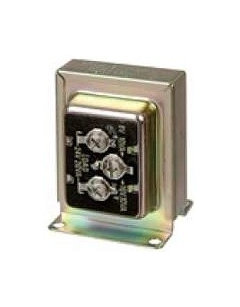
    You're looking for something that is more or less the size of a two-and-a-half to three-inch lopsided cube.

    One kind has

    for mounting in a box or, in older installations especially, almost anywhere someone decided to screw it in.

    Another type is

    .

    Good places to look are: (1) mounted on or near the electrical main panel (2) in a utility closet serving the hot water heater, furnace, etc. and (3) inside and above the door in a front-hall closet (common in older houses). However, you should also know that thermostats for heat also use transformers that look identical, so be wary of confusing one that powers your thermostat(s) with a possible second transformer for the door bell.

    BTW, you can do the kind of testing outlined above with a cheap (I believe still under $10) test light as long as it has indicator lights for 24 volts and 110-120 volts. (Most also have lights for 220-240V, but that's irrelevant to the topic at hand.) Just be a bit careful when touching the probes to the 120V transformer posts--they're the ones that can give you a real jolt.

  • 17 years ago

    Thank you so much once again, Tom. I think I know what happened. Just don't laugh. We moved to this roughly 30 year old house last year. There was tons of no-longer-used wires, mostly for sound systems, etc. While clearing up those junk wires, I must have carelessly disconnected the door bell wire from the transformer. Now I need to put the transformer back into the old junction box. The one I found look very much like the pictures that you gave. It is made by NuTone. On the front side, it says "LINE 120". On the back it has only two screws, it has "CHIME" on top of the screws. Below the screws, there is "5VA" underneath the left screw and "10V" under right screw. My questions are: 1. Do these V and VA #'s relate to the 24 volts output that you talked about? 2. Also, does it matter which bell wire (red or white) goes to which? I supposed I could try simply switch around and see which way works better. And, by the way, what are the difference between VA and V #'s?Thanks again.

  • 17 years ago

    VAs or "volt-amps" are roughly equivalent to "watts".

    They're a measure of the total amount of power put out, not the voltage. (The difference between VAs and watts is largely academic here, involving something called a "power factor".)

    [Just for fun, a 24-volt transformer putting out 10VAs delivers 10/24 or 0.4 amps of current. A 16-volt transformer putting out 10VAs delivers 10/16 or 0.625 amps and so forth. In either case, the wattage is the same.]

    Now that I've danced around your real question, I hate to say it, but I honestly don't know whether you should use the 10VA or 5VA terminal. Since it's marked for chimes, etc., it isn't a generic transformer but one that came with that specific model of chimes. (And, I should note, I recall some door bell transformers being 16 volts rather than 24 and some may be 9 volts as well.)

    Do you have any idea whether this model had an option for a front doorbell and a rear doorbell with different chime patterns (e.g., one ding versus ding-dong) for each? That might explain the option. Whenever I've installed those things, I've pretty much just followed the directions and, with my rotten memory these days, I just don't remember. (It's the CRS syndrome at work, I'm sorry to say.)

    I hope someone else comes along with a more definitive answer.

  • 17 years ago

    Chime transformers are now 16 volts. Older chimes (really old) often were 10 volts.

  • 17 years ago

    Thanks so much Tom. It is working perfectly now. I measured our transformer output, it was around 15~16 volts. I also switched around the red and white wires on the terminals, both works just fine except one has a single tone the other has 2 tones. Thank you very much again.

  • 17 years ago

    Good news, annie-lee, and thanks for reporting back on your results.

    And thanks to you too, bus driver, for the clarifying the matter of "usual" voltage these days. Spot on.

  • 17 years ago

    This is a great thread. Thanks everybody.