Software
Houzz Logo Print
heinz_gw

Minimum distance from House for Standby Power System

19 years ago

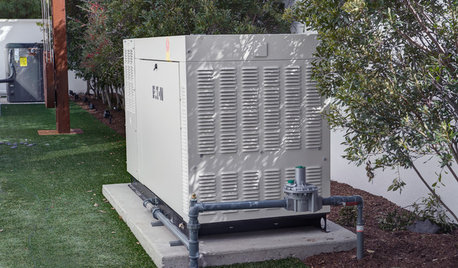
I'm going to install a 15KW ait-cooled Generac as a DIY project and have been pouring over the Code Book and searching on the Generac Site and elsewhere to see if there is a minimum distance requirement. I'd be installing it 18-24" from the house and alongside the Electric meter. What I mean by alongside is about 18 inches lateral and then 18-24 inches out so that access for the meter reader is unobstructed.

There are no windows alongside the proposed installation so the main concern is to maintain a pleasant appearance and if I have to install it furher from the house it'll look somewhat out of place is what I'm thinking.

Thanks in advance for any suggestions and/or links you may be able to provide.

Heinz

Comments (7)

  • 19 years ago

    Heinz, I have no idea of what the codes are where you live, but would suggest the MOST important distance from dwelling is that from your neighbours, ie not too close.

    Apart from any code considerations I would imagine you will need a council permit to make a permanent installation. How is it fueled? There will probably be regulations pertaining to this also if there's oil or gas to be stored.

    Another consideration is noise - is it fully silenced? What about exhaust? Is it diesel, and if so, will the exhaust go all over your walls or neighbour's?

    You also want to ensure it doesn't foul the air being drawn into your HVAC system or that of the neighbours either....

    Things like that, I guess.

    I just saw Costco online's offering a cool standby system (if you have 10k cdn) that runs on natural gas which is kind of neat although not much help if power AND gas are knocked out, although I guess it eliminates the worry of fuel going stale or getting contaminated - and the issue of how much fuel you can legally store at home.

    I guess if it's powered by gasoline the idea is to periodically replace stored fuel with fresh, pump it into car or truck if it's legal...

  • 19 years ago

    A 15kw Generac will be nat/LP gas.

    This number will NOT be in the NEC. It will be in the instructions of the unit. It is likely to be 36", most are.
    I never said this, but that number can be fudged by 6" or so with no repercussions.
    Said what? I didn't say anything....

    The 36" is typically for working clearance as there is usually not much ventilation done on the house side of the unit.
    Th exhaust faces away from the house.

  • 19 years ago

    I see this thread is a few months old, but I'll throw in what I've found researching this very question.

    The generator manufacturers instructions will likely list a minimum clearance around the unit for maintenance and operational purposes, but not necessarily for safety. That's why they also will mention NFPA 37 "Installation and use of Stationary Combustion Engines and Gas Turbines", which I found at my local library. A key paragraph is 4.1.4 "Engines Located Outdoors" (2006 edition). It requires engines and their weatherproof housings to be 5' from openings in walls and also to be 5' from structures having combustible walls. Building codes would normally consider pretty much any wood frame construction to be combustible, even if it has a masonry veneer.

    The clearance may be reduced "where the following conditions exist." If the adjacent wall of the structure has a 1 hour fire rating, and if the weatherproof enclosure has been designed to contain a fire. The wording makes me think that both exceptions must be met before you can reduce the 5' minimum clearance. Its my understanding that Generac will not make the claim that their enclosures will contain a fire.

    Now that being said, I've yet to see any photographs of installations, including those from Generac or their dealers that show a generator offset that far from a wall. This may simply be a standard rarely enforced, or I may be fundamentally misunderstanding its application.

  • 19 years ago

    NFPA Documents normally fall into one of three categories, codes, standards, and recommended practice. NFPA 70 is a code, the National Electric Code. NFPA 37 is a standard. The actual title is "The Standard for the Installation and use of Stationary Combustion Engines and Gas Turbines."

    Codes are typically adopted for enforcement by local jurisdictions. Standards are typically used for architectural and engineering specifications and are rarely adopted for enforcement except in very special situations. Recommended Practices are just that - Recommended Practices.

  • 19 years ago

    "Building codes would normally consider pretty much any wood frame construction to be combustible, even if it has a masonry veneer."

    Even a brick veneer wall has more than a 1 hour fire rating.

    Follow the manufacturer's instructions and any local codes.
    They may be in the mechanical code.

  • 19 years ago

    "Standards are typically used for architectural and engineering specifications and are rarely adopted for enforcement except in very special situations"

    I'm glad you posted that, because it made me get out the books and look up some additional stuff. My codes experience is primarily in commercial work, and I had remembered that the International Fuel Gas Code requires NFPA 37 compliance (paragraph 616.1), but I looked deeper and found that the IFGC cedes jurisdiction to the International Residential Code for single family dwellings. The IRC never mentions NFPA 37. That makes installation sites easier.

Sponsored
AIS Renovations
Average rating: 4.5 out of 5 stars15 Reviews
Custom Craftsmanship & Construction Solutions in Franklin County, Ohio