Software
Houzz Logo Print
johnfrwhipple

Tiling a Deck over Living Space: Hoarding and Tarp Work

11 years ago
last modified: 11 years ago
Working outside can be a joy or it can be an epic pain in the back side. Tiling outside no different. The weather is not your friend when your tiling. The changing temperatures, over night lows, rain and wind all wreck havoc on a tile installation.

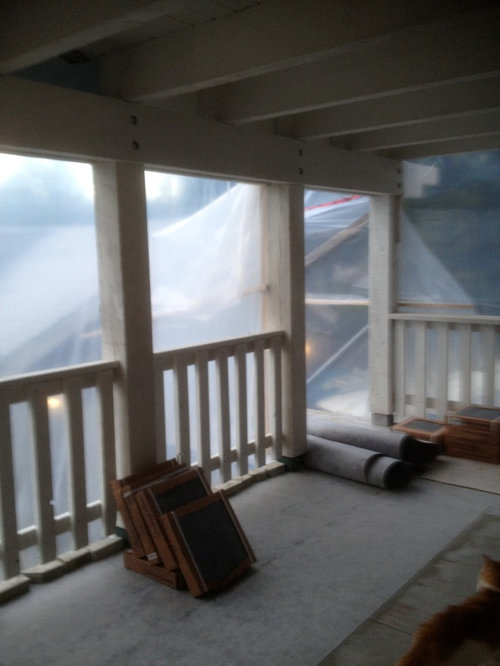
The most challenging outside tile work I have done ever is on my own home. The photo below taken from my kitchen door looking South West.

My exterior deck is over living space and I choose to tile in the winter - because of scheduling and other reasons. The cold was brutal. The wind like ice.

Hoarding can be defined as a large board in a public place, used to display advertisements; a billboard. But is also know as a temporary board fence erected around a building site. This is the more common term in the tile business. Just like the farmers did back in the day planting trees around their fields and homes any fence or structure helps to calm or redirect the wind some what. Even a little plastic goes a long way of changing the temperature of the substrate. In the summer keeping the job in the shade can be the difference from being able to tile or not working at all.

The risks of not hoarding are huge. Thin-set can flash set before even getting tile set into it. Rain can ruin the job before it is even grouted. Plan to be safe.

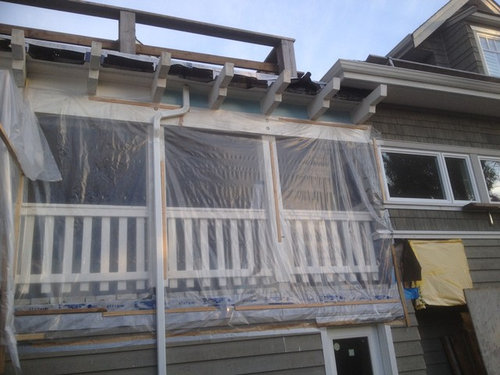
Here are a couple pictures of what I did. I would love to see some other examples of hoarding work if you can share your pictures. I have another deck build coming up in the summer I hope and can use some more ideas. This deck I will not be able to nail into like I did on my home.

Looking North.


The heat source for this tile work was placed both in the room or space and under it. Most of the heat from beneath. I had all my cast iron column radiators daisy chained (connected one to the other) below the deck in my garage. I added a 500 watt shop light and space heater inside the plastic and with overnight lows below freezing the temperature inside the plastic stand at about 12 degrees. All that heat trapped by 6mil plastic and some duct tape, furring strips and nails.

Comments (17)

  • 11 years ago

    I have a simple question.... Why??? Why tile a deck thereby almost certainly trapping water between the tile and sub-structure with a resulting rot factory waiting to encompass your entire deck?

  • PRO
    11 years ago

    Why? Because the tile looks awesome. Feels good under foot. Is easy to clean with a hose.


    There is a waterproof membrane under the tile designed for exterior elements. I build showers, wet rooms and steam rooms for a living. I used the same principles to prepare my back deck for tile.


    I'll let you know in 40 years how I did.....

  • 11 years ago

    The membrane (ditra?) *might* keep water off the wood sub-structure, but, once the grout sealant degrades, it will let water in and it will break down the thinset and cause tile failure. Tile on deck is not the same as a floated floor... but of course.... you know that.

  • PRO
    11 years ago

    Actually Ditra is not allowed to be used on an exterior deck unless it is used as part of a system. That system needs a primary waterproofing membrane. Schluter does not sell one (a primary exterior waterproofing membrane for use over living space) at all.


    I looked into the Ditra Drain option with Jiffy Seal 140/60 and did not like it. Still trying to get rid of the stuff. I have on a side note found a good use for the Ditra Drain in my shower builds...

  • PRO
    11 years ago

    Which waterproofing membrane did you use?

  • PRO
    11 years ago
    last modified: 11 years ago
    Hi Duradek - I used Noble Company's NobleDeck. This material is not approved for Canadian Decks since it's a 40 mil membrane not 60. But it was the system I liked the best and ended up installing at my place.

    A good client of mine is in the middle of framing his new deck. Swong by for a beer last night and checked it out. Looking pretty.

  • PRO
    11 years ago

    Most contractors and builders I know spec Torch On. it seems to be the favourite. You guys have a roll on membrane right? As well as the sheet?

  • PRO
    11 years ago

    We just have sheet vinyl. Specifically, our Tiledek is an anti-fracture vinyl membrane used under exterior tile applications. It's fully waterproof and also approved for roofdeck applications. It has a fabric top to receive the thinset. The concept originated out of the fact that contractors were using Duradek for tile applications. It was almost a no brainer for the manufacturer to see the potential in developing a more specialized product to work with the tile specifically.

  • PRO
    11 years ago
    last modified: 11 years ago

    One of the builders I work with has used it before. I have not as yet.

    Most the tile guys I know have stopped even quoting tiled decks anyway. Because the spec list to do it right is so long now it is like the industry does not want us to build anymore exterior tile jobs.

    I'm going to do one more I think and then stop.

    Have you seen the new product from Ardex for allowing water to drain away under a tile job? They show cased it here in Vancouver a few months back. Still waiting for samples.


    I would think it would work well with your system as well. It's not a primary waterproofing product but a drainage mat. Kinda like an unbonded Ditra Drain but a little different.

  • PRO
    11 years ago
    last modified: 11 years ago

    This is the new deck project. The crew assembled this structure in a day! Awesome large Kiln Dried Fir Beams. You can see the Red guard waterproofing on the deck that was used as a Winter Band Aid to keep things dry if the tarps and plastic failed in the wind.

    Just working on the details now and will be jumping on this deck once I wrap up a couple new bathrooms that got scheduled before this. This deck will get 1'x1' Granite Tile set over Noble Company's NobleDeck.

  • PRO
    11 years ago

    I'm not familiar with Ardex's product, but Ditra's drainage mat has been used in cooperation with our Tiledek system as well. Since the Duradek manufacturer is located in the Vancouver area, they may be more familiar with it. No doubt if it is something that works with their system, they'll pass that info along to us. They like to test things and get some track record with new products though before they start recommending it with their system.

  • PRO
    11 years ago
    last modified: 11 years ago

    I think the Ardex drain mat will work with any primary waterproofing system. It still is brand new and I want to play around some with the stuff.

    When I built my deck I almost used Jiffy Seal 140/60 and Ditra Drain. Then I changed my mind to NobleDeck. This new Ardex system is un-bonded and I'm not sure how I feel about that. Need to mock a few things up and see how they handle the climate here in Vancouver.

  • 10 years ago
    last modified: 10 years ago

    Hello, I'm the client in the picture above... John went MIA on me so I'm handling on my own. It's unfortunate because he was great.

    In the end I went with Duradeck Tiledeck as the primary water proofing membrane. I'll set the Ditra Drain on the tiledeck and then set the tile. I considered eliminating the Ditra Drain from the build up and depending on a good setting materials (Granirapid or alike). In the end I opted for the Ditra Drain. In theory it does all the wonderful things that Schluder claims (uncouling, vapour balancing, drainage for water) but in the end what sold me was I likened it to rain screen on a building envelope. I've never believed that water would travel through thinset any reasonable distance which everyone seems to tell me is the case. It's just going to sit there and saturate if exposed to continuous moisture, and at some point hopefully evaporate. With the delta drain there is the opportunity for evaporation from under the tile as well, which in my mind is a big benefit. With a good tile install, sealed grout, and well maintained I'm not expecting much water to come rolling out on the front side of the deck through the Ditra Drain. I'm thinking it can't hurt to ensure the drain mat is able to breath from both the front and back edges and not just plug up the back edge with thinset.

    I will say that there appears to not be one person I spoken to, nor read online that has a consistent install method. It appears this is not a common installation. I'm approaching with extreme caution.

    I've already learned a few lessons that I hoped to not. My first installer use a thinset mix that was too dry and the ditra drain was not properly secured. Out it's going to come out, thinset smooth and take two 1/4" higher.

  • PRO
    10 years ago

    Hi, Aaron, we've had very successful installs using Tiledek here on the East Coast...some with the Ditra, some without. Out of curiosity what type of tile did you use?

  • 10 years ago

    I'm using an 18x18 granite (nero absoluto ) tile.

  • 6 years ago

    Hi Aaron, how did it all go? We are building a new home and have an accessible flat roof and are considering duradek but also wanting to incorporate electric heat for snow melt and deicing.