Software
Houzz Logo Print
zarkrey

Crown molding gaps in Kitchen... would YOU caulk it?

13 years ago
last modified: 13 years ago
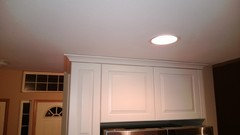
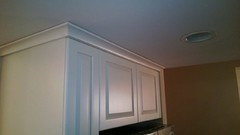
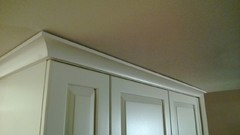
Hi Design friends! I need help! We have just had a new kitchen installed nice white cabinets with crown molding... Slight problem in that as is typical, the ceiling is not even so there are small gaps that makes the crown molding look odd. They are big enough that you notice them, but not so big that I though caulking would be a good idea. The crown molding is flush on the ceiling, there isn't suposed to be gap. Our contractor is telling us that if we caulk the crown molding we will have to also paint it AND the crown molding so it doesn't look weird. He also says this will mean we loose our "shadow effect" of the crown molding. Since the crown molding is flush on the ceiling, I'm not sure how much "shadow effect" we actually have... Our ceilings are white as are the cabinets and the crown molding. I'm not sure if this will look weird, all I know is that the gaps look like a horrible installer did the work. We paid a lot of money for the cabinets and really want them to look great. Please help!

Comments (19)

  • 13 years ago
    What part of the country do you live in? If you are in a cold climate plan on the wood expanding and possibly closing the gaps when it gets warm. Caulking has its purpose but there will be ongoing maintenance with any caulked area as things expand and contract the caulk will eventually crack too.
  • 13 years ago
    Post pictures if you can.
  • 13 years ago
    Hi Bonnie, We live in Washington State so it's pretty moist all year round, but we do get all four season...
  • 13 years ago
    If you can stick a finger in the gap I would fix it if it were smaller I would caulk it
  • 13 years ago
    last modified: 13 years ago
    The seasonal caulking crack is an inescapable phenomenon where we live (Ohio). So in winter it looks like all of our kitchen cabinet moldings and crown moldings (which are caulked and painted), especially in an addition we built onto our older house, have cracks next to the ceiling, where they are pulling away. Then as summer approaches all the cracks disappear and everything looks like new again. Since our kitchen was renovated in the summer we were a bit freaked out the first winter this happened. Now we are used to it.
  • 13 years ago
    last modified: 13 years ago
    Is the crown molding not painted? Even pre-finished moldings are usually painted. These little gaps are typical when you have the crown flush to the ceiling - ceilings are not as flat as moldings even in brand new homes. Caulking is the typical way to handle this, unless the gap is so big you have to add additional shoe or a pc of quarter round molding to the top. If you live in the parts of the country where wood expansion is a problem, caulk usually works best because it is flexible.
  • PRO
    13 years ago
    This is always one of the issues with painted cabinetry - against the ceiling and the walls. I think your contractor is correct in that once you caulk it, you will see the difference in color and more painting will need to be done. If everything is not the same white, you may want to have the ceiling painted the same white as the cabinets. You will see the expansion and contraction that feeny and others pointed out as seasons change.
  • PRO
    13 years ago
    take a small peice of veneer with white glue on both side and fill the gap. The veneer can be sanded to make it thinner where the gap is narrower .Sand when it is dry and paint over top.
  • PRO
    13 years ago
    In my experience as a custom carpenter, I do whatever it takes to eliminate visible gaps in all moulding to drywall/plaster applications. Painted crown moulding (very often white) installed against a white ceiling is always the most difficult installation, but probably the most common. More often than not, ceilings will have "bumps" (convex) or "dips" (concave). Often I can shave a moulding (most profies) with a small block plane to accomodate small bumps in the ceiling but usually not more than 1/8''(depending on the size and profile of the molding). Dips in the ceiling are treated after the moulding is installed. To do this I "float" joint compound over the dips in the ceiling. Essentially replastering the ceiling to achieve a flat plane.( Wall irregularities can be treated the same). This plastering need only be done in areas where the gaps exeed 1/8'' or so, and usually feathered in to the existing ceiling within 6''-8''. This feathering can often be done in one coat (depending on th size of the dip) then sanded and primed. At this point we want any moilding to wall/ ceiling joint to be less than 1/8''. This small joint is then caulked very neatly, taking care not to caulk over the mouldings. Of course any patches will need to be painted, so we often give the ceiling its final coat of paint after the moulding. As far as seasonal movement is concered, I have found that MDF moulding moves less than wood. Looking at my crown moulding now (dry, winter) I can,t see any visible separation.
  • 13 years ago
    Sean... you sound like an awesome craftsmen!
  • PRO
    13 years ago
    Thanks Bonnie. I like to think so.
  • 13 years ago
    Here's some photos, I think we are going to either caulk or some other method to fill the small gaps...
  • PRO
    13 years ago
    Crow molding, leave a 1"space if the ceiling is not level it won' t show,and the space makes the molding stronger looking. If it is already installed take it out it will never look right.
  • 10 years ago

    Common problem for sure. White prefinished crown on white flat ceilings is a finicky install. If the time was taken, that specific crown has lots of top profile to be scribed to the ceiling. In this case there's no crown riser so it's a toss up. With this setup there's not really any play. If there's ceiling crown there needs to be a riser. Only other way to make it work was for the installer to work top down in his install mindset and set all cabinets to the highpoint of the ceiling minus crown rise and then crown could be scribed tight. All in all, a hard thing without a crown riser.


  • PRO
    10 years ago
    Nearly three year old post.
  • 8 years ago

    Hey Brandon... I can tell you that we ended up having the contractor caulk the gaps. today nearly 4 years later, I still say we made the right decision. You can't see gaps, you can't see the caulk and we didn't paint it! To each their own, but I'm happy with the decisions we made!

  • 7 years ago

    Thank you, Sarah, for updating post in 2017. We just got new cabinets and I was trying to decide about caulking ot not.

  • 2 years ago

    And here I am in 2024, finding my way here for the same issue... and this was a helpful post, even 11 years later!