Software
Houzz Logo Print
roygbiv

Need advice to rehab old waterfall/pond

11 years ago
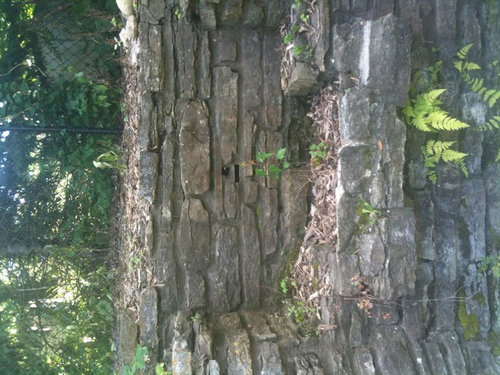

**The photos show up sideways--at least on my iPhone.

We have a stone wall waterfall and pond likely built at the same time of our house in 1940.

Our goal is to get the water running again but we're not sure if we can get the original equipment to work or if we need to retrofit it.

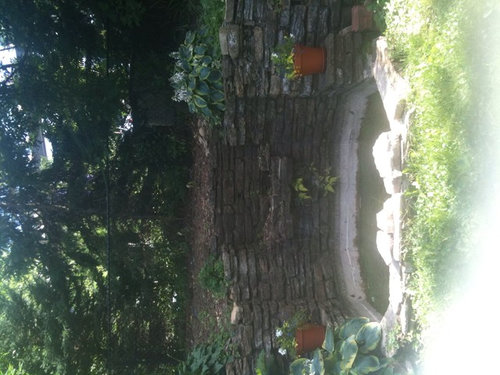
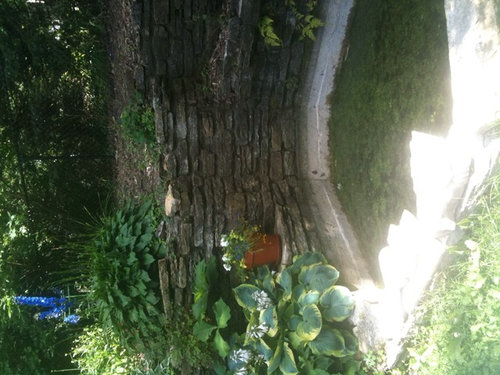
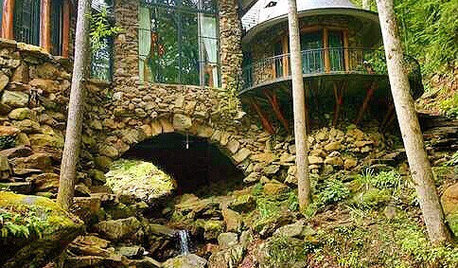
Description: A semi-circular stone wall built into a sloping hill. The wall starts at about 2' and rises to about 66" at the peak where the output pipe sits. Centered within the semi-circular wall is the pond.

The waterfall drops 64" from the output pipe at the top of the stone wall to the pond water surface (86" from the spigot to the floor of the pond). The pond is 6'8" round x 22" deep.

Here are the pieces of our pond puzzle:

We discovered a small pipe running underground up the slope of the side stone wall to the outflow pipe atop the wall. We're not sure where the other end of this pipe starts or ends.


There's a vertical pipe inside the pond which I presume is for overflow.

We also found a larger in diameter underground pipe that leads out of our basement aiming directly toward the pond but we don't know if it services the pond in anyway--we haven't dug up our yard to see where it terminates.

There are two square holes about a third of the way down from the top of the stone wall and below the two holes a splash basin. We're not sure of the purpose of the two square holes.

We only have a basic understanding of how a pond works. We thought the pipe that exits from the basement might be a water supply but from what I've read, it seems modern ponds are a closed system, relying on rain and maybe an occasional top-off from the garden hose.

Questions:

Other than digging up our yard, is there a way to figure out how this pond was meant to work and if the pipes are still water-tight?

What equipment do we need?

How do we clean debris out of the pipes?

Thanks!

Comments (6)

  • 11 years ago

    We need to know where you are (freezing, plants, water) although it may not be critical. It appears that your pond is holding water. If it is really old, that is surprising. And yes, most new ponds are closed systems and old ones could have just been water run to the pond for fill up and a pleasant trickle for an afternoon hanging outside. You might want to try to loosely connect a hose to any of those pipes and see if they are open somewhere. On the other hand, it would likely be just as easy or easier to replumb the whole system.

    Again, if it is really old, then I would expect that nothing works, but who knows. If you could turn water on in the basement, and water comes out inside the pond or actually out of the wall outlet, I suppose you could just use it intermitantly. Or it could be modified to use for refilling.

    More likely, everything leaks or is clogged so you retrofit. You put a small liner in the pond. You get a small in pond pump and connect a flex hose that somehow gets around to the back wall where it either connects to the old pipe or a new one with a decorative spillway, outlet. The hassle is hiding the pipe/hose from the pump where it either exits the top of the pond, or exits thru the liner and old pond bowl while maintaining a seal at the liner. If one of the old pipes actually goes into the pond, you might be able to cut it off outside the pond and connect it to the spillway.


  • PRO
    11 years ago
    Thanks for your thoughtful response!

    We are in Minneapolis. We usually don't drain the pond for the winter and we aren't interested in fish--except, maybe, the mosquito eating kind.

    The pond doesn't leak! It is cement and may have been re-sealed more recently than 1940, but not since we moved here 17 years ago.

    We'd like to put a few plants in it but if it complicates things too much, it's not necessary as we have many flower gardens.

    There are no plastic hoses attached -- the metal pipes are the only hints at how this operated. Do you think they used the water pressure from the house water supply to act as a pump?

    From what I can see, the metal pipes look solid with just surface rust--but there's a lot I can't see.

    Would retrofitting involve taking down the stone wall?

    If we have to retrofit, what type of equipment do you suggest -- I'd especially appreciate info on how powerful a pump would be needed to push water up 86" to the top of the waterfall. What brands are best? What type of filter, etc.

    Thanks again!
  • 11 years ago

    Yes, I was suggesting that the house pressure may have been an occasional 'pump'. I was assuming that the water flow was not large and either just trickled down the face of your wall or perhaps poured out of a missing medallion with a mouth or spout.

    You said: There's a vertical pipe inside the pond which I presume is for overflow.
    I wondered if you actually meant a horizontal pipe that went thru the bowl at the top of the expected water level and would have drained any overflow into a very small stream or plant bed or something.

    A retrofit could be very easy and not expensive because it doesn't appear that you need much water flow. I also wonder about the height. From your picture, it appears that water was supposed to flow out from that rectangular hole just above that three or four wide, two layer thick, jutting out section of stacked stone that is only a little higher than your two pots. If water was actually to gush over the whole jut out, then a larger 2000gph (gals per hour) pump might be needed, costing in the $200 range, but if it would be more of a trickle, you could get a smaller pump for cheap from Harbor Freight. You might want to search on 'cliffandjoann' here. They have big old expensive pumps but also little aux. pumps (<$50??) that create side streams that they got from Harbor freight.

    BTW, if you don't have fish, you don't really need to worry about flow rates or much of anything. You don't really even need a flow. Run it when you are out there and off otherwise. If you want continuous flow, than Mag drive pumps would be better for considerable energy savings. You certainly don't need to mess with your wall. You might be able to re-purpose one of the existing pipes to get water from in the pond to the wall outlet (although they are probably smaller than a best choice which would more likely be 1.25" tubing). More likely, you could just drape a flex hose from your in pond pump, over the bowl, hidden by a plant or something, and then up along the back of the back wall.


  • PRO
    11 years ago
    Again, I so appreciate your time and excellent advice! Thank you!

    The pipe inside the pond is definitely vertical. It is open-ended and stops just a few inches from the lip of the bowl. We've never had the pond overflow even during very heavy rains. I'm not sure where the pipe leads underground or where it dumps all of the overflow water.

    I'm fairly sure water came out from the top rather than from those two square holes. I wonder if they're for overflow if the splash basin just below them fills up for some reason? I haven't seen anything inside those square holes that looks like a pipe--either for water output or as an overflow drain. There is an open-ended outlet pipe at the very top and when we first looked at the house with the realtor there was some sort of garden ornament (I guess it was sold at prev owner's garage sale) and so I believe that is the one and only water outlet. I could be wrong, though.

    We want to have to pond and waterfall going for several reasons; it's the main focal point of our yard, to oxygenate the pond in the hope it will get rid of algae (need advice for getting rid of algae as well, if oxygenating won't help), to get rid of the mosquito nursery (now were using mosquito dunks) and to provide a nicer sound than our neighbor's swimming pool equipment which sits about 6ft directly behind the top of the stone wall. (We are also getting a wood fence installed to hide the pool equipment and their ugly chain link fence!).

    I'm not familiar with the source you mentioned for pumps...and confused by the mention of the two names to search under....? I'll check it out. And brand names you suggest?

    Will I need filters, skimmers, pond additives, etc. etc. (especially if we put in a few plants?) I'd like to buy or order everything I need at once rather than realizing I also need this or that. Is it advisable to buy a metal-housed pump or a higher quality pump rather than a plastic one?

    Thanks for all of your help!!!
  • PRO
    11 years ago

    Found Harbor Freight and Cliff & Joann's site! Thanks!

  • 11 years ago

    I don't see where your water fall would spill from, although I suppose it doesn't really matter. If it fell onto that outcrop, it would give extra sounds although it would probably spill out the back so I suppose the fall is elsewhere. you never actually said how big the existing pipes are, but if they are 3/4 inch galvanized pipe, for example; that was probably too small for a regular modern waterfall anyway.

    I'm not sure that any of us is an expert on algae. I have a long stream and a skippy filter. Look skippy filter up. I am quite certain that my stream is my major filter. I get string algae, but find it generally useful. It doesn't cloud up the water; it just looks green. In my case, it is mostly in the stream. I occasionally remove it with a toilet brush to snag it, or just grab it by hand. People with the pea soup algae try all sorts of things and sometimes they work, and sometimes not.

    We occasionally have a poster named waterbug_guy. He has done lengthy study and believes that string algae fights off the single cell (pea soup type) algae. But of course, you have to have some to fight the other type. I think that there is general agreement
    that the UV tube device will kill free flowing algae. I have heard that
    the uv bulb needs replacement every year or so. You don't really need a filter without fish. Again: I never had a problem so am not much help and many who do, don't always get things solved.

    If it were me, I would go one step at a time and get a pump and flex tubing. First, I would quickly pump all the water out and clean the bowl with something and see if you can dry it out while installing your plumbing and spillway or whatever. Then I would fill and run it; scrounge up a few plants (hooked on or supported on something, or find a neighbor or store with a water lily to toss in the bottom) and see if algae forms. If you get pea soup that doesn't go away in a month, then get a UV tube thingie and see if that does the trick.

    You could look up 'trickle tower' as a filter device. It is a fairly new idea that I know nothing about. But again, I think it is more for preventing build up of ammonia or nitrates that can come from fish waste. No fish, no problem, I suspect.