Software
Houzz Logo Print
ka_w2

Help

11 years ago

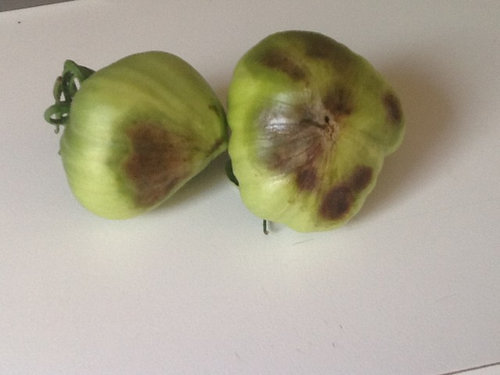
What is wrong with my heirloom tomatoes? Initially I thought it was blossom end rot because that is where it seemed to be focused, it got dark brown then black at the bottom. Recently I found these, and several others similarly marked, they go from this to gooey black. It just seems to be the heirlooms, which are in the same raised bed as other types. I have three other types of tomatoes in that particular bed which all seem to be doing just fine, I've already harvested some beautiful tomatoes from them. Ideas?


Comments (14)

  • 11 years ago

    How do the plants' leaves and stems look ? Are they healthy ? If "Yes" I would still think that what you got is some kind of BER type rot.

    Another possibility is Grey Mold. But in that case the plants' leave will be covered with greyish mold before the fruits are affected.

    Sey

  • 11 years ago
    last modified: 11 years ago

    Looks like very bad heat damage to me is the root of the problem, and then rot took over. It might look like BER, but the way it got there is likely very different than typical I'd bet, perhaps sun exposure started it. Did you use a row cover or something?

    Cheers

    PC

  • 11 years ago

    The plants look hearty and healthy, nice colour thick stock, etc. They tend to droop a bit more than others but overall they look great.


  • 11 years ago

    I don't use any coverings. Wouldn't the other strain of tomatoes in that bed also exhibit some heat problems or would it just be too much for the heirlooms?

  • 11 years ago
    last modified: 11 years ago

    "I don't use any coverings. Wouldn't the other strain of tomatoes in that
    bed also exhibit some heat problems or would it just be too much for
    the heirlooms?
    "

    Most hybrids are more resistant because they've been bred to be tougher, not to bruise or crack. Yours looked more bruised to me, it really is dependent on the individual variety and the stage of development the condition caught it at. I admit sunscald is rarely a problem with green tomatoes, just heat can do that and maybe some very hungry stink bugs starting it off. I'm really not sure what to think because the pattern is different from what I've always seen on my BERs, where the blossom end is where it starts and there are blotches, but never seen them so well defined near the equator like this. What were the varieties and source of the seeds? How did it initiate, soft, uninfected, infected, etc.

    It is possible BER is internal and got a secondary infection which just manifested itself out the sides I guess. Can you make an axial cut passing through the longitude of one of the infected bruises and show us a cross section to see if it is surface or from the seeds/placenta, which we can see if the rot really started on the distal ends after all, or if it was external as in the case of heat/bug damage?

    Cheers

    PC

  • 11 years ago


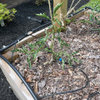
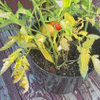
    The seeds were a "Rainbow Blend" consisting of Black, Pink, Red and Yellow Brandywines. Just a standard seed pack available anywhere. I wanted to give heirlooms a try since I'd been doing some other varieties quite successfully in containers and now raised beds. I have taken some pictures of other tomatoes that I've removed over the last two days so they are in various states of decay; but pretty much look like they did when they came off the vine. I also took a picture of the plants themselves, I watered them last night, today is scorching hot and they will require water again but this is what they look like presently.

    These are the other ones I've removed

    This is the cross section
    The other one


  • 11 years ago
    last modified: 11 years ago

    Two other possibilities, the pic is not too sharp: Alternaria and Buckeye rot

    PC

    edit: just saw the new pics cross posted with me. It's probably BER from the new pics which tell a better story. First the pic shows internal BER on the apex of the placenta. Look at "the other one", the second picture and notice internally on the blossom end the development of rot on the left half right at the apex, and if that's not good enough, the others in these pics all are starting from what appear to be growing ends where BER would happen, including the whole tomatoes pic which looks a lot different than the initial posted pic.

    Plus the scorching hot weather and uneven soil water you hint to ... very conducive to BER, and to the heat damage originally I mentioned to complement that.

    "I've already harvested some beautiful tomatoes from them. Ideas?"

    Yes, mulch them well to help counteract the watering/drying.

  • 11 years ago

    Oh, I neglected to mention. I sprayed them with neem oil approximately a week ago thinking it was some type of parasite.

  • 11 years ago

    Ok, I'll treat it for BER and see where that takes me, I was leaning towards that, based on where they seemed to be starting, but with the overall "bruising" type of markings I wasn't sure. I'll see what happens. Thanks so much for your time.

  • 11 years ago
    last modified: 11 years ago

    Buckeye rot?

    Edit: just saw the new pics that show blossom end rotting after my post

  • 11 years ago
    last modified: 11 years ago

    "Oh, I neglected to mention. I sprayed them with neem oil approximately a week ago thinking it was some type of parasite."

    OK, that clinches it for me that it was a combination of BER and heat. In the heat of the day the neem may have become like a row cover (or tomato wrap) contributing to the burning. If you didn't, next time spray neem in the evening or very early morning, and at the prescribed dilution. The edges of the bruises looked strangely bordered by bruised but not infected tissue and I bet this contributed to the different "look".

    Cheers

    PC

  • 11 years ago

    Quite possibly, however I did spray them at night..... nope.... I sprayed them in the morning. Dilution was accurate however I sprayed them because of the brown on the bottom etc. Although it does make sense that that could be a contributing factor to the odd patterning.

  • 11 years ago

    No. It's plain old BER.

    Concentrate on maintaining even soil moisture so that subsequent tomatoes don't have the same problem.

  • 11 years ago
    last modified: 11 years ago

    "Although it does make sense that that could be a contributing factor to the odd patterning."

    Yes, it nicely explains the appearance of the initial strange patterning posted, however the subsequent cross sections clarified the situation.

    Cheers & good luck, and as we've already discussed, mulch well ;-)

    PC

Sponsored
Peabody Landscape Group
Average rating: 3.5 out of 5 stars8 Reviews
Franklin County's Reliable Landscape Design & Contracting