Software
Houzz Logo Print
larsi_gw

Enzymes and Hot washes (LaundryMitch)

10 years ago

I saw a post this morning from Mitch, about how enzymes stop working or are killed off around 120F. Is this true?

Persil detergents (Henkel) and Miele detregents (Kreussler) state on the boxes & bottles that the formulas are safe and effective at 20C, 40C, 60C, 95C. So, 60C is about 140F and 95C is almost 205F.

If enzymes stop working at or above 120F...how is is that German detergents are effective up to 205F?

Just curious! Thanks everyone, and Mitch...I'm not "confronting" what you said...just curious :)

Comments (45)

  • 10 years ago

    It is my belief that enzymes die at around 140 degreeF..

    On the other hand although Oxygen bleach works at lower temps once the water hits 140f and above it really takes off.

    I will check into this a bit, but this has been my understanding.

  • 10 years ago

    Actually enzymes are at their best at 120f but will work at lower and higher temps and will die at 140f .


  • 10 years ago

    German detergents can work on boil wash cycles because our washers always start out cold. My Duet, for example, fills with cold, heats to about body temperature and stops heating for a while (enzyme phase), and then goes up to the target temp. Basically all Euro washers work like that.

    You might want to switch the hot water intake for the main wash off (supervisor level) for particularly though stains. The 5,000 watts heater should be able to heat the water on its own. ;)

  • 10 years ago
    last modified: 10 years ago

    Thanks. Yes, my machine takes from the hot water tank, which is set roughly at 140F. It then heats and maintain heats with the 5000w on board heater.

    I saw in Supervisor level about hot water intake off, but I was afraid if I did this, the machine would think I want cold washes only....there are settings to regulate and prevent certain temps from being accessed or used.

    Supervisor Level thrills and terrifies me on my new Miele!! LOL

    Or I could just set my Cottons cycle to 120 or 130F. Then no worries about Supervisor Levels :)

  • 10 years ago

    When I was doing the cheat sheet, tina and I actually measured the water temps because we didn't completely trust the 120 v machines. I have instant-read kitchen thermometers which are very accurate. The temps were right on in the detergent drawer. I was surprised.

    Techs told me that the sensors check the water temp with the setting. In winter, our water is very cold -- sometimes in the 50s. If I cold wash it warms it to default cold wash temp 86F, I was told.

    The manual for my machine (3035) says that max hot water house temp should be 140F. But if you wash at very warm 125F the sensor should, in theory, cut back on the hot and balance out the cold.

    So I don't see any advantage in raising the house hot water temp with a FL with a heater. Different story with a top loader, or a machine with no onboard heater, of course.

  • 10 years ago

    Out of curiosity, I accessed Supervisor Level, and set Main wash water to fill with cold only, No heated water from the hot water tank.

    With using the Hot water tank a Cottons Universal Cycle with 3 deep rinses and 140F is 56 mins.

    Setting the machine to fill with cold only and then heat up via the machine....Cottons Universal Cycle, 3 deep rinses @ 140F is 1:06 mins.

    So not too bad, only adding 10 mins by using the on board 5000w heater!!

  • 10 years ago

    Wow, such a versatile machine Larsi. Love hearing your reports.

    larsi_gw thanked enduring
  • 10 years ago

    When I still had my washer connected to hot and cold at my previous place, it would alternate cold and hot to reach a max. of 104F in the drum - on all but the delicate cycles.


    Here's a short excerpt from Miele's Washer Tips Sheet

    " If a customer is going to use temperatures at 120° or above it is recommended that they use a prewash cycle first. At temperatures of 120° and above, the incoming water is hot and will set any organic stains on the fabric. A prewash cycle is a short 13-minute cycle that uses cold water only, thus removing any organic stains on the clothing."

  • 10 years ago

    Thanks Whirlpool, that is very helpful information. I do tend to use the prewash cycle on my W3033 but the info about setting stains and the cool water, helps me understand even more about the process of laundry.

    larsi_gw thanked enduring
  • 10 years ago
    last modified: 10 years ago

    Let me quickly mention, that Enzymes, don't last forever, lol. They really do most of there work, in the first five to seven minutes, they start working... and then they start to become unstable.

    They become really unstable, in oxygenated, or even worse, chlorine environments. Just in general... all that oxygen, is toxic to the Enzymes. Not only that... but, Chlorine especially, and Oxygen Bleach... Target Bacteria. And... Enzymes, depending on how they are derived, are considered a source of bacteria, in some cases.

    larsi_gw thanked User Post
  • 10 years ago

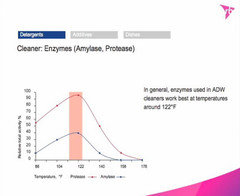
    @mamapinky is right. At 120* F, Enzymes, are loving life. But, at 130* F they start to really die down, and become unstable, and at 140* F... they die off completely.


    Here's my little reference chart for anyone interested. Straight From Reckitt Benckiser (Makers of Finish & Woolite)

  • 10 years ago

    Laundry Mitch, I believe that enzymes are derived from bacteria, not that the bacteria is in the detergent.

  • 10 years ago

    @enduring. Keep in mind, I'm writing all of this, pretty sleep deprived. But... If I remember correctly, some enzymes, are still considered bacteria, while some, are considered a little more cleaner.


    I wanted to write a huge post on this, but... I don't wanna sound "off" so to speak, lol. :-)


  • 10 years ago

    The article I've attached is very interesting and tells of the fermentation process and the filtration process involved in developing enzymes for detergents. A great read, you'll like it :)


    enzymes in deterents

  • 10 years ago

    @Enduring. In the P&G Case, it seems like the way there almost chemically-produced, they wouldn't be considered living-organisms, so they wouldn't be considered bacteria, in most cases. But... your are definitely right, they are derived from bacteria themselves.


    Honestly, this is a subject, I really no little about. I mean... I know about how they preform in the wash & I know they can be found in meat tenderizer, but, I have no idea how they make them. I've just never seen anything, talking about it before.

  • 10 years ago

    @Enduring, thanks for the link :-)

  • 10 years ago

    Let me know if the link doesn't work. It is a very interesting read. I stopped at pt 14. But I want to get back to it.

  • 10 years ago
    last modified: 10 years ago

    Enzymes are just proteins that catalyze reactions- in this case breaking down proteins and starches. I seriously doubt that ordinary laundry detergents have live bacterial cultures in them because they wouldn't be shelf stable at room temperature.

    However, high temperatures denature proteins (mess up their structure, leaving a shapeless glob of amino acids), including enzymes. That's why you have to prewash blood stains in cold water - hot water denatures the proteins and sets the stain.

  • 10 years ago

    Agree fishcow, did you see the link I posted above? It goes into the manufacture of enzymes from bacterial sources. It even explains how the detergent is encapsulated into those round beads. Its very interesting.

  • 10 years ago
    last modified: 10 years ago

    @Larsi - Bet you get great results with cold water only fill. When I had my Asko that's how it was set up due to the onboard heater.

  • 10 years ago
    last modified: 10 years ago

    I tried to look at the article, but my phone browser doesn't like scribd. I can look on my computer later.

    My bosch washer had a "Power Wash" button that can be used with any cycle to use a cold water fill and wash for longer. I think it extends the cycle by about 20 minutes. The manual says it is to activate all components of the detergent, which I suppose means the enzymes.

  • 10 years ago

    Mich, meat tenderizer, yes I knew that, but would there be any effect to making a paste with the stuff as a stain remover?

  • 10 years ago

    Yes @mamapinky0. It should act, just like the enzymes from the detergent box would. Although, if your worried about staining... Should Liquid Spray, also has Enzymes. :-)

  • 10 years ago

    Lol..thanks Mich..I will have to try it, the meat tenderizer..I think many years ago my aunt Jean told me the stuff removed stains...by the way Aunt Jean ran a large laundramat back in the 50-60-70-80's. It was the absolute funest. <<< not a word..place to be as a kid.

  • 10 years ago
    last modified: 10 years ago

    @mamapinky, I could imagine how much fun that is. Detergents we're loaded full of Phosphates, and suds we're just considered lovely at the time :-)

  • 10 years ago

    Meat tenderizer contains a protease derived from papayas, I believe. So it could work on protein stains but probably not on other types.

  • 10 years ago

    SOmewhere on the net I ran across a recipe for making enzymes..was a good while ago.

  • 10 years ago

    @ Rococogurl...I had coffee today with a friend of mine I went to University with (she now lives in San Fransisco). We got on the subject of Miele, and she told me she has a W3033 washer and a T8005 dryer and she found a cheat sheet online. OMG...YOUR cheat sheet. She could not believe "I know" you and she has been using your sheet for years. Small world!! Btw, her units were bought brand new in 2008 and they are going strong, with not a single service visit.

  • 10 years ago

    You could probably mix meat tenderizer with some amylase from a brewing supply store, and maybe lipase from a cheese making supplier if you want to get fancy, and have homemade stain remover ;)

    The only enzyme cleaner recipe I've seen online is various bloggers claiming you can make homemade pet stain removing "citrus enzymes" by fermenting lemon peels and brown sugar. That makes absolutely no sense, because the only useful cleaning agent it will produce is alcohol...

  • 10 years ago

    99% Rubbing Alcohol has a lot of uses ;) Cleaning & Machine wise in general.


    One of the best things someone taught me, was using it to clean the little sensor in the dryer.

  • 10 years ago

    Laundry Mitch, it's really interesting that enzymes do most of their "work" in the first five to seven min. So is there any benefit gained from soaking for say 30 min. or longer. And if they are happy at around 120*, how do they do at,say in the 70's, which is about what my warm temp is in the winter? I guess what I'm really asking is, what is the optimum temp range to get the best results?

  • 10 years ago

    Every enzyme is a little different. It's incorrect to say they all die off at 140F. While most lose their maximum efficacy at those temps, some are still active at higher temps. Protese, amalayze, and lipaz all work a little differently. They remain most active when they have something to feed on, e.g. protease and lots of protein stains. The biological will feed and flourish in a warm water environment in the presence of protein. As the temperature of their environment rises, or the PH rises or chlorine bleach is introduced, they die off. Just like yeast. Warm water and some sugar for something to feed on. Too HOT and it dies and won't work. Years ago enzymes were almost exclusively used as a pre soak which they are most effective before a main wash. Detergent of that era didn't contain enzymes. It wasn't till later years when they became popular and integrated into detergents, and very popular now with the lower wash water temps. If your using enzyme detergent in blazing HOT water from the start, your wasting your money and not getting the full benefit of their use. Better results would be obtained with the presoak, and then a blazing hot heavy-handed alkali based wash for whites. For colored clothing it's a very useful one shot product at lower water temperatures.

    larsi_gw thanked rpsinfoman
  • 10 years ago

    Larsi - the Miele is awesome! I would most likely set that to a cold fill and let the onboard heater handle the rest. It looks like it heats very quickly and you will get better performance out of enzyme detergents as opposed to an initial 140F fill. Once the change is made at supervisor level, is that active for all cycles or can you make that just stick for one or two custom programs?

    larsi_gw thanked rpsinfoman
  • 10 years ago

    @ Larsi -- You made my day!! There's a method to my madness and people I don't even know find it LOL. I've just given my blog a facelift and one reason I haven't been around so much lately is because I'm doing this incredibly tedious work on 500 posts so far. The idea that someone could find something helpful is why I do it.


    Thank you, thank you for the wonderful story!

    larsi_gw thanked rococogurl
  • 10 years ago
    last modified: 10 years ago

    YAY Rococogurl. So happy you are happy. I got so excited that she is using your Cheat Sheet, and we "know" each other. Such a small, wonderful world!!

    What's your blog name??

  • 10 years ago

    @rpsinfoman.....Thanks!! Yes, I entered Supervisor Level and set the machine to fill EVERY cycle using cold only (you can reach back and feel the hoses..the hot one is OFF during each & every fill ;)

    I have the rinses set to Cool/Cold. You can also set rinses to Warm/Hot if you wish...but it applies to every rinse, so I kept it cold. Also, if I do a 140-200F wash, I need and want cool rinses!

    It applies for every cycle. I think this will really aid enzymes during the wash cycle. I guess that 5000w heater is handy sometimes, LOL. Adding only 10 mins to reach 140+ to a wash cycle is not bad at all. :56 mins to 1:06 is not a big deal.

  • 10 years ago

    @larsi... I looked at some of those options at supervisor level. That machine is outstanding! I have never seen that level of control in anything other than commercial equipment. You even have the option of selecting the pre-wash water temp and adding a second pre-wash to programs like Kitchen. I am rapidly becoming a fan boy! That machine in white can be had around here for 3490.00. Dealer an hour away. Only disadvantages is need to pull a 220 line, (easy for me), and the capacity. Deserves some serious consideration though!

    larsi_gw thanked rpsinfoman
  • 10 years ago

    rpsinfoman...I 100% agree. I'm a rabid Little Giant Fanboy now too, LOL. The level of total control, options and programs are amazing. Mind boggling actually!!

    I wanted white, as not only is it less money, but I love the look of white in the laundry room. Since I found and bought the solid stainless steel dryer first, I ordered the stainless washer to match. I really like the look and "modernity" of the stainless, but I would have preferred Lotus White.

    DO NOT let capacity deter you. I'm telling you, everything my 4.3 cu ft Electrolux washer did, this Little Giant does too...CA King blankets, CA King complete sheet sets, everything.

  • 10 years ago

    When I was at Miele showroom in Chicago last week they said you can wash a king sized comforter in the Little Giant. So happy you are having so much fun with your machine.

    larsi_gw thanked enduring
  • 10 years ago

    With enzymes working only for a short amount of time, it makes me woner what is happening/doing the cleaning during the very,very long high-performance Eco cycles on European washers.

  • 10 years ago

    Here's the fun stuff 4 U: Laundry at Atticmag

  • 6 years ago

    I know this is an old thread but it occurred to me that using the washer's high heat sanitize cycle for my towels would kill off the detergent enzymes. Maybe I should just use the "HOT" water temperature instead?

  • 6 years ago

    twebbz,

    Depends on how much enzyme exposure the load needs. Assuming your washer isn't a 240v machine with a high-wattage heating element, the temp rise is slow enough that enzymes have some time to work.