

Neutral Bonding in a Generator
I am in the process of attaching a 2-Pole transfer switch to my breaker panel and powering it by a 7500W generator. The generator is ground-bonded-to-neutral. I understand I have to disconnect this in order to power the transfer switch safely. This consists of removing a jumper on the alternator. My question is: Can I install a toggle switch (30A light switch if you will) between jumper to be able toggle the ground off when connected to the transfer switch and on when using as a stand alone generator?
Comments (31)
 10 years ago
I suppose you could, but I'd be careful. Not having the bond in the case of running the generator separate from the house is way more of a problem than having it when you are part of the house system.
Barry Campbell thanked Ron NatalieBarry Campbell
Original Author10 years agoThanks for the comment, Ron. I agree. That was my reasoning behind installing the switch. As you can tell, I'm not an electrician, just handy with enough information sometimes to get me in trouble. Theoretically, could I install a 30A switch to the frame, connect the wires to the respective end of the neutral / ground jumper, and toggle it according to what it's hooked up to? Would I ground the switch to the frame? I appreciate the input.Related Professionals
Augusta General Contractors · Jacksonville General Contractors · Oklahoma City General Contractors · Santa Rosa General Contractors · Wichita Home Remodeling · California Home Remodeling · Dayton Home Remodeling · Escanaba Home Remodeling · Portsmouth Home Remodeling · Murrieta Home Remodeling · Magnolia Bathroom Remodelers · Panama City Bathroom Remodelers · Annapolis Bathroom Remodelers · Rochester Bathroom Remodelers · Farmington Bathroom Remodelers- Barry Campbell thanked Ron Natalie
- 10 years ago
That changes NOTHING in the discussion. If the generator is connected via a transfer switch that doesn't switch the neutral (and when the Barry says he is using a two pole transfer switch I assume it is NOT switching the neutral), then the code does not consider this a separately derived system and the NEUTRAL and GROUND shouldn't be connected in the generator.
However, this is a small error. The bigger error is just about every situation (either a switched neutral transfer switch or as the poster suggest, the use of the generator not connected to the house electrical at all). In this case it is VERY important that the neutral and ground be bonded.Barry Campbell thanked Ron Natalie Barry Campbell
Original Author10 years agoThanks again, Ron. That is my understanding also, although after reading so munch about this subject, my head is kind of swimming. So, to recap, when the generator is hooked to MY transfer switch that DOES NOT switch the neutral, my jumper should be removed / open. When operating as a stand alone device, the jumper should be intact / closed. My main point is I'm unsure if my theory on the 30A switch I propose to replace the jumper with is somewhat sound. I understand the dangers is running the generator with a bonded jumper with the transfer switch, and also the danger in running without a bonded jumper in every other situation. I'm still uncertain if my "work around" is sound or sketchy. Assuming I WILL flip the switch to accommodate the individual application I am considering, is this switch that I propose sound? Thanks again.
- 10 years agolast modified: 10 years ago
So, get a 3 pole transfer switch so that the generator doesn't have to be rebonded every time it is unplugged from the house and used as a portable generator. The GFCIs on the generator won't work if the neutral is not bonded to the ground.
Barry Campbell thanked User - 10 years agolast modified: 10 years ago
The switch would get you a hefty fine with OSHA if you used it anywhere but your house, basically. It would need to be a locking switch and rated more than 30 amps and for motors to be anywhere near safe. They make warning labels to stick on unbonded generators which would also be a good idea.
Barry Campbell thanked User - 10 years ago
Most companies have an add-on accessory to disconnect the neutral in the transfer switch.
Barry Campbell thanked User Barry Campbell
Original Author10 years agoThanks, Fred. Unfortunately, I already have the equipment. I have a Reliance 310A Pro / Tran2 Transfer
switch and a Westinghouse 7500W Generator. The generator manual states I
must remove the jumper wire if the transfer switch is a 2 pole switch.
Reliance confirms what I have is, in fact, a 2 pole transfer switch and
the jumper must be removed to operate safely. I just wanted a "work
around" to not reinstalling the jumper when I wanted to use it as a
stand alone generator.While I am handy, I am NOT a professional. This generator is only for my personal use and probably would never go near a true job site. In considering this, my intent is to be able to reverse any modification I make and restore it to factory specs. If creating a "locking" switch rated for 40A is what I need to make this RUN safely in each individual scenario, then that is what I will do. I just don't want to kill myself by doing something that is not sound in its execution. That's why I'm asking questions. If it turns out that this would not work, or would endanger me (even assuming I operate the switch correctly), then I will abandon any notion of modifying the generator. Thanks so much, guys. I appreciate your time.
Barry Campbell
Original Author10 years agoI'm checking with Reliance on the add-on, but I don't think so. I thought I did my homework pretty well until I ran across the bonded-neutral information in the generator manual. Opened up a can of worms I didn't anticipate. Thanks.
- 10 years agolast modified: 10 years ago
This says "Retrofit most any make or model of manual transfer switch, load center or isolation device".
Barry Campbell
Original Author10 years agoResearching this now, Fred. This looks like a better option if I can make it work with my transfer switch. Thanks again.
- 10 years ago
Buy a 120 volt plug, jumper the ground and neutral in the plug body. Plug into generator outlet to bond neutral/ground when needed.
Barry Campbell
Original Author10 years agoI read about this somewhere else but, once again, I didn't know how sound that theory was. I have 1 x 240volt plug and 2 sets of 2 120volt plugs on the generator. All 3 sets have their own gfi device. Would plugging this into 1 outlet ground the entire system or just that set of outlets? That would be much easier than replacing the jumper or running the switch I
referred to, but I was skeptical of the process when I first read about it.- 10 years ago
Plugging what into what? You've lost me.
Anyhow, if you regularly leave the generator completely unplugged, I might argue that it is a separately derived system and wouldn't worry too much about leaving the bond in all the time.
As I stated, the safety issues of NOT bonding it when it should be (in the stand alone case) far outweigh the issues of bonding it when it shouldn't. - 10 years ago
Ron: I don't know if the code has changed recently in this area or not, but I do remember reading and trying to understand the NEC 2011 about this and getting confused. Maybe you can explain the difference between a 'separately derived' system versus a 'standby' system. From what I could tell, it boils down to whether the unit is permanently installed or is portable.
Someone had asked this question on one of the generator supply sites and their answer was that if it is a 'separately derived' system (portable), the bond did not need to be removed. However, it had to be a generator that did not have GFCI on the 240v plug since it would otherwise trip when connected. A 'standby' system needed to have the neutral bond removed if it was there.
Oh, and Barry was responding to the post about using a plug in a 120v receptacle with the neutral and ground tied together, using it when neutral and ground need to be bonded and removed otherwise (assuming the bond has already been removed in the generator housing).
- 10 years ago
Standby and separately derived aren't exclusive terms.
Yes, if you have a seperately derived system the bond should NOT be removed. If it is not, then it should.
If the system shares a connected neutral it is not seperately derived. If you have a transfer switch with a switched neutral (or in my opinion if you're just going to unplug it when not in use), then you can consider a seperately derived system.
The presence of a GFCI or not doesn't change any of this.
The bond should be on the supply side of the GFCI. - 10 years agolast modified: 10 years ago
@Bgeery, Even if you could bond the ground and neutral on the load side of the GFCI,(it will trip it and disconnect the neutral under normal circumstances, but will not if the generator frame is insulated from the ground) and then have a neutral to case(ground) fault at your circular saw, which GFCI will trip first? (You now have two identical "bonds" on either end.) The one with the jumper, or the one protecting YOU? Once the GFCI with the jumper trips, YOU will unknowingly be unprotected. That is about the same as playing Russian Roulette, but now you only have a 50/50 chance instead of one in six.
- 10 years agolast modified: 10 years ago
"If the system shares a connected neutral it is not seperately derived."
The second you plug in the generator, it shares a connected neutral, and becomes a code violation. This means that there will be two separate points that the neutral is bonded to the ground. "The bond should be on the supply side of the GFCI.", but the normal house bond will be on the load side of the generator's GFCI, AND the generator GFCI will trip the moment that the generator is put into service. It will not physically work.
Separately Derived System. A premises wiring system whose power is derived from a source of electric energy or equipment other than a service. Such systems have no direct electrical connection, including a solidly connected grounded circuit conductor, to supply conductors originating in another system.
NOTE; it doesn't say "permanently connected" , it says "solidly connected". Once the generator is plugged in, it is solidly connected.
- 10 years agolast modified: 10 years ago
Sorry, my advice of using a bonding plug when needed would be incorrect if the generator is equipped with GFCI 120 volt outlets. The bonding plug would most likely instantly trip the GFCI, of course.
In that case, I would use a universal keyed ignition switch and switch the bond with that. In the supply side, of course. Label as needed.
@Fred, you note in a message "The GFCIs on the generator won't work if the neutral is not bonded to the ground." This is incorrect. GFCI does not not need ground in any way to function as designed. It looks for an imbalance between hot and neutral, and trips when the imbalance grows above 6mA.
- 10 years agolast modified: 10 years ago
"The GFCIs on the generator won't work if the neutral is not bonded to the ground." ..... If you stick the end of the cord in a mud puddle, it WILL work, but if you have a neutral to case fault(the supposedly grounded metal parts of your saw), it will NOT work because there is no return path to/for the ground wire. The portable generator is insulated from ground by rubber tires etc, unless you drive a ground rod everywhere you go and bond it to the generator case. YOU would be the only path to ground, meaning that you would still have to get shocked first before the GFCI trips. It is SUPPOSED to trip when the fault is ONLY to the metal case of the motor, and BEFORE it has to go through you to trip. Sure, it will work in some situations, but now we are back to Russian roulette.
The overcurrent or GFCI won't sense a hot fault to equipment grounding conductor either if the other end of the ground wire in the cord goes back to hook up to NOTHING. There would be no path for the current to flow. The ground has to be either connected to the neutral, or not insulated from ground by the wheels that make it portable, or a wood deck can even insulate it sufficiently, or a vinyl floor, or the mat in the back of a pickup.......
PS. Instead of trying to correct an electrician, you should listen and learn ;)
When you install a GFCI without a ground in a house, you are getting some benefits of the GFCI, but not ALL of them. There is a reason that an outdoor extension cord must have three wires instead of two, even though you plug it into a GFCI receptacle.
- 10 years agolast modified: 10 years ago
"If you stick the end of the cord in a mud puddle, it WILL work"
Ah, no it won't (necessarily). There is no imbalance created by sticking the end of the cord into water so no reason for the GFCI to trip. The overcurrent device will probably trigger, however. See my example below.
"YOU would be the only path to ground, meaning that you would still have to get shocked first before the GFCI trips."
You will receive 6mA or less, and the GFCI will trip in 1/2 cycle as intended. So what? That's how GFCI is supposed to work.
With or without a ground wire, GFCI will trip when there is an imbalance between the hot and neutral of over 6mA. The 6mA is going somewhere, and the GFCI doesn't care where. The only way you are getting electrocuted with GFCI is if you insulate yourself from ground, and make contact with both the hot and neutral. In that case, no imbalance is created and the GFCI will not trip and it's up to the breaker to do its job. At that point its about wiring protection, not life protection.
"When you install a GFCI without a ground in a house, you are getting some benefits of the GFCI, but not ALL of them."
Ground is about getting enough current back to the breaker to trip it faster. It plays no part in the operation of a GFCI device.
- 10 years agolast modified: 10 years ago
"If you stick the end of the cord in a mud puddle, it WILL work" yes, it may trip the over current device instead, but if the neutral hits first, the GFCI will trip. NOT pertinent to the point.
"You will receive 6mA or less, "
A GFCI does not limit the current. It merely trips at 6mA OR ABOVE.
YOU do not need to lecture me on how you think a GFCI works. It may not kill you directly, but it is still an unsafe practice. The jolt can still be sufficient to make you jump(react) and cut off your finger or fall off a ladder and break your neck. There are still plenty of cases of workplace injuries every year due to a missing ground prong even though it is plugged into a GFCI. A cattle prod won't kill you either, but you would probably be pretty angry if someone was trying to poke you with one while you were operating power tools.
To even suggest that the FIRST line of defense against shock should be through someone's body is irresponsible and shows that you have no idea how the whole system is supposed to work together, and that a path through a person is supposed to be the LAST form of protection that a GFCI actually provides.
- 10 years ago
Another electrician that thinks he has nothing new to learn.
I'll encourage readers to study the issue for themselves.
I'll go back to debating some more with the one electrician on YouTube that insists a GFCI can't work without the ground wire.
- 10 years agolast modified: 10 years ago
I can't say it any more plainly than this.
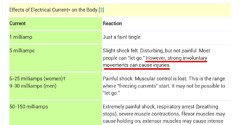
Per OSHA statistics
ELECTRICAL HAZARDS can result in various effects on the body, including:
● SHOCK – The physical effects caused by electric current flowing in the body.
● ELECTROCUTION – Electrical shock or related electrical effects resulting in death.
● BURNS – Often occurring on the hands, thermal damage to tissue can be caused by the flow of current in the body, by overheating of improper or damaged electrical components, or by an arc flash.
● FALLS – A common effect, sometimes caused by the body’s reaction to an electrical current. A non-fatal shock may sometimes result in a fatal fall when a person is working on an elevated surface.
Thinking that a GFCI actually limits the current makes you clueless. That would only be true if the laws of physics dictated that a current has to start at zero, and rise steadily until it hit the point that the GFCI would trip. Arcs, which are usually the start of a ground fault, tend to start out at a much higher rate.
Futheremore, grounded metal parts on equipment will provide a 5mA path back to, and trip the GFCI long before the resistance of your skin will allow 5mA go through your body. Which provides even further protection, especially if you are not even touching the metal parts when the fault occurs.
Barry Campbell
Original Author10 years agoGuys, all of these answers are appreciated. I would like to think I have learned a lot more about GFCI's and grounding than I ever thought I would. Some of the discussion, I'll have to admit, is over my head as I'm not electrician, but that's is why I came here, to get some sound advice.
My original question related to neutral bonded to ground on my generator. Both, the makers of my transfer switch and the generator, recommend the bonding be removed while operating my portable generator as a backup device in MY system. I won't argue that point with you or them. That seems to be consistent from your answers and theirs. Likewise, while using the generator as a stand alone device, the bonding needs to be there for my protection. Agreed.
I am just looking for a way to switch back and forth between that grounding situation depending on the individual use of my generator. My original thought, which doesn't seem to gain much support from anywhere, is to install a 40A switch on the chassis of the generator, hook something like a 6 or 8G wire from one pole of the switch to one side of the "grounding jumper" on the generator and another wire from the other pole on the switch to the alternator, which is exactly how my current jumper is bonded, just without the switch in the middle. Flip the switch to "open" when using the transfer switch; flip it closed, aka grounded, when using a stand alone device. I still don't understand why this won't work. I understand the risks of forgetting to flip the switch or failing an OSHA inspection, just not the theory behind why it won't work. Someone stated that the switch may get fused. If that happened, would the switch be permanently closed? aka permanently neutral bonded to ground on my generator? Is this not the "safer" position to be in? If I attach it to my transfer switch while "fused", the GFCI will trip. If I use it as a stand alone, it's fused, so I'm still protected. Again, I'm not an electrician and won't understand as much as you guys who've been doing it forever, but if you say it won't work, I'll go with it.
The second "fix" was to use a 120V plug, bond the neutral and ground, and plug it into the generator when I want to use it as an external, stand alone device. This seems more shaky to me as I don't completely trust this will ground the entire system. Also, as someone stated, this should trip the GFCI on that circuit anyway.
The third "fix" recommended to me by another electrician who doesn't necessarily work in home or generator wiring was to get a 3-4 ft copper grounding rod and stake it wherever I use the generator as a stand alone device and ground it with 6-8G wire from the grounding screw on the generator to the grounding rod. As someone stated, I don't relish the ideal of carrying a grounding rod and hammer with me wherever I take this generator, whether it be 20 ft or 20 miles. I'm still pounding at least 4 foot of copper into the ground that I may not get back.
The fourth "fix" was just to reattach the jumper as needed. PITA, but not overly taxing. I can do that if my switch idea is a no-go.
I appreciate the discussion and answers here. As I said, I've learned much more about this topic through you guys. Thanks for sharing your knowledge and insight. And, again, if anyone has a better "fix", or a solid opinion on one of these listed, I'd love to hear it. Thanks again, guys.
- 10 years ago
Theoretically, it works. But I think it would be dangerous. The switch might fail (either open or closed). Or many other things. Option 4 is what you probably need to do.
- 10 years ago
I ask that question as well to my electrician when he installed the interlock kit for my portable generator. He feels its not worth it to constantly try and remember to hook/unhook the neutral/ground when using to power the house or standalone when i use it to power garden tools.
He says the bigger danger is leaving it unhooked so you lose the GFCI/ground protection of the 120 receptacles when used as a standalone. So thats what i do is i leave the neutral/ground bonded as it is when i bought it. I could have bought a switched neutral transfer switch but they were over $250 not including installation and my electrician felt it wasn't necessary to install considering how infrequent i use it when the power goes out. 80-90% of the time i use it as a stand alone to power garden tools, stereo, etc.
Barry Campbell
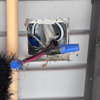
Original Author10 years agoGlad to know this thread is alive and well. I made the executive decision to go with my original plan. I ran 10 G wire from the 2 poles of the "jumper" to a 40A Welding switch and bolted it to the frame of the generator. I labeled one side "Transfer Switch" and the other side "Standalone Generator." I used an OHM meter to test the neutral and ground when switched to OFF and there was no connection on the 120V nor the 240V outlets. When switch ON, there was a "grounded" connection on all outlets. I am pretty thorough and plan to do this each time I use the generator, which will be sparingly. I bought a pair of heavy rubber gloves that I packed with the generator equipment and will use them when plugging into and stopping the generator. This may not be the soundest plan to the pro's out there, but the only con's I remember seeing was: the switch may get fused open or closed, and I'll forget to flip the switch. If it gets fused, the rubber gloves with help and I have my OHM meter packed with the generator equipment. Two, I installed the switch; I don't forget that sort of thing. Thanks again for all the input. I'm not one of those that can't learn, so if anyone else has any ideas or input, I'm more than willing to take that into consideration. Thanks, guys.












User