Software
Houzz Logo Print
mblan13

Seed starting mix?

10 years ago

I hate the stuff!

Is it really necessary, or just slick marketing and old wives tales?


Comments (16)

  • 10 years ago

    What percentage of pine fines is in your GM?

    The seeds I'm going to start (Agastache Rupestris 'Apache Sunset') prefer dry rocky fast draining soil, so that'll save a repot.

    The mix I was going to make for them is 25% fines, 25% partially decomposed fines, 25% grit and 25% turfAce.

  • 10 years ago

    I didn't really measure....I just go by look and texture now. But I'd say the mix is 50% sifted fines (1/4 inch), 25% Perlite, 20% Turface, and the remainder red lava rock and some quartzite. I meant to add a dash of Osmocote, but I forgot.

    Josh

  • 10 years ago

    I've been starting seeds in straight pumice. They are so much easier to prick out. Then you can pot them up into whatever or use a dribble and mud them into place.

  • 10 years ago

    As long as the temperature required to germinate a particular seed is achieved it is not important how it is reached, a heat pad is just convenient.

  • 10 years ago

    I vote for slick marketing, I too hate the stuff. I now use a similar mix as greenman and seedling problems have all disappeared.

  • 10 years ago

    Most seed starting mix I've bought has been mostly peat, which is very hard to keep moist. My favorite seed starting mix is made by Miracle Gro. I ran out of it, so I just start my seeds in Miracle Grow Potting mix. They start in it just as well.

  • 10 years ago

    I use something similar to Josh/greenman without the pumice/lava rock. Those are hard to come by here and I reserve them for specific plants. I cover the mix with a thin layer of coconut fines or pine fines to help preserve moisture. I have three level shelf (home made) with CFLs. Except the bottom shelf the other two get warmed up during the ON hrs of the light. CFLs generate quite a bit of heat. This does accelerate the germination process. Most of my vege seeds germinate in 7-14 days. The ones with tougher seed coat germinate around 10-20 days period. I do not scarify or nick them - I am too lazy for that.

  • 10 years ago
    last modified: 10 years ago

    I use PRO Mix HP with a little perlite added at 3:1 ratio to
    make a 50/50(Peat/Perlite) mix. Seeds are surface sown with a covering of grit (Perlite,Pumice,Sand,
    or Granite Grit)at about 1.5 times seed
    thickness. This keeps seed in humid environment and stems drier after
    germination. Eliminate grit for seeds
    that require light for germination such as Sage Brush, Lettuce, etc. Subirrigate by capillary action or lightly mist from above as needed(usually at the 90% of container water capacity weight point or 10% weight loss). Pretreat
    seeds as needed to break dormancy (Scarification, Cold Treatment, Smoke Water, etc).

    Mulch Texture.
    One of the primary functions of a seed covering is to maintain a
    "moist, but not wet" environment around the germinating seed. To
    the novice grower, it might seem logical to choose a material that holds
    water but this is not the case. A good seed mulch functions by creating a
    break in texture at the top of the growing medium (figure 8.19).
    Because the growing medium is finer textured, water will not move into the
    coarser seed covering and so the surface of the medium remains moist,
    creating ideal conditions for seed germination. from "The Container Tree Nursery Manual Vol 6 Chapter 2"

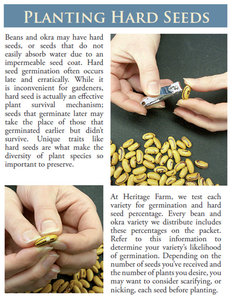
    Hot Water Method: Good for Seeds with hard seed coats such
    as Lupines, Acacia, Black Locust etc. Plant the Swollen seeds, and retreat
    unswollen seeds.

    Capillary Bed ,Pregermination, and Hot Water Seed Treatment Examples

    Sidenote: Received some
    acorns this Jan, from CA Coastal Live Oak and CA Interior Live Oak. Placed acorns in container of water to select viable ones (sinkers). Removed Viable Acorns,Placed Acorns in a Baggie with Slighly Moist
    Peatmoss. Check weekly for Germination ( root starting to emerge). Placed
    Germinates on surface of soil mix 50/50 Peat/Perlte in tree tubes, and mulched
    with Perlite to just cover acorn. Seedlings are about 4in now doing great. Fertigate
    with 30ppm N with 18-18-22 for now, started fertigation about 3 weeks after sprouting. Large size of acorn supplies nutrients for a while to seedling.

  • 10 years ago

    Dale, you are much more systematic than I am. You are right some seeds can have very tough coating and require special treatment. I grow mainly vege from seeds. Some like winter/ash gourd can be tough. I just received some seeds of that and I am going to pre-soak them in hot water.

    mblan13: I used to use those seed starting mixes. They tend to be very wet with the possibility of damp-off. Later I mixed in a bit of perlite and that improves the situation a lot. For the past few years I have been using the modified 511. More like 311 with pine bark sifted to 1/4" and all dust screened.

  • 10 years ago
    last modified: 10 years ago

    tropic, I had some Arroyo Lupine seeds, just rubbed seeds between 2 sheets of sandpaper. Then soaked them, planted the swelled seeds. Repeated on unswelled seeds. Many seeds have protection for scattered germination periods over many seasons. I just have many seeds with unknown dormancy. Manzanita is the toughest. Was going to try my daughter's rock tumbler with some sand for scarification of large lots of seeds. As far as vegetables Lettuce seems very picky about temp range and sowing depth. Not sure which Vegetable Seeds are more heat sensitive. The water is usually cooled to 200 to 180 F before using. It would surface sterilize the seed also, to prevent diseases.

    Addtion:

    I would use a Hydrogen Peroxide Solution of 1 part household 3%H2O2 to 20 Parts Water instead of Bleach Solution. Soak 15 min to 1 Hour depending on seed surface texture.

    It seems that Cucurbits are temp Sensitive. May have to use physical scarification on the squashes(Sandpaper of small File).

  • 10 years ago
    last modified: 10 years ago

    Some Extra Seed Treatment Info on Cold
    Stratification without medium ,that might be useful for Seed Propagators. Works good for smaller seeds like Giant Sequoia. This is from the “Raising Forest Tree Seedlings at Home” Manual .
    Techniques can be used for other seeds also.

    2.2.1 Naked Stratification

    This method is best for larger quantities of seeds (more
    than a handful or two).Start by putting seeds into a bridal mesh or cheesecloth
    bag. A square piece of mesh, with seeds placed in the center,can be tied to form
    a crude bag (Figure 2.13). Don’t put more than a half pound of seeds per bag.
    Label it. Place the bag into a bucket and allow water to run through it for
    48 hours. This allows seeds to absorb sufficient water to start metabolic
    processes necessary for germination, and running water removes fungal spores. After
    soaking,allow the bag to drip dry for a minute or so and suspend it
    within a plastic bag( Figure 2.14). Hang the bag in your refrigerator for the
    required time. Check it often for mold. If mold is
    present, gently rinse the seeds in running water and rehang in the refrigerator.

  • 10 years ago

    Good info, Dale. You seem to be into this. I usually cold stratify outside for the few seeds I do. And that too just put them in a ziplock bag and store it along with my grilling supplies on my back porch. Most germinate but I have not done any systematic experiment to find out.

  • 10 years ago

    hello everyone. I've found this twice in my seedling soil. What is this? Good or bad? Please help

  • 10 years ago

    Harmless centipede. Likes to hide under pots, stones, bricks.

  • 10 years ago

    Oh my thank you so much. They looked like it but I've never seen brown centipedes

Sponsored
Peabody Landscape Group
Average rating: 3.5 out of 5 stars8 Reviews
Franklin County's Reliable Landscape Design & Contracting