Software
Houzz Logo Print
kentc

alternatives to ivy for small area groundcover

10 years ago
last modified: 10 years ago

I know the mere mention of ivy brings out the worst in some people. I know that in some areas of the country it can escape and become invasive. I have no worries about it doing that in my LA suburban garden, Sunset zone 18/19. But I also know that ivy can get out of control and needs constant maintenance so if there is an alternative that can provide what I need with a more manageable plant I'd like to have suggestions. Many of the ground covers suggestions in the Sunset garden book are either much too tall, 1' or more, or too short, like dymondia. Plus many don't really cover the ground and can become patchy, like ajuga.

Here's my situation. I have an area about 15' x 20' that I'd like to have complete coverage with green groundcover, something hardy enough fill in completely, thick enough to hide the constant litter of nearby oak trees but thin enough to keep the look of a flat, hugging ground cover instead of short plants, so no more than 6-8 inches. Those trees, plus a large sycamore, are to the west of this area, which has southwestern exposure. This means that from about mid May to mid July it is in bright shade during most of the day but in the hottest months of the year when the sun is lower in the sky, late August to October, it gets very strong full sun. The soil is very sandy loam, exceptionally fast draining. There will be a drip system with 1/2" inline emitters spaced about 1 foot apart. So it has to be tough, green, thick and dense, and able to thrive in direct sun or bright shade. Ivy seems to fit that desciption. I wouldn't use algerian ivy, I've got some legacy algerian on two chain link fences on my lot and, like most people, I hate it. This would be some small leaved English ivy cultivar.

Any suggestions besides lectures about invasiveness would be welcome.

Comments (25)

  • 10 years ago

    In time, English ivy easily becomes much thicker than 12". And once established, it becomes an almost perfect habitat for rodents - read 'rats'. I can see now a colony of rats traveling back and forth between the ivy and the palms they love - it's inevitable!

    I'd suggest Taiwan creeper or creeping raspberry, Rubus hayata-koidzumii (syn. Rubus pentalobus or R. calycinoides). It is evergreen, with a great foliage texture, tolerates both sun and shade and is relatively drought tolerant once established. It infrequently produces white flowers often followed by edible gold berries. It is NOT thorny :-) And probably the best weed suppressing groundcover I have encountered.

    btw, don't fool yourself on the lack of invasiveness of ivy in suburban LA. It IS!! Just because it cannot spread easily from your garden doesn't mean it can't be dispersed by other means. Ivy flowers and produces berries if allowed to grow without routine shearing back and the birds love the berries. They eat them and poop them out anywhere they fly or perch. That's how it came to be considered an invasive pest along most of the west coast.

    kentc thanked gardengal48 (PNW Z8/9)
  • 10 years ago
    last modified: 10 years ago

    Thanks for those suggestions, when I search on Taiwan creeper or other names I mostly get hits for the PNW, BC, the bay area and other mild and cool climates in the US but not southern CA. One hit showed that Sunset limits it to the cooler zones of the bay area and excludes the hotter and drier zones prevalent in Southern CA, although I don't have my book with me here right now to check. Does anyone have experience with it in the drier and hotter southern CA climate?

    There is lots of ivy used in the older neighborhoods of Pasadena and San Marino, my own childhood home in San Gabriel also used it, the smaller leaved cultivars of English Ivy seldom reach 12" deep in So Cal growing conditions that I've seen. Part of the regular maintenance for ivy should be periodic shearing to keep it under control. And this is a relatively small area with easy access. Maintenance is much harder for large and more inaccessible areas, which means ivy is not a good solution for those kinds of places.

    As for rats, do they have a special affinity for ivy, renters credits or affirmative action for despised species? Why wouldn't any thick and dense groundcover be a haven for them? Yet no one ever mentions them except when talking about ivy.

    My house is right next to the Verdugo mountains and only a few miles from the San Gabriel mountains. I hike regularly in both of them and have for years. In spite of having lots of ivy in our neighborhoods I've never seen any ivy in these mountains beyond the direct fringes in contact with homes, not in the cooler, wetter canyons and certainly not in the drier areas. Nor have I ever seen ivy taking over areas of the San Bernardino or Santa Monica Mountains. I've read about it's invasiveness in the PNW and the NE USA but I think the chicken little cries about it here in southern CA are greatly exaggerated.

  • 10 years ago

    lgt, I'd never heard of Kurapia before. Most of the literature says a maximum height of 1" although some of the photos seem to show it a little higher than that. I really want a groundcover that will eat up the constant debris from the oak and sycamore, although I will have to clean up the sycamore leaves, which means a somewhat thicker mat than kurapia. One website was selling it, enough for 300 sq feet was more than $250, almost a dollar a square foot, kind of pricey. Do you have any experience with it or know of any place in the LA area where it's growing?

  • 10 years ago

    " I think the chicken little cries about it here in southern CA are greatly exaggerated." It is serious enough to be included on your state's invasive species inventory as a "severe threat" and they do not limit it geographically. But feel free to argue the point.

    As to the rats and ivy, who knows why they prefer it but they do.....probably because it is nearly omnipresent in any urban environment and forms a thick, congested evergreen habitat that few, if any, other groundcovers do. If you have large stands of blackberry brambles, you will probably find them nesting there as well but those tend to be somewhat less common in urban areas. You don't have to believe me on this point - the documentation on this phenomenon is very well established.

    As to the appropriateness of the Rubus in your area, since it is recommended as an edible groundcover for a sustainable garden in San Diego, I would assume it would work as well in LA. I used to see it all the time in gardens in OC.

  • 10 years ago

    Kent, just because a plant can reach over a foot in height does not mean you must allow it. If you use Ivy you will have to shear it periodically so you should consider other plants that you would shear also. Maybe Ceratostigma Plumbaginoides will work for you. It may not bloom much in full shade but it will grow just fine.

    I have had success with Ivy beds. I kept it short and used a square spade to keep the edges defined. My beds were not deep and it was no problem to shear them. Your bed sounds more difficult to shear. Is mowing possible?

    I had a Sycamore tree but it died of age. Anyway, the leaves are large and will not disappear into Ivy. I think a leaf blower will be needed.

  • 10 years ago
    last modified: 10 years ago

    Yes, the large leaves still have to be removed but between the oaks and the sycamore there is a constant fall of tiny twigs, oak leaves and bark flakes that show up even 1 day after raking/blowing. I want something that can swallow that debris so that it looks neater for longer.

    I was looking at Bob Perry's book last night and discovered Trachelospermum asiaticum. I don't think I've ever seen this, or if I have I hadn't noticed it. Perry describes it as having smaller leaves than its cousin Trachelospermum jasminoides, denser foliage, less than a foot high, spreading, full sun or partial shade. It sounds like it's more of a spreading plant rather than a ground cover that grows as a mat, but it looks like a possibility. Star jasmine used as a ground cover is pretty common in southern CA but this looks better to my eye, finer texture and less leafless twigs. Anyone out there have this or have seen this in the ground, know any nurseries that carry it?

  • 10 years ago

    Ice plant? Drought tolerant. Beautiful when it flowers

  • 10 years ago

    I don't recall growing the Asian star myself. Monrovia grows T. asiaticum, so you should be able to order through them, if they are still doing their retail sales thing. Or you can have a nursery that sells Monrovia's plants special order the number you want.

  • 10 years ago

    I think I'm going to look into the T. asiaticum, see if I can find it at the nurseries I go to. Thanks for all of the suggestions and replies.

  • 10 years ago

    My neighbor has his front slope planted with Trachelospermum asiaticum. It does get dense and grows well given sufficient moisture. It is not really placed well on that slope as it's south facing all day sun and the irrigation system waters parts of it heavily and other parts not at all. Where it is well watered it is nice looking. It fills in but forms hillocks, or humps. Where it is not watered it died. The humps are about a foot tall.

    Myoporum parvifolium 'White' ('Prostratum') is listed 3-6" tall and 9' wide. There's a groundcover myoporum around here that does well and is of that proportion, I'm guessing that's what it is. The myoporum I grew hid falling leaves quite well, but I can't remember much more than that other than it grew really fast. When we terraced the back slope it got removed.

  • 10 years ago
    last modified: 10 years ago

    Thanks hoovb, that's one of the plants that I've noticed and then forgotten about, that looks worth investigating too. I like it because it has even finer leaves than the T. asiaticum. Some of the hits I get say only full sun, others say full sun or part shade. Have you seen it growing in shade?

  • 10 years ago

    My friend has Trachelospernum asiaticum growing as a small area ground cover under a Sycamore. It faces northeast and gets little to no direct sunlight and it's growing great. It does need some trimming a few times a year, but it's slower growing than ivy so not as much trimming as ivy.

  • 10 years ago

    I have not. That is certainly a consideration. Around here on large slopes it looks best in part shade, perhaps due to not getting much water? A little less sun = a little less water needed? Mine was in half-day sun, and did very well. You could try just one plant and see what happens. The Asian jasmine took years to fill in on my neighbor's slope. You could plant half and half and see which one wins.

  • 10 years ago
    last modified: 10 years ago

    That's the problem with this area, right now until about the end of July, near the summer solstice when the sun is high in the sky, it's in shade about 80% of the day. But as the summer wanes it gets more and more sun until late Aug to Oct it's in full, brutal, direct SW sun during those hot months. Both the asian jasmine and the myoporum are worth looking into more, I'll be searching for it this weekend. Thanks everyone for the help.

    Update: Green Arrow nursery in North Hills has both in flats.

  • PRO
    10 years ago

    You might want to look into crassula multicava. It takes extremely little water once established and I wouldn't put anything that needs water under an oak tree because water makes an oak tree susceptible to black mold. Both myoporum and jasmine take alot of water.

  • 10 years ago

    what about Crassula muscosa or Sedum moranense? With some occasional shearing they can form a nice ground cover.

  • 10 years ago

    'Lipstick' ornamental strawberry grows like a groundcover, with attractive light pink flowers. It grows more easily than regular strawberries, and is considered suitable for climate zone 10. They will still need consistent water though.

    Taiwan Raspberry (Rebus Pentalobus) is another unusual groundcover. It is easier to grow in Southern California than regular raspberries.

  • 10 years ago

    I've decided to go with the trachelospermum asiaticum for the areas that are sunny to shady that I originally talked about. I have another area that is more direct sun year round and there I'm going with the myoporum parvifolium.

  • 10 years ago

    Are you irrigating native oaks?

  • 10 years ago

    No, this area is not under any oaks. There is a large, leaning oak to the west as well as a very large sycamore. They cast a lot of shade on this area even though it is just outside their driplines.

  • 10 years ago

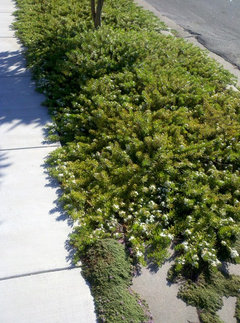
    We don't do much to this area. Don't water much, do whack it back off the sidewalk now and then, and it stays very nice all year round. We are in sunset 14/15.


  • 10 years ago

    Jubilanti - what is the ground cover in your photo?

  • PRO
    10 years ago

    I think it looks like myoporum parvifolium

  • 10 years ago

    Yes it is myoporum, I thought it might be helpful for the OP to see it in action! I think we planted a small 6 pack or 2? In full bloom it is very pretty. Don't know much else about it other than it has been easy to keep looking good as part of our 180ft of hellstrip on our corner lot!