Software
Houzz Logo Print
mtvhike

Breaker question

10 years ago
last modified: 10 years ago

I've recently posted some questions regarding wiring some parts of my unfinished basement. Today, I'm going to break into the breaker box and add one or more breakers. The electrician who wired the house was very good about labeling all the circuits, both on the breaker box door and on the wires themselves. Five of the breakers are labeled (by the manufacturer) AFCI/GFCI; these circuits are for the LR sconce lights, receptacles in an artist's studio, Master BR receptacles, and two LR receptacle circuits. The one labeled GFCI is the MBa lights/exhaust fan circuit. The MBa receptacle next to the vanity has a GFCI recepacle In addition there are two Kitchen circuits with GFCI-protected receptacles.

Question 1: why the difference in the way ground fault protection was addressed (breaker vs receptacle).

Q2: Why are some lights AFCI and others not? There are lighting circuits in the laundry room, the powder room, the hallway, the fan/light circuits for the LR and the MBr, and outside lights for the porch. None of these circuits are GFCI-protected either.

Q3: what kind of connections are allowed inside the breaker box. An electrical inspector told me many years ago that two circuits cannot be connected to one breaker (in the sense that two wires cannot be put into the screw connector of the breaker). Are any connections between wires, using wire nuts, allowed inside the box? There are a couple in my box.

Q4: I seem to be running out of neutral and ground connections. Can two wires be put into one hole? This is also already present.

The original electrician had run a line from the ceiling light circuit to an unused wall box in an unlighted room; I used that for a switch for more ceiling lights. I ran a new 12Ga line from a new position on the breaker box to a GFCI outlet, and put several more receptacles on that line following the GFCI one. Thanks for your input.

Comments (22)

  • 10 years ago

    #1 preference of the electrician. The lights don't necessarily require a GFCI, but perhaps it was due to something being closer to the tub/shower than the electrician or inspector was comfortable with. An exhaust fan that is directly over the shower generally needs GFCI protection per the unit's installation instructions.

    #2 The areas where AFCI protection is required by code has changed over the years until almost all areas require it. It started with just the bedroom circuits.

    Here is 2008

    http://freenec.com/T26.html

    Here is 2014

    http://www.eaton.com/ecm/idcplg?IdcService=GET_FILE&allowInterrupt=1&RevisionSelectionMethod=LatestReleased&noSaveAs=0&Rendition=Primary&dDocName=BR003005EN

  • 10 years ago
    last modified: 10 years ago

    #3 "An electrical inspector told me many years ago that two circuits cannot be connected to one breaker (in the sense that two wires cannot be put into the screw connector of the breaker)." - it depends on the listing of the specific breaker.

    "Are any connections between wires, using wire nuts, allowed inside the box?" - it depends on the listing of the panel and how much room is in the panel. Generally, it is OK for splices specific to the panel.

    #4 "I seem to be running out of neutral and ground connections. Can two wires be put into one hole? This is also already present." - it depends on what year's code was being used at the time. In general, it is now just one neutral or ground wire per hole. Depending on the listing of the ground bar, there may still be an exception or two (for the ground wires only), but it is better to go get another ground bar and move enough of the ground wires to the ground bar to free up space in the neutral bar for all of them separately.

    I may look up the actual code later....

    .

    In general, most AFCI protection must be breakers in order to protect the entire circuit, but GFCI protection is for "personnel" and can be either a circuit breaker or a receptacle since it is meant to only protect what is plugged into the receptacle.

  • 10 years ago

    The house was built last year in upstate NY and final inspection was in October, 2015.

  • 10 years ago

    Does the same apply to neutral connections?

  • 10 years ago
    last modified: 10 years ago

    "Does the same apply to neutral connections?"

    Does the same what? A "groundED" conductor IS a NEUTRAL.

    A "groundING" conductor is the bare copper wire for grounding metal parts of equipment, and help facilitate quick breaker tripping when there is a hot to ground fault.

  • 10 years ago
    last modified: 10 years ago

    OK, so my original question was for both the ground and the neutral conductors. In both cases, there don't appear to be enough holes for all the relevant wires in the bus bars. I haven't counted them up yet, but I would think that in a 42 position panel (square D), there should be 42 holes in each bus bar, since each position has at most one circuit (there are 4 pairs of positions feeding 240 volt devices and each of these pairs have only one ground and one neutral). 38 positions are currently used, and I need to add two 120 volt and one 240 volt circuits.

  • 10 years ago
    last modified: 10 years ago

    I should clarify this,

    "Are any connections between wires, using wire nuts, allowed inside the box?"

    It is OK to splice two 12 gauge HOT wires to a pigtail in order to connect two "half full" circuits together and put them on one breaker.

    It is NOT OK to splice and pigtail two neutral or ground wires together in order to not get another ground or neutral bar. This is because two neutral wires , say 12 gauge, each with corresponding hot wires on a 20 amp breaker, would make the pigtailed part susceptible to 40 amp currents.

  • 10 years ago

    "I haven't counted them up yet, but I would think that in a 42 position panel (square D), there should be 42 holes in each bus bar"

    Square D likes to make you buy additional "ground bars" (not neutral bars).

    You may, or may not be allowed to double up a few ground wires (bare copper, not neutrals). The shorter Square D ground bars are only a few bucks, and screw directly to the panel.

  • 10 years ago

    Yes, in the current installation, no neutral wires are doubled up, but there are several instances of ground wires being doubled (or tripled) up. So, in my case, I need to find three unused holes with set screws in the neutral bus bar for my three new circuits.

  • 10 years ago

    Thanks. If this is what my load center has, then I need three if I have more than 30 neutral wires (I think I have 34).

  • 10 years ago

    They make longer ground bars. The back of the panel will have pre-tapped holes for the ground bars to screw into. You only need to move enough of the bare copper wires out of the neutral bar to make room for the three new neutrals. That should not be more than 9 (3×3) out of the existing neutral bar, plus three more grounds for a total of 12 more holes.

  • 10 years ago

    Of course, the panel is already wired up. Can a new, longer bus bar be installed under these circumstances?

  • 10 years ago

    Not a new longer neutral bar, just use a short ground bar...

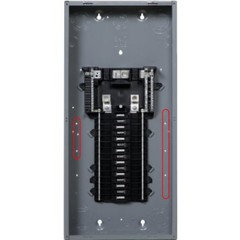
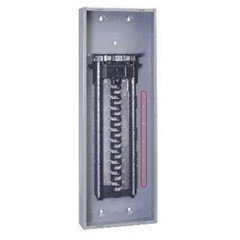
    The additional ground bars go here.

  • 10 years ago

    Or in any of these holes on this style panel.

  • 10 years ago

    Are any connections between wires, using wire nuts, allowed inside the box?

    Should not be necessary, only certain applications like that of a generator transfer switch kit.

    http://www.homedepot.com/catalog/pdfImages/a4/a46b987b-8809-41bf-a665-c32b47fe6c3c.pdf (see page 5)

  • 10 years ago

    There were a couple of cases where, I guess, the black wire wouldn't reach the breaker location, so the electrician lengthened it. That's what I was asking about. Same thing, in one case, with the white wire.

  • 10 years ago
    last modified: 10 years ago

    http://diy.stackexchange.com/questions/39798/is-it-against-code-to-splice-wires-inside-of-the-load-center

    Seems it is ok to extend wires in the panel based on the answer here referencing NEC 2011 unless it changed....

  • 10 years ago

    How would one install an additional bus bar (ground or neutral) in a already pretty full load center, without cutting the power? I assume you should not do that. If I cut the power, then I have no light and would have to get adequate battery-powered work lamps, in addition to my headlight.

  • 10 years ago

    I've never had to cut power to make such connections, though I can't say I've ever had to install a ground bar in a panel that was yet live as I don't tend to have to deal with things that were dangerously and illegally done to start with. If you have to cut off the lights, get sufficient worklights. Walmart has battery powered lanterns in the camping section if you must.


  • 10 years ago

    I hope the work isn't dangerous or illegal - it was done by a licensed electrician, as part of the whole house build, and inspected several times by the local building inspector. I wasn't there, so I don't know how thorough the inspection was. I appreciate your comments as to how to correct practices that perhaps weren't the best. I am not there now, but am going there tomorrow and will inspect the panel and determine if the neutral bus bars have any holes with multiple wires in them, and add another bar if there are (and no empty holes). Of course, I will cut the power before doing that. I understand the ground bar may have more than one wire in one hole. I need to add one more 110 volt and one 240 volt circuit, and that will fill the panel. If I need more circuits, then I will have to get and use an additional panel.