Software
Houzz Logo Print
hzdeleted_27749664

Rhododendron 'Unique' virus?

10 years ago
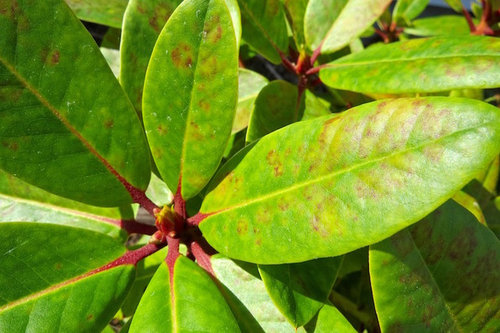
I bought three Unique rhodies spring of 2015 and red rings started showing up on all the leaves by end of last summer. Now they are everywhere. It appears to be a virus. Anything I can do for them? I've just given them another shot of acid fertilizer hoping to green them up as they look anemic, too. Advice and comments welcome. Thanks.

Karen


Comments (11)

  • 10 years ago

    Lace-bugs or mildew. Look at the leaf undersides.

    User thanked Embothrium
  • 10 years ago

    Thank you! I don't see lacebugs but it does look like mildew - some fuzzy growth on the underside where the dark circles are. The plants aren't crowded and I water in the morning, but I live close to the coast so humidity is pretty high all the time. Is there anything I can do other than get rid of them if they become too unsightly?

  • 10 years ago

    Powdery mildew on rhodies doesn't bear much resemblance to PM that appears on other plants.....seldom does one ever note any fuzzy white fungal mycelia on either surface of the leaf.

    'Unique' is noted in the literature to be rather prone to necrotic ringspot virus so that remains a possibility; however the leaf symptoms are not yet very pronounced if that is the case. I'd lean towards PM as well but you will most likely want to keep monitoring.

    What is your soil pH? Or are the rhodies planted close to the foundation or any concrete patios or walkways? They DO look anemic but that could be a factor more of pH than a need for regular fertilization.

    User thanked gardengal48 (PNW Z8/9)
  • 10 years ago
    last modified: 10 years ago

    The neighbors and myself lost decades old 'Unique' to mildew some years ago. The top of the leaf looks just like your picture, with a dusty appearance to corresponding areas on the underside. I've looked with a magnifier before and seen a quite apparent fungal growth covering the leaf surface, to produce this appearance.

    Extra susceptible cultivars such as this one gradually go bald due to premature death and dropping of the leaves, once infested. The 'Unique' here were cut down before the fungus killed them completely.

    When the mildew showed up at our place in the 1990s the first thing it did was destroy some previously outstanding 'Virginia Richards' that were producing flower trusses the size of basketballs. 'Anna Rose Whitney' is another formerly common one that has probably been to a large extent taken out by this problem. (Both, as it happens, are Whitney hybrids).

    User thanked Embothrium
  • 10 years ago
    last modified: 10 years ago

    All three of these rhodies are planted on the north side of the house a few feet out from the foundation. I don't know the soil pH. Two other rhodies planted a little further away don't look anemic so I assumed the pH was proper for their needs. Could be the foundation is contributing to the problem. Also, we have Hoypus soil, sandy gravel, that holds little water so have to water frequently. Owner of the rhodie garden I purchased from suggested the extra feeding. There are some Pieris japonica planted alongside the house that are having problems too (new growth isn't greening up) so maybe I need to move them all.


    Edit to add: I had to look at the underside of the leaf with a microscope to see the slight fuzzy mycelial growth.

  • 10 years ago
    last modified: 10 years ago

    If the pieris have spectacular reddish pink new growth maybe they are 'Forest Flame'. Yellow mottling of the leaves in summer is normal for this. Another frequently offered example of the same coloration type is the 'Sem' sorbaria.

    Check out the second photo in this discussion.

    http://pnwhandbooks.org/plantdisease/rhododendron-powdery-mildew

    By 1990 the condition was becoming prevalent, with apparently many
    mistakenly thinking the hard winter that year was what had caused some
    of their rhododendrons to look sparse. 'Vulcan' held out for a long time here but finally became shabby a few years ago and was removed.

  • 10 years ago

    Well that picture and the description is definitely what I'm seeing. There are a lot of chemical controls mentioned... any of them worth trying? If Unique is prone to PM it sounds like a losing battle and maybe not worth the effort if I'm going to have to treat it year after year. Wish I had known about the problem before buying them.


    Not sure what kind of Pieris I have. The mature leaves are green with white edges, more or less. The new growth was red/pink that went sort of pale yellow and has been like that for months. These yellow leaves seem to be very sensitive to sunlight and are getting scorched. They're also on the north side of the house and get morning sunlight until about 11 am, then direct light again after 3pm and that seems to be too much. The nursery where purchased said they could be put in a direct sun location but I think these would be happier in full shade.

  • 10 years ago

    Given enough water, they can tolerate a lot of light but likes some relief from the afternoon sun. Scorching usually means it needs more water. Check the rootball.

    What kind of soil is it growing in? Sand, loam, or clay?

  • 10 years ago

    http://hortsense.cahnrs.wsu.edu/Public/FactsheetWeb.aspx?ProblemId=531

    WSU has pictures of this problem on rhododendrons. The typical fairy ring growth of fungus which powdery mildew is, shows in your picture. Darker on the outside of the ring, lighter shade in the middle. They list cures and preventative measures for this disease in rhododendrons on the Hortsense site.

    User thanked johnaberdeen
  • 10 years ago

    Soil is Hoypus, sandy, gravely. I have to monitor water pretty closely because the soil dries quickly even with mulch. The two plants that get both morning and evening light show scorching, while a third plant next to the others but round the corner of the house gets only evening light and has no scorching which leads me to think sunlight more than water, but could be the soil is drying out faster on the sunnier side despite the mulch.