Software
Houzz Logo Print
mtvhike

Preferred duplex receptacles

10 years ago

I'm installing a fairly large number (~30) receptacles in my basement work room and utility room and other areas of the basement (probably several circuits). I started using some extra receptacles from earlier projects (mostly regular 15A ones being replaced with Decora style). They vary greatly in the ease of wiring. The easiest are the GFCI ones which are at the start of each run, or the Pro-rated 20A ones, but they are the most expensive. One of the problems is that I'm using 12GA wire, which is difficult to wrap around the screw, in some cases. So, what is your preference. Also, do I need to use tamper-resistant ones in a basement?

Comments (19)

  • 10 years ago

    I always use 12 gauge. Not sure why you have a problem wraping the wire around the screw. The procedure I use is;

    (1) strip the sheathing from the cable and put into the box with at least 1/4" of sheathing in the box, and staple the cables to the studs

    (2) connect the ground wires together with a pigtail for the receptacle, and fold that wire nut to the back of the box.

    (3) trim all the wires evenly so that all the wires when pulled straight out of the box stick out about 6".

    (4) strip the insulation off the ends of all the wires.

    (5) loop the wires with the hole in the strippers.

    (6) attach the ground wire. Wire wraps around screw in a clockwise direction.

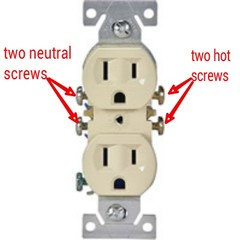
    (7) attach both neutral wires at the same time. Put both loops under the screws. Since the wires are the same length, you can pull on the receptacle to keep the loops under the screw while tightening the screws.

    (8) flip receptacle over and repeat for hot wires.

    Some wire ocassionally comes out stiffer than most, commonly referred to as hard drawn.

    According to the code, pretty much all receptacles installed in new work need to be TR. If you get an inspection, I imagine they will look for TR. Otherwise, I think that TR is a little too Big Brother...

  • 10 years ago

    So, even if I have only one cable, I still use a pigtail for the ground wire? I've done that and the pigtail cable is easy, it's wrapping the 12 GA wire around the ground screw that's difficult.

    Your comment 7 - are you assuming there are two cables, hence two neutrals? I don't think two 12 GA wires will fit under the screw. I did try this type:

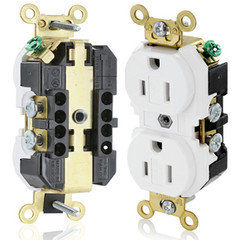
    and inserted the wires in the back. Is that OK? (I don't think it is TR, but I can get the TR version).


    I know I have to get new receptacles, especially if they all have to be TR, so I was simply asking what variety you prefer.

  • 10 years ago

    "So, even if I have only one cable, I still use a pigtail for the ground wire?"

    No, not usually.

    "I've done that and the pigtail cable is easy, it's wrapping the 12 GA wire around the ground screw that's difficult."

    Maybe I don't understand what you mean, is the wire too stiff, or are you not making a loop on the wire before you wrap it around the screw? You should be using the same gauge wire for pigtails as you have for the rest of the circuit.


    "Your comment 7 - are you assuming there are two cables, hence two neutrals?"

    Yes

    "I don't think two 12 GA wires will fit under the screw.

    "I did try this type:"

    Looks like it will hold up to 4- 12 gauge neutral wires.

    "and inserted the wires in the back. Is that OK?"

    There are two types of "wire in the back". One is pressure fit stab lock that only accepts 14 gauge. The other tightens the connection by the screw on the side like the GFCI devices normally have, and are fine with 12 gauge, but are more expensive than regular receptacles.


    "I was simply asking what variety you prefer."

    I USE the standard receptacles because nobody wants to pay for the upgrade, and I have no problem wrapping wires. If money were no object, I might prefer the ones you pictured.

  • 10 years ago

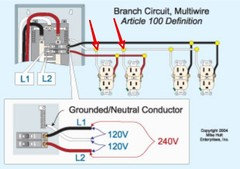
    You should not use the device itself to form the junction between the neutrals in a MWBC. Frankly, I don't like to do it in either case.

  • 10 years ago

    Not that we are talking about a MWBC, but...

    Branch Circuit, Multiwire. A branch circuit that consists of two or more ungrounded conductors that have a voltage between them, and a grounded conductor that has equal voltage between it and each ungrounded conductor of the circuit and that is connected to the neutral or grounded conductor of the system.

    300.13 Mechanical and Electrical Continuity — Conductors

    (B) Device Removal. In multiwire branch circuits, the continuity of a grounded conductor shall not depend on device connections such as lampholders, receptacles, and so forth, where the removal of such devices would interrupt the continuity.

  • 10 years ago

    mtvhike-

    "I don't think two 12 GA wires will fit under the screw." Just to clarify: NEVER put more than one wire under a screw head. When you have more wires than screw heads and/or backwire connection points, you use pigtails. Trying to put two wires under one screw head is a sure way to have a problem, possibly a dangerous one, with the circuit in the future.

  • 10 years ago
    last modified: 10 years ago

    I see this thread is really about which receptacles are easy to wire, but do you have opinions on the quality of various brands? We need tamper proof, 15amp, and want the rectangular kind, not the older oval-ish ones pictured in this thread. Was thinking of just going with leviton - they are pretty well priced. Thoughts?

    Wiring ease isn't an issue - my electrician will be installing them.

  • 10 years ago

    Yes, Kudzu, that's what I thought. I also thought that the little piece of brass connecting the screws should never be used to connect two circuits, which is what would happen if you had an 'in' wire connected to one screw and the 'out' wire connected to the other. Also, Fred, I was not planning to use the backstab type of receptacles, only the ones I pictured. Yes, they are a little more expensive ($6.00 in stead of less than $2.00 at HD), but thats not much in the greater scheme of things. The annoying thing is that at HD, the cheap ones are available in 10-packs, the ones I pictured are also, but not the TR version. Maybe I'll try a real electrical supply house.

  • 10 years ago

    I also thought that the little piece of brass connecting the screws should never be used to connect two circuits, which is what would happen if you had an 'in' wire connected to one screw and the 'out' wire connected to the other.

    There is absolutely no problem with using both screws and letting the "little piece of brass" carry the current downstream as long as it isn't the neutral wire in a multi-wire branch circuit (where 2 hots on opposite poles share a neutral wire).

    Note: When you say "to connect two circuits", that's not actually what you are doing. It's connecting 2 sections of the same circuit.

  • 10 years ago

    Right, Greg. What I mean is that one connection goes to the source (e.g. the breaker box) and the other continues town the chain. I wasn't sure that if a heavy load was put on the next part of the chain, the little piece of brass might not carry it. To digress, I believe I learned from one of you guys that if I have a 20A circuit with 12GA wire, the receptacles don't have to be rated at 20A. So, I could see that in the example I mention above, the little piece of brass on a 15A receptacle might be asked to carry 20A. So that's why I wouldn't use it as the weak link in a chain.

    But, I don't understand the reason behind the prohibition of using this on the neutral line in a multiwire branch circuit. Is it because of the fragility of the connection which, if it failed, might result in a highly unbalanced branch?

  • 10 years ago
    last modified: 10 years ago

    Fifteen amp receptacles are good for 20 amp feed thru. The only difference is in the slot configuration on the face of the receptacle.

  • 10 years ago

    OK, that makes sense.

  • 10 years ago

    For practicle purposes, 300.13 is referring to the connections at the arrows.

    mtvhike thanked User
  • 10 years ago

    Not that I am planning to do it soon, but would it be OK to use three conductor (+ground) to several boxes, as in your upper illustration, with some receptacles connected to one side and others (maybe even in the same box) connected to the other side? Or, have one box with a 240 Volt receptacle (such as for a table saw) and a 120 Volt duplex receptacle (such as for a dust collector) in the same properly sized box?

  • 10 years ago

    Back to the TR question: Whether they are required is determined by which NEC code cycle you local jurisdiction has adopted and whether it was amended when adopted. Best check with you building dept.

  • 10 years ago
    last modified: 10 years ago

    "but would it be OK to use three conductor "

    Yes, usually, but not that practical.

    I find that, in non-metalic sheathed cable, 12-3 is usually more than twice the price of 12-2, so it is usually cheaper to just run two separate circuits.

    "Or, have one box with a 240 Volt receptacle (such as for a table saw) and a 120 Volt duplex receptacle (such as for a dust collector) in the same properly sized box?"

    You may be able to get away with that if the table saw is 240v, rather than 120v, but usually, a table saw needs to be on a circuit of its own, or the overload on the motor trips too easily. (At least not on the same circuit as the dust collector that would be in use at the same time.)

    Also, a dust collector may as well be 240 volts as long as you have it available.

  • 10 years ago

    Pima: Since TR receptacles were installed in the original build (2 years ago), I assume that they are required.

    Fred: My table saw is 240 volts (no neutral needed or provided for), and the dust collector is 120. As a temporary installation, I installed two separate boxes, one for the saw and one for the dust collector, but the DC is on one leg of the saw circuit. I am simply wondering if it is OK to put these two receptacles in the same double box. There are, of course, grounds for both.

  • 10 years ago

    And you know what assumptions are the mother of....