Software
Houzz Logo Print
abojeva

Help picking a hardwood floor - engineered vs. hardwood!

9 years ago

Hello everyone. I had posted here recently about my quartz and now I need your advice on hardwood. Essentially I should have asked earlier but...We had really like engineered hardwood floor for our new house. Starting to read now, essentially I am terrified of all these horror stories that one minor spill and it is done. Problem is, we have to pick from what is available in the design center and there is not much in terms of colors that we want. We had settled on this : http://www.vintageflooring.com/ENG/hardwood-flooring-white-oak-nautilus-hand-scraped/

It goes perfectly with my walnut cabinets and we adore it. However, we don't even have kids yet and I cannot worry about every time a droplet of water falls to the floor. Any advice/suggestions are welcome...what would be close to this but in real hardwood? Is this even possible? Any advice will be much much appreciated!

Comments (29)

  • 9 years ago

    Hopefully one of the flooring experts on here will comment, but I just went through the process of choosing between finished on-site hardwood, engineered, and pre-finished hardwood. It's all pros and cons. It looks like the one that you are looking at is pre-finished hardwood, correct? So it actually is solid wood, it just gets installed like engineered.

    We almost went with a pre-finished hardwood but decided not to because the planks all have to be beveled in order to give a level appearance (since they aren't being finished on-site and sanded to fit your subfloor). You're looking at hand-scraped, so you must like the look of wavy floors, so it would probably be a good option for you. Supposedly the pre-finished hardwood is way more durable than site-finished because of the factory-applied finish. But then when you go to refinish it, they have to sand down way more than site-finished to get it completely smooth, so you won't get as many refinishes out of it.

    I had engineered in my last house, and I didn't have any issues with water, but I didn't have it in a kitchen or bathrooms. My mom's dogs peed on her engineered, and it did cause significant problems but it seems to have dried out and gone back to normal for now...

    Having just lived with the installation of site-finished hardwood in only one room, I am really happy with the results, but the installation and finishing process was terrible. We want to replace some more carpet in our house with hardwood, and I am reluctant to do site-finished again. It just created loads of dust, chemical smells, took longer than expected, etc. I would only do it again if I covered as much as possible in the house, chose an installer who I was sure would use the best dust containment system possible, and moved out while it was being done. We may have just chosen a bad installer.

  • 9 years ago

    Thank you for clarifying! As you can tell I am not knowledgeable about these things. We are essentially buying a new home from a builder, so we will not be installing this ourselves or hiring installers or anything of the sort. We just pick it at the design center and then when the house is done we move in. Would that be okay then in this case? Do you think the one we have picked since you said is not engineered but prefinished will not be problematic? Also we really like that look of this hardwood but I am unsure what you mean by wavy floors? All in all, I am worried about it being super high maintenance. We are not the most OCD people when it comes to cleaning up every speckle of dust in our home so I don't want to be constantly worried. In addition, not sure if this helps but hardwood would only be in living room. It is tiles around our island but it is not like the kitchen is completely isolated from the hardwood floor. Thank you for your advice, it really helps since we have never had to deal with this before.

  • 9 years ago

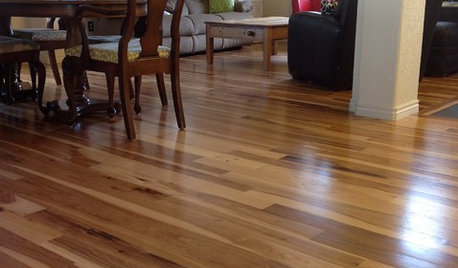
    You should go to a flooring store and talk to someone about the different options. Does your design center not have someone who can explain? I did a quick search, and this is the best photo I could come up with that illustrates the waviness I'm talking about. This is the type of thing you will usually get with "hand-scraped" pre-finished hardwood. See how it's not completely flat across the boards? Just whatever you prefer and supposedly it hides scratches and such better so maybe it's best for you guys. I definitely think the lighter color is great for hiding dirt.

    Naperville Residence: Kitchen, Mudroom, Powder Room · More Info

  • 9 years ago

    They are not very helpful and just want to get you to pick at the design center. We have been pretty good and went a lot of times ourselves. In essence, we are pretty much repeating this model home: http://www.houzz.com/photos/query/the-oxford-tamarack/nqrwns

    Same cabinets. Hardwood is not the same for simple reason that they have 3 suppliers they work with but the one that provides the original flooring does not supply the area in which we are building. So we had to choose the most similar hardwood available to that one from the supplier who is responsible for our area. Ours is a townhome but we have picked same cabinets and quartz, very similar backsplash, tiles, etc. I did not notice the waviness in the model home but even now when I see what you mean, I don't mind it, I do like that a lot. We are picking our finishings today ( I know, cutting it close by asking this here today) so here is hoping they can answer some questions. Much thanks to you for the advice.

  • 9 years ago

    Best of luck, I am sure it will be gorgeous!

  • 9 years ago
    last modified: 9 years ago

    I'm not sure CF is entirely correct about your flooring. The specs in the link you provided look to me to be for engineered flooring, not solid hardwood. Engineered flooring is a thin layer of genuine hardwood on top of a layers of plywood or something similar - it has many of the characteristics of hardwood, but is structurally more stable. It comes pre-finished, which makes installation a faster process than finishing on-site.

    It will not disintegrate if you spill water on it, but, like hardwood, it does need care if used in areas where spills may occur. I had actual hardwood in my last house, and engineered in my current one, and in terms of care, they seem to be much alike. With the engineered, I vacuum or sweep it regularly, and mop it with a damp (not wet) mop every now and then. It's fine, no higher maintenance than any hardwood floor. Incidentally, we do not have kids but we do have a dog (he sheds a lot, hence the regular sweeping!)

    The only disadvantage with engineered is that the wear layer on top may be thinner than the wear layer on genuine hardwood, which limits the possibilities of future sanding and refinishing. I'm told ours could be refinished a maximum of three times - but that's not a concern for us.

    Sophie says in her comment that engineered is more suitable for concrete than hardwood would be. Trust Sophie: she knows her onions.

  • 9 years ago

    jmm1837-- I think you're right. The site described its flooring as "Prefinished Hardwood" but now that I look at the specs, I think it is actually "Prefinished Engineered Hardwood" instead of "Prefinished Solid Hardwood." I've never heard anyone refer to engineered as "prefinished" since that is understood when you get engineered.

  • 9 years ago
    I have engineered hickory over a concrete slab. I've had no issues with it at all. I don't have it in the bathrooms or kitchen, however, my cat has thrown up on it in several places which I found in the morning when we got up. It cleaned up perfectly. We didn't buy cheap hardwood, it was fairly expensive, so I don't know if all engineered floors are created equal, but we are very happy with ours. It doesn't scratch easily, either.
  • 9 years ago
    last modified: 9 years ago

    Unfinished engineered also exists. It is just scarce, and expensive.

  • 9 years ago

    CF - I was a bit confused too, but the way that flooring is structured makes it engineered in my book. But I'm no expert (I did read up a bit on engineered though when we were selecting it for our new house, because I wanted to know some of the same things the OP did. I had a look at the flooring I eventually chose in the public reception area of a business, and decided it looked pretty good after two years of wear and tear, so I went with it.)

    I think the main thing here for the OP is that the engineered does have a wear layer of real wood on the top, so the surface will behave like real wood, not laminate.

  • PRO
    9 years ago

    It sounds like there is some confusion as to what qualifies a wood as prefinished and/or engineered. Sophie is correct that an engineered floor can be either prefinished or unfinished.

    Prefinished simply means that the product was finished in a factory rather than on site. So that could either be a solid or engineered floor. Just because a material is prefinished doesn't necessarily mean that it is engineered. There are plenty of solid prefinished options as well.

  • PRO
    9 years ago

    Just throwing this out there, jmm1837 is correct the flooring you provided the link for is an pre finished engineered hardwood. I work with all kinds of wood on a daily basis. I would say if you choose the engineered hardwood option the design center is showing you, please please please pay attention to the RH (Relative Humidity) requirements to keep your warranties valid. In most cases depending on where you live in the US an in-line humidifier is required to be installed on your HVAC system to control the RH levels in your home and keep the manufacturers warranties valid. Low RH "Anything below 35%" in most cases across most wood manufacturers and your floor will Gap (shrink), Face Check "Small cracks", dry cup "Bow or curl". I looked at the Vintage downloadable specs. They do show Humidity requirements on page 5. I would recommend you go thru all 6 pages of that download. I tried to post the link here but not sure if it will show up. I would also call the manufacturer 1-877-256-0231 and chat with a representative if you feel like your questions aren't being answered by reading the warranty page. Care instructions can also be clarified with customer service. Looks like they have a full line of care products specifically formulated for the product. Also the method in which the floor is installed is very important. I would recommend you do a direct glue application, which is the most permanent and lends itself to a decrease in install issues later on. Direct glue is more expensive than nail down applications but well worth it in the long term. If anything a nail down install will be just fine. I wouldn't recommend floating "not attached to the sub-floor" as an install option. Most manufacturers will allow for a floating install, but in my experience it's not in your best interest. Floating installs generally don't sound like a real wood floor when walking on them also if your sub-floor isn't perfectly flat you'll have some movement while walking on it. Hope this helps!

  • PRO
    9 years ago

    Just my opinion but a good site finished hardwood floor is the best long term option. It will last for decades, can be refinished many times and is a classic look that never gets outdated. Just make sure that the wood is of a good quality and your installer/finisher is competent.

  • 9 years ago

    In the 70% of the country that uses concrete slab foundation construction, site finished solid wood is a physical impossibility. Slab construction requires the use of glued down engineered hardwood. Or floating, but that isn't a quality sound, or experience.

  • 9 years ago

    Thank you all for your advice...we are sticking with this hardwood floor, God help us all lol. Hopefully we will not live to regret it. We don't have pets yet and no kids yet as well, and the floor is only in the living room so let's pray we can keep it looking as good as new for a long time. I am really grateful to anyone who commented!

  • 9 years ago
    I think you'll be very happy with the flooring you picked out!
  • 9 years ago
    Oh, also forgot to mention.....we did NOT float our floor, it is glued down.
  • PRO
    9 years ago

    @Alex B. That floor you picked will look very gorgeous against the real walnut cabinets. Vintage is a strong brand in quality. 4 mm top layer and a full 3/4' structured engineered floor should perform really well compared to solid wood floors, but more stable. I am not sure you have all realized that this floor collection allows a bigger swing of Relative Humidity. That means they are more comfortable with their floor structure. Good luck with your project!

  • PRO
    9 years ago

    Hello Alex, I just want to start by saying the Vintage Hardwood line is an exceptionally well build line of flooring. They are a Canadian company and offer one of the the best production methods of engineered hardwood on the market today. Your selection is fantastic.

    So just a little hardwood 101 - whether you select engineered hardwood or solid hardwood they are in fact, BOTH hardwoods and once installed there would be no way of knowing which one you have down from looking at the finished product. The biggest difference between the engineered and solid is that engineered hardwoods are built specifically to be more dimensionally stable. This allows home owners in traditionally dryer climates to go to up to 5" and 8" wide planks without having them shrink back (gap) or face check (appearance of fine splits on the face of the hardwood). Even where we live, solid hardwood wider than 4.5" is almost guaranteed to experience damage where I've installed a 7" wide engineered plank in our own home and have had no issues!

    The white oak is a very desirable species and is harder than the more common red oak on the market today. Add to that, the hand scraping effect, filled knots and sapling effects and you will enjoy a floor that requires minimal maintenance and won't show every footprint and dust particle (Yay, bring on real life!)

    For installation, Vintage will allow you to glue, float or nail this product but anything over 5" really should be glued to assist with the stability. Lastly, it's always the customer’s responsibility to make arrangements for an acceptable Humidifier when purchasing a Hardwood floor (solid or engineered). This Manufacturer typically requires humidity levels be maintained from 25-70%. What you need to understand is that wood products are made up of living cells and below 25% humidity these cells start to change, at 20% relative humidity your hardwood floors’ cells and fibers will actually break down, hence the cause of cracking and face checking. So invest in a good humidifier and enjoy your incredible new floors for many years to come. You made a wonderful choice!!

  • 9 years ago

    Thank you for your comment. On the note of humidifiers, we do have an air exchanger. Is this enough? If not, what is a good humidifier you would recommend?

  • 9 years ago
    last modified: 9 years ago

    Talk to your HVAC professional. Adding in a humidifier will make your home much more livable and comfortable. People are much like wood. We find the same range of humidity comfortable. Plus, so does every other single piece of wood in your home, from your cabinets to your end table. In fact, cabinet companies also have humidification requirements. Just like flooring companies.

  • PRO
    9 years ago

    Hi Alex, deciding this will partially be determined by where you live. If you're in a typically dryer or colder climate where fireplaces, wood stoves & electric heat sources are used a lot more, these will create VERY dry conditions. If this is the case, I would definitely recommend stepping up to a separate humidifier over the air exchanger. If you're in a relatively humid climate, before you make any big equipment commitment, pick yourself up a decent hygrometer. They're not very expensive but they will accurately measure the relative humidity in your home so you always know exactly where you stand. From there, you'll be able to determine just how heavy duty a system you need and as Sophie eluded, you can discuss this with a local HVAC professional. Hope that helps.

  • PRO
    9 years ago

    It's really hard to advise you about this online as this depends on where you live (humid/dry) and your subfloor (concrete or plywood). I really would speak to your local experts and it's too bad that your design center won't help. I would push them further as I'm sure you're paying them a lot to build a whole house.


    As others have mentioned, I think this is a beautiful floor and it's an engineered wood and appears to be a high quality engineered wood.


    HOWEVER, it appears to have an oiled floor finish. While it absolutely looks lovely, the oiled floors do NOT protect against water/liquids and yes, I would expect a lot of maintenance on this floor. So, be very aware of what you are getting yourself into. And, I agree with the comments on dehumidifier and check moisture levels. The oil finish has nothing to do with engineered or solid hardwood...it is the finish...it gives you the "look" and protection (or in this case lack thereof)...or at least that's how it appears.


    While engineered may be good if you are over slab and in a humid environment, if you are over plywood and in Northeast, Mid Atlantic, Mid West sort of areas, solid hardwood is generally more preferable and for kitchens, I as someone else mentioned, doing site finished, especially for kitchen is generally best - smooth edges, full coating (very important for areas with water) and easier to clean/less likely to get dirt in grooves (but this one looks like square edge).


    You may find these articles helpful

  • PRO
    9 years ago

    There are a lot of factors to consider when choosing the right hardwood floor for your space. We have removed that guesswork from the buying process via our simple online quiz based on your climate for your zip code and other factors that go into your space so you don't have to stress over the research. https://revelwoods.com/

  • PRO
    9 years ago

    We are installing engineered birch hardwood in the entire main level except kitchen. We are on a slab. The wood id tongue and groove. We have carpeting that will need to be taken up. How much of a mess am I looking at? Dust? Chemicals?


  • PRO
    9 years ago

    @robin_hoch222 - carpet hides HORRIBLE subfloors. Builders ignore the concrete when they know carpet is going over top. Be prepared for a decent amount of concrete prep before a wood floor can be installed over top. Some heavy duty cleaning, some grinding and some leveling. If you estimate $2-$4/sf for the concrete prep, you should be fine.

    Dust = lots because of the carpets (dust traps). Dust because of the concrete prep (grinding and leveling and grinding again). Chemicals? Who knows. It depends on the wood you purchase (chemicals in a box) and the type of installation you choose (glue or float = chemicals in a bucket or a tube).

    Just removing carpet can be EXTREMELY dusty...imagine emptying the shop-vac 5-10 times because of all the dust the carpet "held on to".

  • PRO
    9 years ago

    Thank you for confirming the mess I am in for! My husband jokingly said we should move out for a week while they are working on the floor! Unfortunately, we can't do that so we will have to learn to live with the mess until they're done.


  • 6 years ago

    @Alex B, what did you choose and how is it holding up? Thanks :)