Software
Houzz Logo Print
wantonamara

Spanish Oak trimming question

9 years ago
last modified: 9 years ago

I am involved in my yearly trimming of some forrest. Some small twisters hit my area couple of years ago. My neighbor lost 40 trees. I lost maybe 6 but I did sustain damage on some oaks that are still living but weird.,I am doing a head scratching and was wondering what others might think. We are talking about Quercus buckleyi. This small oak has its long branch now wanting to travel along the ground, or maybe it grew that way because it was all strangled by cedars and snaked its way through a thick bramble or Its branch might have been twisted and lost its structure when the twister hit. It is still sustaining growth on it long branch with many healthy leaf nodes waiting for spring. . Another major part of the tree was twisted OFF so I am confused by what I should do with this.

Here is a picture of the long branch lying on the ground. One option is to trim it at this Y joint on the ground.

From another angle , one can see the trunks. One can see the torn off trunks. I have thinned the cedar trees away from this tree. Another option is to take this whole branch off . That is the later branch that is sinking in the frame towards the left side of the frame. As you see, two trunks of the multi trunked tree are gone and what remains is just plain weird and not in good shape

This tree is stressed and this branch is growing, but on the ground a long way!. So far it is growing healthy, the only healthy growth on the tree., But I don't think it will stay healthy. What do you think. This is in the forest so Garden worthy is not what I am aiming for. I like wildness but I like healthy. I don't mind odd form but not usually this weird. I am having a hard time seeing this tree as it might be in the future. These trees will grow back from the roots too.

Here is another angle the limb in question is the one sinking off the frame to the right. Drastic measure would be to take it off at this juncture. Any thoughts about what you would do with this misbehaving tree. I am hesitant to take the largest healthy part of this tree off, but I might have too. Sorry about the not very good photos. Hard tree to even photograph and explain.

Switching gears here. Another Spanish oak that we rescued from cedars' strangling grip 20 years ago. It has more than quadrupled in size. It had a branch that dropped to the ground and we left it there and trimmed the cedar back a couple of times through the years as it grew. I just re cleared around the canopy because it was getting crowded. In this case , I am glad that I let the drooping branch stay. The branch was not as long and skinny as the one I am looking at now. At least this tree had balance and symmetry in its lateral explosion.

Another view

Comments (7)

  • 9 years ago

    What are you're trimming/pruning objectives? Is it aesthetic, fire safe landscaping, mimicking fire ecology, wildlife benefits (or deterrents), promoting specific plant species, accelerating (or arresting) forest succession, etc.?

    There is a lot of overlap between the objectives but knowing what you hope to achieve will help us guide your trimming strategy.

  • 9 years ago
    last modified: 9 years ago
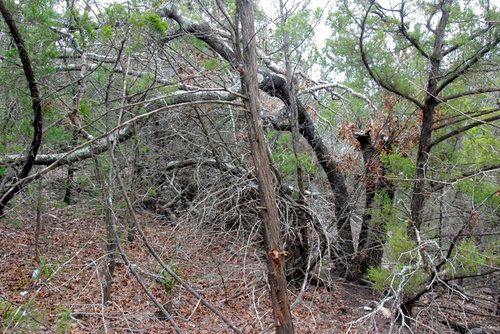
    I just found a better picture of the chaos of this tree.

    My hopes are of bringing back diversity from a progressively monoculture cedar brake, some aesthetics's. Fire safe not really possible in this chaos but the thinning should help. Helping the woods get past this choked stage of too many saplings. I have a wildlife exemption so that is a concern.

    I did find four small madrone trees, 5 red bud , escarpment black cherry and a bunch of struggling red oak seedlings and they got caged . I will be using th slash to slow the downward movement of water.

    This question is about one tree. But in this half acre of what I call virgin woods , or un worked woods ,I feed up 6 spanish oaks from their prisons. hopefully they will grow now and not dieback. the other areas were easier to read what I should do.

    This

    Became (see the oak in the back)

    This

    To

    I have still to go and dice up the downed trees into slash and make berms out of them. This is still a work in progress.

  • 9 years ago
    last modified: 9 years ago
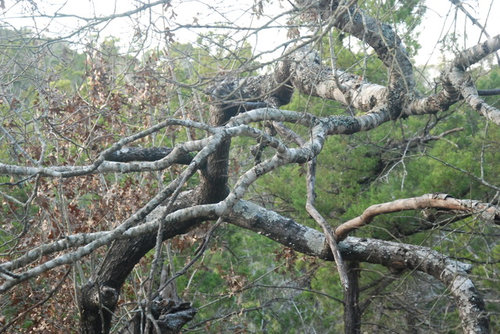
    I am looking at the photos on this rainy cold day and the one at the beginning of the last post that I made was taken in January of last year when I trimmed back around it and the pictures that I just took at the top of the thread that I JUST took show that the branch has leaned further over onto the ground. SO, I think I have decided to go the drastic rout and cut off to the last larger branch. It is strange, sometimes I can see things more clearly when I back away.

  • 9 years ago
    last modified: 9 years ago
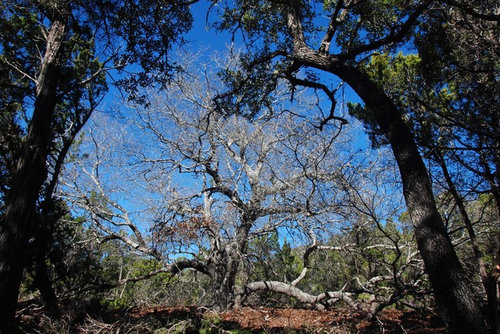
    Looking good! The kind of brushing/trimming you are doing is not a "one & done" kind of work. I'm sure you already know that. :)

    Some years ago, when I would get to a part of my woods that were coming strong with a mix small trees and brush, I would take out some the less desirable trees and brush but make sure that I didn't thin things so much to encourage wild new growth of brush to come in the spaces. Then when the canopy warranted more thinning, I would take a little more. Today I have a nice pure stand of hardwood trees.

    I know nothing about Spanish oaks but around here, any storm mangled tree would be removed as it will never become a nice, straight, tall tree no matter how you prune it.

  • 9 years ago
    last modified: 9 years ago
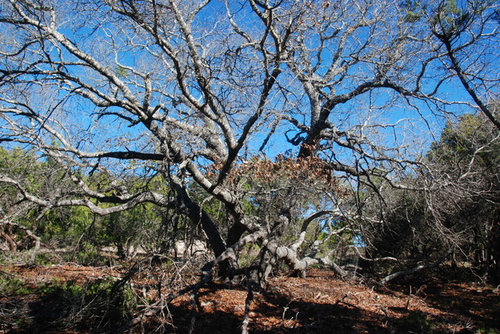
    Central texas woods on slopes are not tall woods. Spanish oaks will come back from their roots. They are good subjects for coppicing. Damage from ice storms, twisters and fire seems to be part and parcel of the ecology out here. So is atrocious soil and bad historical land usage. . This area might have been stripped of old growth cedar for rail road ties during the beginning of statehood and the ranching cleared more. These woods have been mangled in the last 150 years.. I am not knowledgable about why the cedars are so uniformly young here. I ran across a picture taken of this back valley during an ice storm in 2007 where we had about an inch of accumulated ice. One can see the oaks in the area. all of these trees have lost their tops,....sad. The tree we are talking about is the one on the left, I think, or it might be just to the left of the tall trunk. hard to say.

    here is another cropped down version. The tall trunk is history and we are now trying to save the left trunk.That trunk is snapped and on its way to making humus. Spanish oaks are now getting more endangered because there are not many young trees making it to teenager hood because of drought and over abundance of deer.. I am not a cavalier about writing an oak off since they are in this situation. I found not many young trees in this area.

    After I finish , I will probably not be back in this area for another 8-10 years. I have been putting off this area because of the difficulty.

  • 9 years ago

    You are inspiring to me, wantonamara. I have a small patch of undeveloped woods that I've just been watching and thinking about. Hoping to start this spring with loppers and roundup! Keep up the good work. :-)

  • 9 years ago
    last modified: 9 years ago

    Thank you, I get a lot of joy seeing the improvement through the years. I recommend getting a Styhl Easy start chainsaw. It is amazing how fast it goes with that and a large Corona lopper. Many people recommend the cordless reciprocating saw. I find for the amount of damage that I need to do, the batteries just don't last long enough and the speed of the work is not fast enough. If you are a nibbler and your woods are small, then maybe it is a good fit for you.It its safer and easier together started. I cut the trees into 2-3' pieces when I fell them as much as possible. Then I arrange the slash into berms on the slopes above the arroyo and anywhere where I am experiencing erosion. With Texas gully washers, that is anywhere there is a hole in the canopy. I use the slash to protect seedlings from deer. I also make some animal piles with the slash. I used to burn the slash but now I do not want to loose the nutrient load of the woods. I want to sink the carbon back into the soil and make homes for bugs and all sorts of things,

Sponsored
AIS Renovations
Average rating: 4.5 out of 5 stars15 Reviews
Custom Craftsmanship & Construction Solutions in Franklin County, Ohio