Software
Houzz Logo Print
pmother

Icf vs rigid foam basement foundation? R value and cost

9 years ago

Hello we are building a home in Canada, snowy cold winters.

We are thinking of an ICF basement. However, a builder we talked to, disagreed with ICF. He prefers rigid foam insulation, applied to both sides of the foundation. He stated both are equally as good in terms of RValue. Is this the case? And which is more cost effective to install? Which will provide a better ROI?

thank you

Comments (18)

  • PRO
    9 years ago

    Sometimes builders are hesitant to do things that they don't usually do, even if it's a better option. If I were you, I would independently get a couple of estimates for both methods and compare.

    ICF is thought of by many as the premium insulation method, with superior R Value. Depending on the region you're in, it can cost 2-10% more than other methods. The ROI can be great if you plan on staying in the house long enough. You'll have to do the calculations. How much more will you spend on an ICF foundation vs foam board, how much money will you save monthly on your utility bills with ICF, then figure out how many months you'll have to stay in the house to recover that investment.

    You might seek a consultation from a Home Energy Rating Company, which hopefully you have in Canada. They are unbiased, independent companies that look at your house plans, regional climate, house orientation and other things, then make recommendations for the best kind of insulation for your home.

    Love stone homes thanked Build Your House Yourself University (BYHYU)
  • 9 years ago
    last modified: 9 years ago

    Here in Manitoba, Canada, ICF basements are now VERY common, and many builders use them as they go up faster/easier than traditional framing. My guess is your builder is very old-school and doesn't want to have to learn anything new, or possibly invest in some new ICF supplies/equipment (tho they are pretty common to all concrete-work)

    Love stone homes thanked lookintomyeyes83
  • 9 years ago
    last modified: 9 years ago

    Research has shown there's no advantage to using ICF walls in extremely cold climates. As for basements, I don't see the benefits either. Just greater costs. Of course, if someone specified one I'd be happy to do it on their dime! If you really want an airtight basement wall, sprayfoam it.

    Love stone homes thanked worthy
  • PRO
    9 years ago

    I tend to agree with worthy, it takes extra thick insulation on the outer layer to get to international code minimum insulation values. Great you are thinking about your building envelope though, what's the plan for above grade?

    Love stone homes thanked Springtime Builders
  • 9 years ago
    last modified: 9 years ago

    Byhyu...thank you great advice, more research to do.!

    Lookintomyeyes...said "My guess is your builder is very old-school and doesn't want to have to learn anything new," You are correct, he admitted he does not have a lot of experience with ICF and he stated that most of his customers decide not to go ahead with it, and prefer to use 2" rigid foam.

    Worthy said "Research has shown there's no advantage to using ICF walls in extremely cold climates. As for basements, I don't see the benefits either. Just greater costs. Of course, if someone specified one I'd be happy to do it on their dime! If you really want an airtight basement wall, sprayfoam it."

    I am surprised to hear this. Also, I trust your judgement. We are building in the Ottawa area, so big cold snow country. Furthermore, electricity rates are through the roof, Our area does not have natural gas. We will use oil. We want to be as energy efficient as possible ! We want the basement temperature to be more consistent with the upper floors. We were under the impression that ICF was the best way to attain this consistency. Any other ideas, suggestions are more than welcome. Thank you so much. And if you know of any good contractors in the Ottawa area, please private message me. Thank you.

    springtime said". Great you are thinking about your building envelope though, what's the plan for above grade?" 2x6 walls, which of course is code up north. We are still exploring this issue. All ideas are welcome. Thank you.

  • 9 years ago

    Think about the differences between ICF and rigid foam.

    Those are basically in the construction as the insulating factors are virtually identical, given the same thickness of the material.

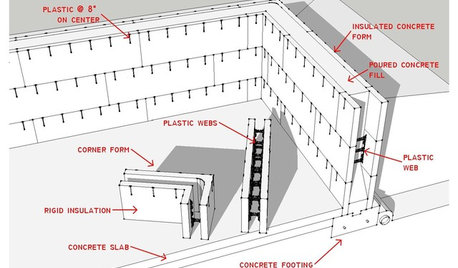
    ICF is done by assembling the blocks in the correct pattern, adding rebar as designed, and pouring the concrete.

    Rigid foam is applied after the concrete is poured and set.

    The other major difference is the knowledge and experience required to build with ICF, which is a bit more technical than conventional foundation construction.

    Cost should be similar, with ICF being more expensive than conventional pouring, but the added cost of adding the rigid foam means the final costs should be similar.

    I've helped build both types. The difference is the entire house we built was ICF(with conventional truss built roof), not just the basement. Made for much more savings to heat/cool.

    Love stone homes thanked User
  • 9 years ago
    last modified: 9 years ago

    worthy, that link will not work without a paid account, so I cannot read it. I did find this one, http://www.greenbuildingadvisor.com/blogs/dept/musings/all-about-thermal-mass, which speaks that ICF is less useful in cold climates, but it also mentions that they are "...of greatest benefit in climates with large diurnal swings in temperature".

    This could be quite true for my area - as MB often has large temperature swings in a day. We are NOT a temperate climate, after all, but a land-locked one with regular large temperature swings in a day. (When a local company built a large passive building for their staff, the german engineers on the project were amazed at our weather patterns...)

    We went with ICF 'to the roof', as we also like the severe-weather-proof, noise-proof, rot-proof, longevity aspects of it. We did go with thicker exterior insulation to take advantage of thermal mass.

    For us, and for our plans for the home when we die (it will become a halfway house/library for children) we do believe it has value.

    Love stone homes thanked lookintomyeyes83
  • 9 years ago

    lookintomyeyes83 (and anyone else who wants to look at worthy's article) -- as a workaround, just paste the link into a Google search box and click on the top result. That'll sneak you past the paywall.

    Love stone homes thanked dauglos
  • 9 years ago

    We built all-ICF in upstate SC, and the performance is remarkable in our fairly mild climate. Given the same foam thickness, either method should perform about the same. The only big advantage I can see for ICF is that it has fastening strips embedded for attaching drywall and exterior siding, if desired.

    I think ICF does best in moderate climates, with performance falling off at the extremes of temperature. While building our house, I measured the core temperature during the coldest part of winter, and it was about 13 C. (55 F.). I imagine in a very cold climate, it would be much lower than that. Our small house has about 100 tons of concrete in the walls. I'd hate to try to heat that significantly. Here, our ground doesn't freeze more than a couple inches. Our winter design low is -7 C. (20 F.), and in the summer, it is often 34 C. (93 F.), occasionally much warmer, and rarely gets below -18 C. (0 F.) in the winter, and is almost always above freezing during the day.

    I read an article measuring the true R- performance of ICF in different temperatures. During the shoulder seasons, when temperatures are rather mild, it can perform as high as R-66, while the 'true' R-value is R-24. That's why you sometimes see inflated claims as to its performance. For a very cold climate, you'd want extra foam on the outside of the foundation, plus careful attention paid to isolating the concrete core from the cold ground temperatures. They do make ICF with different thicknesses inside and out.

    Love stone homes thanked mushcreek
  • 9 years ago

    Seems to me the far more important discussion is upstairs where "2x6" and "code" were thrown around which can be improved much more than the possible difference between rigid foam vs ICF.

    If it were me in an oil environment with extreme cold, I'd be be doing 2x10 walls or at least 2 inches of foam on top of 2x6.

    I also think there is a bit of confusion - the OP is talking about basement construction not whole house. The same rules don't really apply - all basement walls will have large mass. The walls also don't see diurnal variation - they see constant ground temp - so there is no diurnal mass effect.


    Love stone homes thanked David Cary
  • 9 years ago

    It depends upon how 'buried' the foundation is. With our walk-out basement, more than 50% of our 'foundation' is above ground. Even on level ground, a certain percentage of the foundation is above ground.

    I noticed that, too, about the upstairs. If I were building in that climate, I'd look at SIP's.

    Love stone homes thanked mushcreek
  • PRO
    9 years ago

    I'm not a fan of ICFs. I suggest you consider a pre-cast concrete foundation system by Superior Walls if they are available in your local area www.superiorwalls.com

    Love stone homes thanked Charles Ross Homes
  • 9 years ago
    last modified: 9 years ago

    Charles Ross. Re superior walls...unfortunately not available in Ontario. But who knows mayb it will be available by the time we build in 2 yrs. how does this system compare in price and RValue to rigid foam, or spray foam insulation? thank you for the info.!

  • 9 years ago

    I'm interested in hearing more on the superior wall versus ICF question too. I was really considering superior until a builder I met with says he doesn't like them and prefers ICF.

    Love stone homes thanked doc5md
  • PRO
    9 years ago
    last modified: 9 years ago

    Precast Concrete walls like Superior are the way to go if available and the site allows it. Our region is blessed with a very competent and experienced branch. We are currently starting a project on a steep slope that will use precast stem walls, below the daylight end basement walls, a first for us. Vulnerable foam is kept to the interior, engineering is included, fastest set time, best warranty, and pricing includes labor which is the main way they are replacing traditional foundations and why ICF don't stand much of a chance.

    Love stone homes thanked Springtime Builders
  • 9 years ago

    Springtime said" Vulnerable foam is kept to the interior, engineering is included, fastest set time, best warranty, and pricing includes labor which is the main way they are replacing traditional foundations and why ICF don't stand much of a chance." DH and reviewed the product. With any luck, it will be available in the Ottawa region by the time we break ground, in about 2 years. Please keep us posted how your build progresses. (:


  • last year

    ICF is superior R Value but the cost is extreme, the major issue is the termite damage to ICF foundations