Software
Houzz Logo Print
jamesandbrittany_williams

Adding a switch controlled outlet

Hi, so I'm reluctantly engaging in some wiring projects around my house. The tougher jobs are going to be where the drywalls already up (contractors want 5500 for a job that should be less then half that in my area). I have a friend that rewired his whole house to code with permits, so I won't be alone in this but I do want to educate myself prior to planning this out with him.

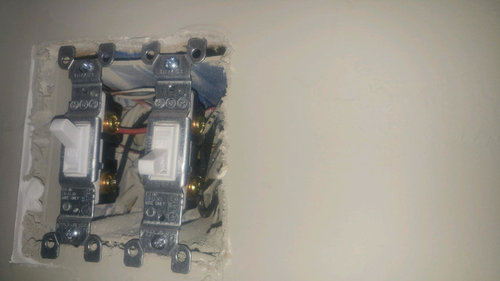
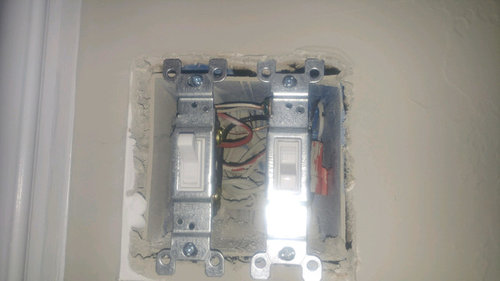
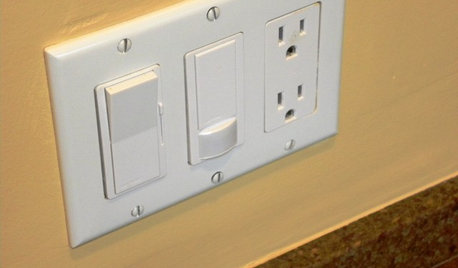
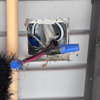
Anyway one key job will be to add outlets controlled by switches. This will be done on walls with no insulation and on one side I'll have attic access, also there will be switches present at each location I do this. So, I wanted to provide you the photos of a double switch that will be a triple when I'm done. In my mind I believe all I have to do is tap the feed wire, send it to the switch and up to the outlet. Then feed the neutral from the outlet back to the box and tie it in (I think the bundle of white wires back there are the neutrals but I'm hoping someone can confirm). Anyway any instructional advice would be appreciated.

Comments (12)

  • 9 years ago

    You'll need a bigger box if going from 2 to 3 switches.

  • 9 years ago

    If you have power running to the wall box, upgrading to three switches should be relatively easy if you don't exceed the box fill with the number of wires. However, sometimes lights are wired so that power goes to the light fixture, and the wall switch is simply a switch loop (no power at the switch).

    With a switch loop you are just "switching" the black wire, so you usually have the black (or red) from the light fixture connected to one side of the switch and the white from the light fixture (colored by black marker) connected to the other side of the switch. Essentially, the black and white wires are being used as if they are two blacks with a switch in the middle, which is why you color the end black.

    FYI - 2011 code requires a neutral wire at the light switch (a functional white wire, not a white wire colored black for a switch loop), so when running new wire you should run power to the switch first. This is apparently needed to make some of the new electronic switches (occupancy sensors, etc.) operate properly, because they need a small constant current for the switch's stand-by power.

    Bruce

    JamesAndBrittany Williams thanked Bruce in Northern Virginia
  • 9 years ago

    Not sure if you'll read this Bcarison78248 but if anyone else does, this house was just built so it should be based on current codes. I will be getting a larger box to add the third switch. It looks like I have the black in black out to the light and a black to red for the fan or maybe its visa versa. I saw some white wires in the back but wasn't sure how they tied into the circuit. I imagined I could pigtail off the black feeding into the switch and then black to the outlet white back in to pigtail with the whites in the box (new 3 switch box that is).


    Second question, I have one light switch that is in a horrible place but I have incredibly easy attic access to splice the wires going there into another switch in another spot. Do I have to remove the old wire from the stud since it's likely stapled all the way down? Or can I just decouple it and go on my way?

  • PRO
    9 years ago

    One thing to consider is if the circurit breaker for the switching is on a different circurit breaker than the outlets circurit breakers than mixing the neutral from the outlets to the switching power on a different breaker could cause a back feed or worse. Even though code may allow switching and outlets on the same circurit breaker for general purpose openings it is not a good idea. The reason is if you trip a circuit breaker that has lighting switching and outlets mixed together than you lose lighting and outlets together. A better solution is to have dedicated circurit breakers for lighting and outlets separated this way if outlet circurit breakers are tripped you will not lose your lighting also,

    www,dbelectric.us

  • 9 years ago

    Personally, I'd run 14/3 from the switch to the receptacle (assuming this is a 15A circuit). That's 3 wires (red/black/white) plus a ground. Feed the red from the switch and feed the black from the power source.

    Then you'd have switched power AND constant power at the receptacle. Then you can break the little tabs on the receptacle and have the top outlet switched and the bottom outlet constant power. It's rare that you'd want both outlets switched.

    Do I have to remove the old wire from the stud since it's likely stapled all the way down?

    If both ends of the wire are disconnected, then you can push the ends out of the box and just abandon the wire. You don't need to physically remove them. You just need to make sure that they can't be hooked back up.

  • 9 years ago

    I did what Greg advised, except that I used a dimmer switch so I could dim the lamp which was plugged in to the switched side of the receptacle. I later learned that having a dimmer on switched receptacles was not allowed, so I removed the dimmer. I was just wondering if it is true that dimmers on switched receptacles was illegal.

  • 9 years ago
    last modified: 9 years ago

    Illegal? No they won't throw you in jail if you do that. :)

    But it is against code. Just because you always plan on plugging a lamp in there doesn't mean that it will always be a lamp. If any other device is plugged in, it could potentially destroy the device (and be a fire hazard or something).

    I believe there are special receptacles and plugs that you could use if this was the desired end result. Basically it makes it so that only a device with a special plug on it can be inserted into the special receptacle and therefore it avoids the potential fire hazard.

    Example of special receptacle and plug

    It costs around 50 bucks for the two pieces so you really have to want to dim it. :)

  • 9 years ago

    I'm wiring in a led strip to up light the ceiling. Not sure if there's an easier way to wire it directly in without the outlet (but this outlet will be located about 7 ft in the air behind trim, so the likelihood of anything else being plugged there is slim).

  • 9 years ago

    And you are going to dim the led strips? It probably still won't pass code (but maybe an actual electrician can jump in here to confirm if there are any exceptions that might apply).

    If there's a way to hardwire your led strips into the box then that would be the cheaper route. Otherwise, if you want to do it to code, you'd need those special plugs.

  • PRO
    9 years ago

    greg_2015

    LED strip lights use remote control to switch and control mutil color LED light strips. AC power is applied to the transformer and the LED strip lights operate on 12 volt DC thru the transformer. If this is the case than using a AC dimmer switch to supply voltage to the transformer would not be a good idea. Because AC dimmer switches lower AC voltage to the device being operated meaning the AC voltage voltage to the transformer would be lowered.

    https://www.bing.com/videos/search?q=how+to+dim+switch+a+lmutli+colol+ed+strip+light&&view=detail&mid=F6A021A82686DBBD80AFF6A021A82686DBBD80AF&FORM=VRDGAR

  • 9 years ago

    D B Electric,

    Some LED strip lights may use remotes and are 12v DC. As you stated, those wouldn't use a dimmer at the switch.

    However, I believe there are some LED strips that are 120V AC and could potentially be dimmed at the switch. I may be wrong though.

    That's why I was asking the OP's plan. The OP actually hasn't even mentioned dimming at all. That was mtvhike. So maybe the OP has no plans to dim it.