Software
Houzz Logo Print
bananafan2

Big leaf magnolia - anyone own this tree?

9 years ago

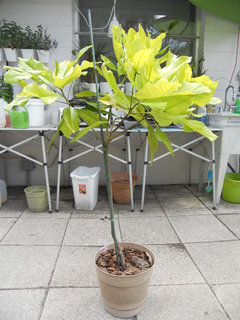
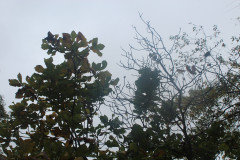
I thought the magnolia grandiflora might be a big leaf magnolia. Would like to hear if anyone has this tree and would like to share your experience with this tree. I'm in 9b fl.

Comments (37)

  • 9 years ago

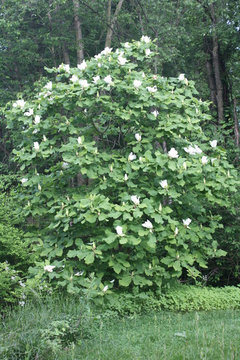
    I've only seen them in the wilds in Al . The leaves were like 3 ft long and had a huge flower.

    is this the one you have?

    bananafan2 thanked User
  • 9 years ago

    I have rescued seedling bigleaf magnolias from the woods here in north Georgia, zone 7a. They seemed to transplant ok, but I transplanted them right before their leaves emerged. They are in pots right now, and are anywhere from 1 to 3.5 feet high. Their foliage is very tropical but they seem to have a zone range of 5-8. I am not sure how they would do in 9b? Wouldn't hurt to try one to see of they can acclimate.

    bananafan2 thanked (ryanga7a) Ryan M
  • 9 years ago


    See my thread from a few years ago.

    bananafan2 thanked sam_md
  • 9 years ago

    A sheltered spot is best....leaves tear in wind

    bananafan2 thanked viper114
  • 9 years ago

    M. grandiflora = big flowers. M. macrophylla = big leaves.

    Bigleaf Magnolia would appreciate partial shade, moist but well drained soil, and shelter from wind.

    bananafan2 thanked Smivies (Ontario - 5b)
  • 9 years ago
    last modified: 9 years ago

    Yeah, was going to say Big Leaf Magnolia is a completely different species from M. grandiflora. The Big Leaf seems to be seldom planted in my area even when fully hardy. Big Leaf seems to be more an understory tree that appreciates some shade and protection from WINDS. It is also fully deciduous as opposed to grandifloras. It is also a cold hardier tree and can be successful in colder winter zones than grandiflora. It is extremely tropical in appearance and may even look out of place in comparison to other northern trees.

    bananafan2 thanked User
  • 9 years ago

    Is it M. macrophylla or possibly M. tripetala or M. obovata...both of which are more tolerant of exposed positions in full sun.

    bananafan2 thanked Smivies (Ontario - 5b)
  • 9 years ago
    last modified: 9 years ago

    Agree it doesn't quite look like the M. macrophylla I've seen. (which isn't many)

    OTOH a M. obovata of that size would be rare outside of Asia or various milder climates, I suspect.

    bananafan2 thanked UpperBayGardener (zone 7)
  • 9 years ago

    Closer view needed. Otherwise general aspect is that of macrophylla. Definitely not the Asian species.

    Southernmost version Ashe magnolia is native to Florida.

    bananafan2 thanked Embothrium
  • 9 years ago


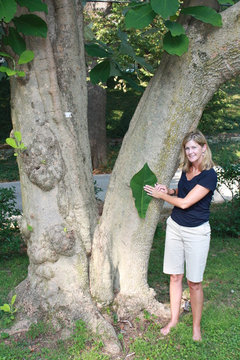
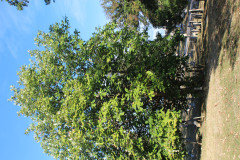
    Owner standing by her bigleaf magnolia, notice double trunk. Baltimore City.

    bananafan2 thanked sam_md
  • 9 years ago
    last modified: 9 years ago

    sam, yep, the one you show is the MD champ:

    http://www.mdbigtrees.com/tree_detail.aspx?tree=TR20121020120747210


    And another magnolia -- a massive cucumber tree:

    http://www.mdbigtrees.com/tree_detail.aspx?tree=TR20121022133613913

    bananafan2 thanked bengz6westmd
  • 9 years ago
    last modified: 9 years ago

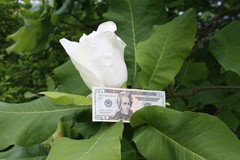
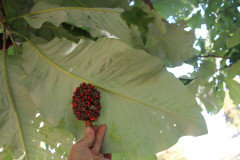
    Last picture doesn't actually give very good views of the leaves. However if they have eared bases - as appears to be the case with the one she is holding - then that would fit.

    Notice that there are in fact other trees of some size around, that are casting shadows onto at least part of the tree in both photos posted here. It is not the same as if the tree were by itself in an exposed field or pasture, for instance.

    I lost mine to honey fungus. It likes magnolias.

    bananafan2 thanked Embothrium
  • 9 years ago

    I'm confused, we are looking at a different tree right? This woman doesn't own the cemetery?

  • 9 years ago

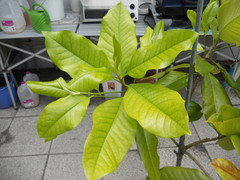
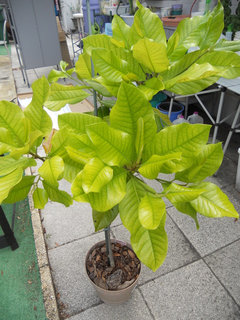
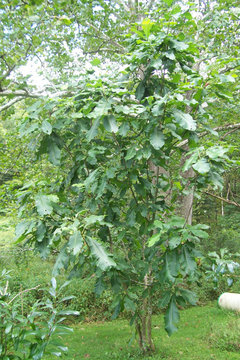
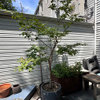
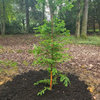
    Thank you all for sharing all your valuable comments and observations. I've learned so much here. Since it's still so small, I'm not really certain what variety it is. It seems there are so many possibilities. So, I'm just going to repot it to a bigger pot and watch it for a while. I heard it will bloom at 3 ft. Maybe, it would be easier to tell what exactly it is when it blooms.

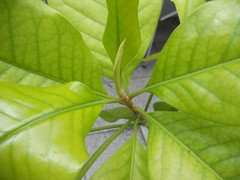
    Here are more pix taken today. Is this the sign of a bloom bud?


  • 9 years ago

    The images above are of a Magnolia grandiflora.

    The bud you show is an elongating foliage bud.

    Unless your tree has been selected for that foliage color, it is either chlorotic or "starving".

  • 9 years ago

    bananafan2, kentrees is right, you have a Southern Magnolia or M. grandiflora which is an evergreen magnolia, my suggestion is to plant it in the ground ASAP.

  • 9 years ago

    Here is my Ashes Magnolia, a real treasure, incredibly fragrant, blooms for me in about two weeks.


  • 9 years ago
    last modified: 9 years ago

    Flowers look kind of jumbo for that one, you might want to check.

    http://www.efloras.org/florataxon.aspx?flora_id=1&taxon_id=119452

    Magnolia ashei differs from M. macrophylla in being a smaller, often multitrunked tree with smaller leaves, fewer stamens and pistils, smaller seeds, smaller stipules, filiform trichomes, and smaller, nearly glabrous, cylindric follicetums.

    http://www.efloras.org/florataxon.aspx?flora_id=1&taxon_id=233500767

  • 9 years ago

    Sam, that's a beauty. Very twiggy and floriferous, very UNLIKE every macrophylla I've ever seen.

    I've got 3 bought as ashei, and 2 bought as macrophylla. One ashei has the form and flowers of yours, but nowhere near the size. It is growing under a closed canopy of 75' Liriodendrons, for frost protection. The other 2 from a different source are similar to macrophylla, only different. Since ashei has a much restricted natural distribution, I suspect there is very little genetic diversity in the species, so my 2 macrophylla-like ashei's are probably hybrids.

    My 2 macrophyllas, bought from 2 different sources, are pretty much identical.

  • 9 years ago
    last modified: 9 years ago

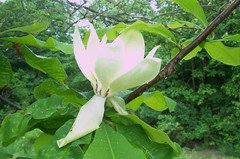
    One of my Umbrella magnolia (Magnolia tripetala) flowers from a couple springs ago:

  • 9 years ago

    Notice the tapering leaf bases.

  • 6 years ago


  • 6 years ago

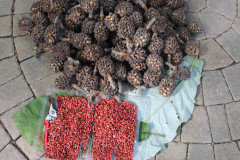
    Above is this year's haul, 2 lb 14 oz uncleaned seed. This is from the M. macrophylla in the cemetery. I casually picked up cones from the ground. Consider how productive the tree is, it is still laden with cones.

    Someone likely planted this tree many years ago as a memorial and I'm sure glad they did. Location: Baltimore.

  • 6 years ago

    Yes, sam_md, the native deciduous mags should be planted more, w/the caveat of placing in sheltered areas.

  • 6 years ago

    I have one, sort of. It did not make a lot of terminal buds this year. I think it drowned in last year's unending rains here in S. Cen. Penna. The tree leafed out, but only a few flowers opened, the rest were 1/2 buds that wilted. The tree was about 10 years old, planted in the local clay soil. We had about 150 days of precip. in 2018, and although that part of the lawn slopes a little, we went about 4 months(July-Oct) with no more than 3 days of no-rain between bouts of rain. (Sometimes 3-4 consecutive days of rain.) The result was drowned Chinkapins (Castanea sp.), English Walnut, Pawpaw, Fringe Tree (Chionanthus) and probably the Magnolia too. For those of you with a hill for a lot, I am jealous.

  • 6 years ago
    last modified: 6 years ago

    HU, I'm very close to S central PA. Heavy rains last year & up thru June this year didn't hurt most, but it did finish off my ailing concolor fir & now my Japanese larch looks bad (dying lower limbs). Umbrella magnolia in flood plain looks fine tho:

  • 6 years ago
    last modified: 6 years ago

    I feel your pain, HU-435404624 and beng. I look back to my preteen and teen years, of being both a 'typical' suburban kid who was paid to cut a couple neighbors' lawns, but also to help maintain a large Williamsburg-style formal garden. I remember a dry spell or two...there was a quite bad one somewhere in that mid 80s to mid 90s time frame, but I don't remember what feels like an alternation between drowning and drought. It seems like too many recent summers have been that way.

    Anyhow I have a tree from Woodlanders that is supposedly a seedling of a ashei X macrophylla cross, so it will be interesting to see how it turns out. It has certainly produced some enormous leaves so far. PIcture later if I can snag one.

  • 6 years ago

    Will also be interesting to see how it smells, since, supposedly...ashei are sweet and macrophylla are some kind of indecent. Maybe sweetly indecent LOL.

  • 6 years ago

    HU, your fringe trees may be being attacked/damaged (like mine are) by the Emerald Ash borer, as they are closely related to ashes.

  • 6 years ago

    Just spent 2k to remove 2 huge ash trees whose death could adversely affect future garden planning. It's closing in on my area though I'm not seeing any dead ashes in the immediate vicinity yet.

  • 6 years ago

    Hey beng. I looked for exit holes and did not find any. I saw some in Carlisle, PA and told the warehouse manager his parking lot trees were on their way out, so I have seen them before. (They cut them the next year when the Ash did not leaf out.) It doesn't mean they weren't there, I may have missed them. The thing was tri-partite with 2 large side shoots framing a 12ft. central 'tree'. The left 2/3 is dead, the right one shows abnormal sprouting. I have already said goodbye to it. If the right side lives a few years, I'll enjoy the bloom. At it's peak, it was a blob 12ft tall and larger in diameter. Absolutely a "come see this" plant when in bloom.

    I do worry about my Ptelea trifoliata though. I think it is also in that group. After many years of white fly infestation (shake the tree, watch it snow), this year they are mostly absent and it has leaves in Oct. Does that mean the borers get here next year?

  • 6 years ago
    last modified: 6 years ago

    HU, my fringe trees are like yours -- multiple trunks & sprouts (some can grow 6-7 ft a season) from continued die-back. I don't see any exit holes either, but it may be you won't see them on sprouts/very thin trunks -- ash saplings here are dying from EAB but show no holes. I haven't given up completely on my fringe trees yet -- one of the three seems to be much less affected. If you look at my above pic of the umbrella magnolia, the leaves in the bottom-left foreground are an American fringe tree.

  • 6 years ago

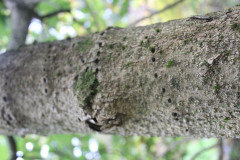
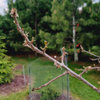
    Earlier on this thread I posted about my Ashe's Magnolia in all of it's crowning glory. Bad news! As of today the right fork is leafless:

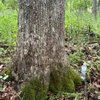
    Following down the trunk I found this:
    Whatever could this mean? Is the right half of my tree dead?

  • 6 years ago

    That looks like sapsucker damage. And depending on the tree, it can be serious.

  • 4 years ago

    I am curious how the tree is doing as well. I am scrolling through crabapple forums to try and find the right fit for my yard. Mainly looking for good disease resistance.

  • 4 years ago

    I am curious how it’s doing as well! I am looking to put a couple crabapples in my yard and am wondering about disease resistance.