Software
Houzz Logo Print
ryanga7a

Transplanted beech trees and shock

When do I know when “transplant shock" is over for transplanted beech trees? I live in Northwest GA (metro Atlanta), Zone 7a.

I transplanted two beech trees off a development site two months ago. I will call them Thing 1 and Thing 2.

Thing 1 was .75 inch caliper DBH, 8 feet tall with not as many branches. I dug out a 14-16" root ball in all directions, and down about a foot. I followed the main roots out a few inches beyond the root ball. Thing 2 was ~1.5 inch caliper DBH, ten feet tall with a lot of branches. I dug out a similar size root ball. I planted them both in shade, nearby three older beech seedlings (that are 15-25 feet tall.) I mulched lightly and kept the root balls moist but not soaked. The soil was mostly the native soil around the trees, but I added a mix of 1/3 top soil, 1/3 compost, and 1/3 my-native-backyard-soil. I figure the backyard is a recovering forest because there are six beech trees in the backyard already, and two additional seedlings that I planted last fall that took well.

But back to Thing 1 and Thing 2.

Both trees leafed out. The smaller tree (Thing 1) kept its leaves, but didn't grow any. The larger tree (Thing 2) was different: it grew a few inches, then dropped its leaves, but it is now growing a second set of leaves. I kept it watered for two months and checked all twigs, and only 1 or 2 twig ends snapped when I bent them. All others remained flexible. I never trimmed any branch from either tree, thinking that the tree had energy reserves stored in the wood of its branches (not sure how true that is.)

Are these trees now in the clear? Do I need to do anything like feed them a diluted sugar water mix? Should I continue to baby them and keep the soil consistently moist? Re mulch? Add a top soil of compost mixture? Loosen soil three to four feet out from the trees?

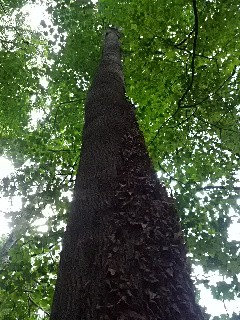
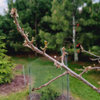
A picture of the bigger tree (Thing 2) is below. The green stems were from the first flush of leaves/growth. The first leaves fell from the green stem but the stem has always remained green.

Comments (17)

  • 9 years ago
    last modified: 9 years ago

    After 2 months, your trees are probably over the initial shock of being chopped out of the ground and moved to a new location but they certainly aren't 'established' at this point.

    Recent transplants continue living in a somewhat weakened condition until the roots are completely restored and the canopy is large enough to fully supply the plant, which can take up to a year or two. You will still need to water during dry spells and inspect frequently for insect and pathogens that may try to take advantage of this. Mulch is good. It will keep the roots cool by keeping the sun from baking the ground and evaporating the water you give the tree.

    I've never used sugar water on a plant and I don't know if a trees roots can convert sugar, directly from the soil, into anything usable to the plant. I may be wrong but hearing this first off, it sounds kind of 'corky' to me. :-)

    (ryanga7a) Ryan M thanked User
  • 9 years ago
    last modified: 9 years ago

    I wouldn't feel confident until they survive their first drought and first heat wave. Water them during droughts for the first two years. I might set up a tarp to give partial shade during the hottest days of summer. Summer heat is their enemy.

    No need to keep them constantly moist in the spring, or add top soil.

    As far as sugar water...I heard a study saying corn syrup helps crops, but I'd worry it would promote fungal and bacterial growth.

    By the way, I'm impressed...in your taste in trees and your skills. I never had much luck transplanting beech.

    (ryanga7a) Ryan M thanked edlincoln
  • 9 years ago

    Thanks, Bill and Ed! I was hoping you two would chime in because you two are great with your knowledge and expertise on the forums. I have an affinity for trees and am trying to increase both the diversity of species on my property as well as the quality of trees. Some trees will eventually come out because they are diseased, or got struck by lightning, etc. But I want to start some seedlings now so that in a few years, they can jump off when they get a little more sun. "Suburban forest management" is what I like ot call it.

    Bill, I'll look more into bugs and pathogens that can affect beech. When I transplanted soem native azaleas, I saw several things growing on them, so I snapped them off and threw them away -- it turned out to be "crown gall." The trees are in a mostly shady area, but the ground drains relatively well. My lot is kind of at the "basin" of two slow sloping hills, which feed an old dry-creek bed that is at the very corner of the property. The area seems to drain rather well, which means it can get drier more quickly than I think!

    Ed, thanks for your suggestions about summers. They get very hot here (I think last year, we had 90+ days in a row with highs of at least 90 degrees.) The trees are in a mostly shady area. however, last week a snag fell and ripped a branch off a tulip poplar, which may bring more sun into the area over the summer. I'll see what I can do with a sun filter/blocker before the heat gets here.

    Also, I'll stay away from the sugar water and just let the roots do their natural thing. I only read it in two sources, so I wasn't sure if it was a good practice.

  • 9 years ago
    last modified: 9 years ago

    Aw shucks. There are many on this forum who no way more then me...NHBabs, wayne.

    Tulip Poplar are another great choice. Do you have space for a tulip poplar and multiple beech?

    I like the idea of planting slow growing shade tolerant trees (like beech or Tupelo) near faster growing trees. (Like American Persimmon or Tulip Poplar)

    Heat isn't so much the threat as too much sun and drought. I was picturing you digging up a tree from the woods and planting it in the middle of a suburban lawn. Beech evolved to grow in established forests...functioning in shade until they are mature. If it already has some shade in it's new home the issue may be moot.

    What other trees have you planted?

    If you are taking things from a wooded area...have you considered scattering white oak acorns and shagbark hickory nuts?

    I like American Persimmon, ilex opaca and Tupelo. You also probably have a lot of options I know nothing about because they don't grow as far North as me.

    (ryanga7a) Ryan M thanked edlincoln
  • 9 years ago

    crikey .. trees.. thru their leaves convert sunshine into sugars which are stored in the roots ...


    the roots do not suck up sugar ... they suck up water ...


    ma nature has been watering trees with this stuff called rain.. which is water ... for a couple billion years ... shes good at it ... and i suggest you follow her lead in just using water.. to supplement which she provides... for 2 years .. due to the transplant.. after that .... it will be free range.. and rely on her billion year old system ...


    trying to beat her.. or out think her.. is verging on trying to love your plants to death ...


    ken


    (ryanga7a) Ryan M thanked ken_adrian Adrian MI cold Z5
  • 9 years ago

    Water, water, and more water! Then in three years, they will be able to live as beautiful, low-maintenance shade trees.

  • 9 years ago

    Ed, me and my neighbors have some large trees for being in a subdivision. It is the type of 1970s neighborhood where they built around the trees. The attached is a tulip poplar that sits between my driveway and my neighbor's house. It is a little over 26" in diameter (dbh), so roughly 80 years old. There is another poplar on the other side of my house that is large as well, but is double trunked starting about 12-15 feet up.

    The other big trees are mostly sweet gum and pine, which makes me believe that this is a recovering forest that was logged around 1900 or so. I dont think it was farmed because I am finding a lot of scattered stones. The largest beech in my backyard is about 6" dbh so it is “big" compared to the others, although really all of them are very small.

    Many people would consider my yard to be over planted but I've hiked enough to see thriving ecosystems with a tree count twice of what I have. I am missing the understory trees and the shrub layer in a lot of areas. I also plan on taking out a fair amount of pines because they are honestly getting too big (1.5 to 2 feet thick and 80 to 90 feet tall.) But the hawks nest in them and they suck up a lot of water, so I have kept them so far.

    I need to conduct a tree census. I actually did with hickory and tupelo, and have 29 hickory and 20 tupelo, but they are all “whips" (I think is the correct term), under six feet tall. Except one tupelo in the understory that is 15-20 feet tall. I have seven white oaks, but only one of them is over six feet tall (and even then, it is only 8 feet tall.) And they all love to split low to the ground, so I need to read up more to see if I can fix that.

    All of these are in the shade to dappled sun, which makes me think that the forest is slowly transitioning into a hardwood forest of the beech-oak-hickory-blackgum variety.

    So far, I have planted an overcup oak (in the white oak family), two black gums, a couple of dogwoods, some hemlocks (despite the onslaught of the "wooly adelgid" in north GA), a shumard oak and northern white oak (for succession when I take out some scraggly pines), a few beech, a red maple, a handful of native pagoda dogwoods, and two Japanese maples.

    I have a few young poplars, one of which is really well placed for succession in the area with the scraggly pines. On the other side of the yard, I have two sweet gum that need to go. One was struck by lightning and is dying, and the other just seems sick with weak growth...which is sad because I estimate it to be 90 years old. The two beeches were planted in the area for succession once those sweet gums are removed.

    In which part of the continent are you?

  • 9 years ago

    Thanks, Ken. I thought it sounded funny, and with all these trees, I am beginning to understand (respect?) The power of a forest. So many things drop, so many weeds grow, that naturel “mulch" prevails almost everywhere now!

  • 9 years ago

    'knowledge and expertise' I've been called a lot of things before but never,,,,,, lol:

    I found a few articles that say sugar water is harmful to plants because the sugar can interfere with the way water moves through the membranes inside the vascular system that pumps water through the plant (in a nutshell). I wondered why I never saw sugar as an ingredient in fertilizer.

    For those that might want to do some reading. https://www.quora.com/Does-watering-plants-with-sugar-water-help-them-grow

  • 9 years ago
    last modified: 9 years ago

    I'm in New England. A zone colder and more built up. Most of the trees you mention are ones I can grow around here...although tupelo is seldo planted around here. I'm not use to such yards though.

    Part of the reason people in suburbia plant trees farther apart then you find in forests is they like the perfect symmetrical look, which you don't get if trees are crowded. I've always liked the faux old growth forest look.

  • 9 years ago

    Another reason you would not see sugar in fertilizer is that sugar is a carbon source. In order to get the desired nitrogen content, more nitrogen would gave to be added to the fertilizer to compensate for the carbon. This is the reason you can put sugar on a dog pee spot and save the grass from dying from too much nitrogen. The excess nitrogen will be consumed by the explosion of soil bacteria that is breaking down the carbon source.

  • 9 years ago
    last modified: 9 years ago

    "I found a few articles that say sugar water is harmful to plants because the sugar can interfere with the way water moves through the membranes inside the vascular system that pumps water through the plant (in a nutshell). I wondered why I never saw sugar as an ingredient in fertilizer."

    I knocked over a cup of mcdonald's corn syrup, I mean, sweet tea onto a potted chrysanthemum. Half of it died, but I don't know if that contains sugar or not, but I can say that it doesn't contain tea, Lol. All joking aside, I don't see how watering with sugar is going to help (or hurt) a plant, unless it is done in excess. That still isn't as crazy as the suggestion I received to pour food coloring on a clematis (or, if you want to get even more absurd, flowering dogwood) to achieve a different flower color. What you should hopefully take away from this, is that if something sounds absurd, it most likely is. Although, if I catch someone pouring sugar on their trees, I'll make sure to take a photo and meme it, then proceed to post it here ;). Good luck with your beech trees. You may want to consider a shade garden under them (hostas, forsythia, ninebark, etc.) to plant under some of your trees. There's nothing like a pop of color added by variegated, purple-leaved, and golden-leaved plants all mixed together into one landscape.

  • 5 years ago
    last modified: 5 years ago

    Ryan, how did your trees (beech) do? I live in what I call a semi-old growth woods in central SC, with lots of native beeches around. From the HUGE ones in my yard and the woods behind me, to their very small children. Planning to move to the NC mountains later this year, and have been thinking about taking some of those babies with me. Have noted a couple of likely prospects - about 5 feet tall, no thicker than a finger. Have yours made it?

  • 5 years ago

    i would not take3 5 footers ... its a false idea.. to think bigger will get you a bigger tree faster ... due to all the roots you cut off and all the attendant stresses .... if you could find and take 2 to 3 footers.. inside 5 years.. they will outgorw the larger transplants ...


    besides the fact ... they wont be sticking 4 feet out the back of you yugo as you tool down the road ...


    i would .. if you can.. find some trees.. and dig and pot them in dormancy ... so no matter when you move... they can go with you ..


    it would not be good to dig and pot fully leaffed out trees in summer and try to move them ...


    if you were sure to be moving late next fall.. after they go dormant... then you could wait until them ...


    you probably would have been much further ahead.. if you had started your own post ... so replies will come to you.. and include many more important facts to your particular project ...


    ken


    and BTW: a 5 footer that is ONLY finger width.. is not worth taking anywhere ... once planted in sun.. and settled in.. it will grow a much bigger canopy.. and probably flop over due to its big whompin head ...

  • 5 years ago
    last modified: 5 years ago

    Original poster Ryan's most recent comment was almost 3 years ago: https://www.houzz.com/activities/user/ryanga7a/comments

    Of course he still might be around as a 'lurker'.

    Would it not make more sense just to find some beeches in the mountains?

  • 5 years ago
    last modified: 5 years ago

    Yeah this seems to be a tree that is often started that way, since, at least until the native plant movement became mainstream, it was hard to find nurseries that stocked it. Back in 2014 I posted pics of a Virginia collector's garden with a lot of beech cultivars. Not even going to try to find it...for some reason, although they still exist somewhere in the houzz server farm...posts that old are really hard to find in google. Anyhow, that guy wanted an American beech and couldn't find one at a nursery so he just moved it out of the nearby woods. It's a beautiful big tree now. When I was in college in the mid 1990s and started working it that garden in was maybe 1-2 inch caliper, 7' tall, and he had bought the property in the 80s so that took over 10 years. Now it's maybe 25', 3-4' caliper. In partial shade and root competition of other trees.