Software
Houzz Logo Print
robertmsiegel

Help identifying disease on Heirlooms

9 years ago
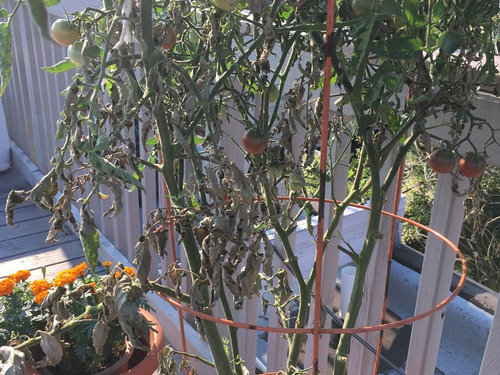
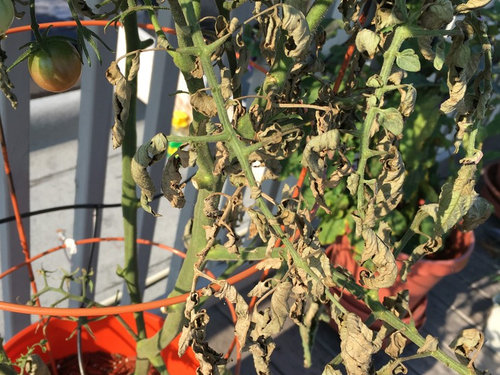
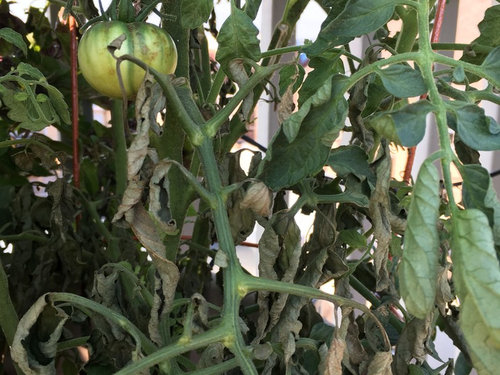
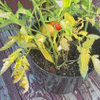
I'm not sure what this disease is and wondering if anyone has any idea or treatment recommendations. It doesn't appear to be blight as the leaves are not spotted, just browning and slowly dying off. I have the tomatoes in containers and this started after heavy rainfall. I removed the lower branches early in the season to try and prevent soil disease like this... but doesn't appear to be working. I have started to spray copper fungicide, but not sure it's working. This also happened to me last year around this time, so I changed all of my container soil this year... if they were doing so well a week ago.

Comments (15)

  • 9 years ago

    That's a really small (and half-filled?) pot for such a large plant. I'm guessing malnutrition.

  • 9 years ago

    short of water, too.

  • 9 years ago
    last modified: 9 years ago

    Agree - way too small a pot for way too big a plant. Heavily stressed and dying due to both malnutrition and water issues as the plant is fully rootbound in the container.

    Dave

  • 9 years ago

    If you guys think it's lack of water (they are in drip irrigation and I regularly check the soil - so not sure I agree) and/or rootbound and lack of nutrients... why do you think this only started after the heavy rain we have recently got in MD?


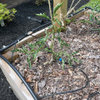
    these are on a roof deck(see below) so they get all day sun. I had previously side dressed with fertilizer but perhaps not not... this am I fed each plant a healthy dose and will keep this up every week to see if anything changes.

    Thanks for the help

  • 9 years ago

    Heavy rain could have leached out whatever nutrients they were barely surviving on. Nice set of plants, but we were talking about the ones that are many times the size of the pots.

  • 9 years ago

    That is not typical water/lack of nutrients, not sure why you guys are seeing that. What exactly it is though... doesn't look familiar. Look closely at lightly affected leaves, those should give the best clues, maybe gray mold, or something?

  • 9 years ago

    Leaves just browning and drying up are signs of a seriously stressed plant. I agree with the OP that it doesn't look like disease. If those pots are as small as they look in the picture, it's not hard to imagine that the plant is heavily root-bound and seriously stressed. The OP says that this happened the same time last year. That's consistent. Same big plant in the same small pot makes for the same stress.

  • 9 years ago
    last modified: 9 years ago

    "If you guys think it's lack of water (they are in drip irrigation and I regularly check the soil - so not sure I agree) and/or rootbound and lack of nutrients... why do you think this only started after the heavy rain we have recently got in MD?"

    Drip irrigation in no way insures "enough" water. "Enough" is defined as the ratio of amount of water supplied to the amount of soil in the container to absorb, evenly distribute, and hold that water. Same applies to nutrients.

    In a rootbound pot there is minimal if any soil remaining to hold and distribute that water or nutrients. Instead it is filled with root mass and most of the soil except for the very top couple of inches has washed out. So do you know for a fact that your plants are not rootbound? Are roots visible on the soil surface? Are roots coming out of the bottom of the pot through the drain holes? Sorry but when the drip line of the plant's circumference is so much greater than the circumference of the container it is in there is a real problem for the plant.

    "I had previously side dressed with fertilizer but perhaps not not... this am I fed each plant a healthy dose and will keep this up every week to see if anything changes."

    Numerous discussions here about the problems of using dry granular fertilizers in containers. Liquid supplements are many times more effective.

    Dave

  • 9 years ago
    last modified: 9 years ago

    I strongly agree with the diagnosis of stress.

    Even though regularly watered -- how often is that? -- the affected plants have extraordinarily excellent air circulation. So much so that they're likely drying more than you realize.

    What's the output of your drippers? (If you're using drippers, it's likely the water is going straight downward through the potting mix, thereby missing the bulk of the roots. Mini-sprinklers might help.)

    How many per pot?

    How often do you run the system?

    How long do you run the systme?

    Does the water drain out through the bottom?

  • 9 years ago
    last modified: 9 years ago

    Well, OP says that they "regularly check the soil" for moisture. So if done properly, that would argue against stress from lack of water. But highly root-bound plants are not happy. Instead of being adjacent to nutrient rich soil, their roots are adjacent to ... more roots.

  • 9 years ago

    Root bound plants or stressed in no way become directly crispy while petioles remain green.

    OP, check for russet mites. Get a very good loupe (like really good, they will be very small) and look on green leaves above the affected ones, look especially on the small leaflets and petioles, underside as well as upside. They should look like slightly yellow tiny worms, and not very mobile.

    If those varieties are black/green tomatoes, the typical russet mite symptoms are usually not the classic ones, there should still be some bronzing on the stems though, but the leaves go directly to crispy dark, and not yellow, and petioles do remain green for a while. The crispiness should advanced from the base of the leaf going to the tip.

  • 9 years ago

    In m y experience, russet mites damage the tomato fruit long before any wilt appears. The leaf damage looks different than on these plants.

    These are short of water for the several reasons which have already been stated. Russet mite damage to foliage looks different than wilt.

    See http://ipm.ucanr.edu/PMG/GARDEN/VEGES/PESTS/tomrusmite.html

  • 9 years ago

    robertmsiegel, like always, one has to take the opinions he was given, make closer analysis on the plants and decide what diagnosis fits best.

    Jean, I have had russet mites and as I said, not all plant foliage has the same symptoms. I would not just dismiss an opinion of someone with experience vs an internet picture. Also, what if they were short of water? How do the symptoms correlate with the lack of water?

  • 9 years ago
    last modified: 9 years ago

    My opinions are also from experience.

    Different folks have different opinions.

  • 9 years ago

    thanks Jean, i did some research and think you may be correct. I've applied diatomaceous earth to the plants to see if this helps. the interesting thing is that the plant impacted the most (black cherry) keeps producing well at the top. i don't have a good enough magnifier glass to verify, so i will see how this works.