Software
Houzz Logo Print
breenthumb

Can anyone name this wire/cable?

9 years ago
last modified: 9 years ago

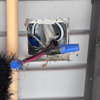
The incoming wire on our house needs replacing. I'm about to get estimates but it would help to be able to name it. Wire from pole to house is fine. Its the next section running down the side of my house, then inside to (or from) panel box, that I need a name for. Thanks.

Comments (14)

  • 9 years ago

    Thank you. This will be so helpful.

  • 9 years ago

    The cable that goes between the meter base (round meter installed by the power company) and your electrical panel is usually referred to as SER service entrance cable, and its your responsibility. However, the service entrance cable running down the side of the house from the service head into the meter base is usually provided by the power company, and in many cases they will fix it for free if there are any issues.

    Bruce

  • 9 years ago

    POCO is typically only responsible for the service drop from the pole to the point of attachment on the house. I've never seen a POCO willing to fork out for 10 - 20' of 2/0 × 3. Homeowner is responsible for the weather head on down. Maybe the POCO is very generous in Virginia? Hasn't been that way in the two states I've worked in.

  • 9 years ago

    Not only don't they pay, but any work done requires the meter to be moved outside. Plus at least a half dozen other regulations to be carried out in the process. So I have an estimate of $1800 for this outside & basement work. Then we'll start on the inside.

    Knowing the name of that cable reduced my request to electricians to just a few words. Thanks again.

  • 9 years ago

    Wow I've never seen a home with nor ever heard of an indoor meter. Is your main panel part of the same assembly or right next to it?

  • 9 years ago

    Next to it. All panel boxes are mounted on a board between gas & electric meters in the basement. Used to be fuse boxes, then updated to breaker boxes. Now regulations say meters must be outside. I think for meter readers. Would love to know where you are. ?

  • 9 years ago

    I am in the New Orleans area so this is not a good measure of basement use. In slab home areas, and I assume where raised homes predominate, the rule is outdoor meters and main panels. A few people have the main panels inside. Around here, indoor panels last a lot longer, but people apparently don't want to sacrifice the space in what will usually be their kitchen, living room or other "public" room since the service entrance us usually on the front of the homes.

    Before living here, however, I moved 5 times in 15 years. Most of my life was in rural NY, some time in Arizona, Philadelphia, Tucson, Pittsburgh. Outside of the country doesn't count for this. As far as I've seen, meters are always outside. Paradoxically, the newer ones can be read remotely and they are making you move yours :-(

    I appears to me the authorities want anything before the main breaker outside so even having the main breaker very far from the meter is unacceptable or frowned upon. They want them outside with the meter or just on the other side of the wall.

    Here is a meter movement story for you. I recently arranged to have a new service installed at dad's house. The original meter location, of 50 years, had a shrub growing in front of it. POCO told the electrician to move the meter. The contractor did not think it was a problem and I am thousands of miles away so he just moved it around the corner, literally. On the other hand, maybe he just wanted to get on with the job instead of waiting for someone to trim the ornamental. The first question I would have asked is, can we just trim the shrub instead? A pussy willow would look good in front the new panel location, but the soil is kinda dry there so maybe something else.

  • 9 years ago

    $1800 gets you new from the POCO cables to the new outdoor meter, a new meter pan, and new cable to your existing main panel? What is the capacity of your existing main service equipment and cabling?

  • 9 years ago

    I can't resist it any more. I'm going to name the cable "Bob."


  • 9 years ago

    If we are going to get silly, it is only "Bob" after you shorten it. It has to be "Robert" and shortened to Bob. Rephrasing a little, the cable is Robert and bobbed to Bob.

  • 9 years ago

    ionized, dk capacity, but we do have central AC and had 220 appliances before we changed to gas if that means anything. I have a similar situation to your dad's house. Meter would come out right in front of an access door into garage. I asked if it could be put behind a bush on that same corner in front between house and walk. No, it must be much higher. Which is why it will cost more to move it elsewhere.

    So now we are going to run the cable into the garage and out the side wall. I think cable from pole will attach at garage roof now instead of house, where it has been a frayed eyesore for way too long and meter will be out there somewhere. Hoping that $1,800 covers all mandated work...panel boxes, whatever needs to be done.

    Oh, and about "Bob" you guys are going in the wrong direction. Cable is getting much longer.

  • 9 years ago

    Lol

    SER BOB

    Kind of like sir bob, but not.

  • 9 years ago

    I am not getting a good picture in my mind's eye of the current proposal. You are going to have a new weatherhead on the garage roof. The drop wires connect to your service entrance wires there. The service entrance conductors (cable or in conduit) run into the garage interior space and then out a side wall? Is this going to be in conduit? How far from your garage is the existing basement main panel that you are aiming for?

    These modifications are where the electrician's experience and creativity come in. Unlike in a new build where everything about the structure and its services are interactively planned, the constraints make things pretty interesting sometimes. There may be more than one way to consider doing it depending on where the utility poles are in relationship to the home and where the best points to contact are. Some electricians will have a better eye than others for this kind of stuff. They also know what the POCO and inspectors will tolerate and what they won't. I don' t know anything.

    The capacity of your main service equipment is probably the same as your main breaker, 100, 125, 200 amps. Usually all the components match up, the POCO's drop, the service entrance conductors, the the main panel, the meter pan and the meter. Sometimes, a smaller than the maximum allowed main main breaker will be installed. That happens sometimes when someone needs a new panel installing one with more positions, but does not want to change everything else in the line. You could say the panel is "downgraded" in a case like that.