Software
Houzz Logo Print
bwspot

Under cabinet wiring -- small DC junction box

9 years ago
last modified: 9 years ago

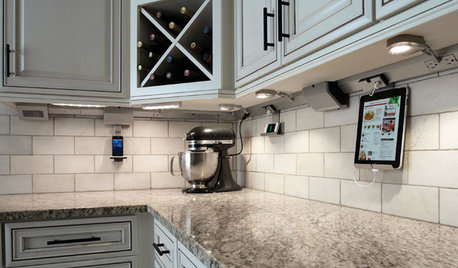
So i want to prepare my new cabinets to be ready for the under cabinet lighting.

So far the electrician installed AC power outlet and DC outlet. (2 separate junction boxes) His idea is to use plugin power supply that goes into power outlet and then feeds the DC outlet. The DC wire then comes out in the corner of the cornet cabinet where it will be spliced with 1 or 2 wires coming from the LED channels.

I would like to install some low profile junction box that i could attached the BX and then inside the box splice the dc with wire wires coming from the channels.

Anyone knows of such a nice box.

I have a standard 4x4X1 but it would look ugly under the cabinet.

thx

Comments (12)

  • 9 years ago

    The original post here is a little confusing. As a general rule, you keep line voltage and low voltage wiring strictly separate.

    But if you mean that you want a box for splicing low voltage (only) wiring, you can buy plastic and aluminum project boxes in almost limitless sizes and shapes from electronic supply houses. Drill wiring holes in them where you like.

    I recommend using strain-relief style cable glands where the wires pass through the box, especially if you use a metal box. If not that, at least drill the holes oversize, fit grommets, and tie knots in the cables inside the box to act as strain reliefs.

    PS - yes, BX is obsolete, and it has some problems. But it still exists in older homes, so we still have to work with it. That said, I don't see why you'd have any BX in the low voltage side of this circuit.

    bwspot thanked DavidR
  • 9 years ago

    Thx you both for explaning why the separate junction boxes.

    This is an old house and power outlet was added for the cabinet lighting though the 4” long Bx. It would be hard to install a conduit there as there are tons of water pipes on the way.

    The electrician also run the short bx from the dc box (that is to be inside the cabinet) to the corner of the under cabinet.

    Because he used the bx for the dc run I wanted to connect that bx with some box in the corner of my corner cabinet and later connect the led wires inside that box. My cabinets don’t have any leap so it would look more estethic if I use some box and run the led channels from there.

    i went to the electric supply store and all they had was the 4x4x1 aluminum box.

    Can you provide any links to stores with the box you mentioned?

    I attached how it looks.

    thx


  • 9 years ago

    Your electrician should not be "running BX" for any reason. The existing cabling is grandfathered. Adding new cable is likely illegal. He needs to use Type AC, MC, or some other listed wiring means.

    I'm still not understanding why you want BX (presumably carrying 120V) and the LV wiring in the same box.

  • 9 years ago
    last modified: 9 years ago

    i though that most adapters that come with LED systems were designed to be installed into some bigger junction box.

    Is not there a rule in IL that if the wire is shorter then 6' or its impossible to install the conduit the BX is legal?

  • 9 years ago

    "Is not there a rule in IL that if the wire is shorter then 6' or its impossible to install the conduit the BX is legal?"

    Where did you get this impression?

  • 9 years ago

    So you're somewhere that conduit is required everywhere? Chicago? I can't help you with the codes there, sorry.

    As for BX, those letters are sometimes used as a generic term for metal clad cable. However, it's a trademark (originally owned by Sprague). It refers to a particular brand, kind of the way Romex is sometimes used as a generic term for NM cable, even though that's a trademark too.

    The reason some folks get their backs up at BX is that it has a safety problem. With the original Sprague BX, which IIRC was in common use by the 1940s, the armor was used as the grounding conductor (equipment ground). That was a big mistake. As BX aged, the armor turns oxidized, and stopped making good contact with each other. The resistance of the ground increased drastically. When a ground fault happened, the armor could heat up red hot. Fires started this way.
    Today there are different metal clad cables available, such as MC. MC has an insulated copper ground wire included so that the armor is no longer needed or used for the grounding conductor. Whether these kinds of cable are allowed in your area, and under what circumstances, I don't know. I sure hope your electrician does.

    I'm still having some trouble figuring out what's happening in your photo, and matching your description to it. I don't see
    a 4 inch run of what you call "BX" anywhere. I do see what looks like a
    junction box toward the top right, and a second one beside it, but that's a lot more than 4 inches away from the box at the left.

    They look like some kind of flexible metal-clad cable is going to at least the left one. You seem to be saying that one of those is to be connected to 120v power, and the other is to carry the low voltage output of the LED power supply to the lights, yes?

    I'm guessing that these boxes are right under where you expect your upper cabinets to mount. If that's so, I don't understand the need for the second box. The power supply is going to be plugged into the receptacle under the cabinets, yes? So it'll be exposed under the cabinets anyway. Why not just run the LV wiring from it right up and then secure it along the underside of the cabinets? Why mess with armoring the LV wiring? Why put it inside the wall at all?

    Assuming your local codes don't prohibit that armored stuff for LV wiring, and as long at it's totally separate from the line voltage wiring, I guess it's OK. You can terminate it any way you like, as long as it's done safely. Watch out for sharp edges that might cut insulation; that's what those little red bushings are for.
    As I mentioned before, if you go to an electronics part supplier that serves hobbyists, you'll find lots of different sizes and shapes of plastic and aluminum project boxes for your low voltage wiring connections.

    BTW, your electrician isn't connecting your cabinet lighting receptacle to one of the countertop receptacle circuits, is he? That's not allowed. Just checking.

  • 9 years ago

    I'm still not understanding you. The transformers typically aren't mounted in boxes at all. You can get some real flakey problems if you do because they'll shutoff internally due to overheat. You make the connection to the 120V side in a box somewhere. The LV nobody cares about much.

  • 9 years ago

    When I had a similar situation, I ran the power from the wall switches to a box installed in the basement, right below the kitchen cabinets. I mounted the LV power supply next to that box, then ran the LV wiring up through the wall to the underside of the cabinet where the lights were installed. I assumed it was OK to run LV wire inside the wall, but now I would like to be assured that it is.

  • 9 years ago

    Like i said i though that dc could be shared with Ac. Now i understand it cannot so that question is not relevant anymore.

    I found the code for Chicago, here:(I live specifically in Oak Park,IL)

    https://www.justanswer.com/electrical/8nipq-il-circumstances-bx-allowed-length.html

    I meant 4 feet. So that wire from left junction box to right is not a BX?

    I am not sure why second box for DC but I am assuming it is for esthetic reasons so no holes would be drilled in the cabinets.

    The contractor told me they usually drill tiny hole in the bottom side of the cabinet to feed the dc cable but not from the inside the cabinet.

    Because my cabinets do not have any leap I want to install nice junction box for the DC wire distribution so it looks clean and neat.

  • 9 years ago
    last modified: 9 years ago

    It's not AC vs. DC, but rather the voltage.

    What you posted is NOT the code for Chicago but some other Q&A site. The comments on that site are WRONG. BX is *NOT* type AC. You can use AC. You can't use BC.


  • 9 years ago

    Thanks for clarifying the length issue. That said, I don't know what your code allows for the use of flexible metal clad cable. I hope that your electrician does, and that therefore he or she used it in a compliant way.

    I'm still not familiar with the term "leap" as it applies to a cabinet. Maybe someone else knows what that is, or else the OP could explain.

    As I mentioned above, the specific trademarked product called BX has not been manufactured for some time. What you appear to have there would be generically called MC (metal clad) cable or AC (armor clad) cable. I think that's what Ron is getting at here and I'm sure he'll correct me if I'm wrong about that.

    However, some people, no doubt including some pro electricians, still refer to MC or AC as "BX" -- just as some people call NM "Romex."

    As for the low voltage wiring, systems operating at 48 volts or less are sometimes considered "inherently safe." That isn't entirely correct, but in any case, low voltage wiring isn't tightly regulated by most codes.

    For example, LV connections aren't required to be in accessible boxes, as they are with line voltage systems. That doesn't mean you can't or shouldn't use boxes for making connections. It DOES mean that what you use for those boxes, if you use them at all, is up to you. Enjoy your freedom. :)